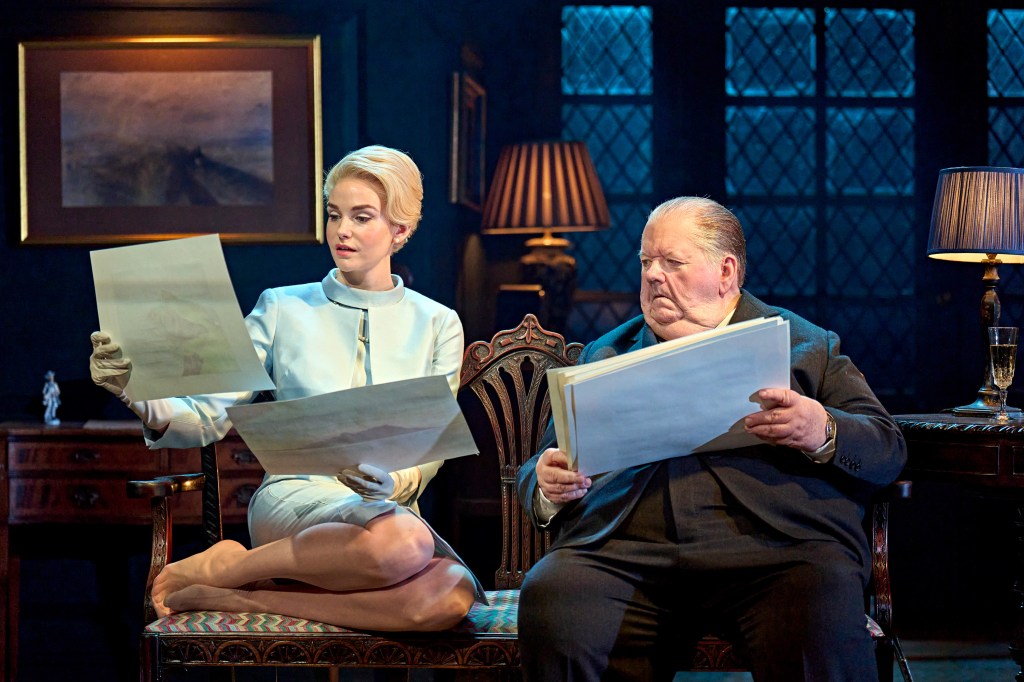
Joanna Vanderham & Ian McNeice. Photo by Manuel Harlan.
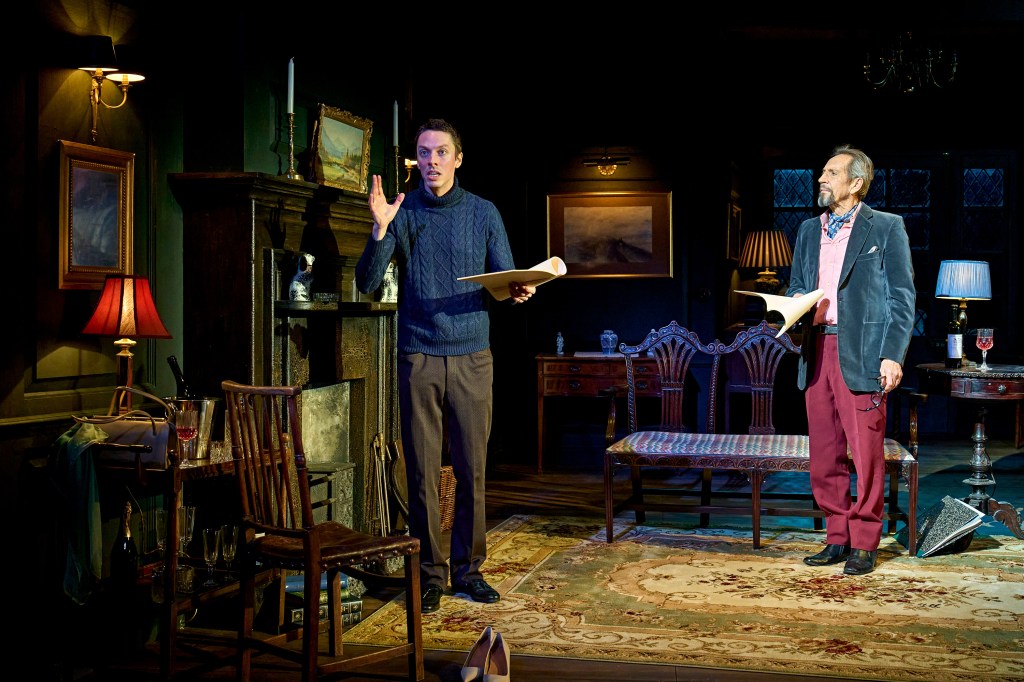
Rowan Polonski and Jonathan Hyde. Photo by Manuel Harlan.
Double Feature by John Logan – Hampstead Theatre, London
John Logan’s new play reanimates two moments of cinema history, taking us behind the scenes to the discussions that ended careers, in very different ways. The play opens with a man in a hat and cloak sweeping, Gothically, into a comfortable cottage. It is Vincent Price (Jonathan Hyde), and he is meeting Michael Reeves (Rowon Polonski), young, brilliant and doomed film director during the shooting of Witchfinder General. Soon, we realise that this time period, 1968, is woven with another, around four years earlier. Onto the same set step Alfred Hitchcock (Ian McNeice) and Tippi Hedren (Joanna Vanderham). Now we are in Hitchcock’s cottage on the Universal lot, during the filming of ‘Marnie’. The relationships between the two pairs are very different. Hitchcock is a sexual predator, offering stardom in exchange for giving him what he wants. And he always gets what he wants. Hedren is his creation, a model he made into a film star, and she fully understands the power Hitchcock has over he. Meanwhile, Reeves has no power and can only beg Price not to walk out on his film and, it turns out, persuade him he is for real. Price looks impressive, but his performance style is hopelessly out of date and the work has dried up.
Logan has written a very enjoyable play that raises multiple questions about reputations and the way we imagine people, as well as the creative process. He also pulls off some technically demanding effects, writing scenes that overlap between the two timelines, sharing moments of dialogue. Jonathan Kent, directing, delivers a production of undeniable quality, and Anthony Ward’s hyper-realist set is richly imagined, even allowing space for Jonathan Hyde to demonstrate Price’s cooking skills by whipping up some pasta in real time.
Ultimately the success or otherwise of ‘Double Feature’ depends on the play’s overriding vision and logic, and on the performances. On the former, it does not quite deliver. It is clear that Logan is very interested in the two relationships he portrays, and in the film history around them. Hitchcock’s poisonous relationship with Hedren has only been fully revealed in the last few years, and is certainly worthy of exploration. Meanwhile, Reeves short career (he died of a drug overdose at the age of 25), and his unlikely encounter with Price, is a fascinating topic. Despite his undoubted writing skills, it is never entirely clear why Logan has chosen to interweave these two subjects, other than as contrasting examples of creative connection. Really, they seem like two short plays that could just as easily have remained separate.
However, where ‘Double Feature’ really delivers is in its cast. Admittedly, Rowon Polonski, while an excellent awkward young man in a hurry, perhaps lacks enough of the underlying darkness that is surely part of Reeves persona. However, the scene in which he persuades Price to stop hamming up his performance is a brilliant moment, as we suddenly hear the voice that makes ‘Witchfinder General’ so chilling. As Price, Jonathan Hyde is a real pleasure to watch, both flamboyant and entirely real, explaining touchingly how he wears make-up to maintain the illusion as he ages.
Joanna Vanderham is entirely convincing, both playing the role of a Hitchcock blonde, and unravelling her fears and anxieties, before finally tells Hitch what she thinks of him. And Ian McNeice is both delightful and thoroughly nasty as Hitchcock himself, obsessing over everything from oysters to luncheon meat, and gradually making his sinister side more and more apparent. By the end it is clear that Hedren’s film career is over, and she will not play another lead – and that’s the way she wants it. Meanwhile, Price will go out on a career high, having finally found a film he really wants to make. There is plenty on offer here to entertain and to inform.
 Tom Bolton