The Shitheads

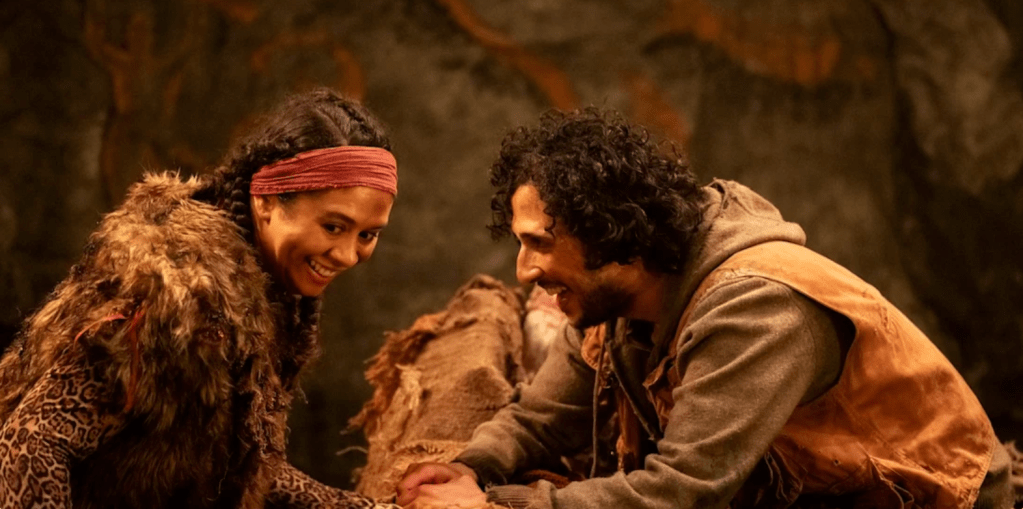
Jacoba Williams and Jonny Khan.

The Shitheads by Jack Nicholls – Royal Court Theatre, London

For starters, Jack Nicholls’ play The Shitheads is set in the Stone Age – specifically, the end of the Stone Age. I can only think of one other play with Stone Age scenes – Alistair McDowall’s The Glow, also staged at the Royal Court. It’s a bold and decisive approach from a writer who sent his work to the Royal Court on spec: they are staging submitted plays as part of their 70th anniversary season. Anna Reid has turned one end of the the Upstairs theatre into the interior of a cave with rock walls that are pretty convincing. It’s hard to make stage rocks that look real. But that’s only part of the setting. The play also uses puppets by Finn Caldwell, beginning with an elk hunting scene. The elk, real size, is operated War Horse style by two people, under puppetry captain Scarlet Wilderink. But this is definitely not War Horse. Nicholls creates a strange and thoroughly disturbing parable about inward-looking societies, fear of outsiders, resistance to change and violence which is entirely current.

The cast are all very watchable and convincing, at ease in their strange, compelling roles. The protagonist Clare is played by Jacoba Williams, a young woman venturing outside the cave where her father Adrian, played by Peter Clements, dictates the world view. Her sister Lisa, played by Annabel Smith, seems innocent but is capable of upending everything. Then a strange arrives – first a hunter, Greg (Jonny Khan), then his wife Danielle (Ami Tredera) who comes looking for him with their baby. The latter is the play’s other puppet, and possibly the most sinister thing in the whole evening. There’s competition for this: the cave is decorated with flesh and bones and the cave dwellers’ deceased mother is in a pit, along with discarded animal carcasses. Cannibalism features. Clare, asked why she lives in a cave, says “Because we’re very lucky” – but things are changing. The people they described as ‘Shitheads’ roam from place to place for better food and climate, and they’re leaving for good as the weather changes. The cave dwellers are doomed, but that may not convince them to change.

Directed by David Byrne, The Shitheads is a riot. The play, written in deliberately contemporary language, is very funny in a Martin MacDonagh, black comedy style. The idea of Stone Age characters called Adrian or Danielle is, in itself, very funny. The scenario also carries echoes of Enda Walsh – plays such as Walworth Road, where a closeted family group creates bizarre rituals to keep the outside world away. Nicholls is a clever and exciting writer, and this collaboration with a Royal Court on a high has all the excitement of the dramas that originally made the theatre’s name. It shows us ourselves in totally unexpected, entirely recognisabel ways, and providing gripping , unclassifiable entertainment while doing so.

Scenes from a Repatriation

Photo: Alex Brenner

Published at Plays International

Scenes from a Repatriation by Joel Tan – Royal Court Upstairs, London

Joel Tan’s new play is an ambitious overview of a post-colonial world, examined through the fraught question of museum repatriations. A statue of the Boddhisattva Guanyin, on display in the British Museum overlooing the gift shop, becomes the focus of attention in the UK and in China, from where it was stolen during the destruction and looting of the Summer Palace in Beijing in 1860, by British and French troops. The violence of this act echoes in the opening moments of the play. The production, directed by emma + pj, has powerful sound design by Patch Middleton, who conjures the screams and earth-shaking roars as soldiers burn the palace in a fire which killed more than 300 servants.

Scenes from a Repatriation switches characters and sometimes eras with each scene. They are announced on a screen formatted like object labels in a museum. The play is in two parts. The first half, set in the present day, tells the story of pressure on British Museum curators to return Guanyin to China, while exploring the experience of people of Chinese origin living in the UK. The second half takes place in China after the return, and features more loosely connected scenes, probing politics, money, social relations in China itself. Tan pushes the limits of the format, staging an epic with a cast of only six, in the Royal Court’s small Upstairs space. It is not entirely successful, but when it works it works well.

The cast, constantly switching roles, do a very good job of telling a narrative that always remains entirely clear. The cast are predominantly performers of Chinese origin, and some scenes are performed in subtitled Cantonese and Mandarin, rare on the London stage. Kaja Chan switches with great fluidity between roles from English curator to Mandarin-speaking secret police interrogator. Sky Yang shows similar range, moving among roles that include a protesting Chinese student and the Scottish soldier who first looted the statue.

The play gives us much to admire, and is also frustrating at times. It would have benefited from an edit. There are a couple of scenes that do not work well, in particular an encounter at a party between a wealthy Chinese businessman, an ingratiating employee and his hired female companion, in which the characters appear either stupid or viciously misogynistic. The production’s tone is also confusing at times, shifting between broad parody – a comic posh curator, a doddery professor, a protest group called Islington Witches for Change – and the intense realism of an interrogation in a Hong Kong prison cell, which diffuse the play’s focus and impact.

However, many scenes do really hit home. A student, boycotting the British Museum, explains to his tutor how Guan Yin is a surrogate mother figure for young Chinese people far from him. A flashback takes us into the mind of a soldier looking down on himself as he loots the Summer Palace. The tokenism of a Chinese-themed British Museum Late is neatly skewered. And the interrogation scene, in which a cartoonist is questioned about the political intentions of his work, is powerful – the interrogator perched high up behind a screen and a civilised veneer that fails to hide that the outcome is never in doubt.

Scenes From a Repatriation brings wider issues to the stage that are both current and neglected. The conduct of the British and colonial armies in China in successive opium wars during the second half of the 19th century, intentionally forgotten in the West, is well-remembered in China and influences international politics now as much as it ever did. The return of looted objects is an issue becoming impossible to ignore. But the play is also about human dislocation: Chinese people looked down upon in the UK, Chinese students propping up the higher education system, oppression of Uiyghurs, crackdowns in Hong Kong. Empires then and empires now use people as their currency.

The production is urgent and exciting – video from Tyler Forward and lighting by Alex Fernandes are integral to the fast-paced story-telling. Joel Tan’s play is entertaining and urgent, with so many stories to tell that they cannot be contained. Perhaps if more work by writers and performers from Chinese backgrounds was staged, there would be less need to cover everything in one go. However, Tan has created real political theatre, dramatising debates that are difficult, unresolved and unavoidable, and reflecting our society in an unexpected light. The Royal Court is fulfilling its mission by staging plays like these.