The Line of Beauty

Photo by Johan Persson.

The Line of Beauty by Alan Hollinghurst adapted by Jack Holden – Almeida Theatre, London

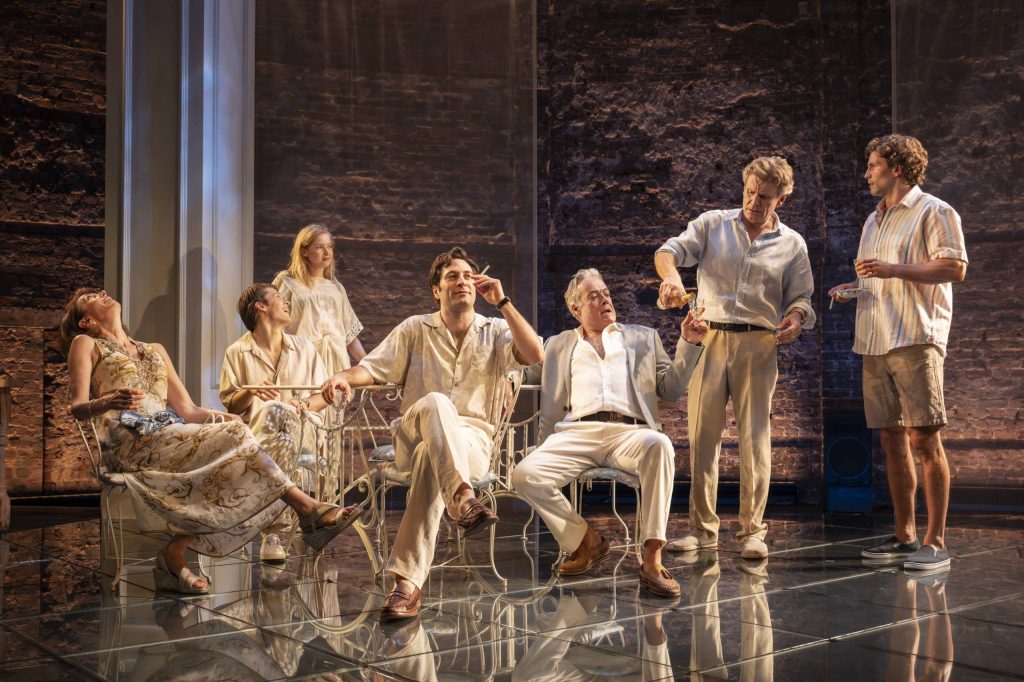
Alan Hollinghurst’s much-loved novel, The Line of Beauty, won the Booker Prize in 2004. Looking back to the rise of Conservative politics in 1980s Britain, and the parallel AIDS crisis, it explored gay life and consciousness through the eyes of ingenue Nick Guest, who learns a lot in a short space of time. Now, adapted by Jack Holden and directed by Michael Grandage, it reappears two decades later on the Almeida stage.

Adapting novels as plays can be a thankless task, especially when they’re well known, but Holden does a good job in not allowing the book to kill the drama. Covering the period between the Conservative victories at the 1983 and 1987 elections, the play dramatises the collision of personal and political from the perspective of Nick, played engagingly by Jasper Talbot and his experiences in love, and while lodging with the family of a Conservative MP. Performances are universally strong, and Grandage’s production is very tightly delivered. Alistair Nwachukwu gives a standout performance as Nick’s first lover Leo, charming, clever and vulnerable. Arty Froushan, as cocaine-snorting playboy Wani, Charles Edwards as smooth, fatherly MP Gerald Fedden, Robert Portal’s menacing Badger, and Ellie Bamber as bipolar Cat Fedden are all excellent performances. Hannah Morrish channels the demeanour of Fergie in a way that is both hilarious and disturbing. Doreene Blackstock, as Leo’s mother, and Claudia Harrison as Gerald’s wife are also very strong, but their roles are rather limited – a problem with both book and play. The staging is sumptuous – sets and costumes by Christopher Oram – who has clearly delighted in recreating and subtley parodying the high society 1980s with its odd combination of frumpiness and glamour.

Some of the more literary aspects of the book get a bit lost in the dramatisation, such as the thematic significance of Henry James and of the ogee, a shape which swings both ways. What is more significant is how much of a period piece the play feels. Hollinghurst was writing about a period 20 years earlier, a time now approaching half a century from the present day. The key issues of the time – homophobia, social conservatism, privilege and the devastation wrought by AIDS should not be forgotten, but are not undiscussed. The play offers a highly professional and entirely entertaining evening, but it is unclear exactly why this novel needs to be staged at this particular moment.

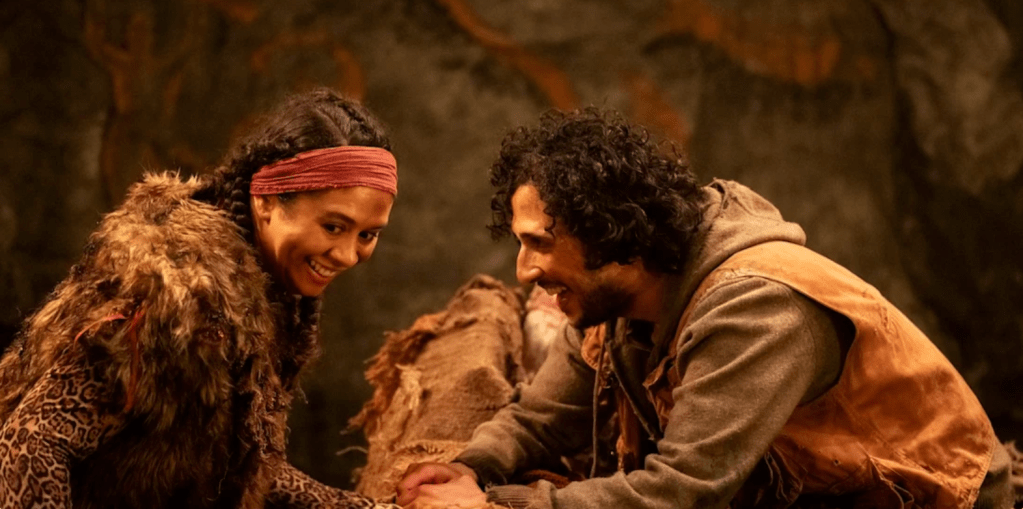
Cyrano de Bergerac

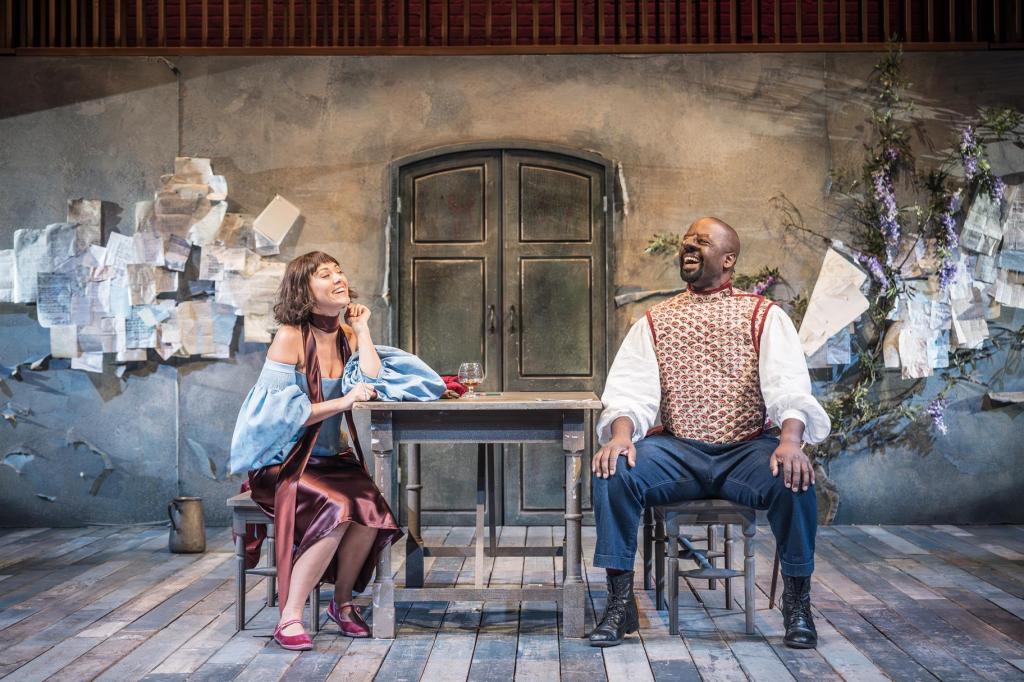
Photo by Marc Brenner.

Cyrano de Bergerac by Edmond de Rostand – Swan Theatre, Stratford-upon-Avon

Simon Evans’ production of Cyrano is a very convincing and enjoyable account of a play which stands up well to re-examination. Evans has also adapted the play, with Debris Stevenson, giving the language a contemporary flavour without undermining the period setting, in a fantasy 17th century France. The play is held aloft by an exceptionally strong case who bring a notable level of star wattage to the stage. Adrian Lester, as Cyrano, exudes leading man skill and control, to the extent that at times he reminds us of Derek Jacobi, who triumphed in the role at the RSC for Terry Hands in the early 1980s, and at others of Simon Russell Beale. Cyrano is a part that requires a dashing, confident, yet vulnerable performance, and Lester provides this with apparent ease. He is brash in the tavern scenes, charming with Roxanne, conflicted with love rival Christian and, in the play’s final scene, when he drops the letter he is reading, supposedly the last missive of the dead Christian, and recites it to Roxanne from memory, devastating. Up until this point the play has been hugely entertaining, but it is this culminating encounter which makes it something special. The play’s emotional weight all builds to this moment of revelation, as Roxanne realises he has loved her all along, and Cyrano realises the same. There is not a dry eye in the house.

Lester’s triumphant performance helps create the conditions for the whole cast to shine brightly. Susannah Fielding, as Roxanne, is exemplary – riding a wave of breezy, charming detachment until her emotions catch up with her. Her outrage at discovering she has been deceived by Cyrano all along unleashes a fascinating cascade of conflicting impulses. Levi Brown is excellent as a casuallly insulting Christian de Neuvillette, cocky and doomed. Scott Handy’s Comte de Guiche is very funny, appearing to belong to a parallel aristocratic world where nothing quite makes sense to him. And Greer Dale-Foulkes makes Abigail, Roxanne’s companion, a very amusing comic adjunct to the action.

Performed on Grace Smart’s sets of torn posters, worn plaster and red velvet curtains, the play fills the Swan stage as though written for it. Evan’s has conjured a hit, somewhat old-fashioned – in a good way because it successfully revives a classic for a new generation without significantly remaking the play. It’s a significant achievement, and makes for a very satisfying evening watching very good actors show us their skills.

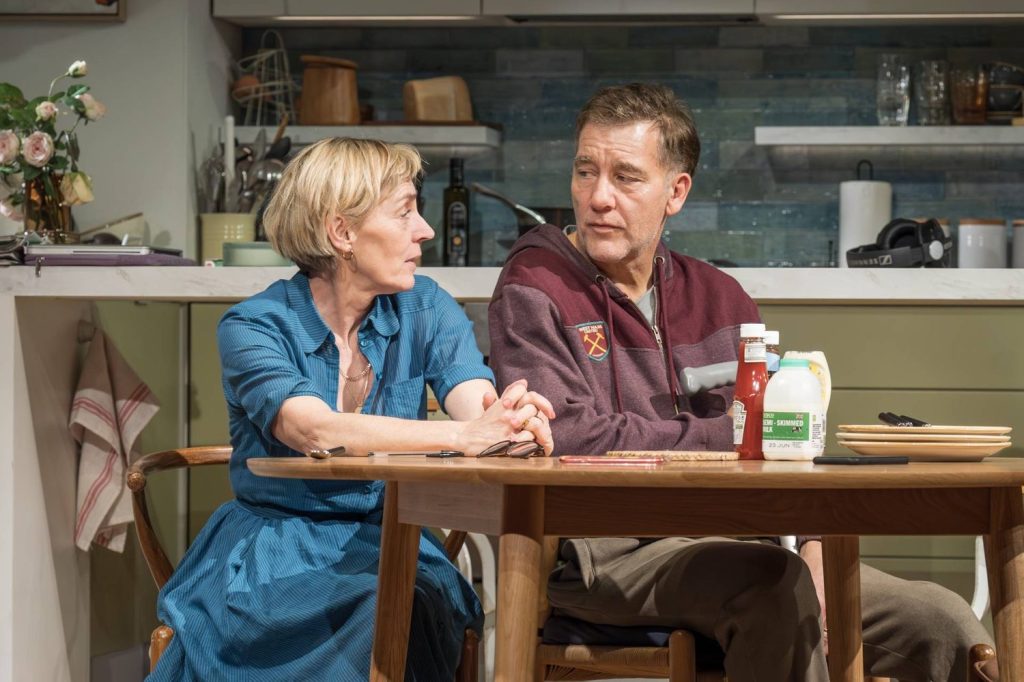
The Land of the Living

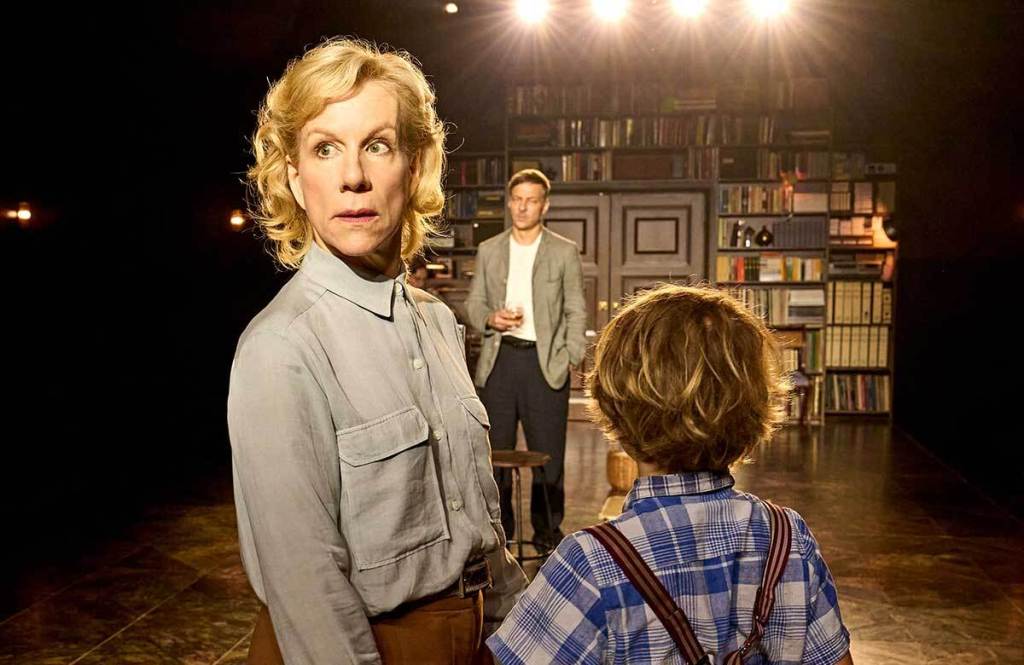
Juliet Stevenson, Tom Wlaschiha and Artie Wilkinson Hunt. Photo: Manuel Harlan

The Land of the Living by David Lan – National Theatre: Dorfman, London

Stephen Daldry’s production of David Lan’s new play, about the moral dilemmas in the aftermath of World War II and their lifelong consequences, piles the pressure on relentlessly. Juliet Stevenson plays Ruth, now in her 70s, living in London. Someone she hasn’t seen for 50 years arrives – Thomas (Tom Wlaschiha) – and we watch the story of what happened to him unfold over the next two and a half hours. Ruth was a young woman working for the UN in Bavaria, the American sector, after the German surrender. She and her small team of women look for children stolen by the Nazis from Eastern Europe and checked for Aryan characteristics. Those who passed the tests were given to German families with new names. Those who did not were murdered. Once the children are identified, the hard part begins. Thomas is with parents who hide his real identity, but are distraught when he is removed. Ruth becomes attached to him, saving him from the fate of many children – removed en masse by the Russians or by the Americans to be rehomed. But she doesn’t send him back to Poland either, where he might have rediscovered his original family. He has flown to London from New York to reveal the consequences.

Daldry crosses the play’s two time periods over one another – literally, with Ruth and Thomas occupying either end of a long traverse stage holding Miriam Buether’s London apartment set .while the events of 1945 play out across the middle. The pacing is effective, with the flashback action erupting into the civilised lives they have both built. Stevenson is remarkable, her calm demeanour drawing the audience’s attention to the emotions shifting tectonically below the surface. Wlaschiha is blank faced, traumatised, and expressing himself through music – although it’s a shame he stands aside from the action for much of the play, providing a catalyst rather than participating. The character Thomas is a pianist, and Wlaschiha has remarkable skills too, performing live on the apartment piano as a number of other characters also do, including Stevenson. It is an ensemble performance, with strong performances from Kate Duchêne as Ruth’s mother, Marek Oravec and Cosima Shaw as Thomas’s adopted parents and Caroline Lonq as Elise in a cast that includes several European stage actors appearing at the National Theatre for the first time.

Lan has uncovered a little documented set of events from a time that is much pored over, and has constructed a rigorous, emotionally hard-hitting story. It is an excellent vehicle for the talents of its very high end cast and production team.

Cascando

Photo by Greta Zabultye

Cascando by Samuel Beckett – Jermyn Street Theatre, London

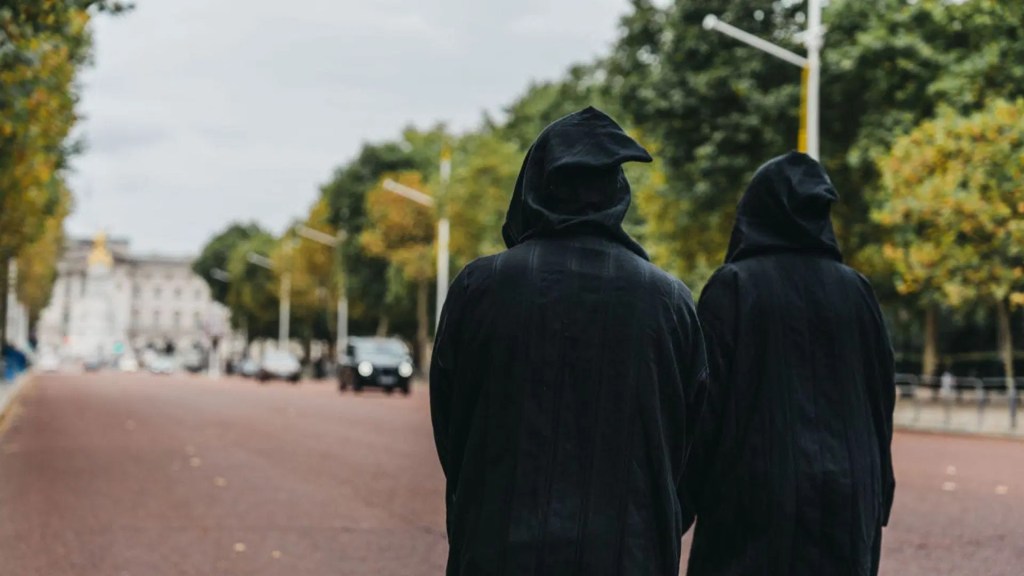
Irish company Pan Pan’s production of Beckett’s radio play, Cascando, is a promenade piece. The audience gathers at the theatre to put on hooded black cloaks and an mp3 player with headphones. With the tech hidden under their hoods, they walk at a measured pace through the streets of, in this case, St. James’s for half an hour while the piece plays in their ears. It is both an intense experience, immersive in the true sense, and a public performance.

Audience members are directed to walk in single file, heads down, focusing on the feet of the person in front ‘as if you were slightly depressed’. The result is a quietly disruptive experience, as a procession of, apparently, monks files slowly through the central London rush hour, amusing and bemusing passers-by, stopping both them and the traffic. The experience of becoming the performance is both very simple, and exhilarating. It is a fundamental twist in the audience contract which turns everything on its head. And that’s without the play itself. Cascando was written for radio and first broadcast in 1963. There are two male voices – Opener (Daniel Reardon) and Voice (Andrew Bennett) – whose rich tones fill our heads. They tell a disjointed story in language stripped to the essentials. Opener sets the scene for Voice, who is apparently trying to finish a story about a man called Woburn, on a journey, ‘same old coat’. The journey seems to be a pilgrimage of sorts, and the Opener a God-like presence. There are also intervals of music by Jimmy Eadie.

The overall production, which premiered in 2016 and has since been performed in venues around the world, is directed by Gavin Quinn. It is quietly astonishing, bringing Beckett disconcertingly alive in a new, modern ritual. As Woburn drifts out to sea clinging to a boat, we know that there is only one way the story will end for all of us, but we measure our steps anyway, one foot in front of another, along the pavements.

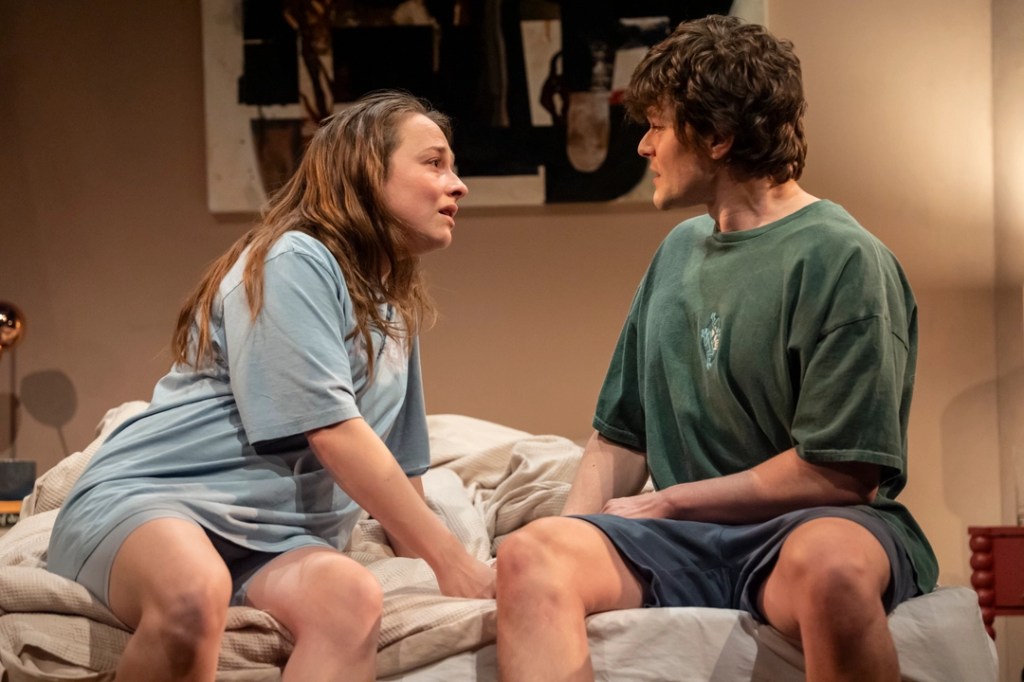
Clive

Paul Keating as Thomas. Photo by Ikin Yum.

Clive by Michael Wynne – Arcola Theatre, London

Published at Plays International

At first he seems a little fussy but in control of his life, an impression that disintegrates over the course of an hour as his obsession with cleanliness grows, his isolation increases, and rejection mounts as it becomes clear that real connection is beyond him. Even the cactus has the capacity to hurt him.  

The show, imaginatively directed by Lucy Bailey, makes great use of the Arcola’s studio theatre. Mike Britton’s wall of cupboards brings bursts of colour into the space as doors are opened, and Chris Davey’s lighting transforms the flat into “Mexico”, “Iceland”, or whatever Thomas asks Alexa.  

Keating – who worked so successfully with Bailey at the Arcola in 2016 when he starred in Mike Poulton’s play Kenny Morgan, telling the story of Terence Rattigan’s real-life inspiration for The Deep Blue Sea – is excellent. He holds the audience’s attention effortlessly and draws them into his increasingly dysfunctional world. He moves from gleeful dancing, polishing the floor with mops attached to his feet, to a full-blown crisis over the course of a well-balanced performance. His victimization as a gay man drives the psychological difficulties that begin to engulf him, retreating from a world that does not seem to want him.  

However, the script by Wynne – who won an Olivier Award for Best New Comedy for his 2009 play The Priory – falls somewhat short. The tone is uneven, with the titular cactus bringing a more whacky than gothic tone to the story, which seems at odds with the abusive and self-destructive behaviour surrounding Thomas. There is also too much telling, as Thomas explains what he is doing and why, narrating his own actions while telling us little we do not already know. Thomas also seems naïve about people in a way that does not fully convince us he is a fully realized character.  

The play was inspired by Philip Ridley’s Covid-era dramatic monologue The Poltergeist, but Clive lacks the weirdness and unremitting menace that make Ridley’s work so compelling. Clive is a well-performed and produced show, but the writing is too predictable for it to be more than the sum of its parts. 

The Estate

Adeel Akhtar, Thusitha Jayasundera and Shelley Conn. Copyright: Helen Murray

The Estate by Shann Sahota

Shann Sahota’s new play is a family drama, tying Southall to Westminster. Adeel Akhtar’s Angad Singh is a government minister, seizing the unexpected opportunity to stand for the party leadership. It quickly gets personal, and his relationship with his two sisters, Gyan (Thusitha Jayasundera) and Malicka (Shelley Conn), and with his late father, become political collateral. Sahota’s writing is very sharp, and she explores themes somewhat outside general discourse – the equivocal position of south Asians within the British establishment, misogyny in Sikh families, and what families have to hide when society expects them to justify their existence by being better than everyone else.

The performances are excellent too. Adeel Akhtar brings his vulnerability and the underlying menace he can produced, which is all the more disturbing for being so expected. He is thoroughly compelling, although it is a little hard to believe that someone quite as self-abasing has made it up the political ladder. His sisters are equally well-played. Thusitha Jayasundera superb, as always, as the motherly older sister ground down by Angad’s refusal to share his inheritance equally with his sisters, against their domineering father’s wishes. Shelley Conn is impressively combustible as the furious, younger sibling. The spiky atmosphere of a minister’s office is amusingly embodied by advisers Petra (Helena Wilson) and Isaac (Fode Simbo). The power of establishment is represented by the towering, besuited figure of Ralph (Humphrey Ker).

Daniel Raggett’s production is thoroughly enjoyable. He stages the play as a drawing room drama on a set that could double for a Noël Coward, complete with sliding wooden panels by Chloe Lamford. The Dorfman is set out, unusually, in a proscenium configuration, playing on the expectations of traditional theatre by using a familiar form to tell stories about ‘brown’ people, as Angad puts it. The Estate is a straight show – a family drama that plays out in a linear fashion, which brings limitations too, but within her own parameters Sahota has done an excellent job.

Ghosts

Victoria Smurfit and Rhashan Stone. Credit: Helen Murray

Ghosts by Henrik Ibsen adapted by Gary Owen – Lyric Theatre, Hammersmith

Published at Plays International.

The back of The Captain’s heavy, balding head is literally papered onto the walls of Merle Hensel’s set for the Lyric’s new version of Henrik Ibsen’s Ghosts, in a repeating patten. He may be dead, but his menacing presence looms large in the lives of everyone he has left behind. Meanwhile, the rear wall is a curtain of mist, dimly reflecting the characters who wander, lost, through a mental fog. The marble and leather opulence of the expensive interior does nothing to disguise the unresolved anguish which is pulling everyone apart from the inside. The Captain was a larger-than-life figure, a bully, a philanderer and arapist. Gary Owen’s pin-sharp updating of Ibsen’s classic preserves the generational impact of dark, unacknowledged secrets, while making them completely of the moment.

The Lyric’s boss, Rachel O’Riordan, has a fruitful artistic relationship with Owen including their hit Iphigenia in Splott. Their new collaboration feels like an event. The show’s emotional impact smoulders from the very first scene, as Rashan Stone’s lawyer, Andersen, visits the Captain’s widow, Helena (Victoria Smurfitt), to discuss arrangements for a new children’s home to be funded by his legacy. The professional atmosphere rapidly dissolves in the face of their unresolved relationship as old lovers. Callum Scott Howells, a force of nature as Helena’s deeply troubled son Oz, arrives on the scene to confront the older generation with the consequences of their silence. His burgeoning relationship with the Captain’s unacknowledged daughter Reggie (Patricia Allison) is both sweet and real, and deeply troubling as they discover they are half-siblings. Meanwhile, her non-biological father, Jacob (Deka Walmsley), is from a different social world, from where he can see exactly how poisonous a situation she is in.

Owen’s rewrite is masterful, pulling the play from its 19th century setting and refocusing on the human relationships that make it powerful and current. The lurking threat of syphilis, which no longer makes sense, is removed making space to dive into the realities of a coercive relationship, the corrosive power relationships created by wealth, and the terrible dilemma of discovering you are closely related to your lover. Ghosts is brilliantly cast. Victoria Smurfit, making a rare and welcome stage appearance, is perfect as a woman struggling with her inability to speak out against her abuser. She switches between full insight and reversion to the language of the oppressor. Her relationship with her son, Oz, is at the centre of the play. Callum Scott Howells is Gen Z to the core in bleached hair and Adidas tracksuit bottoms, his emotions always on the surface. He hides nothing, but being open to his feelings of rejection does not make them easier to bear. The generational gap with his mother, who hid everything to protect him, comes to a head in a scene reminiscent of Gertrude and Hamlet, where he questions her about whether she was raped. It draws gasps from the audience, as do several scenes during the evening.

Rashan Stone’s Anderson is a much more sympathetic character than his original, the hypocritical Pastor Manders. He gives a deeply human performance as a man trying hard to do the right thing, and finding there are no good choices. Patricia Allison’s Reggie is spiky, and fully aware of how much she has to lose while Deka Walmsley, as her father, is also more sympathetic than Ibsens’ original, using what little power he has to protect his daughter. Jacob, a painter-decorator with a broad East Anglian accent, emphasises the social gulf between the wealthy, living in coastal luxury, and those who work for them, who have very few options.

Ghosts is a significant achievement, a fresh look at a classic which shows us just how powerful Ibsen’s writing can be. Gary Owen turns our attention to themes easily obscured by the differences between eras. His version includes a powerful, entirely real evocation of Anderson’s lifelong, unrequited love for Helena. It draws on the power of public image, with the children’s home destroyed by the threat of toxic press coverage, rather than burning down, as in the original. He explores, in excruciating detail, how parents come to emotionally damage their children. And he gives a sophisticated, convicing analysis of the insidious ways a coercive relationship isolates and destroys a woman. Ghosts is a gripping, beautifully acted show, driven by a creative vision that brings this 150-year-old play pulsatingly to life.

Nachtland

Angus Wright, John Heffernan and Dorothea Myer-Bennett. Photo by Ellie Kurtz.

Nachtland by Marius von Mayenberg – Young Vic, London

Translated by Maja Zade, Marius von Mayenberg’s play is a brutal satire on the hypocrisy and racism of the contemporary German middle-classes. Brother and sister Philipp (John Heffernan) and Nicola (Dorothea Myer-Bennett), who have a difficult relationship, come together to clear their recently deceased father’s house. In the attic, they find a painting, wrapped in brown paper which, on examination, appears to by Adolf Hitler. This provides a more than sufficient catalyst to strip away the pair’s principles and dignity, as they attempt to cash in.

Nachtland (an invented German word meaning something like ‘night-land’) is a broad, bitter comedy drawn with cartoonish strokes. Most of the cast have a lot of fun with their absurd characters. Myer-Bennett is extremely aggressive, particularly towards her brother, self-righteous and openly racist. Heffernan is patronising, passively aggressive, and racist in a more insidious way. The two performances complement each other very well, culminating in a jaw-dropping brother-sister masturbation scene, as their excitement about the money they can make from the painting boils over. They play off against their partners, Gunnar Cauthery as Fabian and Judith, played by Jenna Augen. The latter is Jewish, and the only remotely normal character in the play, who whips the rug from under everyone without blinking. The events take place in an aging house, set designed by Anna Fleische, where the past has clearly been shoved in the attic and left unexamined for too long.

The absurdity of Nachtland, managed beautifully by director Patrick Marber, is its strength. Jane Horrocks is restrained, and funnier because of it, as Hitler art expert Annamaria. Angus Wright puts in the most eye-catching performance as wealthy Hitler collector, Kahl. First appearing in a cut scene, dancing to techo in a jockstrap, he re-emerges in furs and coloured chinos to appraise the painting for sale. Wright rings every drop of potential out of Kahl’s quivering ecstasy at the sight of a ‘Hitler’, but also delivers the collector’s dismissal of morality and art with fine disdain, launching into a list of those we prefer to forget were anti-semitic.

It is a little hard to judge Nachtland from outside Germany. Its satire, which feels unrestrained and to some extent shocking, is clearly aimed at Germans themselves. Whether this is familiar territory, or an essential reality check is not obvious to us in the UK. The play is too obvious at times in its humour, and struggles to get off the ground until Wright’s entrance. Von Mayenburg also gives the Devil, in a long tradition, the best lines. But it an entertaining and disconcerting evening in equal parts, with some very memorable moments. And the overall suggestion, of deep-lying, unapologetic prejudice among those who should know better for all sorts of reasons, is highly disturbing and an urgent matter for the stage to address.

King Lear

Clarke Peters and Danny Sapani. Photo by Marc Brennan.

King Lear by William Shakespeare – Almeida Theatre, London

Yaël Farber’s directs King Lear on simple but very effective set by Merle Hensel – a round, black circle backed by a curtain of chains. With dramatic lighting by Lee Curran, it is the perfect space for a hard-edged, menacing production that brings out the violence that courses through the play. Danny Sapani’s Lead is a big, intimidating man. His anger cows those around him, and he rules through physical presence. But Farber suggests that this is also the basis of his relationship with his daughters. For the first time I saw Lear’s actions as those of an abuser: controlling, threatening and micro-managing his children’s lives. The opening scene leaves the impression that Goneril (Akiya Henry) and Regan (Faith Omole) are equally uncomfortably with their father’s egotistical antics, but it is Cordelia (Gloria Obianyo) who has been driven to the point of resistance. Later, in a supremely uncomfortable moment, Sapani forces Regan, his adult daughter, to sit on his knee in front of her husband. Whatever has happened before the play begins, the father-daughter relationship is undoubtedly dark and destructive.

The violence Lear demonstrates when he still has power – smashing news conference microphones to ground in his rage – is visited on him in turn by children brought up in his image. Henry and Omole are superb are Goneril and Regan, taking destruction of others and themselves as the only way out of the situation they can imagine. Obianyo’s Cordelia is detached and angry, her recourse to violence taking the form of a full-scale invasion with a foreign power’s army, which makes her embrace of love and forgiveness all the more dramatic and moving when it comes. It is impossible to sympathise with Sapani’s Lear in the first half, as he rages in the heath scene, but his transformation, which comes only through the complete disintegration of his ego, is startling. His Lear is entirely compelling, and he is a huge stage presence, an actor coming to the part as though made for it.

Farber production is both well-paced – 3 and a half hours feel like much less – and well cast. Michael Gould’s Gloucester is a reasonable man in a mad world, and his scenes with Lear are a high point. Matthew Tennyson’s Edgar is an ingenue from another world, much more at home as Poor Tom than himself. Fra Fee’s Northern Irish Edmund is the opposite – a lifelong charmer whose over-confidence will always be his downfall. Alec Newman’s Kent, likewise, channels his inner, fight squaddie with suspicious ease. Hugo Bolton’s uptight Oswald and Edward Davis’ louche Cornwall are also highly watchable.

The most controversial element of the show is Clarke Peters’ Fool, played as a manifestation of Lear’s inner voice, who no-one else can see. While theoretically interesting, this approach tends to sterilise the action by removing social context, and Peters’ style seems to belong to a different production. His singing talent is put to good use though, and the use of music, composed by Matthew Perryman and making use of an on-stage piano and repeated snatches of ‘A Hard Rain’s Gonna Fall’, is seriously eerie. This Lear is of the highest class, and brings new insight to one of the world’s most pored-over plays.