Edinburgh Festival 2023

The (Hong) Kong Girls by PK Wong, Alice Ma and Justyne Li – Summerhall, Edinburgh

Three women perform connected but very different dance pieces, responses to the derogatory ‘Kong Girl’ identity given to wealthy Hong Kong residents. PK Wong dances naked and vulnerable, her head covered by an giant inverted red dress suspended from the ceiling. Alice Ma presents herself in a doll-like dress on a platform, but stuffs it full of black feathers which spill out in ritualistic fashion. Justine Li seems to fight herself as she dances. All three pieces are startling and compelling expressions of self – an hour of high quality contemporary dance.

InHaus by KlangHaus – Summerhall, Edinburgh

Long-standing band The Neutrinos play a gig, but it takes place in a Summerhall basement in a room full of old sofas and bric-a-brac. Band and audience wander around the space, experiencing it as they please in an atmospheric deconstruction of live performance that feels casual but lingers in the mind as an experience that is cleverer and more unusual than it seems on the surface.

Funeral by Onteroend Goed – Zoo Southside, Edinburgh

Onteroend Goed are sometimes described as the best theatre company in the world, and there is certainly no-one like them. With Funeral they’ve hit on a theme of death and collective mourning that can be found all over the 2023 Fringe – an unconscious response perhaps to everthing happening in the world, not least climate change which preoccupies the company. Funeral is a triumph: every moment is stripped to its essentials, and each is unlike any other experience the audience will have at a stage show, from shaking hands with every person in the room (itself a post-Covid affirmation) to processing in a spiral to cast confetti over a makeshift altar, like ashes. The ceremony is about nothing specific and therefore everything, and has meaning for every person in the room. It’s the collective ritual we all need, and Onteroend Goed understand that deeply.

Lovefool by Gintare Parulyte – Summerhall, Edinburgh

Produced by Théâtre National du Luxembourg, Lovefool is a one-woman play about failing to find happiness. Kristin Winters is very funny in a show that can be rather heavy-handed but has moment of hilarity – a supremely awkward vintage sex education film – and of shock – her character’s self-harming. Sometimes it feels like familiar ground is being trodden on the way society convinces women its failings are their fault, but when it works it is original and revealing.

Dark Noon by Fix&Foxy – Pleasance at EICC, Edinburgh

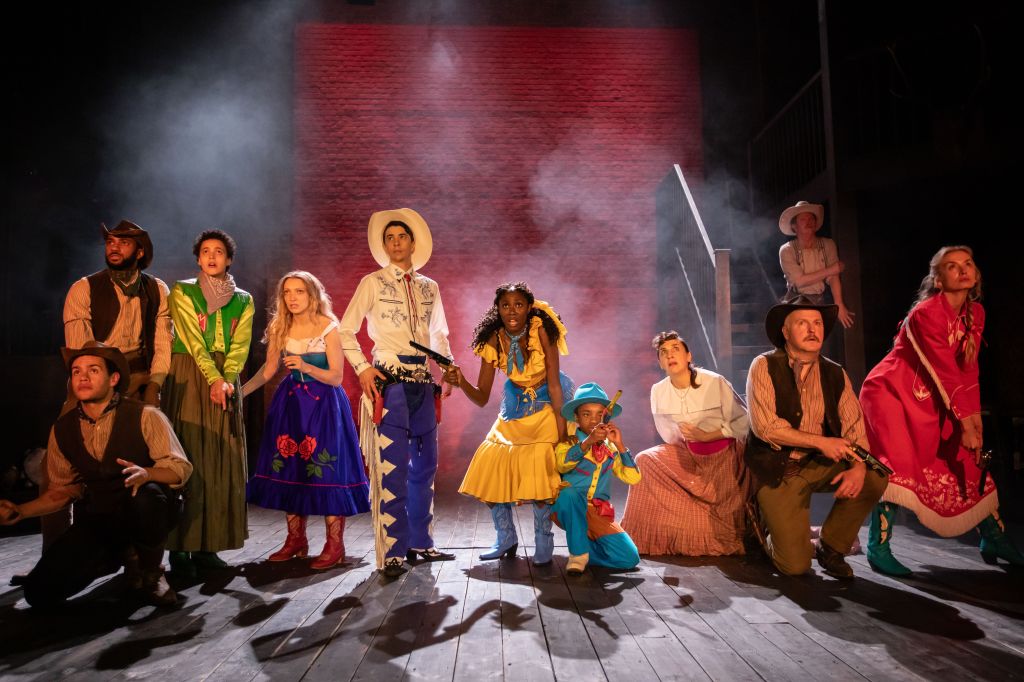
Seven South African actors, six black and one white, reenact the brutal story of the settlement of the USA and the destruction of Native America. Faces in white powder, their story-teeling style is cartoon-like and all the more barbaric for it. As they perform, a wild west town rises around them from the red dirt. This is an impressively ambitious production in terms of both scale and theme and, while it would benefit from a stronger script, it delivers moments that are hard to forget – not least when an audience members recruited for a country dance realise they are being lined up for sale as slaves.

Bullring Techno Makeout Jamz by Nathan Queeley-Dennis – Summerhall, Edinburgh


Nathan Queeley-Dennis’ one-man play, of which he is both writer and performer, may appear to be about nothing significant – a likable young Brummie guy’s advnetures in dating – but it is a tight and clever piece of writing. Nathaniel is winningly self-aware is his quest to present himself in the best light but, while keeping the audience throughly entertained, creates a convincing picture of life as a young man – the spaces of work and the city, and the relationships between black men, symbolised by the black heart emoji, which are touchingly supportive and positive. He makes himself a role model for non-macho manhood.

Things Hidden Since the Foundation of the World by Javaad Alipoor & Chris Thorpe – Traverse Theatre, Edinburgh

Javaad Alipour’s new show uses his trademark multi-media techniques to explore the nature of knowledge and cultural ownership of information, through the unsolved murder of the ‘Iranian Tom Jones’, Fereydoun Farrokhzad. The fact he is constantly described in terms designed to explain him to a Western audience is tip of an colonial iceberg below the surface of Iranian culture and politics. fronted by the affable Alipoor, the show includes an Iranian musician, Raam Emani, wildly famous in Iran as the singer King Raam, but a waiter in the USA where he has fled following the murder of his father. Not content with confronting us with the living embodiment of these parallel worlds, Alipoor also does a nice line in satirising the all-pervasive true crime podcast style, with a host played by Asha Reid. A complex, multi-layered play that for the most part holds together very well and takes us on a very unexpected journey.

The Last of the Soviets by Spitfire Company – Zoo Playground, Edinburgh

Inga Mikshina-Zotova and Roman Mikshin-Zotov sit behind a news desk, reading us items from the work of Svetlana Alexeivich verbatim accounts from ordinary people caught in the collapse of the Soveit Union. The material is staggeringly dark and they illustrate it, appropriately, with tableaux in miniature filmed live on their table. These scenes are disturbing – plates are smashed, soil mashed into chicken and Inga’s hair, and everything sprayed black leaving a strong whiff of solvent. These may be historical accounts, but Irina and Roman are Russian actors living in Prague and the application of these stories to Russia today is left in no doubt. Each performance is dedicated to Belarussian political prisoner Palina Sharenda Panasyuk. It’s raw, upsetting, necessary.

Woodhill by Matt Woodhead – Summerhall, Edinburgh

Woodhill is verbatim theatre about HMP Woodhill, a prison on the edge of Milton Keynes, with the country’s suicide rates. Three people – two mothers and brother – tell the stories of how each of their loved ones died in Woodhill via taped accounts. What makes this piece even more extraordinary than its deeply depressing subject matter is the way that they words are expressed on stage through dance. Tyler Brazao, Marina Climent and Miah Robinson embody the three relatives through fierce, uninhibited movement around a set of archived record boxes.

Written by Matt Woodhead and produced by LUNG, the show is a tribute to the three men who died – Chris Carpenter, Stephen Farrar and Kevin Scarlett – and a furious indictment of a prison system that locks people rather than treating their mental illness, and is so under-staffed that regular cell checks don’t happen, leaving it as a lottery whether you are found in time to save your life or, as in the case of the three men, too late. Remarkable theatre – awful that it is needed.

After All by Solène Weinachter- Dancebase, Edinburgh

Dancer Solène Weinachter’s solo piece is clever, funny and rather brilliant. She engages very naturally with the audience, chatting us through her experience of being asked to dance at her uncle’s funeral, with no warning, and how it has made her think hard about how she wants to plan her own send-off. She does a lot of talking, but there is dancing too. She dances comically, a very hard thing to pull off well, and brilliantly when she finally expresses herself, while creating select moments of theatricality. Such is her confidence, she even pause to blindside an audience member into taking her phone number during the show’s final, dramatic moments. Her confidence alone makes the show a pleasure to watch.

You Are Going to Die by Adam Scott-Rowley – Summerhall, Edinburgh

The fact that Adam Scott-Rowley performs entirely naked throughout is not the most remarkable thing about this show. It is just a vehicle for an hour of physical performance in which he abases himself in front of us, some of his performance involving a strange attachment to a toilet, the only object on stage. There are strong hints of Kenneth Williams in his sneering, joking/not joking persona, and indeed the toilet obsession. The show is unapologetically about physical decay and death, and is exactly the sort of challenging, impossible-to-forget performance that the Fringe should be all about.

Fool’s Paradise by Britt Plummer – Summerhall, Edinburgh

Britt Plummer is an Australian clown, and Lovefool is autobiographical, about a relationship with another clown, from Norway, which developed during lockdown. She thinks she’s invited us to her wedding, but we’re not so convinced things are the way she imagines. The show has charm, and some very funny moments including her sexually explicit re-enactment of the affair using only two coffee cups. There’s not enough focus though, or clowning, to take it to the next level.

When We Died by Alexandra Donnachie – Summerhall, Edinburgh

Written and performed by Alexandra Donnachie, When We Die is a very strong piece that packs quite a punch. Working in an undertaker’s, she has to prepare the body of a man who raped her a few months earlier. The show is remarkable both on the realities of embalming, which Donnachie clearly knows a lot about, and the impact of sexual assault which is revealed in heartbreaking detail. If Donnachie’s writing is precise, honed and exceptionally good, so is her performance which leaves us unsure what she will do right until the final moments of the play. As a show, it’s a complete success.

Blizzard by Emily Woof – Summerhall, Edinburgh

Emily Woof’s one-woman play, Blizzard, has many strengths. She is an engaging stage presence, talking to the audience in a way that leaves us uncertain whether what she is presenting is fact or fiction. She talks about her marriage to a neuro-surgeon, who thinks rather differently to her, and the experience of delivering a scientific paper on his behalf. The set-up works better than the pay-off though, and it seems that Woof didn’t quite know how to end the piece. However, her insights into the human mind are lightly delivered but worth hearing.

N.Ormes by Agathe and Adrien – Roxy, Edinburgh

Agathe and Adrien are two French-Canadian acrobats. Their show is an exercise in challenging gender expectations as they perform increasingly astounding feats, taking equal roles. This is quite something given that Adrien is around 6 feet tall, and Agathe more like 5. Her backflips while seated on his hands, and their arm balance with her handstanding on his upstretched arm are particularly breathtaking, but the whole piece was moment after moment of impossible physical achievement.

Phaedra/Minotaur by Benjamin Britten/Kim Brandstrup – Lyceum, Edinburgh

A show of two halves. Mezzo-soprano Christine Rice performs Benjamin Britten’s cantata Phaedra, with a pianist, in Deborah Warner’s staging. Thrilling dramatic. Then in Kim Brandstrup’s dance piece, tense throughout, Tommy Franzen, Jonathan Goddard, Isabel Lubach dance around a set that has a climbing wall as a backdrop, into the Minotaur’s lair. Some of the dancing on this wall is astonishing – hand-stands on climbing holds for example. Both pieces were of the highest quality, short because that’s all they needed to say what they had to say.

The Last Show Before We Die by Ell Potter and Mary Higgins – Summerhall, Edinburgh

Ell Potter and Mary Higgins live in each other’s pockets, ex-lovers, current flatmates, co-performers. In a piece reminiscent of the messy, very real relationships at the centre of Sh!t Theatre’s shows, they navigate the end of theirs through a show about endings. Performing naked apart from translucent body stockings that are going to holes, they reveal themselves emotionally, falling out on stage, pulling each other apart and then reassembling what makes them love one another. There are some very funny moments – Mary’s determination to deliver a crow impersonation over a recording of her deceased grandfather for example – but what really stands out is the emotions of two people whose lives are heading in separate directions, and can only express their feelings through low-budget, home-made experimental theatre. It is a beautiful thing.

Strategic Love Play by Miriam Battye – Summerhall, Edinburgh

Miriam Battye’s play about dating is performed by Letty Thomas and Archie Backhouse as Her and Him, meeting in a pub for a potentially awkward encounter. Potentially a highly conventional scenario, Battye super-sharp writing jolts it into something else entirely – an unpredictable, coruscating tirade about relationship conventions. Thomas is much too clever for Backhouse, a guy who thinks he’s ‘nice’ and wants things simple. She doesn’t want nice at all, and strips him intellectually and emotionally apart. But of course it’s not that simple and everything turns around more than once. The performances are very funny, with her uncontrollable disdain for herself and everyone else pitted against his genial bafflement. Battye is quite a writer, and this a very good play indeed.

Papillon by We All Fall Down Interdisciplinary Creations – Summerhall, Edinburgh.

Canadians Helen Simard, choreographer, and Roger White, composer, have worked together for 20 years. As We All Fall Down they produce dance with live music. Three performers – Nindy Banks, Mecdy Jean-Pierre, Victoria Mackenzie – dance in contrasting styles, radiating pure energy, while White and two musicians including a live drummer pound out a techno-kosmiche soundtrack. It’s thrilling stuff in a small room, the power of their sound and movement threatening to burst the confines of Summerhall and explode across the Meadows. The music is apparently based on Brian Eno’s Oblique Strategies card system, and the whole piece by chaos theory, which makes its unity even more impressive.

Dear England

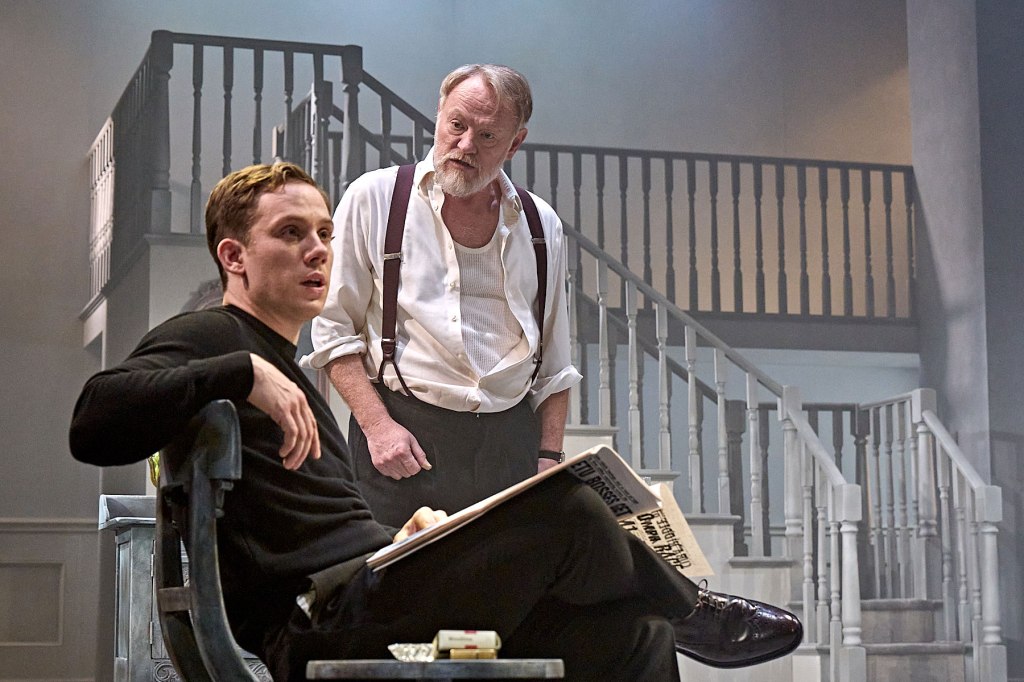
Joseph Fiennes (Gareth Southgate). Photo: Marc Brenner

Dear England by James Graham – National Theatre: Olivier

James Graham’s eye for a story is legendary, and Dear England is the latest example of his ability to make theatre from current events that seem impossible to dramatise. In the case of Gareth Southgate’s England team, the subject of this play, surely we also already know all about it. How can there be new drama to uncover from the most scrutinised role in Britain apart, perhaps, from that of the Prime Minister? Graham, director Rupert Goold and movement directors Ellen Kane and Hans Landgoff conjure something surprisingly and engrossing, and succeed in holding a mirror up to society in a way that dramatists find exceedingly difficult to achieve.

Movement is the key to staging a story that revolves around games of football that can’t, essentially, be show. The England team are constantly moving, interacting, cutting shapes and reflecting the themes of togetherness and mutual support in their stage presence. It works brilliantly, to the extent that I entirely forgot we were in the often cavernous Olivier Theatre. Goold’s team conquers the space with aplomb, backed by a simple set from Es Devlin of neon circles that define the space, and lockers that loosen its configuration. The task of playing people who are both famous and very much alive is also tackled with aplomb. The cast is universally excellent, with special mentions for Adam Hugill, who has a lot of fun with Harry Kane’s infamously deadpan delivery; Gunnar Cauthery who plays a remarkable quartet of roles as Gary Lineker, Sven Goran Eriksson, Boris Johnson and Wayne Rooney; Sean Gilder, who plays Sam Allardyce, Fabio Capello and Physio Phil and showcases some smooth dance skills; and Kei Matsena as a sceptical Raheem Sterling. But everyone is good – Josh Barrow as Jordan Pickford, Ebenezer Gyau as Bukayo Saka, Ryan Whittle as Eric Dier, John Hodgkinson as Greg Clarke/Gianni Infantino/Matt Le Tissier, Lewis Shepherd as Delle Alli, Darragh Hand as Marcus Rashford. The ensemble is a pleasure to watch as they bring the spiky dressing room dynamics to life.

The stars of the show are Joseph Fiennes, who seems weirdly born to play Southgate. He is entirely convincing as the manager who wants to bring humanity, respect and shared feelings to the team as a way to reflect and enable a changing society. His trademark is sincerity, never able to quite forget his career defining England penalty miss, and Graham makes an intriguing case for him as an under-the-radar pioneer and something of a hero. He is supported in his work by psychologist Pippa Grange, fighting and overcoming sexism and doubt, a role for which Gina McKee is also perfect.

Graham treads a tightrope by fictionalising current lives, but he writes with responsibility and manages to deliver a drama that treats its subjects with respect, except the few that don’t deserve it. The only characters to come out of the play with their reputations reduced are former FA Chairman Greg Clarke, who resigned in 2020 after make a series of racist comments in, of all places, a DCMS Select Committee hearing, born-again conspiracy theorist Le Tissier and Sam Allardyce, who can have no complaints. Graham is clearly fascinated by the tensions of squaring a philosophy that winning is not everything with the pressure to win, which never goes away. Since Southgate adopted a different approach to high-level sport management, the England cricket team has taken up the same attitudes. It’s all about entertainment and if you trust yourself, the results will come. We will find out soon whether the media and the public will lose patience, or whether the revolution can be sustained.

Modest

Modest by Ellen Brammer, music by Rachel Barnes – Kiln Theatre, London

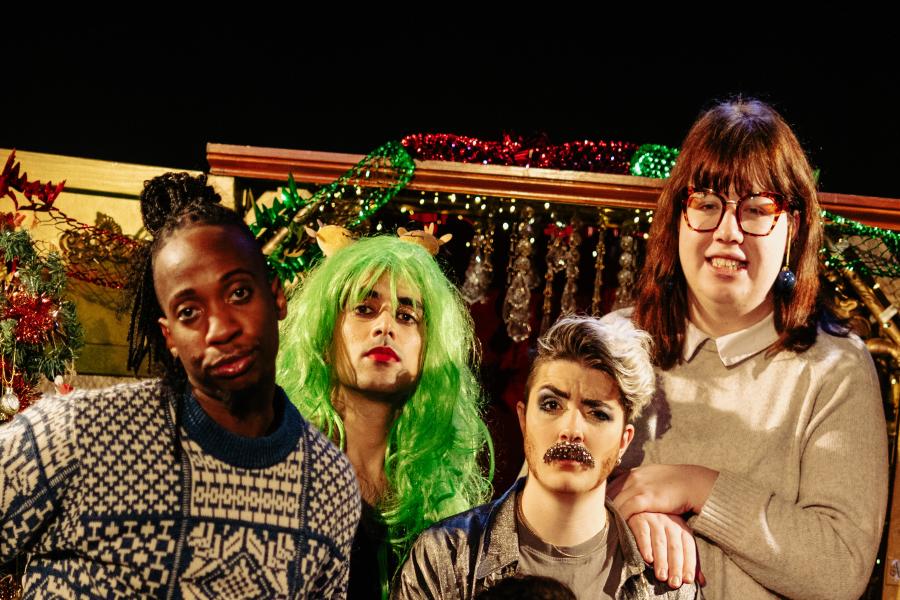
Middle Child, a confident and exciting ‘gig theatre’ group from Hull, bound into the Kiln Theatre with a highly entertaining piece of perked up history, performed by a drag cast. The story of Elizabeth Thompson, nearly the first woman to be elected to the Royal Academy, is an intriguing piece of re-remembered history. Thompson’s Crimean War picture, ‘Roll Call’, was a public sensation at the RA’s 1874 Summer Exhibition, putting pressure on the Academy to formally recognise her. Several years of machinations followed but in 1879, following further public success despite the RA’s best efforts, she missed out on election by two votes.

So far, so worthy – but that’s not how Middle Child do things. Elizabeth, played by Emir Dineen, throws herself at the drama of her role in a flame dress, fabulously talented and absurdly self-centred. She fights a set of ludicrous RA fops gleefully played by LJ Parkinson, Fizz Sinclair and Isabel Adomakoh Young. Fizz also plays her suffragette-poet sister Alice, while Libra Teejay is both non-binary Bessie and Queen Victoria. Jackie Bardelang is Millais. They mash period dialogue with amusingly contemporary interludes (Queen Victoria on seeing the exhausted soldiers of ‘Roll Call’: “They are fucked!”). There are songs, by Rachel Barnes, including the RA Committee number ‘We Are Men’. Directed by Luke Skilbeck and Paul Smith, Modest is a riotous and completely contemporary evening, refusing to take anything seriously as a remarkably effective way to get the message across.

My Uncle is Not Pablo Escobar

Photo: Harry Elletson

My Uncle is Not Pablo Escobar by Valentina Andrade, Elizabeth Alvarado, Tommy Ross-Williams and Lucy Wray – Brixton House, London

The four women who perform ‘My Uncle is Not Pablo Escobar’ take over the Brixton House stage in a wave of energy. All are Latinx (that’s the non-gender specific version of Latino/a) but from different backgrounds, living in South London and dealing with the lazy, ignorant and racist assumptions that come their way on a daily basis. But the show, created by four writers but based on the experiences of two of them – Valentina Andrade and Elizabeth Alvarado – is a celebration, and a reclaiming of narrative agency. Framed by ragged-edged, authentic scenes in which the performers discuss their experiences, to whoops of support from a large Latinx contingent in the audience, is a story of campaigners infiltrating an unnamed bank: evidently HSBC, prosecuted in 2011 for enabling Colombian and Mexican drug cartels to launder drug money on a huge scale. Characters pose as cleaners to obtain evidence of illegal transactions, while a family drama plays out between sisters.

The show is an engaging, sometimes wild ride. The simple but effective set, by Tomás Palmer, and lighting by Roberto Esquenazi Alkabes, cleverly delivers bedsits, cleaning cupboards and City office atriums. the four performers, Yanexi Enriquez, Cecilia Alfonso-Eaton, Pia Laborde-Noguez and Nathaly Sabino channel the energy of London’s young, increasingly visible Latinx community. What the script lacks in sophistication, it makes up for in its urgent need to tell stories that are only now bursting into theatres – with shows such as this, and Guido Garcia Lueches’ Playing Latinx. We can expect to see much more of this group of writers and performers, and the excitement, political insight and entertainment they bring to the stage.

My Shakespeare

My Shakespeare: A Director’s Journey Through the First Folio – by Greg Doran

Review published by Plays International

Covid its aftermath felt like an era shift for the Royal Shakespeare Company. In 2020, for the first time since 1879, there was no summer season at Stratford-upon-Avon as theatre across the globe temporarily ceased to exist. It would take three years to return to a pre-pandemic programme. In the meantime, Artistic Director Gregory Doran had stepped down, following the death of his husband and the RSC’s lead actor, Sir Anthony Sher. In the circumstances, publishing a book is an achievement, but Doran’s account of his life in Shakespeare is more than that. It is an inspiring piece of writing that reveals Doran’s complete commitment to Stratford, Shakespeare and the stage, while remaining overwhelmingly modest. It leaves me thinking that we have underestimated a director, who should rank alongside the Stratford legends who first drew him into theatre.

Doran’s all-encompassing fascination with Shakespeare defines the book, and his career. As a Lancashire schoolboy, a trip to Stratford to see Richard Pasco and Ian Richardson role-swapping in ‘Richard II’ had him hooked for life, and he was soon playing Richard himself on the school stage and hitchhiking down the M6 to see shows. He joined the RSC as an actor in 1987, falling for Anthony Sher while playing opposite him in ‘The Merchant of Venice’, the start of a 28-year relationship. They married in 2005, on the first day civil partnerships between same sex couples became legal. While Sher became an acting legend, Doran soon  moved into directing. His first RSC show was his 1999 ‘Henry VIII’, and he went on to direct almost the entirety of Shakespeare’s First Folio (apart from ‘The Two Gentlemen of Verona’). The plays provide ‘My Shakespeare’ with its structure, as Doran devotes a chapter to each play from his first production, ‘Romeo and Juliet’ in 1979, to his 2022 ‘Richard III’ with Arthur Hughes. He achieves several things at once, producing a fascinating memoir of a theatrical era, an extensive study of Shakespeare through textual analysis, and a moving account of his relationship with Sher. 

For Stratford watchers, the book is essential. Doran packs it with insightful and often very funny anecdotes. He recalls being grilled by some humourless Americans about the appropriateness of presenting a play “where a husband drugs his wife and makes her submit to bestial intercourse with a donkey” (A Midsummer Night’s Dream, naturally). He recalls the spell-binding moment when Sher, as Shylock, addressed his ‘pound of flesh’ speech to the apartheid South African cultural attaché, squirming inches away in his front row seat. He tells us how Michael Pennington agreed to replace Alan Bates in the title role of Timon of Athens at two weeks’ notice. We discover that when David Tennant’s Hamlet opened for booking at the Novello Theatre in 2008, selling out in 10 minutes, calls to the box office accounted for 10 per cent of the UK’s telephone network capacity. If you find this sort of theatrical detail fascinating, ‘My Shakespeare’ will keep you very happy.

Doran is not someone to blow his own trumpet. He is fully committed to his productions, but freely admits when he did not achieve what he wanted, or the press hated the result. He also acknowledges the company’s ups and downs. He experienced the near meltdown in the early 2000s when Adrian Noble pulled the company out of its permanent London base at the Barbican, before resigning. He too has received criticism for, amongst other things, the quality of new writing, the failure to reopen the RSC’s third theatre, The Other Place, and the lack of a strong cohort of Shakespearian directors to provide a succession plan. However, the pressures Doran has worked under have greatly limited his room for manoeuvre, especially the continued lack of a London base, a problem that probably has no solution. And he has delivered a roll call of great productions: Tennant in ‘Hamlet’, Patrick Steward and Harriet Walter’s ‘Antony and Cleopatra’, Sher and Harriet Walter in ‘Macbeth’, Sher’s Falstaff and his King Lear, and impressive lesser Shakespeare’s including ‘Henry VIII’, ‘King John’ and ‘Timon of Athens’. The live-streamed rehearsals performances of the ‘Henry VI’ plays during the pandemic were brave, ground-breaking and fascinating.   

However, Doran does more than just account for his time at Stratford. He also provides us with a lifetime’s worth of textual analysis, packing the book with interpretation of the plays he directed. When he applied, successfully, for the Artistic Director job he set out to emphasise ‘Shakespeare’ in RSC, rather than the ‘Company’ of his predecessor, Michael Boyd. He begins rehearsals not with a read-through, but an exploration of the text as the cast paraphrases each other parts to understand what the play is saying. Doran delights in this process, and it becomes clear how much he is influenced by the RSC’s the company’s ‘grandparents’ as he describes them, director John Barton and voice coach Cicely Berry. There is no greater tribute than to say that much of the book reminds me of the live workshops Barton sometimes conducted, which were rigorous, rich, rewarding and unashamedly obsessed with the text.   

Doran will be succeeded at Stratford by the duo of Daniel Evans and Tamara Harvey, both of whom have considerably less Shakespearian experience than him. This has led some to question whether the tradition of Barton and Berry, who essentially created the modern craft of Shakespearian performance, has ended. Doran says “I have one special hope: that all those who come after me at the RSC will maintain the discipline and craftsmanship that Shakespeare demands”. His legacy to the company must surely be to establish the words that Shakespeare wrote as the RSC’s core rationale. After all, as he points out, “In Shakespeare’s day you went to ‘hear’ a play.” 

Re-Member Me

Dickie Beau © Robin Fisher

Re-Member Me by Dickie Beau – Hampstead Theatre, London

Dickie Beau’s one-man show is an original, charming and clever project. The evening is presented as a theatrical history of, or meditation on, Hamlet and those who have played him. In fact, it is a more a queer history told through the medium of Hamlet. Beau, in full Chariots of Fire running gear plus rainbow headband, is a very appealing stage presence, drawing us into his research – a series of interviews with some of those who worked front and backstage at the National Theatre in 1989. The date is significant because it is when Daniel Day-Lewis dropped out of the lead role in Richard Eyre’s production of Hamlet, still a somewhat notorious theatrical event. But, while this remains well remembered, his replacement by Ian Charleson, of Chariots of Fire fame, who went on to give the performance of his life – perhaps the best Hamlet of them all – while suffering with AIDS and only months from death, seems to have faded from memory, Charleson was the first celebrity whose death was publicly acknowledged to have been caused by AIDS, and his Hamlet an unforgettable experience for those lucky enough to see him, and a social milestone.

Beau’s role in bringing this ignored history to the stage is as an interpreter, not least because he is a lip-sync artist. He takes this obscure stage technique and makes it sing, sliding effortlessly into the words and personalities of interviewees including a hilarious John Gielgud, and Day Lewis’s dresser. The way he channels long-departed characters is almost spooky, and deeply impressive. His interview material is full of insights, including the dresser slipping the cloak from Day Lewis’s shoulders as he weeps in his dressing room to give to a white-faced Jeremy Northam, going on halfway through the show. The one-night only production of ‘Bent’ staged to launch Stonewall, with a heroic performance from an ailing Charleson, is recreated from the memories of those who were present.

The structure of the show lacks a little clarity. A significant amount is pre-recorded and shown on screens, where four Beaus voice conversations about Charleson’s Hamlet between characters including Richard Eyre, Ian McKellen and Sean Matthias. While these play, Beau himself seems wasted as he rearranges the stage, while the screen has similarly to be kept occupied when he is performing live. The Hampstead Theatre’s broad stage is not the ideal setting for a show that would set a smaller venue alight. But it is hard to hold this against a show that manages to be so likeable and funny while performing an important service in educating a new generation about recent history, so quickly forgotten. But Beau, who voices ‘Withnail and I’s Uncle Monty to acknowledge that he “will never play the Dane” should put himself front and centre even more, performing live. He may not be Hamlet, but the audience loves him.

August in England

Lenny Henry. Photo by Tristram Kenton.

August in England by Lenny Henry – Bush Theatre, London

August in England is Sir Lenny Henry’s first play, a one man show which he also performs. As August Henderson, who arrived in London from Jamaica with his mother at the age of eight, he has no difficulty winning the audience over. It’s no surprise that Henry is a charismatic performer, but keeping an audience engaged and entertained for 90 minutes is not easy. To be debuting as a writer/performer at the age of 64 marks an impressive next chapter in a career that continues to fascinate. He just keeps on getting better. The story he tells, of a life threatened by the Windrush scandal, in which the Government’s ‘hostile environment’ policy deported and attempted to deport hundreds of Commonwealth citizens who had lived in the UK for decades. August is a victim, receiving demands from Capita to demonstrate his citizenship, setting impossible levels of proof, and finally being wrestled to the ground on his doorstep by immigration enforcement officers.

This part of the story comes at the very end. The majority of the play is August’s life story, growing up in the Black Country as Henry himself did. His story is funny and engaging, and Henry communicates powerfully with the audience, many of whom clearly recognise his descriptions of Caribbean family life in Britain in the 1960s and 70s. Henry is funny, and the play includes a significant amount of punchline-based material. Every anecdote is rounded off with a joke. These, while amusing, at times undermine the urgent underlying drama, especially during the denouement when August’s arrest involves an exploding shed, an uncomfortable injection of farce just as the play reaches its emotional peak. The Windrush events are also relegated to the very end of the evening. While we have great sympathy with August by that point, knowing his full life story, the balance does not seem quite right.

However, August in England is a high quality entertainment that also packs an emotional punch. August’s personal travails are raw and entirely believable, and when Henry finally breaks down it is truly upsetting. Co-directors Lynette Linton and Daniel Bailey end the show with a series of short video interviews with real Windrush victims, which opens the show up, taking it beyond social history and showing us the brutal and disgraceful reality. The ‘hostile environment’ continues to shame the UK, and Henry plays an important part in revealing the human cost of inhuman government policy.

Hate Radio

Photo by Daniel Seiffert

Hate Radio by Milo Rau – Battersea Arts Centre, London

Milo Rau’s Hate Radio takes us into the heart of the Rwandan genocide of 1994, when Hutus rose up following the assassination of the President, and slaughtered their Tutsi neighbours using whatever they could lay their hands on. Thirty years on it remains one of humanity’s darkest episodes. As a character in the play notes, it is not just that ordinary people – a priest’s son for example – became enthusiastic murderers, but that they went to extraordinary lengths to torture, rape and mutilate their victims. Up to 662,000 people died.

Orchestrating the killing from an office building in the capital, Kigali, was RTLM (Radio Télévision Libre des Mille Collines) a pro-Hutu radio station which denounced Tutsis as ‘cockroaches’ and broadcast details of their whereabouts so vigilantes could find and kill them. Rau’s play sets the scene with filmed testimony from four genoicide survivors, whose accounts are jaw-droppingly terrible. Then we are in the studio, during an hour-long show with three hosts and their MC/link man, which plays out in real time. We hear the relentless pushing of hatred, the repetition of racial slurs, the historical propaganda and the lies. It is like verbatim theatre, replaying real life events in all its ordinariness and horror. It is relentless and chilling – and extraordinary. It is impossible to turn away for a moment.

The three presenters are real characters: Kantano Habimamba (Diogène Ntarindwa), Valérie Bemeriki (Olga Mouak) and Georges Ruggiu (Sébastien Foucault), all now either in prison or vanished, presumed dead. Their interplay is hosts is horribly convincing, and their voices (the play is in French and Kinyarwanda, with subtitles) pound into our heads through the headphones we wear, making the show seem both intimate and separate, just as real radio does. Some of the moments that stay in the mind pass without comment such as when Kantano, as he was known, takes off his jacket revealing that he the gun strapped to his business shirt. Or they are heart-stopping, especially when the radio show goes to a song, each track played in full. Nirvana’s ‘Rape Me’, complete with enthusiastic drumming from the presenters, is almost impossible to bear. The way Kantano dances wildly in his suit to Reel 2 Reel’s ‘I Like to Move It’ encapsulates the frenzy of killing. And the show’s sign-off song, Joe Dassin’s ‘Le Dernier Slow’, is staggeringly sinister and intensely sad. Hate Radio is a stunning piece of theatre, showing us utter evil in all its ordinariness, and delivering a timely warning. If it happened then, it can happen again.

After the Act

EM Williams, Elice Stevens, Tika Mu’tamir and Zachary Willis (c) Alex Brenner

After the Act: A Section 28 Musical by Breach Theatre – New Diorama Theatre, London

The New Diorama’s Intervention 01, a season with no shows during the second half of 2022 is over. Its aim was to take stock post-Covid, regain excitement, and focus resources on building ambitious work that would not otherwise get staged. On paper, it was a bold and forward thinking, but the test lies in the quality of the work that comes out of the process. Breach Theatre’s After The Act strongly suggests this was an artistically inspired move. Their musical about Section 28 – legislation passed 35 years ago by Margaret Thatcher’s government banning “the promotion of homosexuality” in schools – is a wild, moving, engaged and essential piece of theatre. It tells audiences to look much harder at their assumptions about the supposedly progressive society they live in, and does so from the throes of a brilliantly unhinged party.

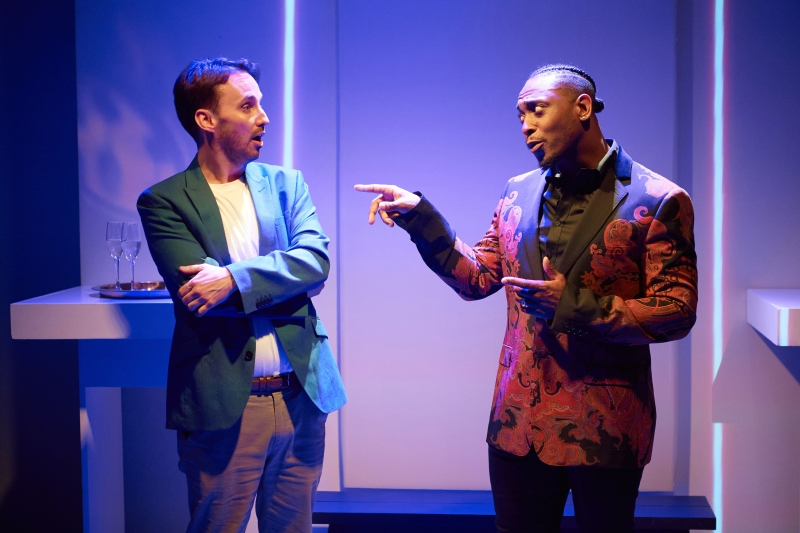
Co-writers Ellice Stevens and Billy Barrett have devised a verbatim / musical / agitprop / physical theatre with strong echoes of Tammy Faye and the film Blue Jean, but with an identity all of its own. Directed by Billy Barrett the four performers, including Ellice Stevens as well as Tike Mu’tamir, EM Williams and Zachary Willis put on a high energy show. Their movement and physical occupation of the stage is beautifully choreographed, as they create the show’s all-action atmosphere by impersonating an entire dance troupe. The music, played live by composer and musical director Frew and by Ellie Showering, is synth-driven, catchy and entirely appropriate to a show about the 1980s, without entering the realms of pastiche.

While the music is highly entertaining, the show’s power comes from the sophistication of its writing, which draws on deep analysis of the circumstances around the Section 28 controversy. It’s safe to say this the first time anyone has put former Manchester City Council leader Graham Stringer’s protest rally address to music, still less the grimly bigoted Parliamentary speeches made by Conservative MPs Elaine Kellett-Bowman and Jill Knight in support of the bill. The clause stated that a local authority should not “promote the teaching in any maintained school of the acceptability of homosexuality as a pretended family relationship.” It is a shocking piece of hate that had serious consequences for some and gave rise to iconic cultural moments. The ‘invasion’ of BBC News studios by protestors is very entertainingly staged, Nicholas Witchell and Sue Lawley still gaining plaudits today for the way they dealt with those awful lesbians. The accounts of the two women who abseiled into the House of Lords debate on the bill are funny and moving. Breach Theatre also cleverly stage scenes from the pages of Danish children’s book ‘Jenny Lives with Eric and Martin’, which became a lightning rod for the fear and hatred that exploded from the bill’s supporters.

The show boldly switches mood several times. Verbatim-style scenes, including accounts of the experiences of a teenager bullied for being gay and a teacher forced to hide her real self, are powerful and make the arguments against Section 28 by themselves. The clause was only repealed in 2003, showing our society had not progressed nearly as far as people imagined by the early 21st century. Importantly, Breach also makes the link with current debates around Trans rights explicit, pointing out that it remains fundamentally wrong to tell someone they must change who they are. Unfortunately, this message remains as urgent today as it did in 1988. The show is full of invention, variety and sophistication. It is a tribute to the New Diorama’s leadership that they have found a way to support and enable work this good. After the Act is Breach’s best work to date, and an exciting leap forward for a company who have always promised much.