A Strange Romance / A Trivial Dispute

A Strange Romance & A Trivial Dispute by Ian Dixon Potter – White Bear Theatre, London

The White Bear Theatre in Kennington, despite its typical pub theatre size (tiny) is carrying on as though the 2020s had never happened, staging a deluge of new writing to a small, socially distanced audience. It’s both a treat and an eerie experience to enjoy such a complete experience of past normality, a harbinger we must hope of what will return.

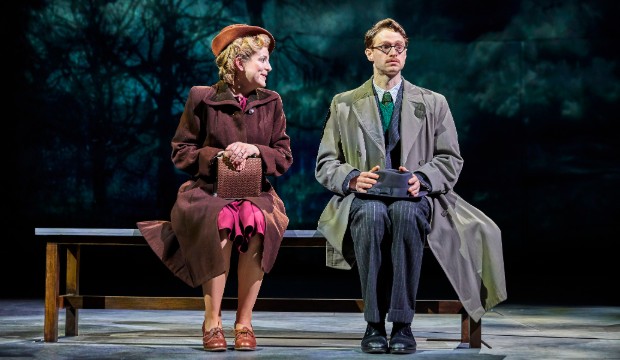
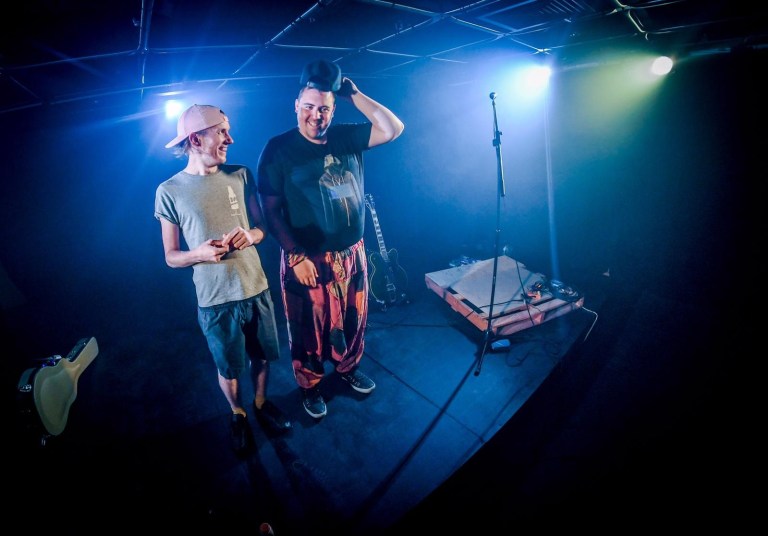
Ian Dixon Potter’s Tales of the Golden Age is a cycle of apparently unrelated one-person shows, monologues which show an admiral inventiveness. These two plays, from a wider repertoire of monologues written in lockdown, address current concerns through single characters. A Strange Romance, performed by Tom Everatt, is a condensed version of Dixon Potter’s play ‘Boy Stroke Girl’. It looks at whether it’s possible to fall in love with someone without knowing their gender, or caring what it is. As an intellectual exercise this is fascinating, but it is undermined by characterisation. Peter, a mechanic who falls for someone called only ‘Blue’, gives the impression of being nice but very dim, which leaves us with the impression, apparently unintended, that he is being manipulated both by his doubting/bigoted mates and by Blue, whose every wish is law.

A Trivial Dispute performed by Neil Summerville, delivers a stronger, more convincing character in Trevor, Purley born and bred, a millionaire three times over, owner of the third largest tanning salon chain in East Surrey and lover of classic cars (British only). Trevor has a certain amount of Alan Partridge about him but, as we gradually discover, is a lot angrier. Dixon Potter has written a biting but never bitter parody of the conservative, flag-waving, Brexit supporter threatened by anything different to him – especially foreign cars, intellectuals, women and people who aren’t white. The Croydon borders setting is very convincing with and the action set in the fictional Blackleafe, a flipside version of real life Whyteleafe. Summerville is excellent, elicting a certain amount of sympathy for Trevor, whose complaints of being looked down upon ring true despite his beleaguered outlook. His confession careers comically and inevitably towards disaster, like a Midsummer Murders plot gone wrong, a cleverly, lightly written combination of tragedy and farce.
Eurydice (& Orpheus)

Eurydice (& Orpheus) by Alexander Wright and Phil Grainger – Streatham Space Project

While the content of live performance takes second place, at the moment, to its very existence, Streatham Space has pulled off a success on both fronts. Being open at all, in any form, is a huge achievement at the moment and the fact that Streatham Space, only two years old, can pioneer socially distanced performance in London is something of which they should be very proud. The venue is exceptionally well-managed, its communications are a model of clarity and the entire experience feels totally safe.

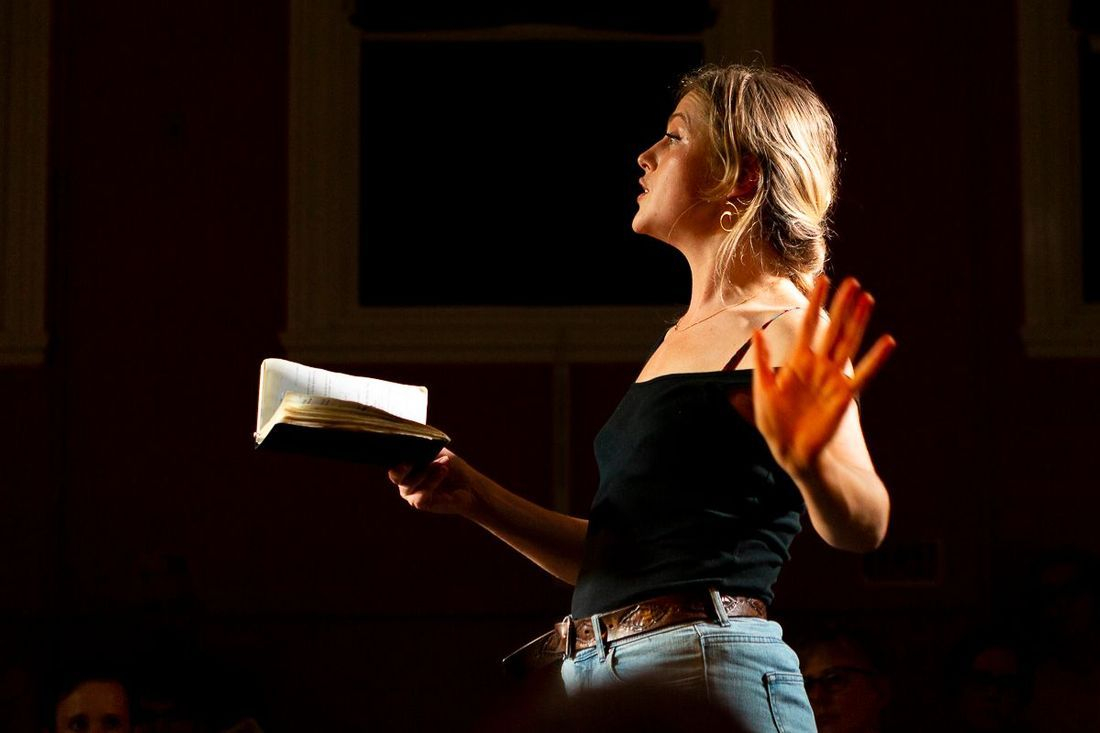
Orpheus and Eurydice are two companion shows, performed separately and sometimes, as one the night I saw them, consecutively. Both are written by Alexander Flanagan-Wright with music by Phil Grainger. They also perform Orpheus, which is narrated from a notebook Alexander had left over from a broken relationship. The story of a modern-day Orpheus – a guy called Dave, hanging out with the wrong mates (not bad, just lads) until a woman with an unlikely name walks into the bar where his 30th birthday drinks are in full swing. Grainger soundtracks with unaffected vocals and guitar Eurydice, which follows, is performed by Serena Manteghni and Casey Jay Andrews with Grainger again, this time on a synth.

These shows are fringe stalwarts, having toured from Edinburgh to Australia and back over the last couple of years. Both play with the power of the myth – love, despair, descent to hell, hope, devastation – and both its applicability to our own lives, and the teasing questions it leaves unanswered. Alexander is a genial performer, clever at maintaining dialogue with the audience without undermining the power of his words. Despite the updating, Orpheus tells the conventional version of the story.

Eurydice, powered by Manteghni’s likeable, manic presence, and Andrews’ calmer presence, takes a more critical perspective. It questions who was in control when Orpheus turned around and lost the chance to resurrect his dead bride and suggests that the decision to remain in the Underworld was hers, not his. This is just the sort of thinking that is being used in writing of various types to unpick new layers of meaning in stories we think we know. It is a pleasure to see performers back on stage, playing to audiences, each as grateful as the other to be there. The companies behind this double bill, The Flanagan Collective and Gobbledegook Theatre, do not disappoint.

Les Blancs

Les Blancs by Lorraine Hansberry – National Theatre at Home (Olivier)

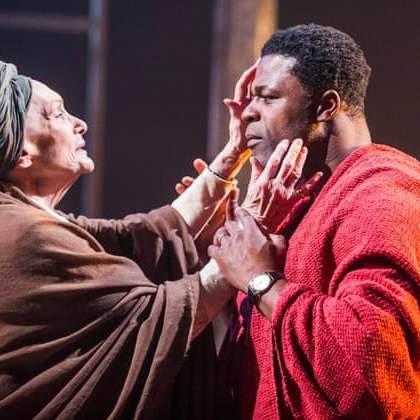
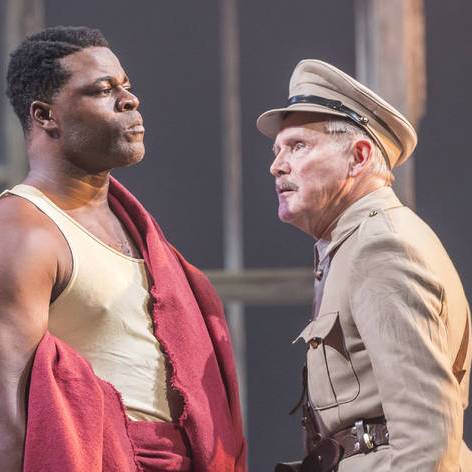
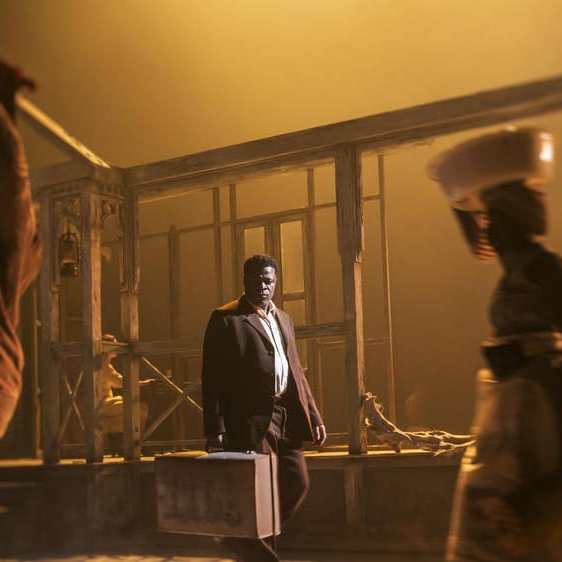
Lorraine Hansberry’s last play, edited after her premature death, is coruscating piece, its rage focused on colonialism in Africa. The National Theatre’s 2016 production was directed by Yaël Farber and used the full resources of the Olivier stage to transmit its full force. A old-fashioned mission hospital in an unnamed British colony seems at first like the quaint remnants of a fast-vanishing time, with its charismatic leader The Reverend, never seen on stage, and his elderly wife Madame Neilsen, played by Siân Phillips surrounded by long-serving doctors and native servants. When Tsehembe Matoseh (Danny Sapani) returns from his new life in London to attend his father’s funeral, it quickly becomes clear that what seems benign is evil, and that the colonial presence has destroyed all in its path.

Farber, with her designer Soutra Gilmour, creates an enthralling drama. We only ever see the mission hut on stage, but the life and, soon menace that surrounds it on all sides feels like a constant presence. People dance and sign Xhosa songs around the edge of the compound, dragging fire barrels as though pulling the earth itself around. A silent female figure (Sheila Atim) shadows Matoseh’s path. The multiple perspectives of colonialism are delivered through a host of powerful performances: the military enforcer (Clive Francis), the naive, liberal journalist (Elliot Cowan), the deeply disillusioned doctor (James Fleet), the single-minded missionary (Anna Madeley), the seat-at-the-table local (Gary Beadle) and the troubled offspring of a forbidden union (Tunji Kasim). The stand-out performances are from Phillips, whose unexpected connections to people and events make her harder and harder to classify, and Sapani. The latter boils over with rage at the deceit and exploitation visited on his people, and his inability to escape what others have done. Les Blancs is a remarkable play, not only for its time (the 1960s), but for how little impression Hansberry’s dismantling of colonial pretence has made on the wider story of the era. Unfortunately, the play feels just as necessary now as it was then.

Small Island

small-island-leah-harvey-and-046512b5cb1448c344c6d3b3af455f695e1c

Small Island by Andrea Levy – National Theatre at Home (Olivier)

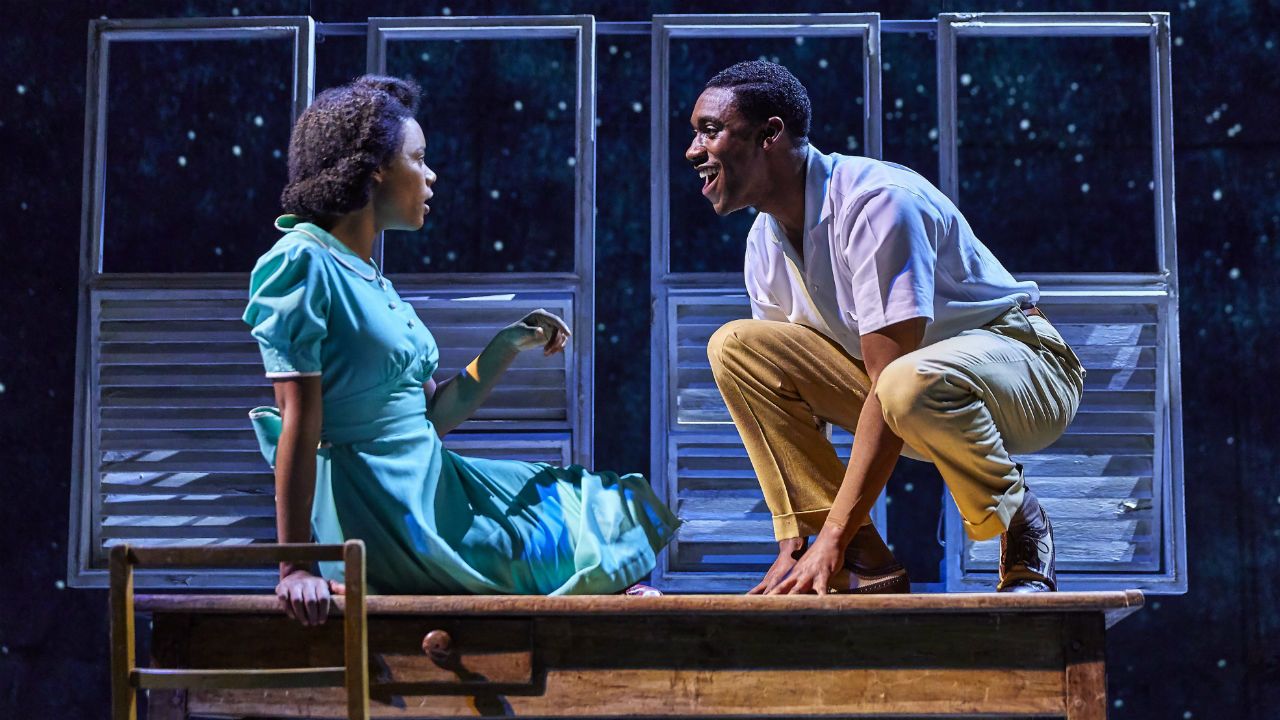
The National Theatre’s adaptation of Andrea Levy’s exceptionally popular novel Small Island makes for remarkable theatre. This is an achievement, as adapting much-loved books for the stage is a tricky business. Helen Edmundson’s version focuses on three characters, and delivers a harsh, corrective history lesson. Hortense (Leah Harvey) is socially despised as a farmed-out child in inter-war Jamaica, but believes her education and her light skin will see her thrive in London. Demobbed Jamaican airman Gilbert (Gershwyn Eustache Jnr.) is persuaded to take here there, in a marriage of convenience. In London, their landlady is Queenie (Aisling Loftus), who has escaped a Lincolnshire pig farm upbringing for a marriage to Bernard, a terrifying uptight, damaged character. The story is epic and episodic, moving across eras and through a war, from colonial Jamaica to the promised land of the Windrush generation, but its message is stark: post-war Britain, and indeed the USA, was a grimly racist country where black skin was despised, people lied to exploited, and lives destroyed.

The early scenes of Hortense’s tough upbringing have strong parallels with Jane Eyre, and similarly she trains as a schoolteacher. The racism and cruelty she encounters in Jamaica are nothing compared to what awaits in London, where black people are openly abused in the street, and Queenie receives protests from her neighbours for renting rooms to ‘darkies’. Gilbert experiences the segregationist attitudes of GIs, transplanted to Lincolnshire, and has no choice but to soak up the abuse in London and accept the one room lodgings he must share with his horrified wife. And Queenie experiences the dislocation of war, left to look after Bernard’s elderly father, left unable to speak by the First World War, while Bernard himself vanishes.

The plot, laid out on paper, contains elements of melodrama but on stage it is handled extremely well by director Rufus Norris. The interweaving stories, performed by a large cast, are entirely engrossing and the play seems to present an essential hidden history. Performances are very consistent, and the staging makes imaginative use of the Olivier stage. Katrina Lindsay’s design regularly sinks characters through the floor as scenes change, neatly symbolic of failed hopes and social betrayal. The dramatic ending leaves some hope for the future, at least for Gilbert and Hortense, but achieved in the bitterest of ways. Small Island is a significant production, making a strong political statement through accessible, popular entertainment from National’s largest stage.

Playboy of the Western World

DruidSynge.-The-Playboy-of-the-Western-World.-Photo-credit-Keith-Pattinson.-2005.2

Photo – Keith Pattinson

Playboy of the Western World by JM Synge – Druid Theatre online

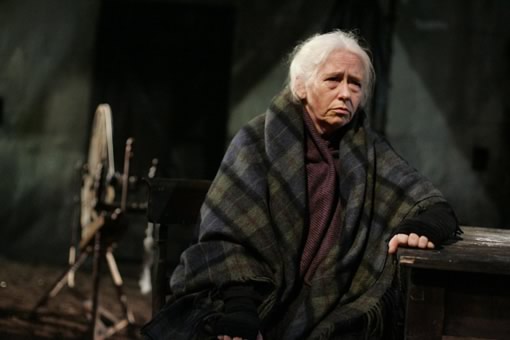
The online release of productions from Druid Theatre’s 2005 season of JM Synge’s complete works is a lockdown boon. Theatre in Galway, or any of the world’s theatre pilgrimage spots, remains somewhere in the future, but these productions are seriously alive. It’s hard to believe that they are not still being performed somewhere right now. After Riders to the Sea and The Shadow of the Glen, I turned to Synge best-known work, Playboy of the Western World, his only full length play and his generally acknowledged masterpiece. Druid’s production makes the connections to earlier work very clear, using the same dark, stone cottage set as for the first two plays. The black comedy of The Shadow of the Glen is at the root of this strangely disconcerting play, which infamously caused first night audiences to riot. An old man who keeps coming back to life, despite his son’s attempts to kill him, is both funny and grim, conjuring a line of Irish stage humour that leads directly to Martin McDonagh and Gina Moxey. In 1907, its tone must have been confusing and disconcerting.

Synge’s play has an atmosphere and a logic of its own. The inhabitants of a County Mayo village are entranced by the arrival of Christy Mahon (Aaron Monaghan), on the run from apparently killing his father. The attraction of a man with a story far outweighs any moral doubts, at least among the women. Monaghan’s performance is all arms, legs and open-mouthed gaping, and there is no doubt that he is not the sex symbol everyone wants him to be. The most sensible figure in the play is bar-owner’s daughter Pegeen Mike (Catherine Walsh), but it is she who falls for Christy for real. The play resolves itself simultaneously as farce and poetry, because the other aspect of Synge’s writing is his celebration of Irish-English. His characters speak, despite themselves, in a welter of intense imagery, dense sentences packed with a language that speaks of place and culture. It is remarkable to behold, and Synge’s achievement in holding rural Western Irish people, at the time some of the most despised in Europe, up alongside people expected to be seen on stage, is real.

Garry Hynes’ production is compelling, bringing waves of people spilling in and out of the play’s bar room, one minute full of excitement and chaos, the next desolate. The poverty of the setting is emphasised, with what might appear to be a pub on the page nothing more than a counter in an earth floored room. The cast is excellent, but Catherine Walsh’s Pegeen Mike is a still point among the rushing events, trying and failing to stand apart and absorbing the play’s contradictions until her final lamentation, as she grieves the ‘playboy’ she has just rejected. Druid have made two more of the Synge plays available online – Deirdre of the Sorrows and The Well of Saints. I will be watching…

Shadow of the Glen / Riders to the Sea

92Catherine Walsh as Nora in The Shadow of the Glen.
downloadMarie Mullen in Riders to the Sea.

The Shadow of the Glen / Riders to the Sea by JM Synge – Druid Theatre online

The lockdown may have ended theatre as we knew it, for the unforeseeable future, but it has driven some gems out of hiding and on to the internet. Production quality varies greatly, both in terms of the show itself and its presentation. Galway’s Druid Theatre show everyone exactly how it should be done with their online films of two JM Synge short plays from 2005. These were part of the DruidSynge project, performing Synge’s complete works for the first time, under the direction of Garry Hynes, a landmark event in recent Irish theatre. They are beautifully filmed performances, delivered with a weight that is almost overwhelming.

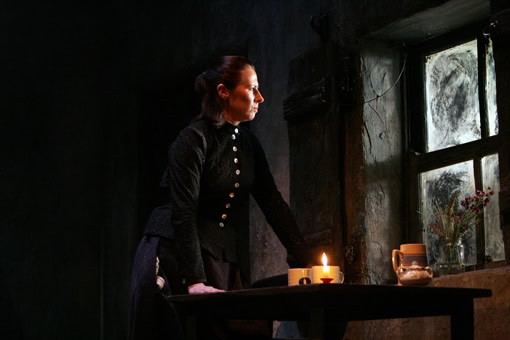
The Shadow of the Glen was Synge’s first play, set in a cottage at the end of a long County Wicklow glen, beset by mist. It is grim and strange, with hints of the more folklore-based parts of Ibsen’s work. We seem to be in middle of a cruel tragi-comic, even farcical parable. The body of a little lamented elderly husband is stretched out in a small, dark cottage when a Stranger arrives, a man of the road looking for a drink. Nora, the lady of the house, obliges. Then events take a turn that cannot be discussed with spoiling the surprise. However, Synge systematically deromanticises peasant life in the course of half an hour, leaving us in no doubt about how women’s lives hung by a thread, dependent on their husbands and their reputations. Stuck in a tiny house with the barest essentials in the middle of nowhere, its not difficult to see how a wife might grab any opportunity for company, and how a life on the road might ultimately prove the better of some terrible options. When first performed in 1903, the play raised controversy with Irish nationalist who considered it to be slanderous to Irish womanhood. It’s safe to say they were missing the point. The performances are excellent – Catherine Walsh as the Lady of the House in particular – and seem to be channelled from deepest Wicklow a long, long time ago.

Riders to the Sea is set in the same cottage interior, but it is now on the remote Aran Islands. This was Synge second play, and this time it upset people with its dismissal of religion. The matriarch of the play has lost son after son to the sea and considers herself cursed, doomed to lose the last son who remains – unable to convince him to stay off the sea as the wind rises in the south. Her two daughters look on, with little in prospect but lives of waiting for death to come from the sea. The play is dark but entirely human, with a devastating detail of the dropped stitches on a sock retrieved from the sea that allow a sister to identify her drowned brother’s body. Marie Mullen’s Maurya has the stature in grief of a figure from Greek tragedy and her final line – “No man at all can be living forever and we must be satisfied” – is, remarkably, taken verbatim from a letter to Synge from a young Aran islander he met during his research. The line between ordinary speech and poetry in these plays is impossible to locate, and the line between ordinary experience and myth is obscured in the mist. Druid has also posted their production of The Playboy of the Western World online, and these shorts are perfect preparation.

This House

this-house-national-theatre-uk-tour-birmingham-rep

This House by James Graham – National Theatre at Home (Olivier)

Seeing This House again, after several years, on a thoroughly absorbing broadcast of the National Theatre’s mid-2010s production, it is immediately clear how prescient it was. The chaos of national politics in the mid-70s  seemed light years away in 2014, but how arrogant that assumption seems now. The events of 2016-19 – bitter national division, two elections in quick succession, a minority government, MPs swapping parties, MPs not fit to attend being dragged to the Commons to vote, a grabbing of the ceremonial mace, even Big Ben stopping for repairs – were remarkably familiar to those who had watched Graham’s play, or lived through the real thing.

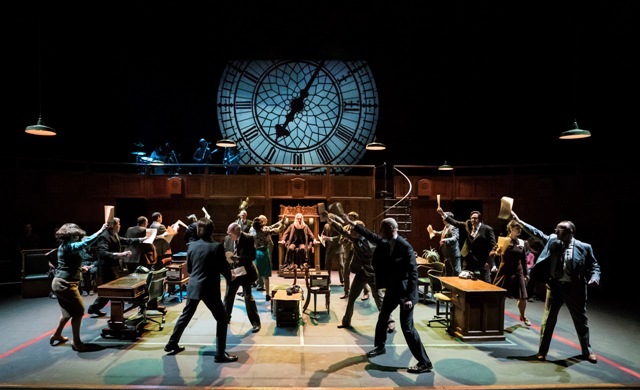
Graham charts the course of the two 1974 elections and their aftermath – a hung parliament and then a wafer-thin Labour majority – from inside the Government and Opposition Whip’s Offices in Parliament. There, the men (and one woman) charged with keeping first Wilson and then Callaghan in power, vote by agonising vote, play out an intense, personally costly drama. Graham is clearly fascinated by the unseen individuals at the heart of the machine, and by how quickly they were forgotten. He specialises in taking apparently obscure historical episodes, well within living memory, and showing us why we are wrong to have let them fade into the past. The drama he generates from the actions of obscure MPs who few could name without him is remarkable. Jeremy Herrin’s production was a big hit at the time, and stands up to rewatching very well indeed. The theatre of the Commons chamber is translated brilliantly to the vast Olivier stage, having opened in the small Dorfman Theatre (then called the Cottesloe), with the opposing benches filled with both actors and audience.

Some excellent performances drive the show – from Reece Dinsdale as master Labour operator Walter Harrison, Phil Daniels as Chief Whip Bob Mellish, Julian Wadham as his hilariously snooty opposite number, Lauren O’Neill as ‘token girl’ Ann Taylor (in real life, to become the first female Chief Whip and Graham’s main source), and Charles Edwards at Tory deputy Jack Weatherill (later to become famous as Speaker). Graham masterfully crams in  arcane procedure and forgotten events, while making every moment seems essential and leaving room for a great deal of humour.  But the drama is intense. Labour whips fight to save the country from a future they dreaded under Margaret Thatcher, their struggles made all the more poignant by our hindsight. Graham celebrates the role of those who sacrifice themselves for the greater good – there are several deaths in the course of the play just as there were in reality – and contrasts it with the individualism of those who think they are more important than the party, whether they are the Militants then infiltrating Labour or the thwarted MPs they unseat. The play ends with a moment of the highest historical , an event in which Walter Harrison shows himself to be entirely selfless – something that was apparently unknown until uncovered by Graham. The drama of his writing is supercharged by the knowledge that this is no fiction

The public tends to see Parliament as a combination of archaic, divorced from reality and irrelevant – then, as now. They also sort of love it, and show no inclination to  vote in favour of changing a strange system that relies on a version of honour amongst men that makes little sense, and doesn’t reflect the role of women much better now than 40 years ago. This House is a fine piece of writing – satisfying to the political geek, but also much more important than that, showing us how little we have changed and how much we still have to do.


The Battle of the Beanfield

beanfield-reenactment-1024x533

The Battle of the Beanfield – Breach Theatre, Vimeo

Available on Vimeo, The Battle of the Beanfield is the first show by Breach Theatre, now known for the excellent It’s True, It’s True, It’s True about Renaissance artist Artemisia Gentileschi. As lockdown watching, it is an interesting exercise in time travel. It’s not often that you can see shows made for live performance five years ago, generally for a reason. Stripped of the moment, setting and context, theatre can appear very different than it seemed to those in the audience on the night. The single camera view at the back of the auditorium and the dodgy sound certainly undermine the experience. Breach Theatre used a combination of video and live action, and the atmosphere was certainly an important element of this show’s success. Reviewed very favourably at the time, it is now more of a context setting piece for the company’s progression. It’s True, It’s True, It’s True is a much more sophisticated show, and The Battle of the Beanfield in retrospect a much more studenty production.

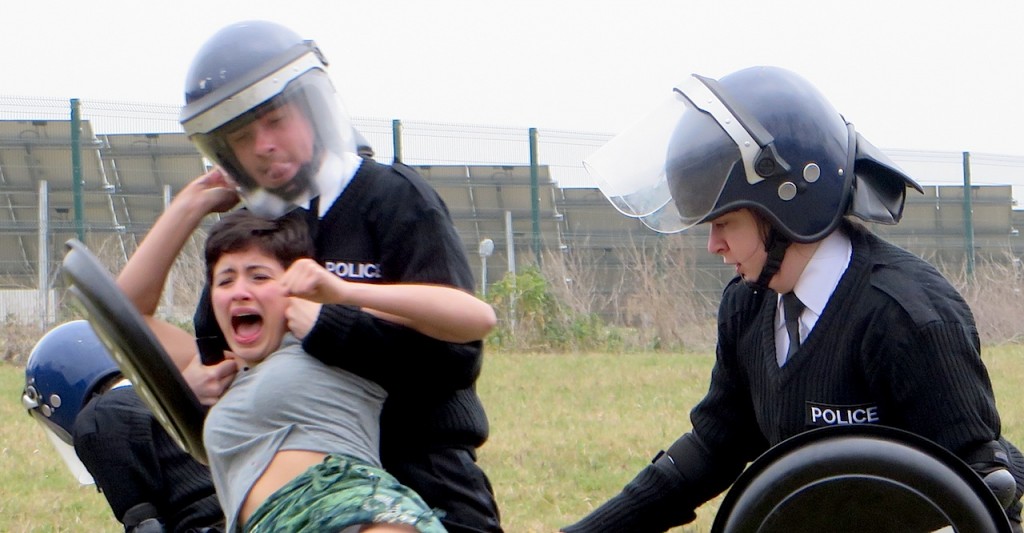
Breach lighted on the grim and somewhat forgotten day in 1985 when hyped up and tooled up police, fresh from the Miner’s Strike frontlines, were dispatched to stop a convoy of 500 travellers from reaching Stonehenge and stopping the annual free festival. The entirely gratuitous violence they showed – attacking people and animals with whatever they could lay their hands on and burning their homes with their own lighters and taking their children away – is still shocking. So is the fact that 600 people were arrested and none convicted. It was pure, state-sponsored violence, as a former policeman who was there on the day discusses in detail on video. Breach have also interviewed Guardian correspondent Nick Davies, who travelled with the convoy, and one of the travellers. Together they paint a powerful picture of a dark day for democracy.

Breach approach this through the device of an historic-style battle re-enactment, although it is never clear why they have chosen this. Their attempts make them very unwelcome with landowners at the battle site, and their progress is cut with fictional scenes from a group of friends attending a contemporary midsummer festival at Stonehenge. The main problem is that they seem more interested in themselves than the events they are investigating. We want to know much more about what happened, the context, aftermath and implications 30 years later, but the theatrical devices get in the way. Nevertheless, it is a fine choice of subject from a company who really were just students at Warwick University at the time, exploring the possibilities of theatre and finding their way.

Barber Shop Chronicles

710 Barber Shop Chronicles at the National Theatre (c) Marc BrennerImage by Marc Brenner

Barber Shop Chronicles by Inua Ellams – National Theatre At Home (Dorfman)

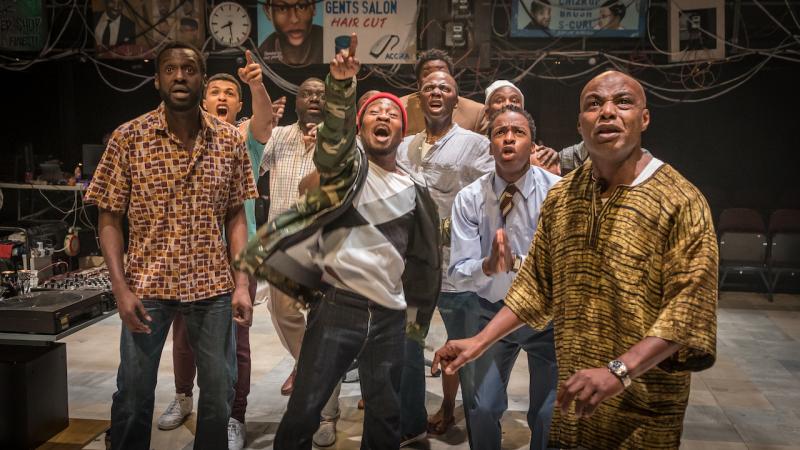
The energy of Inua Ellams’ Barber Shop Chronicles comes across clearly in this version, filmed for the National Theatre archives rather than for live broadcast. While the cameras remain still the cast of nine is a force of energy, driving the play from barber shop to barber shop, in London and several African countries. Ellams has written an all-male piece, but there is a clear justification – the exploration of the barber shop as a space for gathering, particularly although not exclusively for those who do not drink alcohol. His lively writing convincingly creates the atmosphere of social spaces that belong to the men who come, ostensibly for a hair cut, and stay to discuss anything and everything with one another.

The play is also unusual and important because it bring African voices to the British stage. From the opening scene, conducted in Nigerian accents so strong they are hard to make out, it is immediately obvious that we are hearing voices that simply do not feature in our theatre. Yet London is full of people from all the countries featured in the play – South Africa, Zimbabwe, Uganda, Kenya and Ghana. The action switches back and forth between a London barber and shops in cities across these countries, where Ellams shows his skills. He has based his work on 60 hours of recordings made on location, and he makes these settings seem the logical place for discussion of politics, the roles of men and women and of personal hopes and troubles while, in the background, the European Champions League Final plays out on TV between Barcelona and Chelsea. If anything unites characters from disparate places, it is their love of Chelsea FC.

The performers are, above all, part of a very strong ensemble but there are particular stand-outs in Patrice Naimamba as a cynical South African, Fisayo Akinade as a young man with a grievance, who finds out that the men around him are kinder than he ever imagined. Bijan Sheibani’s production is wave of enjoyment that also succeeds in tackling multiple questions about the identities of African and British African, and their complex relationships with two continents.