A Slight Ache / The Dumb Waiter

methode_times_prod_web_bin_22eafc1c-2a24-11e9-a92b-e57f23e07fe4

A Slight Ache and The Dumb Waiter by Harold Pinter – Pinter Theatre, London

The culmination of Jamie Lloyd’s Pinter at the Pinter season, which has been a triumph, is two short plays from very early in Harold Pinter’s career both of which he directs. Not has only the production of all Pinter’s short plays provide that there is a large, enthusiastic audience for apparently difficult and oblique drama; it has also made the case that Pinter’s short drama, comparatively overlooked, should be judged on a level with his full-length plays. They include some of his best writing.

The final pairing brings together The Dumb Waiter, his third play, and his fourth, A Slight Ache, written for radio. The combination is clever, as the former is an acknowledged classic while the latter, despite a 2008 National Theatre production, is less well known. It opens the bill, in a production which ingeniously builds on its radio origins. A cut-glass couple, Edward (John Heffernan) and Flora (Gemma Whelan) are increasingly troubled by a figure standing in the lane outside their perfect, suburban house, apparently selling matches to no-one. The Matchseller, like an Ibsen character – the Button-Moulder in Peer Gynt or the Rat Wife in Little Eyolf – can only be a harbinger of death, but in Pinter’s hands the tension builds beautifully through the language of status. Edward attempts to cow the silent Matchseller with increasingly florid attempts at rank pulling and one-upmanship, including a delightful stream of elaborate drink options, delivered with an aggressively entirely out of keeping with the subject matter. Meanwhile, Flora is keen to diffuse her husband’s fixation on the grim-smelling figure, while sexually attracted to him, incorporating him into a fantasy in which he is kept as a pet. The play is deliciously dark and beautifully played. Whelan’s froideur falls apart deliciously as her life is disrupted and undermined, while Heffernan’s sense of mild disbelief at his own words channels Simon Russell Beale in the same part. Lloyd sets the play in a radio studio, with the actors recording their parts, but the increasing psychological temperature invades the recording booth, all the more effectively since we cannot see The Matchseller they are addressing, and he seems to exist only in their minds.

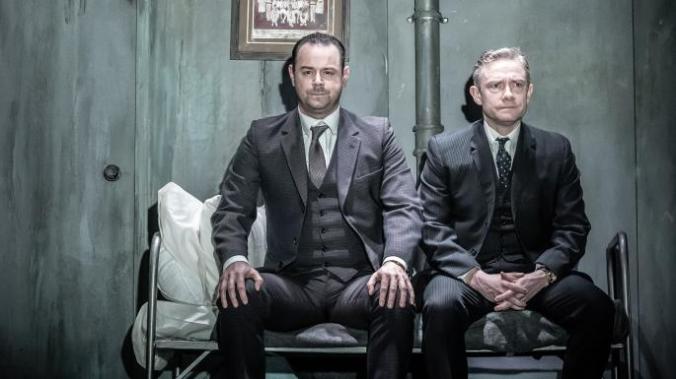
The Dumb Waiter is a simpler play, but devastatingly effective. It has a star cast pairing Martin Freeman and Danny Dyer as the two hitmen, waiting for instructions in the basement of a Birmingham restaurant. The casting is by no means for effect: both are absolutely right for their roles. Freeman plays Gus, the junior, nervier partner who asks a lot of questions. Dyer plays Ben, in charge but not necessarily in control. The play is a masterclass in the banality of evil, the carefully honed talk of ‘The Villa’ and ‘The Spurs’ mixing with moments of utter horror (“What a mess! They don’t hold together so well do they, women.”) Dyer plays the wannabe gangster to great effect. He has the aggression, all the poses, the neck-twitching muscularity, and his every move reveals that he is not convincing himself. Freeman is full of friendly chatter, rising panic and reasonable concerns, the kind you should definitely not be raising if you are a hitman. There are moments of genuine comedy, as the dumb waiter spits out increasingly impractical food order, and the cast tread a delicate line between tension, absurdity and the ordinary as everyone, on stage and off, gropes their way forward in the dark.
 

When We Have Sufficiently Tortured Each Other

1_4Photo by Stephen Cummiskey

When We Have Sufficiently Tortured Each Other by Martin Crimp – National Theatre (Dorfman), London

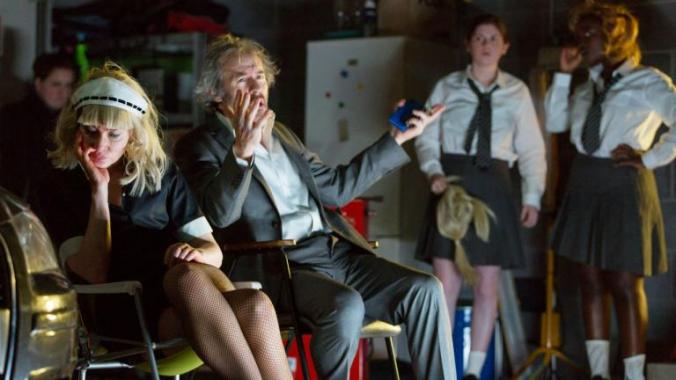
The publicity for Martin Crimp’s new play, gleefully stoked by the National Theatre, has been all about Cate Blanchett and ‘bondage’ scenes. With the chance to even book available only to winners of a ballot, it is not clear why the theatre felt it needed to brief the press about fainting audience members. This approach, and the surrounding tumescent excitement, reminiscent of the male critic-drive fuss around Nicole Kidman’s appearance in Blue Room in the 1990s, sells the performers short. It also builds expectations to unsustainable levels for what is an intriguing, but strangely disconnected and piece.

Katie Mitchell’s staging takes places in a garage, stunningly realised by Vicki Mortimer: not an elegant garage, but an entirely ordinary breeze-block and fibreboard carport, with an interior door leading to somewhere we never see. There’s an Audi parked up on stage, the setting for a number of scenes. The main performers are Blanchett and Stephen Dillane, performing twelve episodes in the coercive/consensual relationship between the unnamed pair. Nominally based on Samuel Richardson’s 18th century novel Pamela – in which a squire attempts to rape his teenage maid and eventually ‘rewards her virtue’ by marrying her – Crimp’s play seems intended to test the boundaries of what can and can’t be said and done between a man and a woman. It is all about roles, as the pair act out their relationship in front of an onstage audience – modern-day servants, who get involved in the action. They also frequently swap roles, with Blanchett playing the man and Dillane the woman. Meanwhile, the entire scenario is a performance of an unspecified kind – the garage setting is never referred to or explained.

Crimp writes in a manner rarely seen on the 21st century British stage, his formal, stylised scenes more reminiscent of Howard Barker or Edward Bond than the realism that dominates contemporary drama. While his style can often be refreshing and exciting, When We Have Sufficiently Tortured One Another falls short of his best work. Despite excellent performances from the two fine leads and the supporting cast, especially Jessica Gunning as the unexpectedly sexually confident housekeeper, it is hard to take the play seriously. The relationship between Blanchett and Dillane seems strangely old-fashioned, much more like a parody of 1970s gender roles than anything that relates to a recognisable present. A sub-strand, in which Blanchett gets what she wants from the handyman and bit-of-rough, plays like a Lady Chatterley spoof. It would  be a mistake to take the play entirely seriously in any case, and it is at its best when sliding into absurdist humour. The climactic (in both senses) scenes, involving a series of vigorous sex acts, including Cate Blanchett in an dildo from an Aubrey Beardsley drawing, are hilarious, taking on an around the Audi while the cast simultaneously delivers formal, explanatory speeches about their roles. But, although the comedy is beautifully delivered, Crimp’s testing of the boundaries, and exploration of what we would do if we were free from the constraints of gender-based expectation, has little to offer beyond the entertainment of seeing skilled performers at the top of their games.

Kompromat

kompromat.jpg

Kompromat by David Thame – Vault Festival, London

David Thame’s two-man show, which premieres at the Vault Festival, presents a naggingly familiar scenario. A young, brilliant, naive mathematician lives alone in a London flat, looking for sex and company in gay clubs. But he has just moved from Cheltenham, an instant giveaway that he is a secret services cryptographer at GCHQ, transferred to MI6 and a target for anyone who wants to know about his work. When he takes a gorgeous young man – a ‘9’ – back to his flat, and tells him about his work in quantum computing he is already doomed.

Kompromat is a fictionalised version of the spy-in-a-bag story, the unexplained death of an M16 cryptographer found dead in a North Face bag in his Pimlico flat in 2010. The key feature of the case is that, despite the bizarre, highly publicised, circumstances no-one actually knows what happens, except presumably those who will never tell. Thame fills the huge gap at the heart of the story by telling it from the perspective of Zac (Max Rinehart), the club pick-up responsible for the death of Tom (Guy Warren-Thomas), the Williams character now lying dead on his sofa. With powerful economy, Thame spins a backstory of a shady network of Hungarian operatives, led by Zac’s ‘daddy’ Janos who keeps in a Budapest mansion, gives him presents for sex and keeps him on hand to deal with problems, such as Williams. The latter is up from the country, insecure, foolish and easy prey for smooth, ruthless operators linked, somewhat vaguely, to Russians and oligarchs.

The play is well-structured, with scenes recounting the evening leading to Tom’s death interspersed with reflection from Zac on his sinister situation and occupation. The story is engaging told, and characters are strong. However, the play is also problematic, a fiction that theorises  the tragic death of a young man whose family have never received a credible explanation. Without a detailed knowledge of the case, which is a web of misinformation, it is hard to know whether Kompromat sheds light on what happened, or simply redeploys elements of the story for dramatic effect. Certainly some aspects – the central role played by Hungarians, for example – beg more questions that they answer. The use of quantum computing – Tom’s speciality – as an human relationship metaphor – also lacks originality and seems tenuous. Thame has created a neat drama, but its explicit relationship to such a complex story, with real consequences for people who are very much alive, leaves a lingering sense that this speculative play allows the writer both to have his cake and to eat it.

Antony and Cleopatra

image

Image copyright Johan Persson

Antony and Cleopatra by William Shakespeare – National Theatre (Olivier), London

Antony and Cleopatra is a tough play to stage. It demands a great deal of the audience, often keeping them at arm’s length from the frequently frustrating main characters, and with a strange change of pace from a decade-leaping first half to a minute-by-minute second half. It succeeds or fails with its leads. Cleopatra is the biggest woman’s role in Shakespeare and Mark Antony has more lines than King Lear, Macbeth, Henry V or Richard II. Fortunately, the National Theatre’s production has cast the leads to perfection, and it is hard to imagine a better account of this strange play.

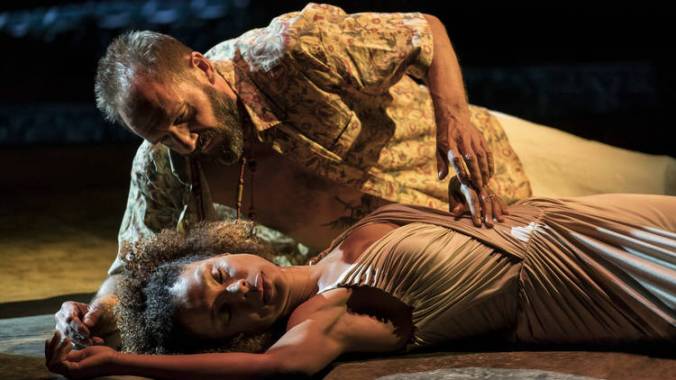
Ralph Fiennes could have been born to play Antony. His general is an aging hipster, used to gliding through life on his charm. When we meet him, he is just too old to get away with that any more, although he is still wearing the open shirts and ludicrous trousers. The exquisitely awkward capers and weird dramatic handshakes that form part of his public performance diminish him, and it is clear he is doomed from the start, although he has no idea. His self-regard, and emotional manipulation of those around him means he is simply unable to see reality outside of himself. In this he is matched only by Cleopatra, who he deserves as she deserves him. Emotional manipulation is her only weapon, but in Sophie Okonedo’s performance her charm, undeniable and hard to resist, but she has a child-like, damaged aspect too. Alone in her palace with no-one but Iras and Charmian, Okonedo seems even less moored to reality than Antony. Her final gesture, pretending to be dead, is an appalling thing to do and only Antony would see it in any other way. The two are consummate performers, but their only audience is themselves and one another.

Antony and Cleopatra is a play about the gap between the legend and the reality. Fiennes and Okonedo give triumphant peformances, utterly convincing as people who believe their own press. The only hope for them is to launch their immortality through death. The grim sequence of events as Antony tries to outsource his suicide, then botches it, and then spends his final moments being hauled up on an Ancient Egyptian winch, are painful and absurd to watch. Cleopatra, alone with her handmaids, makes a better end – with an excellent snake – surely it can’t be real? It is real! –  but the production highlights the futility of their deaths, as Caesar instantly repackages events, standing over their bodies as he uses them to secure himself in power.

Simon Godwin’s production makes excellent use of the Olivier’s expanses, the perfect theatre for this epic. Hildegard Bechtler’s sets are stunning, with hotel Deco opulence, an on-stage pool and a submarine (Pompey’s galley) that rises monumentally from the revolve. The cast is something of a National Theatre classic line-up. Tim McMullan, singled out by Nicholas Hytner in his memoirs as the fulcrum for his time at the NT, is a highly likeable Enobarbus. Katy Stephens is, as always, excellent as the gender-swapped Agrippa, a clever move from the director that opens up hints of a relationship with Enobarbus. Tunji Kasim is both calculating and involved as Caesar, while Nicholas Le Prevost is an ideal stumbling Lepidus. The production, opulent and uncompromising, is the sort of showcase the National Theatre produces better than any other theatre.


Outlying Islands

o3_w9p-d.jpeg

Image courtesy Timothy Kelly

Outlying Islands by David Grieg – King’s Head Theatre, London

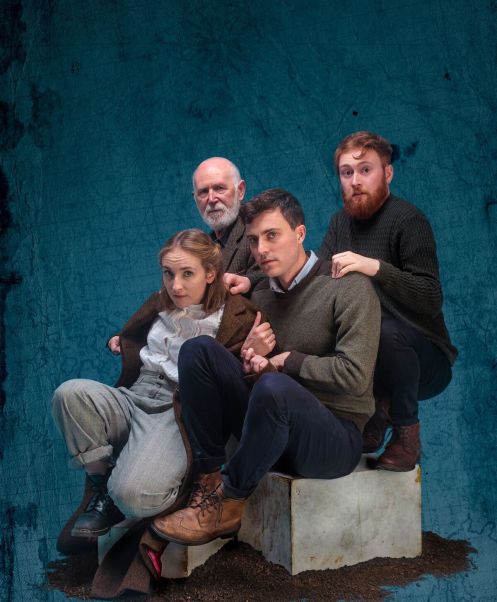
The revival of David Grieg’s 2002 play, Outlying Islands, at the King’s Head Theatre reintroduces a play of wonderful, haunting poetry and complexity, a flawed but brilliant piece of writing. Set in 1939, it features two ornithologists ‘from the Ministry’ arriving on a remote, abandoned Scottish islands to survey the bird population. Robert is confident, charming and somewhat pathological in his obsession with scientific observation, of humans as well as birds. John is Scottish, nervous and hidebound. They are rowed over the island’s owner, Kirk, a grey-bearded Presbyterian with a hatred of sin and cinemas and his niece Ellen, who at first seems shyer than all of them. This is a fictionalised Gruinard, the Western Isle contaminated with anthrax during World War Two experiments, and left uninhabitable for fifty years, and the scientists are there to survey the birds which are soon to be wiped out, along with all other signs of life.

Most writers would stick to that story, but Grieg is a subtle an unpredictable playwright. Over the course of a full length play, he spins out unexpected events, family drama and relationship tension among the four, living alone in wild conditions. Back on shore the world is gearing up for war, but the island sits apart. The play is set in ‘the chapel’, a single room hut with nothing but a stove, broken door and a table, the only piece of furniture on the island – recreated with conviction by designer Anna Lewis. But Kirk says it is a pagan place, and its people are best gone. Far from civilisation, the four remain until the boat returns for them in a month’s time. Perhaps they have a chance to live more like the birds Robert and John photograph everyday, who let the wind take them. But they are recording what lives on the island precisely so it can be destroyed.

Jessica Lazar’s production is an excellent, enthralling account of a fascinating play. The intensity of the four performers shines through on the King’s Head’s tiny stage. Ken Drury as Kirk is both bullying and comic, darkly describing Edinburgh as a place of “random defecation”. Jack McMillan as John is a mass of inhibitions, which makes his final attempts to open up particularly moving. Tom Machell is mercurial and idealistic as Robert, wordly but unable to square the contradictions between the natural and human codes of being. And Rose Wardlaw as Ellen gives the most surprising performance of all, physically unfurling as she frees herself from the burdens of social and sexual expectations. Grieg gives her two remarkable speeches, one in which she describes spying on one of the men, masturbating on the cliffs, and another in which she recounts the legend of the island’s creation by a giantess, scattering sheep droppings from her apron pockets as the Western Isles form.

Outlying Islands is difficult to classify, containing elements of political thriller, an Ealing comedy, folk horror, a coming of age story, a war story, a documentary about the limits of human existence, and a utopian island experiment. This is its strength, and Grieg’s confidence as a writer shines through. The play reminds us of other genres but is simply itself. The King’s Head should be congratulated for a powerful, engrossing production of a modern classic that lodges itself in the mind, sending us into the Islington night to dream of a world where we could take wing.

The War of the Worlds

010819TOR788NDTRHUMWotWProductionJPEG007.JPGImage: Dee McCourt (Borkowski Arts)

The War of the Worlds written by Isley Lynn, devised by the Company – New Diorama Theatre, London

Published on the Quietus website

“No one would have believed in the last years of the nineteenth century that this world was being watched keenly and closely by intelligences greater than man’s…” Everyone knows The War of Worlds, but what is it that they know? Is it H.G. Wells original 1898 book? Is it the 1978 Jeff Wayne musical, narrated by the great Richard Burton? Either of the two film adaptations perhaps, in 1953 and 2005, the latter by Steven Spielberg. Or is it the infamous Orson Welles radio dramatisation, broadcast in the US on 30 October, 1937?

Rhum and Clay take the latter as a starting point for their examination of our era of disinformation and fake news. The Welles broadcast quickly gained a legendary status with only tenuous links to reality. Supposedly, many Americans were fooled by the documentary nature of the drama, which featured interviews with correspondents in the field that cut out suddenly as the Martians descended with their heat rays. A mass panic is said to have ensued, with people fleeing the alien invaders along the East Coast, believing a real alien invasion was underway. 

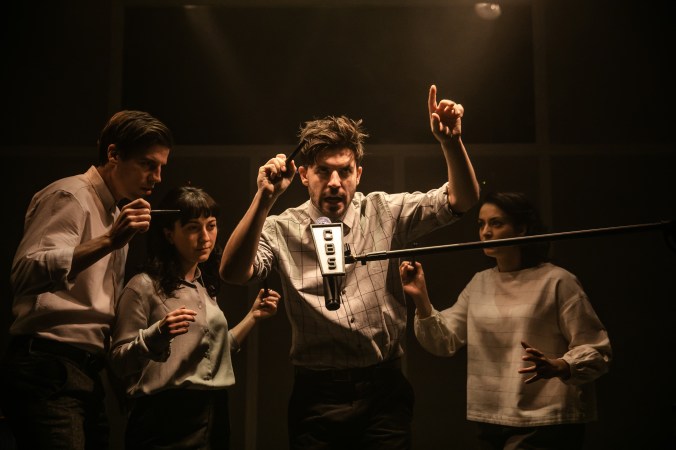
Set in a radio studio, Rhum and Clay’s The War of the Worlds begins with a recreation of Welles’ broadcast featuring four pipe-wielding Orsons. The dramatic techniques he used – interrupting music programmes for news flashes, puzzlement and confusion overtaking the presenters as events appear to spiral out of control – are surprisingly effective. But can they really have had the impact reported in urban lore? The radio was relatively new, the most powerful communication medium in the world, but how can a box sitting in the corner of the living room, pumping out stories have such an impact on real lives? A clear metaphor for the impact of the internet on our era, the evolution of War of the Worlds from pioneering sci fi novel to nebulous truth was new then, but is now the kind of story we hear every day.

Isley Lynn’s script introduces a modern storyline, a young woman (Meena) who seizes on her neighbour John’s family drama as an excuse to make a podcast, and travels to the fictional Martian landing site at Grover’s Mill, New Jersey, to investigate. The town, visited by Rhum & Clay’s Julian Spooner for the show, has become a cynical, tourist-themed attraction with alleged ‘attractions’ and a War of the Worlds Diner, where jaded staff offer a ‘death ray’ experience. The fiction has become reality, with an eerie smoothness, casting a malign influence magnified by the many layers of myth-making that have intervened in the 80 years since Welles. 

The show moves to 2016, during the US election campaign. Meena investigates the story that John’s grandmother was abandoned by her parents, who fled after the Welles’ broadcast, choosing her sister over her. She is drawn into a small, tense family of John’s relatives, whose vaping, socially awkward son Jonathan writes fake news in his bedroom that is fuelling the Trump campaign. He sees no moral difficulty in inventing the stories he posts, claiming to respond directly to demand by providing what the public wants: lizard people, and Hilary meeting paedophiles. He says “It’s not my job to stop giving them what they want. It’s their job to stop wanting it.”

 The War of the Worlds is staged with energy and verve, and its four performers keep the audience constantly engaged. The set – sound-proofed studio walls, with the lighting control box visible throughout where the studio control room would be – is simple, but well-suited to the physical inventiveness on display. Rhum and Clay’s artistic directors Matthew Wells and Julian Spooner play the male parts, and engage in occasional scene stealing, including as a pair of bottom-sniffing dogs belonging to a lady in a Grover’s Mill park. The female roles belong to Mona Goodwin and Amalia Vitale, whose joint impersonation of two panicked citizens trying to buy poison pills ahead of the Martian landing before settling for getting drunk instead, is a mini-highlight. 

It is hard to fault the performers, who switch between an impressive, sometimes dazzling range of characters, eras and settings with apparent ease. However, the 2016 storyline seems contrived. Meena’s character provides an opportunity for a dig at entitled amateur journalists, and her attempts to record a cliffhanging, Serial-esque podcast are both funny and a strong reflection on how access to universal broadcasting has made the issues first highlighted by the reaction to Welles’ broadcast the world’s number one cultural concern. However, she is too much of caricature to carry the family drama that unreels towards the end of the evening. Similarly, Jonathan is a type who illustrates the fascinating and disturbing fake news phenomenon, but it is hard to care that much about his relationship with his parents. 

Amalia Vitale, playing his mother Lawson, has the most developed character, and is able to make the most of it – a believable New Jersey mother who switches between hospitable to hard-nosed to vulnerable within a few lines. Her performance is particularly impressive. The War of the Worlds though, does not quite pull it off and loses its way as it tries to wrap up both drama and argument. The ending, with lost family members reconnecting on Skype, veers into triteness which is a shame, because the rest of the show has been thought through on a deeper level. Rhum & Clay have deep reserves of talent and imagination, and their work is always worth watching. The War of the Worlds is a flawed but intriguing show, lacking coherence but full of invention. The endurance of the myth unleashed by Welles in 1937, showing clearly how the truth does not matter, only the story. The show’s final line, “Are you recording me?”, could be a motto for our crackpot, soapbox times.

Richard II

the-tragedy-of-king-richard-the-second.-simon-russell-beale-and-leo-bill.-photo-credit-marc-brenner-101-700x455Simon Russell Beale and Leo Bill. Photo: Marc Brenner
Richard II by William Shakespeare – Almeida Theatre, London

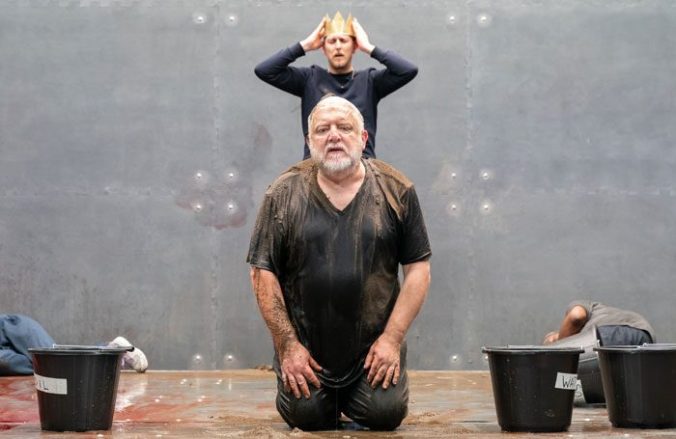
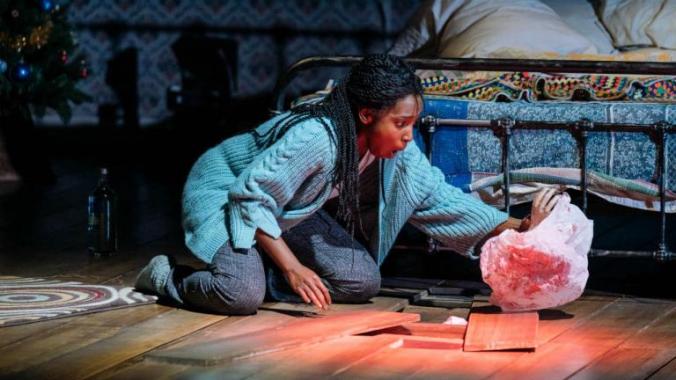
As a radical rethinker of the classics, Joe Hill-Gibbins’ reputation continues to rise. Having made his name at the Young Vic with unforgettable versions of The Changeling, Measure for Measure and A Midsummer Night’s Dream in highly effective, abstract settings, he is now paired with Britain’s foremost classical actor, Simon Russell Beale, for his first outing at the Almeida. He does not disappoint, staging a cut-back version of Richard II in a galvanised steel box. His production exposes the combination of visceral brutality and the Beckettian introspection that, conventionally, emerges gradually from behind the play’s veil of pomp and finery. The production is inherently divisive, and the critics have obliged but, only three days into the year, it is very hard to imagine a more exciting or compelling Shakespeare coming along in 2019.

Simon Russell Beale can play what he wants where he pleases, so it is to his credit that he chooses to work with a young director with such a powerful vision. He has never played Richard and is older than the standard casting, but his performance is a treat well worth the wait. Up close, the subtlety of his acting – every flick of the hand, every twitch of the eyelid serving a purpose – is spellbinding, and his verse speaking, as always, makes the lines seem entirely fresh. Hill-Gibbins begins the play with the prison soliloquy – “I have been studying how I may compare / This prison where I live to the world” – and repeats it in its proper place. Russell Beale presents the two versions, delivered as prologue and again in the thick of degradation and despair, with entirely different emphasis. Second time around, after a chaotic and destructive power struggle, his conclusion that “Nor I nor any man that but man is / With nothing shall be pleased, till he be eased / With being nothing” does not carry the conviction that he will come to terms with his fate. It is a masterful study in analysis and delivery.

This cut and reordered text is the jumping off point for a stripped back production that throws expectations out of the window, removing the play from its specific time and politics, and placing all the focus on the destructive rivalry that pulls apart a political elite. The set, by Ultz, is a box equipped with buckets of the most basic substances – water, soil and blood – which are emptied, one by one, over the protagonists. The lighting is almost entirely provided by a strip light roof panel, and the only music is an insistent clock-like ticking. The entire cast of eight are on stage throughout, a group huddled in a corner or, crouching in despair mid-stage as the performance continues around them. The stage is a cage, trapping everyone in an impossible cycle of ritualised violence, culminating in the glove-throwing scene in which everyone challenges everyone else, an episode that is both ludicrous and charged with violence.

Hill-Gibbins has a knack for identifying much-loved but somewhat underrated performers, and the casting in Richard II is a excellent example of this. Leo Bill’s Bolingbroke is not the usual menacing, confident presence but a skittery, upper-class twit, well out of his depth as the kingdom divides around him even before his coronation is complete. Joseph Mydell’s Gaunt gasps accusatory poetry. Multiple roles are persuasively and subtly played by John Mackay, Saskia Reeves, Robin Weaver, Natalie Klamar and Martins Imhangbe. Gender-blind casting has been dismissed as ‘fashionable’, but an approach that puts fine actors such as Reeves, Weaver and Klamar at the heart of male-dominated drama is far more significant than that. It adds an essential depth to our classical theatre, and is driving a significant cultural renewal.

Played with no interval and a running time of 100 minutes, the intricacy and context of the play’s politics are inevitably lost. However, this is a price worth paying for such a thrilling production. The audience hangs on every word and Hill-Gibbins’ conceptual approach pays off, as the confusion between multiple nobles and plots becomes part of a spiral into disaster that drags everyone down. The universal destruction wrought by weak, power-hungry leaders in this play has never been shown more starkly. The clarity and confidence of this production makes it a must-see, and puts down a marker that promise an increasingly exciting future for this director and for the plays he lays his bold hands on.

The Tell-Tale Heart

tamara_lawrance_in_the_tell-tale_heart_photo_by_manuel_harlanTamara Lawrance –  photo by Manuel Harlan
The Tell-Tale Heart by Anthony Neilson from Edgar Allan Poe – National Theatre (Dorfman), London

Edgar Allan Poe’s classic story, about a man who, driven mad by the ‘vulture eye’ of the old man he lives with, murders him and is pursued by the beating of his heart, buried under the floorboards, is a deeply Gothic tale. Anthony Neilson adaptation for the National Theatre updates the original, adding slasher film shocks while retaining the intense strangeness of the original. The narrator is now a woman, Tamara Lawrence’s blocked playwright, who retreats to an attic studio to write an overdue play for the National. Her landlady is a socially awkward Imogen Doel. The two bond over vodka and pizza as The Writer seizes any displacement opportunity to distract from her empty pages. Then she makes the mistake of asking The Landlady to remove her eye patch. The terrifying sight of a vast, swollen eye eat away at her sanity.

But this is just the start, as Neilson weaves in unreliable narration and enfolding narratives that lead to a series of reveals that revel in their absurdity. The figure of The Detective, played by David Carlyle intervenes, investigating Doel’s dissappearance, as the chronology slips forward and back, leaving us to reassess our assumptions about what is real. The play is staged with a design that, in the hands of Francis O’Connor, keeps the audience jumpy, from the simple expedient of putting up the house lights to showers of eyeballs, spectres reflected in the huge attic rooflights and a bathroom that becomes suddenly transparent, revealing its terrifying contents. The three performers clearly enjoy roles that allow all of them to keep us guessing as to who they really are.

Neilson’s writing is smooth and convincing, and he is confident enough to include moments of sheer silliness, including a knowing dig at the current West End production of ‘Company.’ His direction produces a slick and original entertainment, and revels in the physical nature of Poe’s horror. From unflushed toilets to gruesome eyeball sound effects, bags of body parts and an unnerving obsession with hard boiled eggs, there is not shortage of gasp-inducing moments. While it does not pretend to be anything other than a great deal of fun, as an alternative Christmas entertainment ‘A Tell-Tale Heart’ delivers just what is needed at this time of year: shock, revulsion, and the kind of gleefully disturbing images that will stay in your head for much longer than you would like.

Alice and Bob’s Whopping Christmas Cracker Show/Party

Pegasus-Theatre-Oxford-on-stage

Alice and Bob’s Whopping Christmas Cracker Show/Party – Pegasus Theatre, Oxford

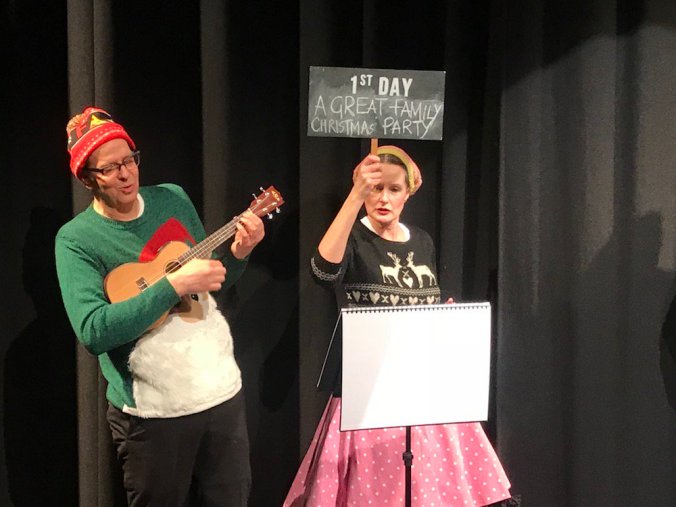
A party is getting underway at the Pegasus Theatre in Oxford. We are greeted as long-lost family by ‘Cousin Alice’ and ‘Cousin Bob’, who seem to know everyone. The family gets together every Christmas, apparently, with an evening full of festive traditions to enjoy, from the Christmas Carol-aoke to the annual family argument. Alice and Bob insist they are twins, although one seems to be English and the other Canadian, and they keep getting confused about who is who. Not everything is what it seems, but the two of them know how to throw a party.

Alice and Bob’s Whopping Christmas Cracker Show is a highly enjoyable children’s entertainment, with something going on for everyone. The two performers, engaging, eccentric and fizzing with energy, lead the audience willing through irresistibly silly activities wound around a story of a Christmas tree and a robin which delivers classic festive food for thought about helping people left on the margins. The fun includes a version of The Twelve Days of Christmas that promises to make all the audience’s Christmas wishes, from world peace to a guinea pig, come true as long as we can remember what order they come in. The seasonal family argument involves two turtle doves who wind each other up something rotten. A cathartic wrapping paper fight reveals how strangely satisfying it is to throw balls of paper at your friend in the next seat, from point blank range. Bob wears a fine Christmas tree costume, and Alice’s London-toned robin is chippy as well as chirpy.

The evening packs plenty in, skillfully combining traditional storytelling with inspired clowning, delivering a show with an alternative edge that keeps all ages entertained without a patronising moment. It’s all about the audience though, as Bob and Alice clearly relish the interaction. Their improvisation gives the evening a delightful level of unpredictability. With two highly talented performers in charge, it’s a pleasure to sit back and let them take us wherever their fertile imaginations are headed. Their deceptively simple work guarantees a fine time for all.