The Box of Delights

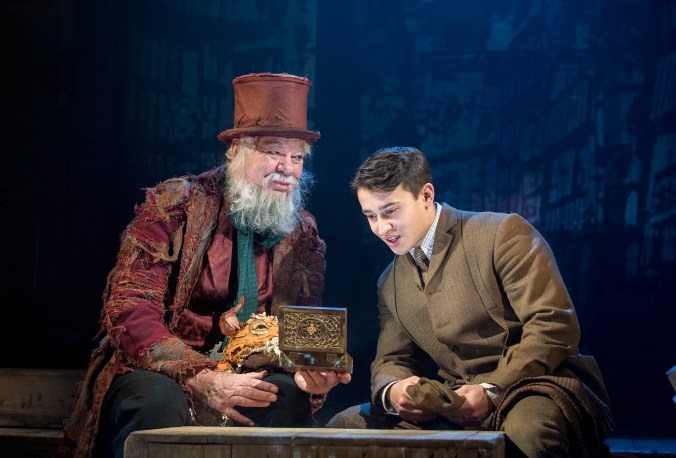
EA59BB22-0DA2-71CA-21637AC5DC0B3997Matthew Kelly and Alistair Toovey. Image by Alastair Muir.

The Box of Delights by Piers Torday /  John Masefield – Wilton’s Music Hall, London

The Christmas combination of Wilton’s Music Hall and the Box of Delights is pretty much perfect. Wilton’s is perhaps the most atmospheric theatre in the country, a miraculously preserved jewel box of a space, fringed with flaked plaster and precariously supported on barley sugar columns. The Box of Delights, John Masefield’s 1938 children’s classic, is a book about a jewel box, which turns out to contain rather more than gems. It is also set in the snowy run-up to Christmas.

It is amazing no-one has thought of staging The Box of Delights before, but they apparently never have. The books is both influential and intensely atmospheric, brimming with childhood adventure and deep magic, threats from the dark that can only be thwarted by Kay Harkins, back from school for the holidays. Best known in its 1984 BBC television adaptation, the book remains somewhat overlooked (although not as much as its prequel, The Midnight Folk). Justin Audibert’s direction emphasises the unique combination of ancient and modern that defines the book – medieval philosophers, witchcraft and the elixir of life mingle with machine guns, kidnapping and a futuristic flying car. Everything is cleverly rooted in Tom Piper’s set of stacked, dust-sheeted wardrobes hidden, like the landscape, under a heavy fall of snow. As events unfold, the sheets are lifted and characters appear and disappear through closet doors, Narnia-style portals to locations in other times and places.

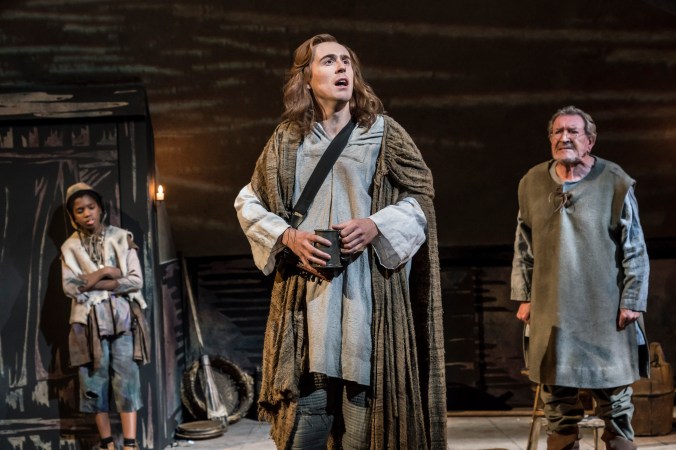
The guardian of the box is Merlin-like Punch and Judy man Cole Hawlings, played by Matthew Kelly. Cunningly, he is also cast as Abner Brown, the evil genius with more than a hint of Aleister Crowley. Both performances are of the high quality Kelly always delivers, but the play does not depend on him. The forces of the dark also include witch-about-town Mrs Pouncer, played with requisite poise by Josefina Gabrielle, and her jewel thief accomplice, a “What Ho!-ing” Tom Kanji. Ranged against them are Kay, onstage throughout in various sizes, played well by Alistair Toovey, and his friends, the adventure averse Peter (Samuel Simmonds) and his sister Maria. The latter, a highly volatile Safiyya Ingar, is the book and the play’s best character, obsessed with gangsters and machine guns, and an absolute determination to cause trouble. If Masefield hadn’t got there first, a modern production might have felt the need to invent her to create a reasonable gender balance. As it is, one of the pleasures of The Box of Delights is that its two most charismatic, fearsome figures are female.

The tonal contrasts in Masefield’s book keep the reader guessing, and place it on a pivot between modern England and the endless expanses of the past. The stage version is adapted by Piers Torday and remains faithful, for the most part, to the distinctive feel of the book. Torday retains enough of the 1930’s children’s slang to enliven the scenes with Kay, Maria and Peter, and sensibly slims the characters without sacrificing atmosphere. He does, disappointingly, feel the need to introduce a more emotional backstory, reminiscent of Harry Potter, for Kay, and a simplified, Disney-esque quest theme to “Save Christmas”. It is not clear why such original material needs to be made less distinctive to appeal to modern audiences, and it is rarely children who demand more conventional story lines. However, the writing rolls along nicely for most of the evening. Audibert’s entertaining staging brings a daunting range of magic and drama to life. Cole Hawling’s dog and the miniaturised Kay are puppets, and trains and flying cars models on sticks. The slapstick elements – such as the ‘scrobbling’ of the entire Tatchester Cathedral choir, one by one – is gleefully played out, and a reservoir deluge becomes a vast sheet of blue silk.

The Box of Delights is a mesmerising evening of magic and tricks, holding the attention of children and adults with ease and Wilton’s is the perfect setting. The 1930s setting is both nostalgic – buttered eggs for tea and a posset before bed – and unsettling, as it should be. The programme authors should read the book more carefully though: the posset recipe they include is for a lemon dessert, not the same thing as “ a jorum of hot milk; and in that hot milk, Master Kay, you put a hegg, and you put a spoonful of treacle, and you put a grating of nutmeg, and you stir ’em well up, and you get into bed and then you take ’em down hot. And a posset like that, taken overnight will make a new man of you!

The Twilight Zone

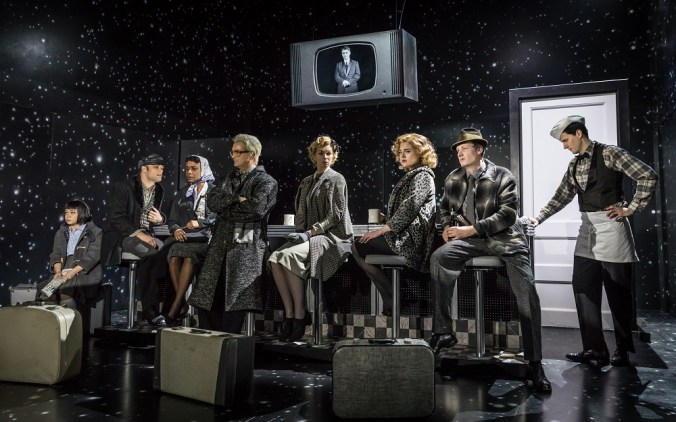
The Twilight Zone. Photo credit Marc Brenner (2).jpgThe Twilight Zone cast – photo by Marc Brenner
The Twilight Zone by Anne Washburn – Almeida Theatre, London

On the surface, the rationale for staging an adaptation of selected stories from hokey 1950s US TV phenomenon, The Twilight Zone, may seem murky. In practice, Anne Washburn’s version for the Almeida, following her Simpsons-based show Mr Burns , is a sharp tribute, recreating both the creakiness and the prescience of the original show. Directed by Richard Jones, best known for his operas, the evening uses eight of the original episodes, weaving them together as shorter pieces and long themes in the style of musical theatre. The action is tightly choreographed, with the nine-strong cast playing multiple characters in a black and white world, wearing black and white costumes and performing in black box speckled with white stars and occasionally, on a television set.

The Twilight Zone has much greater cultural presence in the US. Over here we know the theme and not much more, but there its most best episodes are famous. The material chosen by Washburn soon shows just how influential its ideas have become. Aliens land, government agents lurk, parallel dimensions open up beneath beds, sinister little girls appear in corridors and dreams become reality. Everything from Tales of the Unexpected to Doctor Who owes a debt. Washburn deftly mixes the tales, opening with a bus-load of passengers stranded in a diner on a snowy night, and a policeman tracking the occupant of a mysterious craft that has crash-landed nearby. The scenario is spooky Agatha Christie spiked with hokey comedy in a blend that brings the 1950s straight back to life. The first half of the show concerns aliens and strange dimensions, with inexplicable happenings in the safety of family homes and down-home bars that break through a porous barrier between reality and fantasy. It is creepy but comforting. After the interval the darkness turns up a notch, as man struggles to stay awake to avoid dying in his dreams, and becomes genuinely touching with a love-struck couple who try to put their relationship in cryogenic suspensions for a fifty-year space voyage. The finale is an extended story about the racial and social meltdown of American society in the face of a nuclear attack, as everyone says a lot of things they regret in their struggle for a place in the only shelter in a suburban street.

This complex array of short stories is expertly delivered by a fine ensemble. John Marquez ranges from hard-bitten New Yoyker with a thousand yard stare to the show’s narrator, delivering monologues to camera with an authentic lack of dramatic timing. Adrianna Bertola gives us not one but two sinister little girls. Oliver Alvin-Wilson does a baffled bus driver, a stoic physicist probing child-swallowing black holes and a psychiatrist faced with the impossible. Lizzy Connolly is a vampish torch singer from a nightmare, with a musical number of her own. Cosmo Jarvis is a bystander with an infuriating laugh, and a test pilot whose crew may not be real.

Richard Jones oversees a beautifully-staged piece of theatre. Paul Steinberg’s set gives us whirling cardboard spirals and men in star-strewn black. Mimi Jordan Sherin gives the cast highly convincing, raking black and white TV lighting. Two illusionists, Richard Wiseman and Will Houston, change newspaper headlines before our eyes and make cigarettes mysteriously appear in characters hands as they find themselves temporarily possessed by the narrator’s persona. “But I don’t even smoke!” they exclaim. As seasonal entertainment, The Twilight Zone is clever and classy, but it does more than that. Washburn’s selection of stories shows how the fragile post-war US social settlement pulled at the seams, threatening to come spectacularly apart, as it does again in the Trump era.

Titus Andronicus

www.curzoncinemas.comDavid Troughton in Titus Andronicus

Titus Andronicus by William Shakespeare – Barbican Theatre, London

Titus Andronicus, once a real rarity in the Shakespearian oeuvre, has been seen four times at Stratford this century. Its unhinged excesses – 15 bodies piling up, mostly on-stage, along with four heads, three hands and a tongue – are now more familiar and more actors are testing their skills in its strange array of roles. Blanche McIntyre’s production, transferred to the Barbican as part of the RSC’s Rome MMXVII season, features a fine performance from David Troughton in the title role. His performance as Titus, intensely watchable, is wracked with grief and both real and staged insanity. A mad martinet of a general, who seems to take pleasure in the sacrifice of 21 sons in the service of Rome and coldly kills another who disobeys, he understands true grief only when two more sons are executed.

The play is about war and loss, and its events show how conflict cannot be walled off but spills over into everyone lives. Titus’s apparently victorious campaign against the Goths turns out not be over, and follows him back to consume almost his entire family. At the same time, Rome is a sick civilisation in which democracy serves the egos of self-obsessed rulers epitomised by Martin Hutson’s sneering Emperor Saturnius. Titus concerns a fictionalised Rome, so translating it to here and now as a nation-in-a-state play brings clear Trump era parallels, although the choreographed prelude involving protestors and riot police is standard-issue RSC staging. The set also features, oddly, balconies on either side set up for an absent orchestra, as though a previous show couldn’t clear out in time.

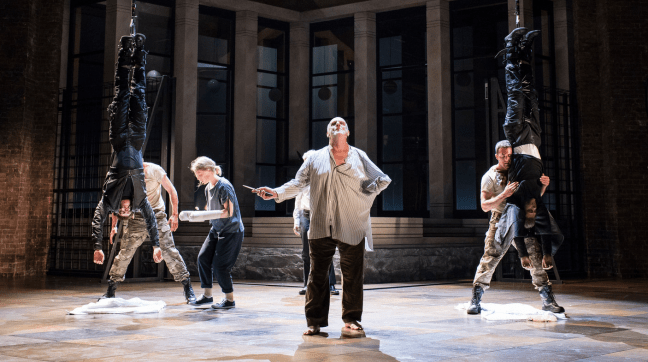
Many other aspects of MacIntyre’s staging are very effective though, in a play that betrays the callow Shakespeare lack of experience through its chaotic plot and use of highly un-theatrical devices such as a deep, dark pit. Troughton feigns madness from inside a large cardboard box, possibly a nod to Ridiculusmus’ box-based show about PTSD, Give Me Your Love. The notoriously gory scenes of mutilation are presented with a well-judged balance of humour and horror, the pièce de resistance surely being the murder of Goth Queen Tamara’s two sons, Chiron and Demetrius, hung by their feet from the ceiling as their throats are slit and their blood drained into a basin.

Beyond Troughton, several performers stand out in play which offers an entertaining selection of parts. Revenging nihilist Aaron is played by Stefan Adegbola as distressingly calm, while whipping up the madness and engineering the violent deaths of much of the cast. Nia Gwynne, brutally treated and then sexually claimed by Saturnius, is as much a victim as an instigator. Hannah Morrish as Lavinia makes a startling transition from smug, privileged daughter to mute avenger.

Titus Andronicus is not a work of genius, but neither is it the crude, valueless play it was seen as for so long. It excesses seem much more familiar in a post-Sarah Kane world, and its challenge to the audience remains strong. Anything that remains this confrontational after so long is worth examination, and this production makes for a disturbing, memorable evening.


St. George and the Dragon

79C57CCD-B995-2EF3-A59E84D577EBFC90John Heffernan as St. George. Image by Johan Persson
St. George and the Dragon by Rory Mullarkey – National Theatre (Olivier), London

British theatre is engaged in an urgent search for post-referendum state of the nation writing and, to its credit, the National Theatre is at the forefront. Rufus Norris’ 2017 season has proved highly controversial, with Michael Billington calling the relative absence of classics ‘a staggering dereliction of duty‘. While his piece is a serious over-reaction, it does reflects the unusual risk involved in staging experimental new plays in the vast Olivier auditorium. This is as much a financial as an artistic tightrope. Follies has been a huge success, but is also surely one of the NT’s most expensive shows, while DC Moore’s Common was a similarly risky new piece. With Rory Mullarkey’s St. George and the Dragon the most surprisingly choice for the Olivier yet, we must hope the NT’s finance department is on top of the situation. In the meantime, Mullarkey has written a larky piece of extended allegory that is both enjoyable and frustrating. It seems to have expanded to fill the space, becoming both surprisingly epic and unnecessarily long.

John Heffernan plays St. George in three different time periods. He shows up as a greenhorn knight in a medieval English village, slaying the enslaving dragon (Julian Bleach, having a great time) and bringing peace and liberty. Then he’s off to fight more dragons and, returning after only a year, finds time has slipped to the industrial revolution and the dragon is not only back but is now running the mills. Finally, after another absence he comes back to modern Britain where, the plays claims, the dragon is within us all and everything is much worse than it was the Middle Ages.

This pretty trite political thesis is the play’s main weakness. However, there are strengths too. The whole show is essentially a pantomime, inhabited by types – the maiden, the father, the miller, the cryer, the healer etc. – who play the same roles in each era. It has an afternoon television atmosphere, silly and enjoyable, but a neat line in clever staging. In fact Rae Smith’s set is a triumph – a tablecloth countryside dotted with model village buildings that spreads over the entire Olivier stage and back wall, and grow as time moves on. Lyndsey Turner’s production marshals the cast very to fill the space very effectively, and occupies the cavernous space overhead with amusingly home-made sky battles between knight and dragon.

John Heffernan is a perfect naive crusader, increasingly out of time and unable to keep up with 21st century drinking culture. Supporting characters, especially Gawn Grainger as the father and Amaka Okafor as Elsa, always about to be eaten by the dragon in one way or another, are strong. The writing is often funny, particularly when questioning the stereotypes of the St. George myth through the familiar out-of-time comic scenario. However, despite its appeal Mullarkey’s play is not nearly focused enough. It sets a leisurely pace but, in the end, cannot back up its allegorical approach with any real cultural and political insight. Nevertheless, there is no doubt we need as much state-of-the-nation drama as we can get in these confusing times. The National Theatre is the right place to see it – Norris needs to continue his search.

Albion

albion-reviewVictoria Hamilton as Audrey. Image by Marc Brenner

Albion by Mike Bartlett – Almeida Theatre, London

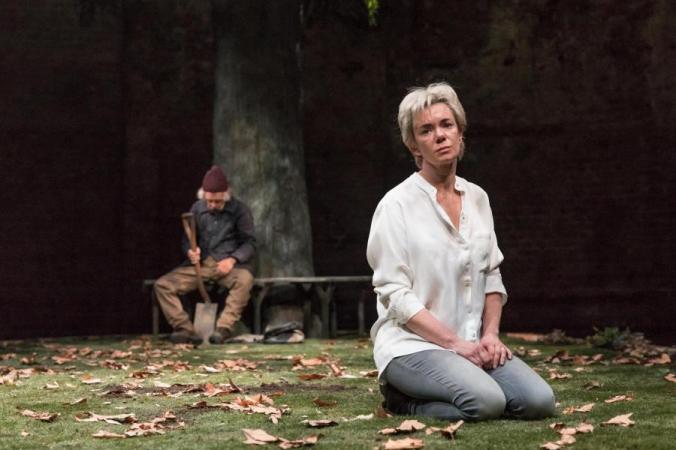
For Mike Bartlett’s new play Albion, the Almeida is almost in the round, the stage stretched into a long oval. Miriam Buether’s impressive set is a garden, with a lawn, a border and a full size mature tree looming at the back. Both title and set make it clear: England is a garden, and this particular garden is England. Bartlett’s three-hour state of the nation play draws out the defining preoccupations and dilemmas of our time through the domineering Audrey, a wealthy businesswoman abandoning London for the country and a garden restoration project after the death of her soldier son. There are parallels with The Seagull and Irina Arkadina, with a social order failing to locate its place in a changed world. Rupert Goold’s production throws everything at the play, with a fine cast and staging, but ultimately Bartlett’s play is too flawed to match these ambitions.

Albion has strong writing, intriguing characters and one barn-storming lead role. However, it is also flabby, predictable and clichéd so, despite its various strengths, it amounts to a frustrating evening. The star of the show is Victoria Hamilton, returning to the stage after several years away, who is worth the price of a ticket on her own. She holds the play together with a funny, powerful performance as Audrey Walters, a Conran-style entrepreneur who controls and dominates those around her. She is a fine comic creation, entitled, dictatorial and impossible, but just about able to get away with it. The play revolves around her, and when her chalk-and-cheese author friend Katherine complains that she is a supporting character in Audrey’s life she speaks for everyone. However, this becomes a major weakness for the play as the large supporting cast lack space to become more than background.

Other actors put in excellent performances. Luke Thallon is endearingly awkward as local boy Gabriel, whose opportunities are constrained by money and class: “I’ll make coffee. Then I’ll manage people making coffee. That’s probably it.” Helen Schlesinger is subtle and compelling as Katherine and the nearest thing to a counterweight, as the liberal, culturally free-wheeling alter ego to Audrey’s self-made traditionalist. Margot Leicester’s ageing, resentful local cleaner Cheryl is a minor triumph of class discontent.

However, despite its good points Albion has too much going on, and much of does not come as a surprise when it eventually arrives. Nothing is left implied, and everything is spelled out to the audience. The second half sags as a series of hot 2010s issues are ticked off: dementia, the housing crisis, millennial rootlessness, Brexit, country v city. Bartlett tries to pack in far too much, with key plot loops playing out, sometimes off-stage, around the increasingly uncertain figure of Audrey. Meanwhile the staging veers from neat coups – the cast plant an entire garden as a scene change – to leaping off the deep end, as Audrey’s son’s grief-stricken girlfriend dances in a rainstorm shoving earth up her dress. There’s a worthwhile play in there somewhere, and Bartlett writes original, compelling characters. However, as with other recent new plays such as Lucy Kirkwood’s Mosquitoes or Ella Hickman’s Oil at the Almeida, Albion tries and fails to deliver all encompassing, era-defining, realist drama. Simpler, subtler drama would come as a relief.

Young Marx

Picture1Rory Kinnear, Oliver Chris and Nancy Carroll. Photo by Manuel Harlan

Young Marx by Richard Bean – The Bridge Theatre, London SE1

Any review of Richard Bean’s new play, Young Marx, can’t help getting distracted by the shiny new theatre it opens. The Bridge Theatre is a serious statement of intent: a new build, 900-seat venue at Tower Bridge, run by Nicholas Hytner fresh from his stint as everyone’s favourite National Theatre director. It seems to be the first new London theatre on this scale since before the Second World War. Venture capital funded, and part of the developer-owned, security patrolled Potter’s Fields development, the Bridge Theatre is as representative of London in the 2010s as the publicly funded and owned National was of its 1970s version.

Nevertheless, it is an exciting addition to the London theatre scene. Hytner and Nick Starr  have dealt beautifully with details that frequently confound theatre management. Food and drink is provided by St John, who have instantly created the best theatre bar in town and a mini-sensation with their half-time madeleines. Programmes are satisfying inspired by the National Theatre’s classic early format. Architects Haworth Tompkins, presumably having learned from their Young Vic refurbishment, have baffled the foyer acoustics so everyone can hear themselves talk. And the auditorium goes some, but not all of the way, down the thrust stage route creating generous sightlines, with only marginal annoyance from the lighting rig cutting across the top of the set from the very back row.

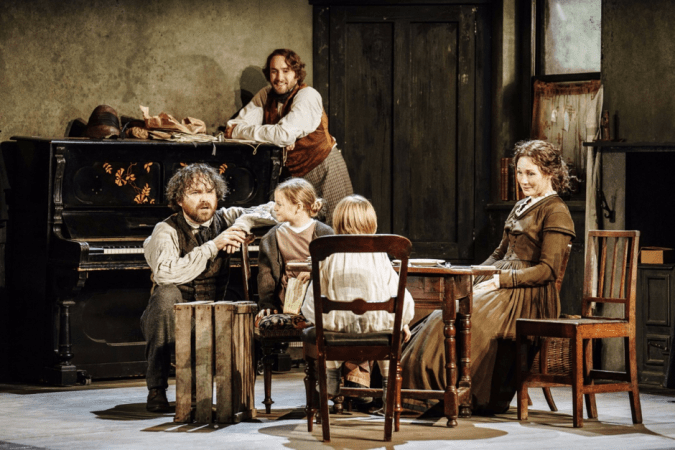
The play is pretty entertaining too, but not the comic masterpiece that would have really topped things off for Hytner. Richard Bean has adapted Karl Marx’s rackety, poverty-stricken years living in Soho and writing Das Kapital into a genial farce. Centre stage throughout, Rory Kinnear’s performance as Marx is a reminder of how indispensable he has become to the British stage. With a tendency to sound more and more like Simon Russell Beale, Kinnear balances rooftop escapes from the law with the funeral of his young son, connecting divergent moods through powerful ability to seem entirely credible in any role.

Overall, however, Bean’s play is curiously old-fashioned. It is not clear what makes a comedy about Marx the most important work to stage right now, but it’s certainly a handy vehicle for sex jokes and a lot of hiding in cupboards. Some ideas are very funny, including running jokes about the literal translation of French phrases and about the police (“Why didn’t you hit me?” “I’ve been on a course.”) Nancy Carroll, as Marx’s aristocratic German wife, Jenny, Laura Elphinstone as family friend Nym and Oliver Chris as Friedrich Engels, Karl’s partner in crime, are all highly watchable. Mark Thompson’s inside/outside rotating tenement set is well detailed. However, it is hard to escape the feeling that Young Marx, while undeniably a well-cast, well-produced piece, is no more than the sum of its parts. The Bridge Theatre’s programming policy is not yet clear, but we can surely look forward to evenings here with more to offer than harmless entertainment.

Medea

Medea2whitenogradientwhitebar-1-e1504707286551

Medea adapted by Wendy Haines – The Gallery on the Corner, Tooting Bec

The final show in By Jove Theatre’s Violent Women trilogy is the most violent of them all, Euripides’ Medea. The story is an archetype of female anger and revenge, but By Jove are anything but predictable. Their exceptional staging presents the story in new, imaginative ways. Using little more than a double bed as a setting, SJ Brady, Sinead Costelloe and Rosa Whicker perform the Medea myth in a Tooting shop unit, renewing the impact of its hard-burning, visceral horror and showing the mental disintegration of a woman who has been cheated and humiliated. Wendy Haines’ new version is a monologue for a modern Medea, brought from her own, unnamed country by her husband, Jason, who abandons her for the younger Glauce. The new couple expect her civilised acquiesence. Meanwhile, passing men crow “Cheer up love, it might never happen.”

By Jove’s production, directed by David Bullen, cleverly splits Medea’s psyche between the three performers. Sometimes Medea is one, sometimes three, and when the terrifying finale arrives her two sons are, as she murders them, both separate and a part of her. Haines’ writing is bold and beautiful, using contemporary language but wringing poetry out of despair. The production’s promenade staging is inventive and highly effective. It opens with black-lipped figures miming eerily to ‘I Will Survive’, crackling out of a tiny speaker. The action revolves around a Tracy Emin-esque unmade bed, Medea’s bedside table equipped with gin, unopened bills and the Little Book of Calm. The audience stands throughout the show which, although only 45 mins long, contains depth and quality worthy of much larger venues and far more experienced companies. Visual effects are meticulously chosen to disrupt and disconcert. The small space is strewn with Rainbow Loops, as Medea’s young son plays up – she picks them all up, every single one. Later, Glauce becomes a white dress suspended over the stairwell to the basement as she meets her end, strangled with gold. As Medea dips her knife in her bedside coffee mug before slicing her children’s throats, it emerges not red but gold, and the final tableau of destruction is splashed with gold paint.

The three performers who deliver an interwoven narrative of mental breakdown combining stylised dance moves with naturalistic acting, all in a space the size of your living room. They are all captivating and SJ Brady, whose performance earlier this year in By Jove’s version of The Bacchae again shows she is a performer to watch. Both Here She Comes and now Medea have been top quality fringe productions. By Jove pull off one of hardest tricks in theatre by presenting old stories in new ways, and making it seem natural. By Jove’s talents deserve bigger spaces and audiences and more attention, and we will surely be seeing a lot more of them.


What Shadows

D7DAD9CD-D9BE-F240-A0FF6A503838CCCAIan McDiarmid as Enoch Powell. Image by Mihaela Bodlovic
What Shadows by Chris Hannan – Park Theatre, London

Like Enoch Powell himself, Chris Hannan’s new play about the man and his notorious speech comes to us from Birmingham – the Rep in the case of ‘What Shadows’, directed by Roxana Silbert. Tackling a historical pariah is a potentially fascinating assignment, but a difficult one to pull off. Can a close focus on Powell help us to understand his ignorant, unpleasant views? Despite his lasting reputation as a racist, Powell was a highly educated and respected man who drew tributes from the Prime Minister downwards when he died. So how did he become a rabble-rouser, remembered only for stepping outside the boundaries of civilised political discourse?

What Shadows has weakness, but also some very strong points. The action centres around Powell, his wife and two close friends, as he builds up to his ‘Rivers of Blood’ speech, delivered Birmingham in 1968. This is counterpointed with a story involving two fictional female academics, one black and the other white, who meet again after falling out over race in the 1990s. One has retreated to a remote Scottish farm, while the other has apparent success but a drink problem, and only a meeting with the by-now aging Powell can deal with questions left unanswered. Unfortunately, no aspect of this storyline seems at all convincing and the two seem to be devices for interrogating the impact of Powell’s rhetoric 25 years on. There are several other narrative elements, including an Indian man, Sultan (Ameet Chana) now living in Wolverhampton, who fought with Powell in the war, and his touching connection with a white war widow. There is a great deal going on, and much of remains fragmentary and therefore instrumental.

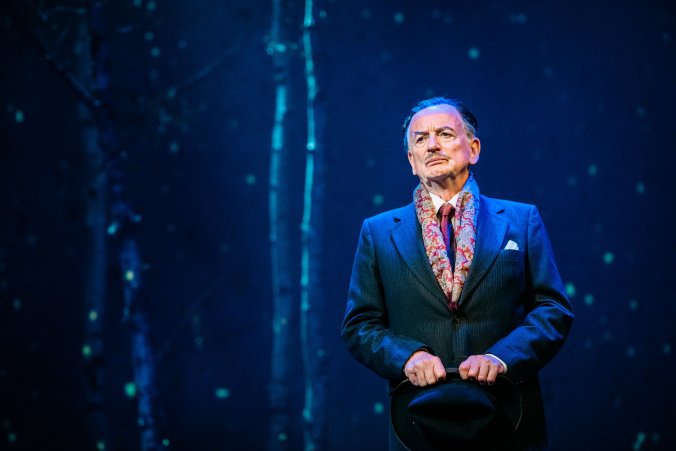
However, the play’s strength is the main narrative and Ian McDiarmid’s performance as Powell. His performance is subtle and fascinating, of the highest quality. He eerily reproduced the Black Country tones of a man who, despite appearing an insider, never seems to have felt he belonged. His relationship with close Quaker friend Clem and his wife, torn apart by the speech, is loving rendered with fine work from Nicholas Le Prevost as Clem and Paula Wilcox as Marjorie, with Joanne Pearce as Pamela Powell. At the centre of the play, the delivery of the notorious speech is compelling and illuminating. Hannan suggests that Powell’s projected his sense of personal rejection into a national crisis, and the full text of the speech supports this theory. Powell reports his constituents’ fury about declining services, but placing the blame for this on immigrants, never mind people of a different colour, seems to be his own interpretation. His own discontent seems to have combined with his ego to produce a disastrous political explosion. While ‘What Shadows’ is flawed, the chance to see McDiarmid becoming Powell, but in middle-age, and in old age suffering from Parkinson’s Disease, is one not to be missed.

Dollywould

event_dw1

Dollywould by Sh!t Theatre – Camden People’s Theatre

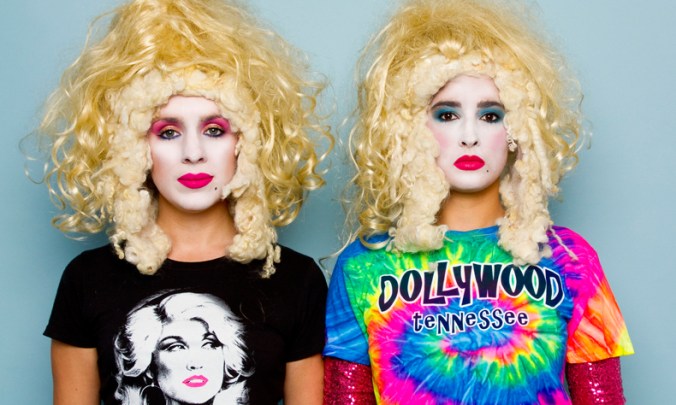
Since their 2017 Edinburgh hit, ‘Letters to Windsor House’, Rebecca Biscuit and Louise Mothersole have been hot fringe property. Under the cover of an amusingly self-deprecating company name, Sh!t Theatre, they created their own form of agit-prop theatre using cardboard boxes and unlikely make-up, personal, political and funny in equal measure. Their much anticipated Dolly Parton-themed follow-up, ‘Dollywould’, sold out in Edinburgh and, on the face of it, could not be more different. In fact, Sh!t Theatre lure us to Tennessee and Dolly’s theme park under false pretenses, offering a comedy fan-girl trip only to head down some disturbing alleys.

‘Letters to Windsor House’ revolved around the pair’s flat share, ending as they fell out and went their separate ways. Apparently this was for real, so they took a friendship-mending holiday to Tennessee (with lighting tech, Jen) to share their love for Dolly. The trip is presented in their signature home-made style, much more sophisticated than they would have you believe. There is verbatim-style re-enactment of a 1977 TV interview with Dolly, just before she made it big; videos of their trip, including toilet visits; karaoke sung by the light of a photocopier; tattoos; and breasts. Adept at discomforting the audience, Biscuit and Mothersole spend much of the show with nipples showing through holes snipped in their tops, before eventually covering up with giant model breasts. This is their way of presenting the physical barrier between Dolly Parton and the rest of the world.

However, ‘Dollywould’ is concerned with much more than Dolly’s public image. The two are fascinated and sometimes appalled by her self-made status and her focus on making money, evidenced by the relentless merchandising at Dollywood. They also trace her long-term lesbian relationship, well-known but never publicly acknowledged. And they provide inimitable context by visiting the nearby Tennessee Body Farm, where corposes are left to decay for forensic purposes and souvenirs are also available. They also dress up as sheep from time to time, slipping between Dolly Parton and Dolly the sheep. An apparently light-hearted piece becomes increasingly unsettling, as Dolly Parton’s identity becomes blurred and questions swirl as to who we really are. These intriguing themes delivered with skill, charm and sophistication. Sh!t Theatre remain essential fringe performers.