The Birthday Party

birthday1

Zoe Wanamaker and Toby Jones – image by Johan Persson

The Birthday Party – Harold Pinter, Harold Pinter Theatre, London

The Birthday Party is 50 years old. It opened to catastrophic reviews, which their authors have never entirely lived down. Now a thoroughly established classic, revived at the theatre named after its author, it is play about an increasingly distant time and lost, post-war ways of living. However, its exploration of oppression and invisible, all powerful structures remains disturbing current. It is also, like much of Pinter’s work, very funny.

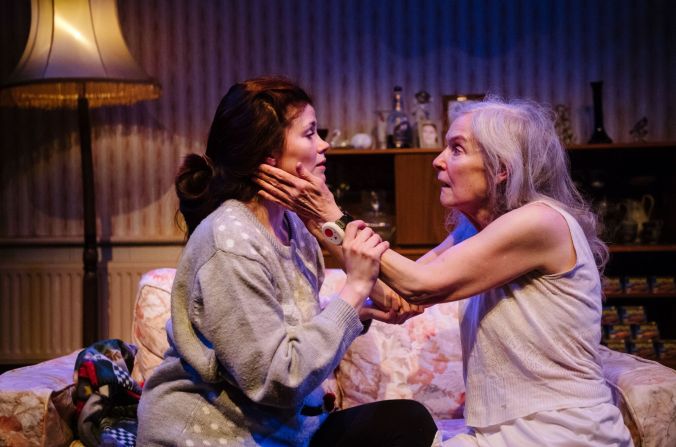
Ian Rickson, who directs, has built up a powerful Pinter CV with productions of Old Times and Betrayal at the Harold Pinter Theatre, and The Hothouse at the National. He lines up a dream cast for the Birthday Party, and the audience is rewarded with a succession of delicious performances. Zoe Wanamaker, an actor who has been at the top of her profession for 35 years while, perhaps mercifully, escaping full-blow fame, is the emotional heart of the play as landlady Meg Boles. She is probably damaged, possibly not a landlady at all, silly and deluded, yet also vulnerable and touching. Equally vulnerable, but for different reasons is her lodger Stanley, played with complete commitment by the endlessly watchable Tony Jones. His history and status are uncertain, shifting throughout the play, until we possess no more information about him than we did at the start, but he is defined by his sexually tense relationships with both Meg and next-door neighbour Lulu (a breezy Pearl Mackie), never defined, but illicit and, towards, Lulu, violent. These scenes of unspoken, escalating tension play out in a meticulously detailed late 1950s seaside front room, in just the right state of slight disrepair, designed by the Quay Brothers.

The Birthday Party is best known for the mysterious duo, Goldberg and McCann, who insinuate themselves as boarding house guests with a mission, for reasons never explained, to torture and kidnap Stanley. Stephen Mangan’s Goldberg, full of false bonhomie and ever-changing stories about his Jewish family background, is an overbearing tour de force. Meanwhile the Irish McCann (Tom Vaughan-Lawlor) seems to be undergoing his own quiet breakdown. He is not the only one. Stanley is left physically unable to speak, after a night in the pair’s company, before they bundle him away. Meg is in complete denial of reality. It is left to her husband Petey (Peter Wight, in a piece perfect casting) to smooth over the night of hidden, grim violence that has apparently taken place by carefully pretending nothing has happened, and going back to reading the paper.

The play is a famous exercise in unspoken menace, but it is much more than that. While intimidation of those who do not fit in, without ever knowing why, seems an unfortunately current theme, Pinter cannot resist playing with language, launching into surreal interrogation scenes (“What about the Albigensian heresy?”), playing out precise, hilarious scenes of spousal miscommunication, and dancing around the nature of the relationship between Meg and Stanley, as the two play games over breakfast without apparently knowing why. Pinter plays games with the audience too, leaving them in increasingly doubt over the boundaries between fantasy and reality in world where facts refuse to stay still. The sheer quality writing makes this play still gripping and audacious, 50 years on.  Rickson’s excellent production demonstrates, without a shadow of a doubt, why The Birthday Party deserves its classic status.

KEN

Ken, The Bunker - Jeremy Stockwell and Terry Johnson (courtesy of Robert Day)

Jeremy Stockwell and Terry Johnson. Image courtesy Robert Day.

Ken by Terry Johnson – The Bunker, London

Ten years after his unexpected death, the influence of maverick theatre-maker Ken Campbell seems stronger than ever. His anarchic creativity and alternative approach to performance is continued by his daughter Daisy, whose Cosmic Trigger was a 2017 highlight. Now Terry Johnson, famed for such plays as Hitchcock Blonde and Insignificance, has taken his tribute play, KEN, to The Bunker after a run at the Hampstead Theatre. It is a hilarious and touchingly personal two-hander that leaves the audience in no doubt about the important of Campbell.

Johnson first encountered Ken when he picked up the phone at his shared house in 1978. Ken was calling to speak to someone else, but Johnson ended up with a job (“Jim Broadbent’s fucked off, so you can have his parts”). These turned out to be in The Warp, a legendary 24-hour play about the life of a man called Neil Oram, the most insane and inspiring of Campbell’s many such ventures. Having appeared in The Warp, Johnson then played half of Zaphod Beeblebrox in Campbell’s disastrous stage version of The Hitchhiker’s Guide to the Galaxy. This closed early, along with Johnson’s acting career. Now, 35 years later, he appears once more on stage, mostly from behind a lectern, to deliver his memories of Ken and to show us something of his impact.

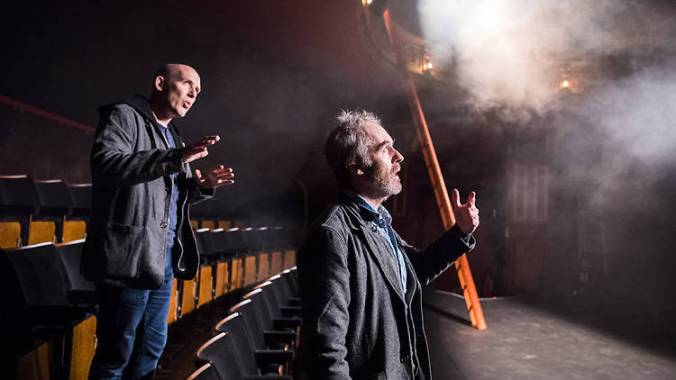
Johnson’s wry delivery makes him an ideal straight man for Jeremy Stockwell, who also worked with Campbell. Stockwell plays not only Ken, complete with one of Ken’s pork pie hats, but also everyone else. His impersonation is uncanny, a nasal Thames Estuary accent and piercing gaze conjuring up Ken on the spot. Assisted by Tim Shortall’s set which transforms the Bunker into a carpeted hippy hangout draped in ethnic throws, the pair build a double act which is very funny indeed. This is down both to Johnson’s sharp writing, but also to Ken himself, an impossible visionary, equally prone to unhinged antics and piercing insight. His declaration that there is no finer act that “one of utter folly” guided his approach and led him, for instance, to liven up The Warp several hours in by leading the audience to a nearby tennis court where the cast were required to perform their scene while playing an impromptu tennis match. Stockwell has enormous fun with not only Ken, but the characters who passed through his orbit – from a husky voiced numerologist to Trevor Nunn, irked at being comprehensively pranked by Ken.

As Johnson observes, ‘ken’ is a noun meaning knowledge, experience and understanding. The knowledge of himself that Ken unlocked in Johnson shaped, he feels, his subsequent life and career. One night Ken jabbed him in the sternum in a Liverpool pub, telling him “You have a switch in here, and it’s off.” Everything he achieved was based on learning how to turn that switch on. The power of Campbell’s influence, whether in heroic success or heroic failure, is made very clear in Johnson’s powerful tribute. What makes KEN really work is the feeling that we been granted a genuine glimpse of the real Ken Campbell, a rare insight into why he mattered. Johnson’s play does not just tell us that he was special, he convinces us.

This show was seen with a free ticket.

Becoming Shades

Becoming Shades at VAULT Festival 2018 (courtesy Maximilian Webster) 2

Image by Maximilian Webster

Becoming Shades by Chivaree Circus – VAULT Festival, London

Deep under Waterloo Station in the darkest recesses of the Vaults is the Forge, a damp, echoing,  cave-like space. Reached by weaving through the crowds and the enchanted spaces of the VAULT Festival to the very back, it is the ideal space for Chivaree Circus’s recreation of Persephone’s journey into the Underworld, a story told through contortions, acrobatics, rope-work and spinning silks, fire and neon.

The story of Persephone, forced by Hades to spend half the year in Underworld while the Earth toils through winter, is the core myth for deep January. Becoming Shades is a promenade performance, and the cast marshal the audience from scene to scene around the barrel-like station undercroft. Charon (Moly Beth Morosa), an HR Geiger creature with neon hands and eyes, acts as our guide while live music is performed by the duo of Sam West and Becks Johnstone, whose voice is deliciously smoky. The look is a dark, late 1980s club: sides are shaved high, basques are worn and costumes would not look out of place in Cybergoth. The audience are supplied with black surgical masks, and games of chance take place is side during the interval, with strong hints of Punchdrunk’s Masque of the Red Death.

Chivaree is an all-female circus troupe set by Edward Gosling and Laurane Marchive, who directs. The narrative frame is really an excuse to show off the jaw-dropping skills of the performers. While the comic relief scenes filling the space between set piece performances are of limited interest, the main attractions are worth every penny. As soon as a performer casually bends into a slow motion back flip, as though out for an afternoon stroll, it is clear we are in for something special. What follows is a display of skills beyond the comprehension of ordinary mortals, most definitely otherworldly. Rosie Bartley, Isobel Midnight and Jessica Pearce juggle many-branched spinning torches, taking the occasional gulp of flame. Anna McDonnell displays awesome strength and agility on the pole. Rebecca Rennison and Alfa Marks slide, split and fly on ropes and aerial silks, and a finale which involves spinning on a wheel of fire supported only by the neck (see above) has the audience gasping.

After last year’s No Show which highlighted the frustrations of female circus artists, the presence of such skilled performers in a show devised for them feels like the future of circus. Becoming Shades is strong on atmosphere, but has its limitations as an integrated piece of theatre. However, the abilities of the performers, twisting and tumbling high above the crowd, have to be seen to be believed.

This show was seen with a free ticket.

East

(c) Alex Brenner, no use without credit, Atticist - East @ King's Head (_DSC4959)_previewJames Craze, Jack Condon and Russell Barnett in East. Image by Alex Brenner

East by Steven Berkoff – King’s Head Theatre, London

Jessica Lazar’s production of East is imaginatively directed, satisfyingly choreographed and acted with commitment by a talented cast within the tight boundaries of the King’s Head Theatre’s postage stamp stage. It is hard to imagine a better fringe staging. However, there is a problem and it lies not with the cast or the creative team, but with the play. Steven Berkoff’s East has become a minor stage classic, and remains influential, a very clear influence on last year’s Flesh and Bone. Forty years after its premiere, it status seems increasingly questionable.

Berkoff’s verse drama about two generations of working class East Enders, made a splash in 1975 with its use of formal, fanciful, heroic language to portray deeply unheroic lives, and with a sexual frankness barely seen before on stage. The latter no longer raises much of an eyebrow and the language, highly reminiscent of Stanley Kubrick’s film A Clockwork Orange, which preceded it, fails to mask an absence of characters with a resemblance to real people, and the gleeful presentation of racist and sexual violence.

Berkoff’s describes the play, sardonically, as “an elegy for the East End”. The men in the play – embittered, women-hating, racist Dad (Russell Barnett), and violent, rapist, racist son Mike (James Craze) and his equally thuggish mate Les (Jack Condon) – are some of the nastiest characters you could wish to meet. They fight, stab and bludgeon, they threaten or attack anyone who is not white, they boast of racist murders, they harass women, force sex on girlfriends, and use underage girls for sex before kicking them out on the street. These scenes take place around family trips to Southend and nights in front of the telly, part of a supposed everyday East End existence which consists of a sickening combination of violence and sentimentality. Because they are such unmitigated thugs, it is impossible to have any sympathy with them, to understand their behaviour, or to believe in them. The play is dominated by stereotypes and, unlike A Clockwork Orange, East uses ultra violence as a substitute for insight rather than a tool for dismembering hypocrisy.

The strongest characters are the two women, Mum (Debra Penny) and Sylv (Boadicea Ricketts), fought over by Mike and Les, and their key scenes represent the sum total of character depth in the play. Mum has a monologue which reveals her to have been destroyed at the hands of her vile husband, while Sylv has the stand-out scene in which she expresses her sexuality, full of youth and energy, and demands the same freedoms as the men. However, the behaviour of men towards women in East is so crude and despicable, and the sexual dynamics so rotten, that it is simply not possible to the scenarios in East can form the basis for any equality thesis.

Tellingly, the most effective scenes in Lazar’s production are those without dialogue: particularly a silent tv-watching sofa scene and a scene change in which the cast remain in character as they bicker while clearing up an overturned breakfast table. Musical director Carol Arnopp plays the piano on stage throughout, soundtracking the action with Cockney classics. The creative energy behind the production is impressive, but the play no longer seems worthy of this level of attention. Berkoff has a long-term connection with the King’s Head but, on the evidence of East, it is time to move on.

I saw East with complimentary review tickets.

The Box of Delights

EA59BB22-0DA2-71CA-21637AC5DC0B3997Matthew Kelly and Alistair Toovey. Image by Alastair Muir.

The Box of Delights by Piers Torday /  John Masefield – Wilton’s Music Hall, London

The Christmas combination of Wilton’s Music Hall and the Box of Delights is pretty much perfect. Wilton’s is perhaps the most atmospheric theatre in the country, a miraculously preserved jewel box of a space, fringed with flaked plaster and precariously supported on barley sugar columns. The Box of Delights, John Masefield’s 1938 children’s classic, is a book about a jewel box, which turns out to contain rather more than gems. It is also set in the snowy run-up to Christmas.

It is amazing no-one has thought of staging The Box of Delights before, but they apparently never have. The books is both influential and intensely atmospheric, brimming with childhood adventure and deep magic, threats from the dark that can only be thwarted by Kay Harkins, back from school for the holidays. Best known in its 1984 BBC television adaptation, the book remains somewhat overlooked (although not as much as its prequel, The Midnight Folk). Justin Audibert’s direction emphasises the unique combination of ancient and modern that defines the book – medieval philosophers, witchcraft and the elixir of life mingle with machine guns, kidnapping and a futuristic flying car. Everything is cleverly rooted in Tom Piper’s set of stacked, dust-sheeted wardrobes hidden, like the landscape, under a heavy fall of snow. As events unfold, the sheets are lifted and characters appear and disappear through closet doors, Narnia-style portals to locations in other times and places.

The guardian of the box is Merlin-like Punch and Judy man Cole Hawlings, played by Matthew Kelly. Cunningly, he is also cast as Abner Brown, the evil genius with more than a hint of Aleister Crowley. Both performances are of the high quality Kelly always delivers, but the play does not depend on him. The forces of the dark also include witch-about-town Mrs Pouncer, played with requisite poise by Josefina Gabrielle, and her jewel thief accomplice, a “What Ho!-ing” Tom Kanji. Ranged against them are Kay, onstage throughout in various sizes, played well by Alistair Toovey, and his friends, the adventure averse Peter (Samuel Simmonds) and his sister Maria. The latter, a highly volatile Safiyya Ingar, is the book and the play’s best character, obsessed with gangsters and machine guns, and an absolute determination to cause trouble. If Masefield hadn’t got there first, a modern production might have felt the need to invent her to create a reasonable gender balance. As it is, one of the pleasures of The Box of Delights is that its two most charismatic, fearsome figures are female.

The tonal contrasts in Masefield’s book keep the reader guessing, and place it on a pivot between modern England and the endless expanses of the past. The stage version is adapted by Piers Torday and remains faithful, for the most part, to the distinctive feel of the book. Torday retains enough of the 1930’s children’s slang to enliven the scenes with Kay, Maria and Peter, and sensibly slims the characters without sacrificing atmosphere. He does, disappointingly, feel the need to introduce a more emotional backstory, reminiscent of Harry Potter, for Kay, and a simplified, Disney-esque quest theme to “Save Christmas”. It is not clear why such original material needs to be made less distinctive to appeal to modern audiences, and it is rarely children who demand more conventional story lines. However, the writing rolls along nicely for most of the evening. Audibert’s entertaining staging brings a daunting range of magic and drama to life. Cole Hawling’s dog and the miniaturised Kay are puppets, and trains and flying cars models on sticks. The slapstick elements – such as the ‘scrobbling’ of the entire Tatchester Cathedral choir, one by one – is gleefully played out, and a reservoir deluge becomes a vast sheet of blue silk.

The Box of Delights is a mesmerising evening of magic and tricks, holding the attention of children and adults with ease and Wilton’s is the perfect setting. The 1930s setting is both nostalgic – buttered eggs for tea and a posset before bed – and unsettling, as it should be. The programme authors should read the book more carefully though: the posset recipe they include is for a lemon dessert, not the same thing as “ a jorum of hot milk; and in that hot milk, Master Kay, you put a hegg, and you put a spoonful of treacle, and you put a grating of nutmeg, and you stir ’em well up, and you get into bed and then you take ’em down hot. And a posset like that, taken overnight will make a new man of you!

The Twilight Zone

The Twilight Zone. Photo credit Marc Brenner (2).jpgThe Twilight Zone cast – photo by Marc Brenner

The Twilight Zone by Anne Washburn – Almeida Theatre, London

On the surface, the rationale for staging an adaptation of selected stories from hokey 1950s US TV phenomenon, The Twilight Zone, may seem murky. In practice, Anne Washburn’s version for the Almeida, following her Simpsons-based show Mr Burns , is a sharp tribute, recreating both the creakiness and the prescience of the original show. Directed by Richard Jones, best known for his operas, the evening uses eight of the original episodes, weaving them together as shorter pieces and long themes in the style of musical theatre. The action is tightly choreographed, with the nine-strong cast playing multiple characters in a black and white world, wearing black and white costumes and performing in black box speckled with white stars and occasionally, on a television set.

The Twilight Zone has much greater cultural presence in the US. Over here we know the theme and not much more, but there its most best episodes are famous. The material chosen by Washburn soon shows just how influential its ideas have become. Aliens land, government agents lurk, parallel dimensions open up beneath beds, sinister little girls appear in corridors and dreams become reality. Everything from Tales of the Unexpected to Doctor Who owes a debt. Washburn deftly mixes the tales, opening with a bus-load of passengers stranded in a diner on a snowy night, and a policeman tracking the occupant of a mysterious craft that has crash-landed nearby. The scenario is spooky Agatha Christie spiked with hokey comedy in a blend that brings the 1950s straight back to life. The first half of the show concerns aliens and strange dimensions, with inexplicable happenings in the safety of family homes and down-home bars that break through a porous barrier between reality and fantasy. It is creepy but comforting. After the interval the darkness turns up a notch, as man struggles to stay awake to avoid dying in his dreams, and becomes genuinely touching with a love-struck couple who try to put their relationship in cryogenic suspensions for a fifty-year space voyage. The finale is an extended story about the racial and social meltdown of American society in the face of a nuclear attack, as everyone says a lot of things they regret in their struggle for a place in the only shelter in a suburban street.

This complex array of short stories is expertly delivered by a fine ensemble. John Marquez ranges from hard-bitten New Yoyker with a thousand yard stare to the show’s narrator, delivering monologues to camera with an authentic lack of dramatic timing. Adrianna Bertola gives us not one but two sinister little girls. Oliver Alvin-Wilson does a baffled bus driver, a stoic physicist probing child-swallowing black holes and a psychiatrist faced with the impossible. Lizzy Connolly is a vampish torch singer from a nightmare, with a musical number of her own. Cosmo Jarvis is a bystander with an infuriating laugh, and a test pilot whose crew may not be real.

Richard Jones oversees a beautifully-staged piece of theatre. Paul Steinberg’s set gives us whirling cardboard spirals and men in star-strewn black. Mimi Jordan Sherin gives the cast highly convincing, raking black and white TV lighting. Two illusionists, Richard Wiseman and Will Houston, change newspaper headlines before our eyes and make cigarettes mysteriously appear in characters hands as they find themselves temporarily possessed by the narrator’s persona. “But I don’t even smoke!” they exclaim. As seasonal entertainment, The Twilight Zone is clever and classy, but it does more than that. Washburn’s selection of stories shows how the fragile post-war US social settlement pulled at the seams, threatening to come spectacularly apart, as it does again in the Trump era.

Titus Andronicus

www.curzoncinemas.comDavid Troughton in Titus Andronicus

Titus Andronicus by William Shakespeare – Barbican Theatre, London

Titus Andronicus, once a real rarity in the Shakespearian oeuvre, has been seen four times at Stratford this century. Its unhinged excesses – 15 bodies piling up, mostly on-stage, along with four heads, three hands and a tongue – are now more familiar and more actors are testing their skills in its strange array of roles. Blanche McIntyre’s production, transferred to the Barbican as part of the RSC’s Rome MMXVII season, features a fine performance from David Troughton in the title role. His performance as Titus, intensely watchable, is wracked with grief and both real and staged insanity. A mad martinet of a general, who seems to take pleasure in the sacrifice of 21 sons in the service of Rome and coldly kills another who disobeys, he understands true grief only when two more sons are executed.

The play is about war and loss, and its events show how conflict cannot be walled off but spills over into everyone lives. Titus’s apparently victorious campaign against the Goths turns out not be over, and follows him back to consume almost his entire family. At the same time, Rome is a sick civilisation in which democracy serves the egos of self-obsessed rulers epitomised by Martin Hutson’s sneering Emperor Saturnius. Titus concerns a fictionalised Rome, so translating it to here and now as a nation-in-a-state play brings clear Trump era parallels, although the choreographed prelude involving protestors and riot police is standard-issue RSC staging. The set also features, oddly, balconies on either side set up for an absent orchestra, as though a previous show couldn’t clear out in time.

Many other aspects of MacIntyre’s staging are very effective though, in a play that betrays the callow Shakespeare lack of experience through its chaotic plot and use of highly un-theatrical devices such as a deep, dark pit. Troughton feigns madness from inside a large cardboard box, possibly a nod to Ridiculusmus’ box-based show about PTSD, Give Me Your Love. The notoriously gory scenes of mutilation are presented with a well-judged balance of humour and horror, the pièce de resistance surely being the murder of Goth Queen Tamara’s two sons, Chiron and Demetrius, hung by their feet from the ceiling as their throats are slit and their blood drained into a basin.

Beyond Troughton, several performers stand out in play which offers an entertaining selection of parts. Revenging nihilist Aaron is played by Stefan Adegbola as distressingly calm, while whipping up the madness and engineering the violent deaths of much of the cast. Nia Gwynne, brutally treated and then sexually claimed by Saturnius, is as much a victim as an instigator. Hannah Morrish as Lavinia makes a startling transition from smug, privileged daughter to mute avenger.

Titus Andronicus is not a work of genius, but neither is it the crude, valueless play it was seen as for so long. It excesses seem much more familiar in a post-Sarah Kane world, and its challenge to the audience remains strong. Anything that remains this confrontational after so long is worth examination, and this production makes for a disturbing, memorable evening.


St. George and the Dragon

79C57CCD-B995-2EF3-A59E84D577EBFC90John Heffernan as St. George. Image by Johan Persson

St. George and the Dragon by Rory Mullarkey – National Theatre (Olivier), London

British theatre is engaged in an urgent search for post-referendum state of the nation writing and, to its credit, the National Theatre is at the forefront. Rufus Norris’ 2017 season has proved highly controversial, with Michael Billington calling the relative absence of classics ‘a staggering dereliction of duty‘. While his piece is a serious over-reaction, it does reflects the unusual risk involved in staging experimental new plays in the vast Olivier auditorium. This is as much a financial as an artistic tightrope. Follies has been a huge success, but is also surely one of the NT’s most expensive shows, while DC Moore’s Common was a similarly risky new piece. With Rory Mullarkey’s St. George and the Dragon the most surprisingly choice for the Olivier yet, we must hope the NT’s finance department is on top of the situation. In the meantime, Mullarkey has written a larky piece of extended allegory that is both enjoyable and frustrating. It seems to have expanded to fill the space, becoming both surprisingly epic and unnecessarily long.

John Heffernan plays St. George in three different time periods. He shows up as a greenhorn knight in a medieval English village, slaying the enslaving dragon (Julian Bleach, having a great time) and bringing peace and liberty. Then he’s off to fight more dragons and, returning after only a year, finds time has slipped to the industrial revolution and the dragon is not only back but is now running the mills. Finally, after another absence he comes back to modern Britain where, the plays claims, the dragon is within us all and everything is much worse than it was the Middle Ages.

This pretty trite political thesis is the play’s main weakness. However, there are strengths too. The whole show is essentially a pantomime, inhabited by types – the maiden, the father, the miller, the cryer, the healer etc. – who play the same roles in each era. It has an afternoon television atmosphere, silly and enjoyable, but a neat line in clever staging. In fact Rae Smith’s set is a triumph – a tablecloth countryside dotted with model village buildings that spreads over the entire Olivier stage and back wall, and grow as time moves on. Lyndsey Turner’s production marshals the cast very to fill the space very effectively, and occupies the cavernous space overhead with amusingly home-made sky battles between knight and dragon.

John Heffernan is a perfect naive crusader, increasingly out of time and unable to keep up with 21st century drinking culture. Supporting characters, especially Gawn Grainger as the father and Amaka Okafor as Elsa, always about to be eaten by the dragon in one way or another, are strong. The writing is often funny, particularly when questioning the stereotypes of the St. George myth through the familiar out-of-time comic scenario. However, despite its appeal Mullarkey’s play is not nearly focused enough. It sets a leisurely pace but, in the end, cannot back up its allegorical approach with any real cultural and political insight. Nevertheless, there is no doubt we need as much state-of-the-nation drama as we can get in these confusing times. The National Theatre is the right place to see it – Norris needs to continue his search.

Albion

albion-reviewVictoria Hamilton as Audrey. Image by Marc Brenner

Albion by Mike Bartlett – Almeida Theatre, London

For Mike Bartlett’s new play Albion, the Almeida is almost in the round, the stage stretched into a long oval. Miriam Buether’s impressive set is a garden, with a lawn, a border and a full size mature tree looming at the back. Both title and set make it clear: England is a garden, and this particular garden is England. Bartlett’s three-hour state of the nation play draws out the defining preoccupations and dilemmas of our time through the domineering Audrey, a wealthy businesswoman abandoning London for the country and a garden restoration project after the death of her soldier son. There are parallels with The Seagull and Irina Arkadina, with a social order failing to locate its place in a changed world. Rupert Goold’s production throws everything at the play, with a fine cast and staging, but ultimately Bartlett’s play is too flawed to match these ambitions.

Albion has strong writing, intriguing characters and one barn-storming lead role. However, it is also flabby, predictable and clichéd so, despite its various strengths, it amounts to a frustrating evening. The star of the show is Victoria Hamilton, returning to the stage after several years away, who is worth the price of a ticket on her own. She holds the play together with a funny, powerful performance as Audrey Walters, a Conran-style entrepreneur who controls and dominates those around her. She is a fine comic creation, entitled, dictatorial and impossible, but just about able to get away with it. The play revolves around her, and when her chalk-and-cheese author friend Katherine complains that she is a supporting character in Audrey’s life she speaks for everyone. However, this becomes a major weakness for the play as the large supporting cast lack space to become more than background.

Other actors put in excellent performances. Luke Thallon is endearingly awkward as local boy Gabriel, whose opportunities are constrained by money and class: “I’ll make coffee. Then I’ll manage people making coffee. That’s probably it.” Helen Schlesinger is subtle and compelling as Katherine and the nearest thing to a counterweight, as the liberal, culturally free-wheeling alter ego to Audrey’s self-made traditionalist. Margot Leicester’s ageing, resentful local cleaner Cheryl is a minor triumph of class discontent.

However, despite its good points Albion has too much going on, and much of does not come as a surprise when it eventually arrives. Nothing is left implied, and everything is spelled out to the audience. The second half sags as a series of hot 2010s issues are ticked off: dementia, the housing crisis, millennial rootlessness, Brexit, country v city. Bartlett tries to pack in far too much, with key plot loops playing out, sometimes off-stage, around the increasingly uncertain figure of Audrey. Meanwhile the staging veers from neat coups – the cast plant an entire garden as a scene change – to leaping off the deep end, as Audrey’s son’s grief-stricken girlfriend dances in a rainstorm shoving earth up her dress. There’s a worthwhile play in there somewhere, and Bartlett writes original, compelling characters. However, as with other recent new plays such as Lucy Kirkwood’s Mosquitoes or Ella Hickman’s Oil at the Almeida, Albion tries and fails to deliver all encompassing, era-defining, realist drama. Simpler, subtler drama would come as a relief.