Krapp’s Last Tape

Krapp’s Last Tape by Samuel Beckett – Barbican Theatre, London

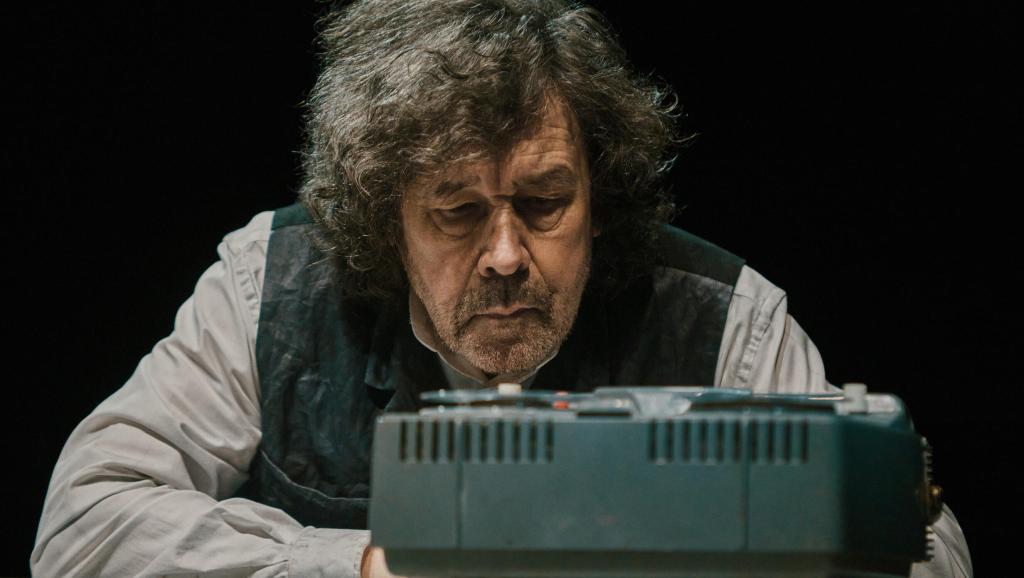
With the pre-announcement of not one, but two future productions of Krapp’s Last Tape scheduled for the mid-2030s (when Sam West and Richard Dormer reach 69, the age of Beckett’s main character), it’s reasonable to ask what makes actors want to play this role so much. To some extent, it could be that recording the lines for younger Krapp at 39 represents a solid investment in future work. But there is also a clear sense that this is one of the big roles, a defining part, and one that suits unconventional actors better than classic leads. Stephen Rea is very much the kind of performer suited to Krapp. Actually 78, although he very much does not look it, Rea bring a hangdog comedy and a deep sadness to a role others have approached with more rage and less stillness. He also met Beckett himself, who attended rehearsals for the Royal Court’s 1976 production of ‘Endgame’ with Rea in the cast.

Vicky Featherstone’s production is designed by Jamie Vartan, who places Krapp’s desk in a square of light beyond which lies only darkness. A path of light leads from the desk to a door, beyond which lies smoke, the drink which Krapp retires periodically to consume, with a comic sloshing sound, and who knows what else. The set also aids the silent comedy at the heart of Beckett’s play, in the form of a ludicrously long desk drawer which Krapp pulls out further and further to reach his hidden bananas. Rea plays the sad clown very well, dialling down the slipping on banana skins but emphasising the shambling walk, which looks both exaggerated and weirdly familiar. The inevitable comedy of decay is inseparable from the sadness, loneliness and failure that haunts Krapp, in the form of his naive 39-year old self, still seeking and possibly expecting happiness. His writing, unlike that of Beckett, faded away despite his epiphany in a storm, which he can not longer bear to hear about.

Stephen Rea recorded the Krapp tapes in his 60s, but they sound like the work of a younger man. The weighted precision of his delivery makes very word matter a great deal, to Krapp and to Beckett as writers and to us as an audience. His performance is heartbreaking without ever needing to fully express the emotions we know he is feeling. This play, so slight, remains a work of remarkable power that can bind the entire audience of a large theatre into the unravelling existence of one man.

Ghosts

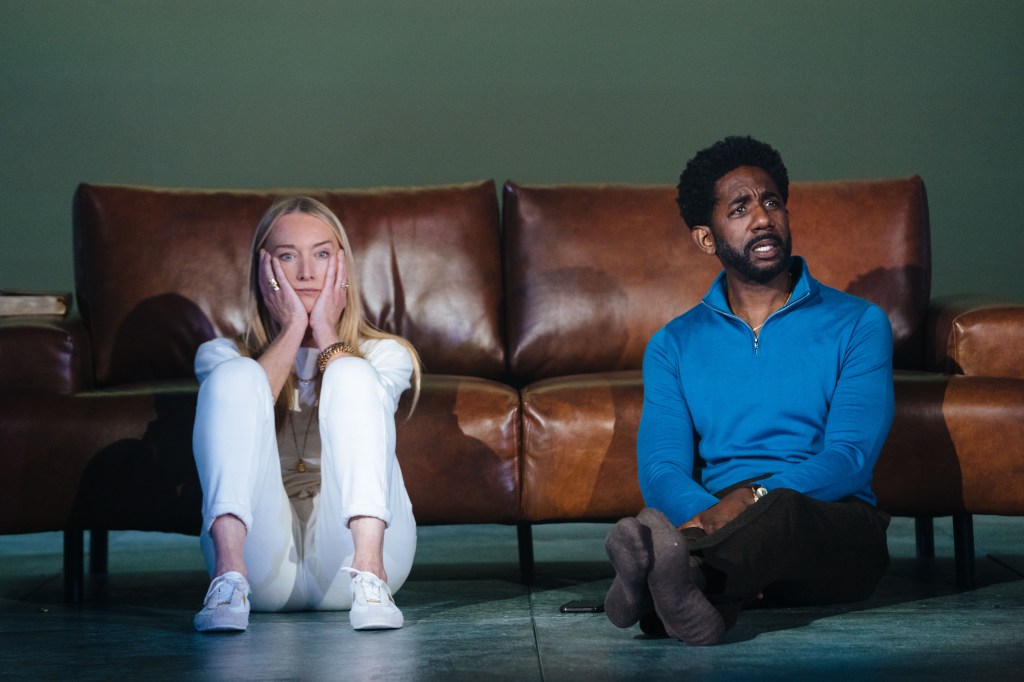
Victoria Smurfit and Rhashan Stone. Credit: Helen Murray

Ghosts by Henrik Ibsen adapted by Gary Owen – Lyric Theatre, Hammersmith

Published at Plays International.

The back of The Captain’s heavy, balding head is literally papered onto the walls of Merle Hensel’s set for the Lyric’s new version of Henrik Ibsen’s Ghosts, in a repeating patten. He may be dead, but his menacing presence looms large in the lives of everyone he has left behind. Meanwhile, the rear wall is a curtain of mist, dimly reflecting the characters who wander, lost, through a mental fog. The marble and leather opulence of the expensive interior does nothing to disguise the unresolved anguish which is pulling everyone apart from the inside. The Captain was a larger-than-life figure, a bully, a philanderer and arapist. Gary Owen’s pin-sharp updating of Ibsen’s classic preserves the generational impact of dark, unacknowledged secrets, while making them completely of the moment.

The Lyric’s boss, Rachel O’Riordan, has a fruitful artistic relationship with Owen including their hit Iphigenia in Splott. Their new collaboration feels like an event. The show’s emotional impact smoulders from the very first scene, as Rashan Stone’s lawyer, Andersen, visits the Captain’s widow, Helena (Victoria Smurfitt), to discuss arrangements for a new children’s home to be funded by his legacy. The professional atmosphere rapidly dissolves in the face of their unresolved relationship as old lovers. Callum Scott Howells, a force of nature as Helena’s deeply troubled son Oz, arrives on the scene to confront the older generation with the consequences of their silence. His burgeoning relationship with the Captain’s unacknowledged daughter Reggie (Patricia Allison) is both sweet and real, and deeply troubling as they discover they are half-siblings. Meanwhile, her non-biological father, Jacob (Deka Walmsley), is from a different social world, from where he can see exactly how poisonous a situation she is in.

Owen’s rewrite is masterful, pulling the play from its 19th century setting and refocusing on the human relationships that make it powerful and current. The lurking threat of syphilis, which no longer makes sense, is removed making space to dive into the realities of a coercive relationship, the corrosive power relationships created by wealth, and the terrible dilemma of discovering you are closely related to your lover. Ghosts is brilliantly cast. Victoria Smurfit, making a rare and welcome stage appearance, is perfect as a woman struggling with her inability to speak out against her abuser. She switches between full insight and reversion to the language of the oppressor. Her relationship with her son, Oz, is at the centre of the play. Callum Scott Howells is Gen Z to the core in bleached hair and Adidas tracksuit bottoms, his emotions always on the surface. He hides nothing, but being open to his feelings of rejection does not make them easier to bear. The generational gap with his mother, who hid everything to protect him, comes to a head in a scene reminiscent of Gertrude and Hamlet, where he questions her about whether she was raped. It draws gasps from the audience, as do several scenes during the evening.

Rashan Stone’s Anderson is a much more sympathetic character than his original, the hypocritical Pastor Manders. He gives a deeply human performance as a man trying hard to do the right thing, and finding there are no good choices. Patricia Allison’s Reggie is spiky, and fully aware of how much she has to lose while Deka Walmsley, as her father, is also more sympathetic than Ibsens’ original, using what little power he has to protect his daughter. Jacob, a painter-decorator with a broad East Anglian accent, emphasises the social gulf between the wealthy, living in coastal luxury, and those who work for them, who have very few options.

Ghosts is a significant achievement, a fresh look at a classic which shows us just how powerful Ibsen’s writing can be. Gary Owen turns our attention to themes easily obscured by the differences between eras. His version includes a powerful, entirely real evocation of Anderson’s lifelong, unrequited love for Helena. It draws on the power of public image, with the children’s home destroyed by the threat of toxic press coverage, rather than burning down, as in the original. He explores, in excruciating detail, how parents come to emotionally damage their children. And he gives a sophisticated, convicing analysis of the insidious ways a coercive relationship isolates and destroys a woman. Ghosts is a gripping, beautifully acted show, driven by a creative vision that brings this 150-year-old play pulsatingly to life.

What If They Ate the Baby?

What If They Ate the Baby? by Xhloe and Natasha – Soho Theatre, London

Published at Plays International

New York performance duo Natasha Roland and Xhloe Rice are fringe stars, winners of Edinburgh Fringe First Awards for each of their three shows: What If the Rodeo Burned Down, A Letter to Lyndon B Johnson or God, and What If They Ate the Baby. Their success has brought them to bigger audiences at the Soho Theatre, where they are currently performing the latter two shows. Their distinctive performance style combines funny, experimental writing with surreal physical techniques, and is both highly entertaining and brilliantly strange. They pick at the tropes of American, as seen in film and music, until they become something both familiar and disturbing.

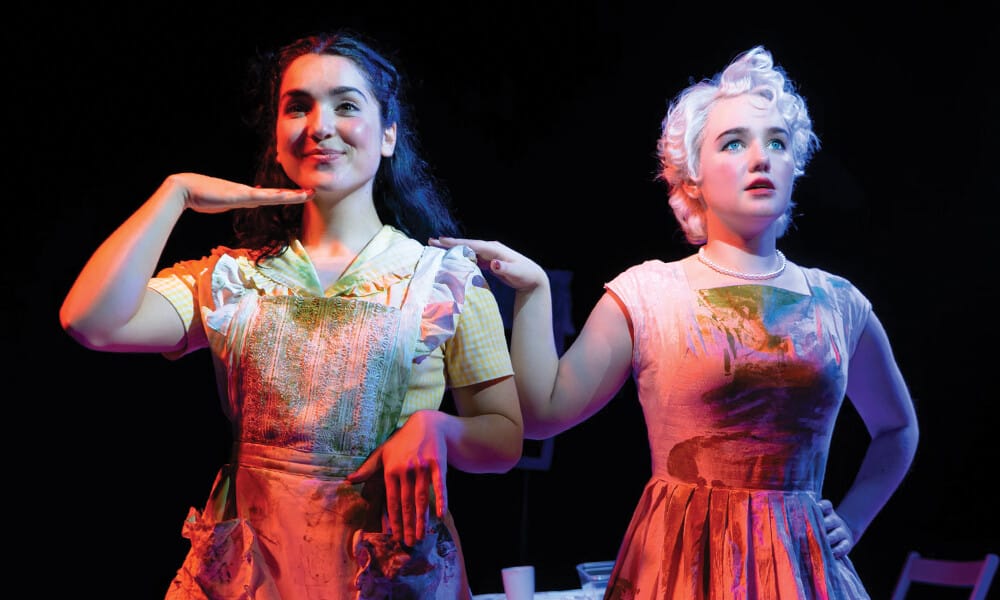
Natasha and Xhloe play suburban American housewives in 1950s dresses inhabiting an unsettling neon interior. A house call to return a casserole dish is all conventional social niceties, in which everything is unsaid. The script becomes a cycle of repetition, carrying shifting meanings as the never-ending visits plays out again and again. Physical gestures are stylised to the point of absurdity, and underlying social and sexual tensions spill to the surface. The two characters want one another, and intercut scenes show them indulging their fantasies. It is also clear that what they are doing is unacceptable in the society of the time, and there are also disturbing suggestions that normal is in fact very strange. There are bodies literally under the patio, and hints at dark deeds reveal a queer rebellion that is constantly bubbling to the surface.

What If They Ate the Baby plays with different sources which have set our expectations of the, brittle post-war suburban USA. The atmosphere is David Lynch crossed with Whatever Happened to Baby Jane?, as deep tensions play out between the pair as both insist everything is ok with their husbands, the neighbours and their homemaking lives. The show is very funny, and very tightly scripted and performed. The insistent repetition of actions, the meanings of which shift every time, is reminiscent of Forced Entertainment, while the combination of silliness and rigour is worthy of Sh!t Theatre. Natasha and Xhloe use music to great effect, from 1950s popular song ‘Music! Music! Music!’ to hip hop, such as ‘Punk Tactics’ by Joey Valence & Brae. Angelo Sagnelli’s work as Lighting Designer and Technical Manager is essential to creating a world with a handful of props. Finely coordinated interplay makes the show a mini-masterpiece of physical theatre. The pair are original, imaginative and highly entertaining performers, and the show is a sophisticated treat which fully justifies their growing reputation.

The Seagull

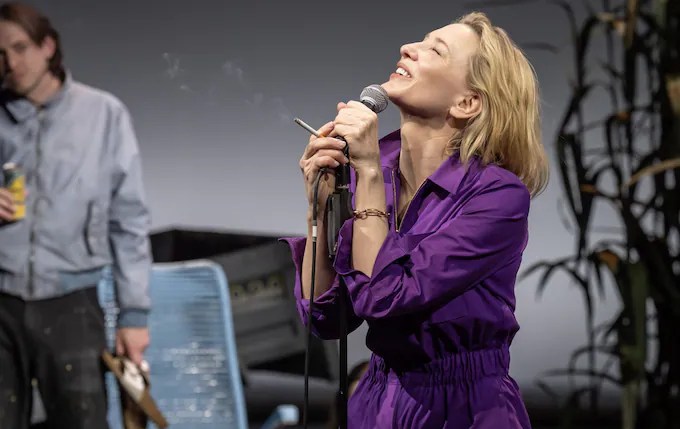
Cate Blanchett as Irina Arkadina (c) Marc Brenner

The Seagull by Anton Chekhov – Barbican Theatre, London

The quadbike which Simon Medvedenko (Zachary Hart) rides onto the stage at the start of Thomas Ostermeier’s production of The Seagull makes a statement straight away about the type of evening this will be. Ostermeier, true to form, strips away the play’s morose, stuffy pre-Revolutionary setting and makes it about the here and now. He has a point: this is something directors are reluctant to do with Chekhov, who still inspires the kind of reverence we long ago got past with Shakespeare. It makes for an entertaining but wildly inconsistent evening.

Hart, having got off his bike, pulls out an electric guitar and sings some Billy Bragg. The microphones that stay on stage throughout are used to address the audience directly, on the basis presumably that everyone is giving some kind of performance. Ostermeier’s approach is to underline everything, which is superficially entertaining. but has the tendency to pull the play to pieces. Central to this is Cate Blanchett, who delivers a fully committed performance as Irina Arkadina but gives the impression of being in a different play, encouraged by alienating devices such as the catwalk attached to the front of the stage on which she drapes herself dramatically, separating herself from the intense drama building behind her.

The rest of the cast ranges from brilliant to ineffectual. In the former category, Paul Bazeley’s Dorn is destroys people without meaning to, and Priyanga Burford brings his occasional lover Polina to intense life with limited stage time. Tanya Reynolds is excellent as a willowy, emo Masha, too wise for her years. And Tom Burke as Trigorin has an intensity of disappointment with life and himself that is truly scary. On the other hand, Kodi Smit-McPhee never fires or convinces as Konstantin, and the climactic scene with Emma Corrin’s Nina, a part to which she does not well-suited, does not deliver chemistry or intensity. On the night I attended, Jason Watkins was unfortunately indisposed and not playing Sorin.

The adaptation, by Duncan Macmillan, sets out to bring the play, leaping and shouting, into the 2020s, showing us it has as much to say now as it did in Chekhov’s era. However, this is never a subtle process, albeit full of energy, and when we hear actors raging about how little theatre doesn’t matter to ordinary people, it’s hard not hear a background hum of self-congratulation at just how self-ware everyone is. And Chekhov speaks to people on a human level, communicating political and existential issues in the frustrations we can all identify with. Macmillan and Ostermeier seem intent on making The Seagull something it isn’t.

There are powerful scenes including, surprisingly, the use of ‘Golden Brown’ by The Stranglers to punch home the sadness of a happiness that has entirely gone. Magda Willi’s clever set is simply a dense patch of maize stalks, from which characters emerge, sometimes addjusting their clothing, and into which they vanish again. But the show as a whole seems somewhat misguided, both in terms of concept and cast.

More Life

Photo (c) Helen Murray.

More Life by Lauren Mooney and James Yeatman – Royal Court Theatre, London

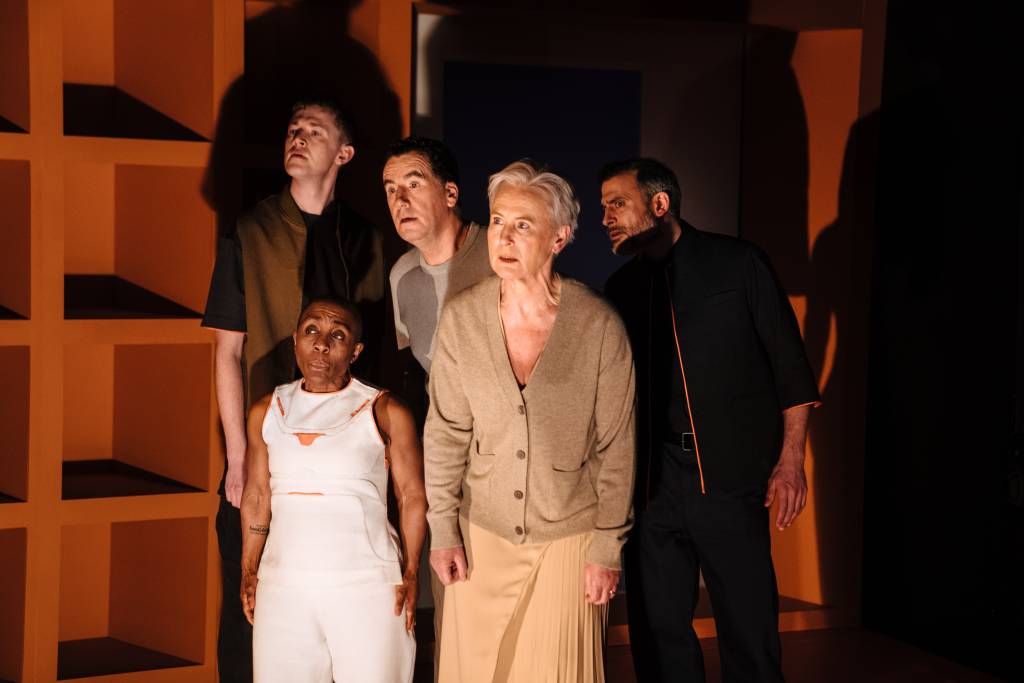
With the tech-enabled delusions of the super rich now the central driving force in global politics, there could not be a more opportune moment to examine the reality behind fantasy bundled as product. Lauren Mooney and James Yeatman, who together are Kandinsky, have devised a chilling and remarkable play for our times. ‘More Life’ imagines what it would actually be like to live forever, and the unequivocal conclusion is… absolutely terrible. Corporate scientist Victor (Marc Elliott) is working to impact the consciousness of dead people, digitally stored half a century earlier, into living bodies – bringing the dead back to life.  After many failed experiments, with people ‘turned off’ when they fail to react positively to the discovery, firstly, that they have died, and then that they have been brought back to life, he succeeds with Bridget, whose new body is played by Alison Halstead. She also appears in her original form as a ghost, played by a Danusia Samal, observing her inexplicable resurrection

‘More Life’ focuses on the emotional impact on Bridget, and her husband (Tim McMullan) and his second wife (Helen Schlesinger), of meeting someone who died 50 years ago. Mooney and Yeatman’s writing teases apart the sheer horror of living in a world where you no longer have a place, and of having your life ripped from its moorings. This is not an advert for AI. A quality cast delivers focused, persuasive performances: McMullan’s blank features crumbling under pressure, Schlesinger’s amenability stretched and torn, and Halstead’s understated performance carrying an emotional heft that builds and builds. Elliott is quixotically driven, while Lewis Mackinnon’s fellow scientist is a counterweight with a conscience.

‘More Life’ is partly an updating of ‘Frankenstein’ – it is bookended with the 1802 electrification of a corpse that inspired Mary Shelley – and partly an echo of Caryl Churchill’s hyper-prescient play ‘A Number’, but very distinctly its own self. Kandinsky’s style is low-key and highly inventive, honed over the course of several productions at the New Diorama Theatre, under now-Royal Court director David Byrne. They present complete, enthralling theatre. The orange cubicles of Shankho Chaudhuri’s set conjure a distant future without cliché; lighting from Ryan Joseph Stafford, sound and music from Zac Gvirtman, and sound from Dan Balfour delineate constantly shifting time periods with complete clarity. James Yeatman’s direction takes an apparently setting and uses the cast in multiple ways, as chorus, narrators, physical presence, and participants in a way that appears seamless, and is very difficult to achieve.

There is an entirely unexpected, devastating scene in which the whole cast sings David Byrne’s ‘Glass, Concrete and Stone’ – a sly tribute to the man who brought Kandinsky to the Royal Court perhaps, and a song of social disconnection. The lyric “Everything’s possible when you’re an animal” takes new on new poignancy in the context of the directions we are choosing to take as a species, or that are being chosen for us. ‘More Life’ is an intelligent and troubling critique, with a fabulous cast – a production enthrals from start to finish. It exemplifies the role of drama as a social mirror which shows us the things we would prefer to ignore.

A Knock on the Roof

Khawla Ibraheem. Photo (c) Alex Brenner.

A Knock on the Roof by Khawla Ibraheem – Royal Court Theatre, London

Published at Plays International

The significance of Khawla Ibraheem’s one-woman play about life in Gaza has only intensified since its runs at the 2024 Edinburgh Fringe and off-Broadway. A Knock on the Roof is one of the starkest, most politically urgent pieces the Royal Court has staged for some time. The war in Gaza has put UK theatre in the spotlight, and not to its advantage. The cancellation by the Royal Exchange in Manchester of Stef O’Driscoll’s A Midsummer Night’s Dream over what have been described as ‘pro-Palestinian’ messages revealed a cultural fault line. It has fed into disputes involving leading industry figures and the Culture Secretary about theatre’s freedom to make political statements, especially on the Israel-Hamas conflict. The brutal events in Gaza have been notable by their absence from our stages, even as they dominate political discourse. In the midst of this, Khawla Ibraheem delivers a masterclass in political theatre. She communicates, with honesty, commitment, humour and self-awareness, the truth of life under siege in a war zone, where politics is not a choice but an all-consuming, everyday reality.

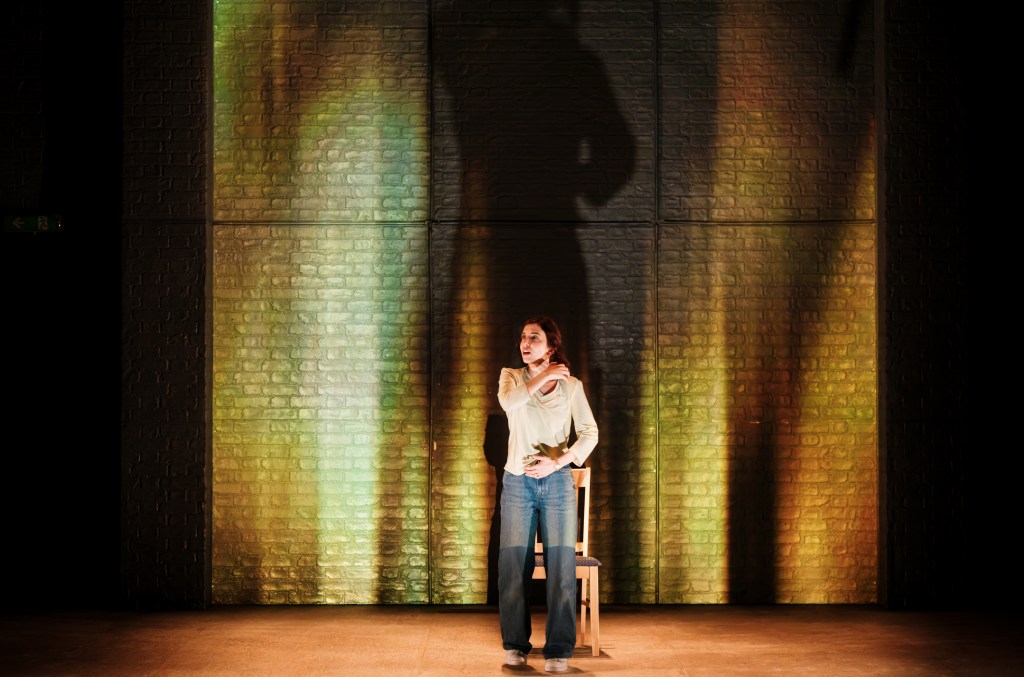
A Knock on the Roof, is both written and performed by Ibraheem. It is named after the tactic, adopted by the Israeli Defense Forces, of dropping a ‘small’ bomb on residential buildings as a five-minute warning to residents that a rocket is coming. Ibraheem plays Maryam, who has a young son, Noor, an aging mother and a husband studying abroad. Her daily existence includes keeping Noor out of the polluted sea, dealing with her mother’s nagging, and negotiating with an absent partner. It also involves escape drills. Maryam becomes obsessed with how far she can run in five minutes, and who or what she can carry, if the knock comes. She practices in the middle of the night, carrying a weighted bag to represent her son, hoping to get fitter, trying to create a scenario in which her family survives.

The constant, never-ending fear that attends Gazan life is both mesmerising and terrible. The concept of being on the alert 24 hours a day for a signal that death is imminent is a deeply distressing scenario, and also farcical. What would you really bring if you had just one bag? Would you choose clothes, or things that really matter to you? How far do you imagine you can run in 5 minutes? Which way would you go? And what if you miss the ‘knock’? The combination of the ordinary and extraordinary is excruciating, but Ibraheem also makes it funny. Her performance, committed, nuanced and physical, is a real success. She appears relaxed, hugging friends before the play starts, engaging in audience interaction, but she is laser-focused. Her writing is multi-layered, acknowledging absurdity as well as terror. We are entirely convinced as she describes what on the surface seems unrelatable, describing an extreme situation entirely in terms of human experience.

The play is also about more than the war, or the many previous wars – even Noor has already lived through two. Ibraheem writes about the frustration of being a woman in Gaza, with a child and husband neither of whom she really wanted, her studies and future curtailed. Her mother reinforces the social expectations that weigh her down, insisting she showers in a dress so she is not pulled naked from the rubble if the building is bombed. The focus is entirely on her performance. The stage is bare apart from a single chair, and settings are shown through light-touch back projections on the bare brick of the back wall – set designs by Frank J Oliva, and projection design by Hana S Kim. Director Oliver Butler developed the piece with Ibraheem, and together they conjure a place we find hard to comprehend from nothing with enormous skill. Ibraheem uses her body to communicate the sheer physical demands of survival in a war zone.

A Knock on the Roof is a significant show for a number of reasons. Staging such a stripped-back piece in the Royal Court’s main auditorium is a big and bold statement. Khawla Ibraheem is not only a significant talent, but a performer we need to hear from right now. And she blows away the fog of political argument and disinformation by showing what it is like to live in Gaza – something that, despite many months of press coverage, we still do not really know. The message she communicates is undeniable, that what happens to people is the only thing that matters. Away from slogans, this is surely the most meaningful lesson we can learn from disastrous conflict. If theatre cannot communicate this, it has no role; but by staging this show Artistic Director, David Byrne, makes it clear that he understands where the Royal Court’s power lies.

The Passenger

Robert Neumark Jones and company. Photo by Steve Gregson.

The Passenger by Nadya Menhuin – Finborough Theatre, London

Published at Plays International

The Passenger is adapted from a remarkable book. Ulrich Alexander Boschwitz was a German Jewish writer who fled the country in 1935 after the murder of his uncle, as the Nazi terror began to close in. Moving from country to country, he and his mother were eventually interned as enemy aliens on the Isle of Man. Deported to Australia, he was eventually freed, only to die when his ship was torpedoed by a U-boat on the voyage home. His last book was an account of the persecution of Jews which followed Kristallnacht in 1938. Forgotten for 70 years, it was republished in 2010 as The Passenger – a rare and powerful account of a terrible time from someone who was there.

The Passenger transfixes the onlooker with horror. Nadya Menhuin has adapted the novel with great skill to create a drama powered by escalating disbelief and panic. In the course of a week, well-to-do businessman Otto Silbermann, who imagines himself protected by his money, social status and Aryan wife, becomes a penniless refugee within his own country, constantly travelling the railway system to avoid arrest. He finds himself betrayed by everyone, from his relatives to his business partner, all of whom choose to protect and enrich themselves at his expense. The story is both familiar and surprising. We know what happened to German Jews persecuted by the Nazis – of course we do – but what that actually entailed is somethign revelation. From forced sales of assets, to being turned back at the border by armed Belgian guards, the reality of being rejected by the society you imagined you belonged to is laid out in all its humiliating minutiae.

As Silbermann, Robert Neumark Jones is driven by exasperation. He simply cannot believe that what happens to him is possible – “This is the 20th century!” he pleasds. As all his assumptions are dismantled, he makes a slow-burning transition into mounting fury, which culminates with a remarkable scene in which he screams at a Nazi policeman to give him the justice that will never be forthcoming. Around him, a resourceful and committed cast flip between multiple characters as Silbermann’s transient existence brings him into the orbit of other Jews on the run, and the anti-Semitic population that persecutes them, actively or passively. Kelly Price expertly plays six different women who offer both sympathy and threat. Eric MacLennan also plays six characters, including blustering Nazi nobodies relishing their sudden power. Dan Milne plays people with the misfortune to ‘look’ Jewish, who Silbermann finds himself abandoning to save himself. Ben Fox channels a resentful thuggishness as, among other parts, Silbermann’s business partner, who fleeces him with relish.

Using every inch of the Finborough’s postage stamp stage, Tim Supple directs the action with great skill. The play is all about movement and constraint, neatly represented by Hannah Schmidt’s waiting room and destination board with an endless round of dangerous destinations. Movement and tableaux are used expertly to generate flow and movement across multiple setting. The production is highly compelling, driven by Silbermann’s disbelief and matched by that of the audience. It is a significant achievement, making the concept that we should never forget the Holocaust something tangible and current. We may think we understand, but each experience of individual catastrophe was both comparable and entirely different. The Finborough has picked its moment perfectly to bring Boschwitz’s crucial the eye witness account to the stage. As clouds of authoritarianism gather across the globe, and immigrants are once again cynically demonised, The Passenger feels much more relevant than anybody would wish. It is both an urgent lesson from history, and theatre of the highest quality.

Macbeth

Cush Jumbo and David Tennant. Photo by Marc Brenner.

Macbeth by William Shakespeare – Donmar Warehouse (in cinema)

Max Webster’s production of Macbeth, screened in cinemas from the Donmar Warehouse, has a set by Rosanna Vize which places much of the action on a raised white square that looks like a sacrificial table. It is kept clean from blood until the very last moments of the show, when David Tennant’s Macbeths lies slain, finally staining the pristine surface with a lake of blood. The exposed stage is countered by a balcony, behind glass, where events outside Macbeth’s consciousness take places – the slaughter of the Macduffs for example, and where a Celtic folk band both play haunting music and transform into the witches and other characters, banging frantically on the transparent barrier. The spotlight arena emphasises the Macbeths’ terrifying internal world, which is clearly a toxic marriage. Cush Jumbo’s Lady Macbeth manipulates her husband in a way that is clearly the basis of their relationship while Macbeth himself responds habitually. passive-aggressively – until the murder of Duncan releases his own inner darkness. He rapidly transforms into something that scares even his wife, and there is no way back.

The intensity of the production is heightened by movement techniques by Shelley Maxwell which are reminiscent of Japanese horror films, with sinister walks that parody the human body and reveal the unnatural world into which the play descends. Tennant is a sociable, likeable Macbeth who performs his place in the Scottish aristocracy until he is no longer able to keep up the pretence. His performance is sophisticated and multi-layered, up there with the best of recent times. Cush Jumbo is force to be reckoned with, but her vulnerability is never far from the surface and she spends more of the play terrified than in charge. Other strong performances come include Cal MacIninch’s Banquo, one step ahead of his friend even as he becomes king. Rona Morison’s Lady MacDuff is justifiably angry at her abandonment, while Ros Wat plays Malcolm against type, physically small but fully equipped to root out evil. Jatinder Singh Randawa gives a good account of The Porter, with genuine laughs from his updated dialogue and audience interaction.

The production is known for its sound world which, in the theatre, is delivered through headphones. Although some of the intimacy is lost in the cinema, Gareth Fry’s sound design is still the defining feature. Alongside snatches of live music, it takes us into Macbeth’s head where the witches who, more often than not are invisible, make their presence known with layered, genuinely disturbing whispered and gasped dialogue. The sound complements the bleak interior world of the design with aural hallucinations which are more alarming than anything visible could ever be.

This is an intellectually rigorous Macbeth, stripping away distractions to focus on the unstoppable descent of its main character. Its simplicity and impact makes the play’s difficult reputation seem hard to fathom. Max Webster, whose concurrent production of The Importance of Being Earnest could not be more different, is revealing himself to be a director with a rare talent to bring out the value in plays we already think we know.

A Good House

Photo by Camilla Greenwell

A Good House by Amy Jephta – Royal Court Theatre, London

Published at Plays International

The set for A Good House starts empty, a bare stage surrounded by a strip of light which looks like an arena designed for combat. The set, by Ultz, transforms into a series of interiors over the course of the evening, as the living rooms of three different homes. Each scene is changed by the cast as they build their own interiors, carefully constructed to build or hide racial and social identity. These houses, it turns out, are battlegrounds.

Amy Jeptha’s tense, funny satire is set on a new-build estate called Stillwater, somewhere in South Africa. In an echo of Harold Pinter’s ‘A Slight Ache’, a mute but menacing presence is enough to explode the conventions holding a fragile social consensus together. With Pinter it was a matchseller in the street outside; in ‘A Good House’ it is a shack, erected overnight on waste ground by unseen hands. It is visible from the sitting room belonging to young couple Chris (Scott Sparrow) and Jess (Robyn Rainsford), and seems to them to jeopardise their entire way of life. Attempts to form a ‘neighbourhood watch’ to deal with the perceived threat strips the covers off everyone’s assumptions about race, threat and social status – and about their most intimate relationships.

Jeptha’s writing is highly skilled and very funny, even as it lays middle-class South African society open. The young couple and the shack become a catalyst for an excruciatingly polite war of words between white couple Andrew (Kair Luke Brummer) and Lynette (Olivia Darnley) and black couple Bonolo (Mimî M Khayisa) and Sihle (Sifiso Mazibuko). The cast give highly entertainingly, finely calibrated performances. Brummer is hilariously tense as he tries to avoid saying the wrong thing, while sounding like a racist every time he opens his mouth. Darnley is equally amusing as a social manipulator not nearly as clever as she imagines. Jeptha mercilessly caricatures white hypocrisy, but also insecurity: Rainsford’s Jess quivers with the effort of maintaining her place on the social ladder, and Sparrow, as her partner Chris, descends into meltdown over his perceived social inferiority. 

However, the focus of the play in on Bonolo and Sihle. A financially successful black couple, they find themselves forced to choose between defending middle-class privilege, or the rights of the unseen shack dwellers. This opens up rifts in their relationship. Bonolo openly questions Andrew and Lynette’s motives, while besuited executive Sihle tries to keep the peace, and not make trouble: yet it is Sihle who grew up in poverty while, as he puts it, the activist Bonolo was always ‘bouji as fuck’. Khayisa and Mazibuko give excellent performances as a couple who love one another, but whose personal lives cannot be separated from the political choices engulfing them. There are a couple of remarkable cut-away scenes, as the tensely polite living room chat pauses and the pair give way to their real feelings about their neighbours, rolling around on the carpet helpless with laughter.

‘A Good House’ is a quality drama, directed with vision and control by Nancy Medina. Jeptha’s writing is honed and precise, exposing the tensions of a society where everything that matters goes unsaid. Her drama involves an intruder disrupting a supposedly cosy social setting, a classic theatrical scenario, but the play feels right up to the minute. The cosiness is superficial, and the self-interest entirely transparent, with characters such as Andrew principally concerned about ‘optics’. Everything and everybody feels closer to the edge than ever before, but ‘A Good House’ is also riotously funny. It is a fine production on every level.