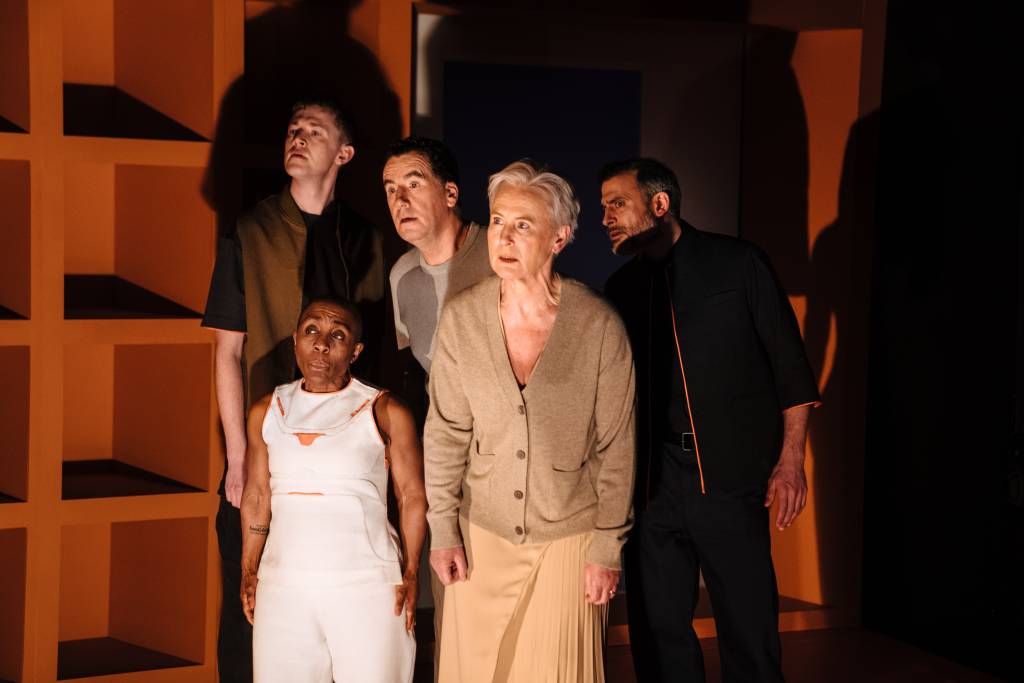
Photo (c) Helen Murray.
More Life by Lauren Mooney and James Yeatman – Royal Court Theatre, London
With the tech-enabled delusions of the super rich now the central driving force in global politics, there could not be a more opportune moment to examine the reality behind fantasy bundled as product. Lauren Mooney and James Yeatman, who together are Kandinsky, have devised a chilling and remarkable play for our times. ‘More Life’ imagines what it would actually be like to live forever, and the unequivocal conclusion is… absolutely terrible. Corporate scientist Victor (Marc Elliott) is working to impact the consciousness of dead people, digitally stored half a century earlier, into living bodies – bringing the dead back to life. After many failed experiments, with people ‘turned off’ when they fail to react positively to the discovery, firstly, that they have died, and then that they have been brought back to life, he succeeds with Bridget, whose new body is played by Alison Halstead. She also appears in her original form as a ghost, played by a Danusia Samal, observing her inexplicable resurrection
‘More Life’ focuses on the emotional impact on Bridget, and her husband (Tim McMullan) and his second wife (Helen Schlesinger), of meeting someone who died 50 years ago. Mooney and Yeatman’s writing teases apart the sheer horror of living in a world where you no longer have a place, and of having your life ripped from its moorings. This is not an advert for AI. A quality cast delivers focused, persuasive performances: McMullan’s blank features crumbling under pressure, Schlesinger’s amenability stretched and torn, and Halstead’s understated performance carrying an emotional heft that builds and builds. Elliott is quixotically driven, while Lewis Mackinnon’s fellow scientist is a counterweight with a conscience.
‘More Life’ is partly an updating of ‘Frankenstein’ – it is bookended with the 1802 electrification of a corpse that inspired Mary Shelley – and partly an echo of Caryl Churchill’s hyper-prescient play ‘A Number’, but very distinctly its own self. Kandinsky’s style is low-key and highly inventive, honed over the course of several productions at the New Diorama Theatre, under now-Royal Court director David Byrne. They present complete, enthralling theatre. The orange cubicles of Shankho Chaudhuri’s set conjure a distant future without cliché; lighting from Ryan Joseph Stafford, sound and music from Zac Gvirtman, and sound from Dan Balfour delineate constantly shifting time periods with complete clarity. James Yeatman’s direction takes an apparently setting and uses the cast in multiple ways, as chorus, narrators, physical presence, and participants in a way that appears seamless, and is very difficult to achieve.
There is an entirely unexpected, devastating scene in which the whole cast sings David Byrne’s ‘Glass, Concrete and Stone’ – a sly tribute to the man who brought Kandinsky to the Royal Court perhaps, and a song of social disconnection. The lyric “Everything’s possible when you’re an animal” takes new on new poignancy in the context of the directions we are choosing to take as a species, or that are being chosen for us. ‘More Life’ is an intelligent and troubling critique, with a fabulous cast – a production enthrals from start to finish. It exemplifies the role of drama as a social mirror which shows us the things we would prefer to ignore.
 Tom Bolton