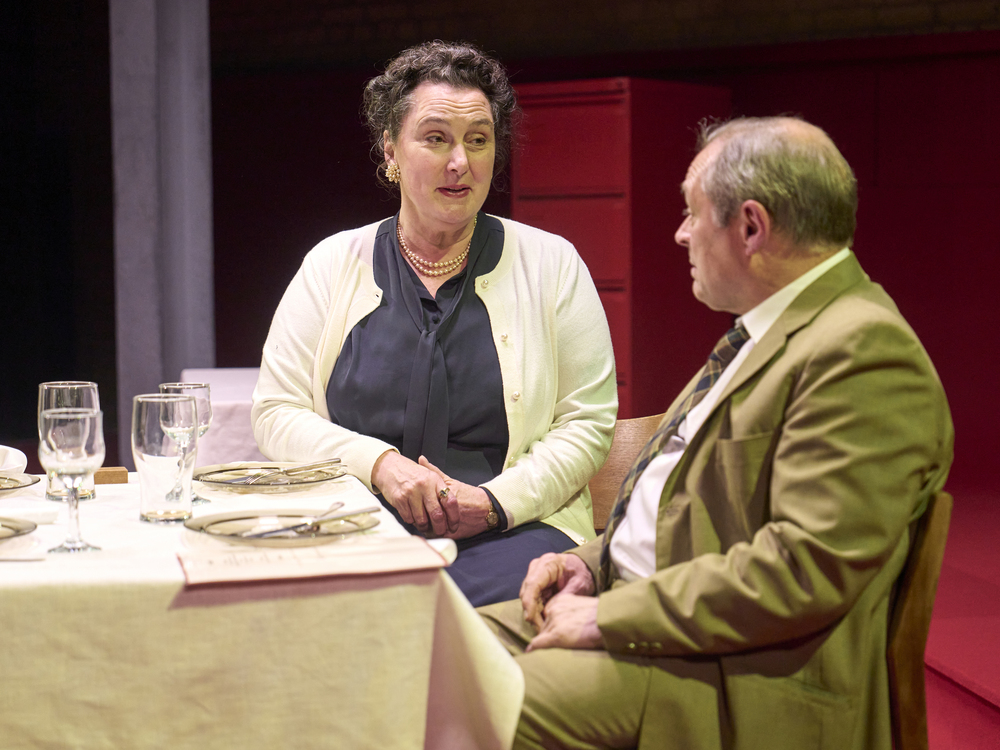
Kate Duchêne and Paul Rider. Photo by Manuel Harlan.
A Quartet in Autumn by Barbara Pym, adapted by Samantha Harvey – Arcola Theatre, London
Like the much-loved novel on which it is based, Dominic Dromgoole’s production, and Samantha Harvey’s adaptation of A Quartet in Autumn is mini-masterpiece of understated human dynamics. Barbara Pym’s book, written late in her career after she had finally achieved recognition, is set in an office and deals with four people who’ve worked together for years – two men and two women. The women are retiring soon, which bring various levels of reckoning with purpose of existence, or lack of it. Lettie (Kate Duchêne is single and contemplating retiring to the country to live with her friend. Marcia (Pooky Quesnel) is defensive and reclusive, and has had ‘an operation’ she refuses to explain. Norman (Paul Rider) is bitter and enjoys provoking the women, although there is unresolved tension with Marcia. Edwin (Anthony Calf) is a widower devoted to the Church of England, but troubled by its decline.
The novel is a terrifying insight into what 1970s life was like for an older generation, baffling to those who didn’t experience it themselves. There is an underlying terror of war, especially from Marcia who hoards tins. The everyday sexism is jaw dropping, whether from Norman who deliberately uses it to goad the women, or Edwin who is casually patronising. And everyone is obsessed with status and social acceptability – whether growing a laburnum over your door will be seen as ‘too much’, or indeed whether anything will. Samantha Harvey, fresh from her Booker Prize win with ‘Orbital’ does not mess around with any of these, translating the subtleties of the way the characters talk to one another within minimal fuss into a dramatic structure that plays out beautifully on Ellie Wintour’s quadruple desk set. It’s not often that the inherently static nature of a drama has been so well used to such strong effect.
The exceptionally well-drawn roles are a delight for the performers. Anthony Calf is both deeply complacent and troubled by the many things he can’t understand. Paul Rider is very convincing as man with a lifetime’s resentment he can’t prevent from bubbling over. Pooky Quesnel is spiky and affronted as a woman intent on destroying herself without realising. But the stand-out performance comes from Kate Duchêne, who is heart-breaking as someone finally realising she can take control of her life, and very funny too. Her story about thinking she’s spotted an old friend collapsed on a station platform, getting closer and hearing her tell people to ‘fuck off’, thinking it can’t possibly be her, then wondering whether her modes of expression might have changed in the decades since she saw her, then deciding to walk away, is classic Barbara Pym, which Duchêne absolutely relishes. The only weaknesses in the production are Pym’s – although the bizarre fate of Marcia could be read as black comedy, in which case it seems slightly less over the top. The production, which is thoroughly absorbing, faithfully transmits her signature combination of apparent social conservatism blanketing deeply waspish and perceptive social critique.

