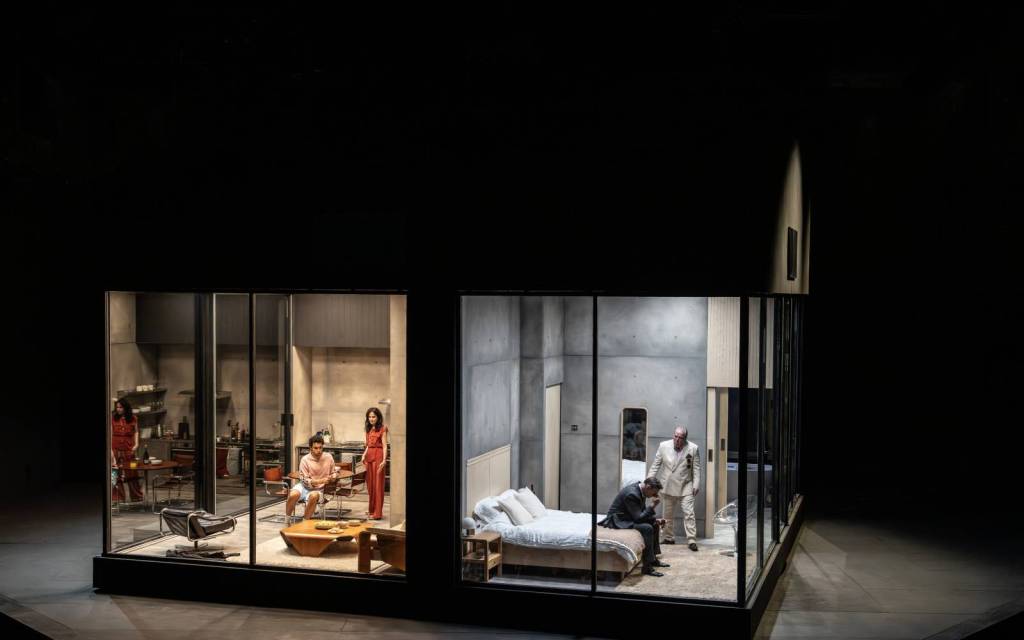
The Oresteia by Aeschylus, adapted by Simon Stone – Bridge Theatre, London
Simon Stone’s version of The Oresteia, transposed to commuter belt Kent, is a cousin to his National Theatre production of Phaedra – or, in the context of this particular drama, perhaps a sibling. Working with set designer Lizzie Clachan, he directs his own loose adaptation of Aeschylus, similarly staged inside a house with glass walls, among the wealthy upper classes. As with Phaedra, he delivers a production defined by complete, unapologetic confidence that the three part unravelling of Agamemon and his family can stripped of all the trapping that we think identify the story and still communicate essential human truth.
Stone dismantles the three parts of the Oresteia to tell much of the story in sequences of flashbacks, the timelines projected above his revolving set. We shamelessly spy on the activities, contained for the most part in the various rooms of an immaculate, expensive house somewhere outside Sevenoaks. A family – parents Christopher (David Morrissey) and Montie (Mary-Louise Parker), children Augie (Tom Glynn-Carney) and Alice (Rosie Sheehy), friends Jerome (John Macmillan) and his son Lorenzo (Archie Madueke) prepare for a birthday party. It’s Alice and her absent twin Isabel’s 21st, but family dynamics are extremely tense. Isabel isn’t coming because she’s fallen out with her father over his firm’s role in supplying military equipment, intentionally or otherwise, to Russia. Christopher’s older brother Melville (Lloyd Hutchinson) arrives, Mafia-don style, to lay down the way he wants it to play out. We know it isn’t going to end well
Stone plays an entertaining game with Aeschylus’ original, tackling story elements that don’t concern his version with insousiance. Melville, a Menelaus-figure, has a wife who had an affair which caused him to ram the gates of her lover’s house with his Range Rover and take a shit on his front steps – the Trojan War, in other words. However, his real focus is on Christopher’s betrayal of Isabel, exposing her mental health problems on national television, leading to her subsequent death by her own hand. The family relationships are thoroughly absorbing, delivered through a series of high quality performances by a fine cast. Rosie Sheehy as Alice, with an overwhelming inferiority complex, and Tom Glynn-Carney as her casual brother ignited to mete out brutal, self-righteous, have a fully believable sibling relationship which establishes a real domestic setting for the staggering violence which defines the play. David Morrissey is anguished and contrite in way that makes you want to… well… murder him. Mary-Louise Parker, in a rare appearance on the British stage, is a woman under impossible family pressure who is capable of being many different things, from loving mother to angel of death. Lloyd Hutchinson is thoroughly nasty, and father-son pair of John Macmillan and Archie Madueke have a deeply uncomfortable relationship based on neediness and rejection.
A long play feels short as the action unspools with a stomach-lurching relentlessness. The scene in which Christopher visits his now-ex wife Montie for dinner with her new partner Jerome, in the company of his new girlfriend Chandra (Rakhee Thakar) is horribly tense. Their housekeeper Jenny – Alyth Ross, channelling a cameo that reveals worlds about working for the super-rich – is drawn into the slaughter that approaches slowly and relentlessly. The transposition isn’t perfect – occasionally there are plot devices that might be more at home in a mid-range tv thriller – but it’s a thrilling and enthralling ride. No-one quite tackles the classics like Stone, and his productions make a significant amount of contemporary British theatre seems clumsy and mired in the past. A little bit of the Berlin Schaubühne does wonders in helping us look beyond our narrow shores.

