Nina by Caroline Williams at Battersea Arts Centre, London
Published at Plays International
The autumn season at Battersea Arts Centre is a statement of intent: an eclectic programme which reaffirms the venue’s commitment to experimental theatre. BAC takes risks to ask questions that matter, but that kind of theatre is more costly than ever and harder to sustain, especially in a glorious, rambling, impossibly expensive building like the former Battersea Town Hall. BAC is irreplaceable, but the feeling is growing that sooner or later we will have to fight for places like this. The fate of Edinburgh’s Summerhall, another shoestring arts complex now forced to compete for space with hotels and student housing, shows there are no guarantees. What better way then to affirm BAC’s role as one of the UK’s most important producing venues, than with an exciting, unashamedly confrontational new play.
Writer and co-director Caroline Williams and fellow co-director Deborah Pearson are a team who grew up on the space for experimentation provided at BAC, where they both started out. Williams wrote Nina during COVID and, intriguingly, it makes arguments which have since dropped out of wider discourse. The MeToo era has given way to anti-woke posturing, and questions about the way women experience the power of men have become obscured. Nina is a timely return to issues never properly addressed. It is also a powerful and absorbing piece of writing which shakes up expectations. It opens with a projected quote from the writer Trigorin who, in Chekhov’s The Seagull, proposes a short story in which a young, aspiring actress is destroyed by a man out of sheer boredom, shot like a passing seagull. This scenario plays out in The Seagull itself, as the young actress Nina is used and destroyed by Trigorin himself. And it plays out in Nina, as a series of actresses audition for the part.
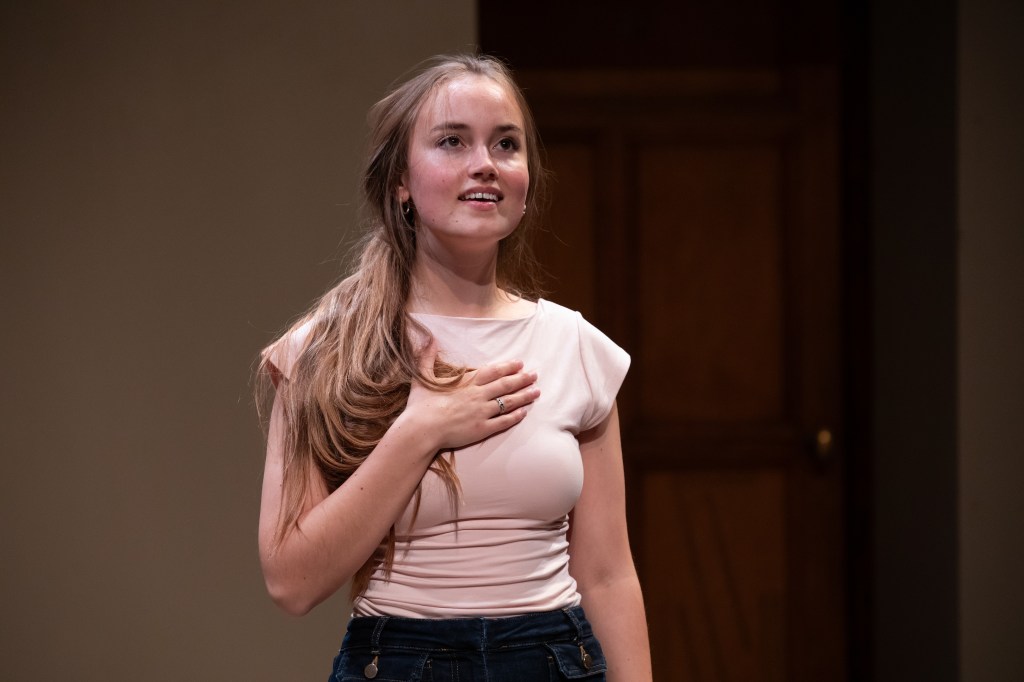
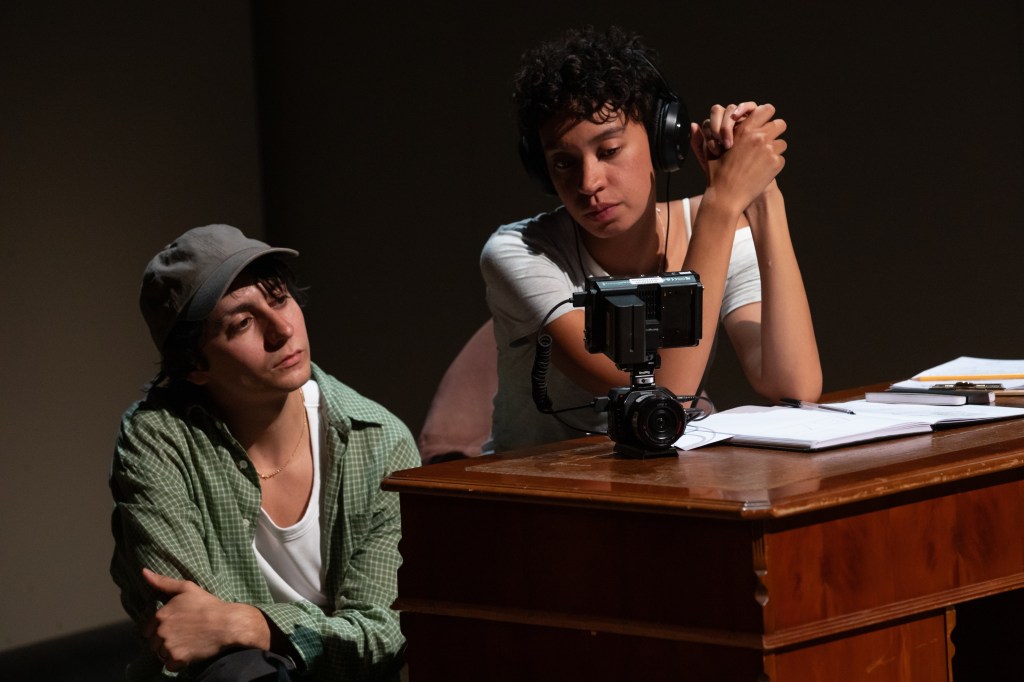
Tomás Palmer’s set is a bare rehearsal room, where four young women stand in the spotlight, while director Goran (Rowan Polonski) directs their auditions, at first as a disembodied voice through a ‘God-mike’. He is an autocratic, generically European director. All the audition candidates tell him how much they love his work, and he manipulates them as he pleases. Nina 1 (Maya Bartley O’Dea) is shot like the seagull after just a couple of lines. Nina 4 (Gemma Barnett) is told she is too old for Nina, too young for the part of Irina Arkadina. Nina 2 (Samantha Begeman) is nervous and, professionally, in no position to assert herself. Nina 3 (Nina Bowers) is too self-possessed for Goran. In an intense and horrifying scene, Goran pressures her into channelling of pregnancy and abortion to enact a childbirth scene, recreating the experience of Nina in the play. When she asks for feedback, it turns out he went to lunch halfway through.
Goran’s treatment of Nina 2 is at the centre of the play. He casts her as Nina and pushes her through an exposing masturbation scene, ignoring his pleas to let her stop. The play is a success and it makes her a star but, when the pair are interviewed on TV, the cost to her becomes clear. Nina is based around a set of stellar performances. Samantha Begeman is remarkable in her journey from awkward inexperience to an insight she never asked for. She gives a speech about the way acting makes her feel she is able to stop time, in which she pretty much does exactly that. But the cost of putting her vulnerability on display, at the behest of a controlling male ego, is shocking. In Daniel Denton’s highly effective video design, her raw performance is projected behind her as she plucks the feathers from her costume in despair.
Nina Bowers is equally impressive as a woman who thinks she is an equal artistic relationship, only to discover she is being used in every way. Rowan Polonski is unnervingly convincing as a liberal, feted, deeply misogynist director. Joseph Payne is excellent playing Goran’s sidekick, a nepo-baby aspiring writer who is an analogue for Konstantin in the Chekhov play – both socially awkward and sexually opportunisitic, touching up Nina 3 the moment she tells him she is in a relationship.
Some of the gratuitous mistreatment of the actresses would seem cartoon-like, if it weren’t for Caroline Williams’ programme note explaining that everything in the play really happened, either to her or to friends. Her writing throws the treatment of women on stage back in the face of perpetrators, but it does more than that. She also challenges the dominance of a classical canon powered by male representations of women, like Nina, suffering trauma at their hands. And she challenges the expectation that actresses will relive their own personal traumas, also experienced at the hands of men, to perform these representations. Nina shows us how much we take for granted, from actresses and the theatre, and asks whether the costs are justified. It is a must-see show, with an exciting cast, from a writer who matters.

