Pass It On by writers from the Yellow Coat Theatre Company Collective – Theatre 503, London
COMPANY B
Lane Swimming is written by Lucy Dobree, performed by Alessandra Perotto and directed by Ella Murdoch.
Untitled is written by Khawla Ibraheem, performed by Hazal Han and directed by Bettina Paris.
Period Pills is written and performed by Emma Lamond and directed by Caron Kehoe.
Dirt, Moss and Pigeon Shit is written by Sherry Newton, performed by Nicola Rockhill and directed by Sherry Newton and Belle Bao.
PA’ing is written by Emma Dawson, performed by Leila McQuaid and directed by beth drury.
That’s Not My Name is written by Siân Rowland, performed by Corinne Strickett and directed by Tania Black.
Grown Ups is written by Claire Marie Perry, performed by Lucy Renton and directed by Belle Bao.
The Argos Delivery is written by Annette Brook, performed by Roli Okorodudu and directed by Ella Murdoch.
Seaside is written by Martha Reed, performed by Marina Johnson and directed by AK Golding.
Let’s Talk About Tea is written and performed by Caron Kehoe and directed by Fiona White.
The full line-up of monologues that makes up Yellow Coat Theatre’s Company B performance is delivered in 60 minutes by ten different actors, each of whom stands up from the side of the stage and steps in the limelight when their moment arrives. The consistent quality of both writing and performance is a real achievement – and there are Companies A and C too! All ten plays are involving, unpredictable and carefully honed pieces. They are by women and about women, but that’s where any similarity ends. Subjects and styles range from a woman asserting herself in the middle lane of the local pool, to a PA fighting her instincts to tell the new starter how she’s really treated to a girl practising fleeing the bombs in Gaza, and finding herself doing it for real. All ten authors do not miss a beat, and the actors deliver their work with uniformly involved performances
The piece that perhaps stood out from a high quality bunch was The Argos Delivery by Annette Brook, about a woman with a surprisingly strong attachment to her toaster. It was offered a perfect side-angle on mental illness and isolation while also being genuinely funny and strange. Roli Okorodudu performed it with a disarming openness, and hints of a lot more hiding behind the mask.
Yellow Coat Theatre Company have something very impressive going on here, and Pass It On is a guide to the theatre of the future.
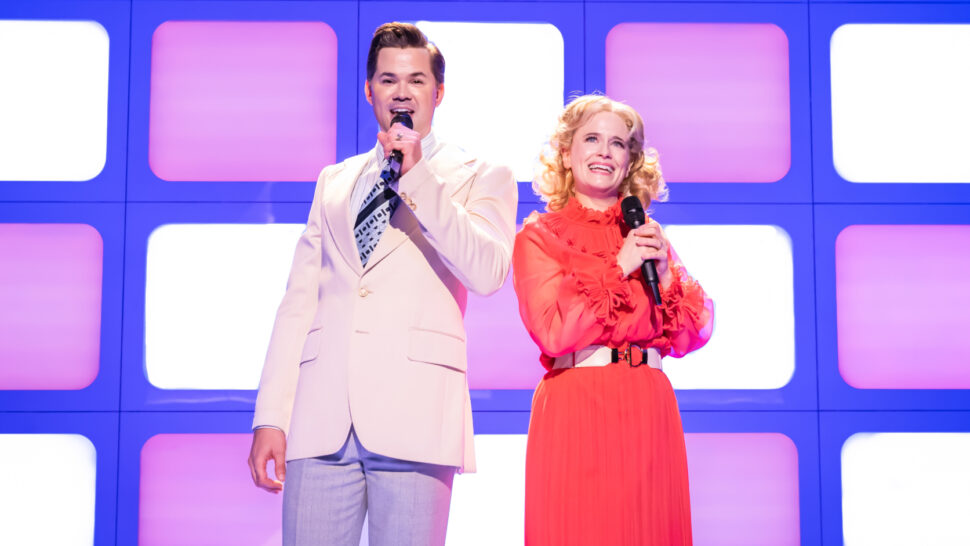
Andrew Rannells and Katie Brayben. Photo by Marc Brenner.
Tammy Faye – book by James Graham, music by Elton John, lyrics by Jake Shears – Almeida Theatre, London
The Almeida, and director Rupert Goold, have pulled off quite the coup with Tammy Faye. Of all the people a director might lure to wrote a new musical, Elton John must be top of the list, probably backed up by Jake Shears writing the lyrics. The dream team might not include James Graham, but his involvement is a very clever move. The result is a musical that is just as camp, ludicrous and over-the-top as everyone would expect, but also politically incisive and historically pertinent. Graham serves us up a warning from history that looks amazing and sounds even better.
The recent focus on Tammy Faye Bakker is a little strange. Half of an American tele-evangelist duo with her husband James, who pioneered satellite Christian broadcast as part of a new wave of Reagan conservatism, she also became an unlikely gay icon. As recounted in Michael Showalter’s 20201 film ‘The Eyes of Tammy Faye’, which won Jessica Chastain the 2021 Best Actress Oscar, she incurred the wrath of evangelical peers by inviting HIV positive pastor Steve Pieters onto her show in 1985, when AIDS was being used as a propaganda tool by the religious right and homophobia was standard. Her reputation is built on this remarkable act, which has prevented her from being consigned to history with Jim, who was convicted of fraud and given a 45 year jail term after the couple’s Heritage USA theme park went under, taking the contributions of many viewers with it. She died of cancer in 2007 and the show begins, in a scene neatly balanced between comedy and tragedy, with Tammy Faye (Katie Brayben) on all fours being examined by her proctologist. Her story is fascinating for various reasons: as a story of resistance to expectations, of a woman fighting to be recognised and as an account of a historical era which extends its influence over US and world politics forty years later.
Graham has woven a persuasive account of conservative intolerance around the rise of the Bakkers. He includes a rogue’s gallery of contemporary preachers – Pat Robertson, Jimmy Swaggart, Jerry Falwell, Marvin Gorman, Oral Roberts and their forbear, Billy Graham – and shows the growth of the tele-evangelists alongside the reintroduction of religion, previously frowned upon, into US politics by Ronald Reagan. Before long evangelical Christians were voting as a block, brought together partly by the unprecedented reach of tv preachers, and declaring war on the liberal issues of feminism, gay rights and abortion. Plus ça change. The evangelists were deeply unpleasant people (and still are – Jim Bakker and Pat Robertson are both still alive and full of hate), but they were big characters and, as well as providing the kind of history lesson only Graham can deliver, ‘Tammy Faye’ is wildly enjoyable ride. Zubin Varla’s Jerry Falwell is all five o’clock shadow and ’70s suits, and unveils a powerful tenor voice to boot. Ashley Campbell gives us an absurd Elvis-esque Jimmy Graham, not to mention a scene as Larry Flynt. Nicholas Rowe is Pat Robertson, Ted Turner, the CNN owner who unleashed Christian tv on the world, and Pope John Paul II. Steve John Shepherd pulls off the equally remarkable trio of Jimmy Swaggart (seedy), Robert Runcie (dishevelled) and Ronald Reagan (very convincing). Kelly Agbowu and Richard Dempsey make an amusing duo as the Praise The Lord Club’s incompetent, increasingly rebellious management team.
This is all very enjoyable, but the stars of the show are Katie Brayben as Tammy Faye and Andrew Rannells, as Jim. Cycling through costumes from their ’60s Christian puppet show beginnings to their ’70s rise, ’80s heyday and fall from grace, they both deliver wide-eyed, driven performances, taking themselves as seriously as only Americans can, even when they are singing Jakes Shears’ innuendo-laden lyrics. A sample number (about Jesus) has the chorus “He’s inside Tammy and he’s inside Jim”. On stage virtually throughout, Brayben is a powerhouse with a top notch voice, probably a great deal more likeable than the real Tammy Faye (who was mysteriously untouched by the fraud prosecutions that brought the couple down). Rannells plays Jim as significantly less sharp than Tammy and flawed in ways that only he cannot see. The pair pile into Elton and Jake’s songs, which range from catchy tunes (‘Bring Me the Eyes of Tammy Faye’) to Bonnie Tyler-esque power ballads (‘Prime Time’ with the hair to match, Tammy being at her ’80s peak). Goold has packed more entertainment into the evening than anyone has the right to expect, filling the stage with capering chorus lines involving Colonel Sanders, an extremely camp Pontius Pilate, flogging a Jesus who seems to be enjoying it and debates between the Pope, the Archbishop of Canterbury and Mormon President, Thomas Momson. Rannells interviews Reagan during a lifestyle cookery segment, pausing to declare to camera “You cannot have too much cinnamon.” Bunny Christie’s set is simple but effective, using a Celebrity Squares wall of television screens. Katrina Lindsay costumes deserved a curtain call of their own.
‘Tammy Faye’ is a real achievement – entertainment, satire and historical reflection in an equal partnership. With any luck it will transfer to the West End, where it can offer lots more people a very good time and give the Almeida some important financial certainty.
A middle-aged man steps up to a spot-lit microphone on a dark stage. He starts a routine, but his humour is dark to the point of obliteration. “I was the best drunk driver in the world!”, he declares, and spins an anecdote about driving as fast as he can while drinking gin from a water bottle, and not just getting away with it, but loving it. His two young children sit terrified and forgotten in the back seat as he speeds through traffic, inches from death. It is an authentic alcoholic’s tale, sentimental and entirely self-centred, but transformed in the telling if, just for a moment, we can buy into the drinker’s mindset. His name is Scott, and the fact he is telling us this at all hints at some sort of redemption. He may be alive, but this is not a redemptive story.
Scott McClanahan’s novel ‘The Sarah Book’ has been adapted and directed by Oliver Reese, Artistic Director of the Berliner Ensemble, last seen at the Coronet Theatre in 2020 with his adaptation of Günter Grass’ ‘The Tin Drum’. The Coronet’s own Artistic Director, Anda Winters, has built an intriguing partnership with Reese and persuaded him to adapt the novel for the stage. McClanahan, from West Virginia, is hot indie property and his work lauded for its raw but funny prose about the realities of American life. Reese has turned the book into a 90-minute one-man show. Performed by Jonathan Slinger, it has its own unmistakable flavour – a queasy, disconcerting experience, in which every laugh is tempered with horror while the darkness threatens to swallow Scott at any moment.
The setting is the American South, a couple of hours from Charleston. This is the only geographical information we acquire in the course of the evening, as everything takes place in an endless succession of parking lots, Walmarts and drive-in burger joints – a void where a society should be. Scott’s marriage, to high school sweetheart Sarah, is falling apart because of his provocative drinking. He recounts his behaviour in excruciating detail, smashing the family computer in front of Sarah after she finds his porn search history; sleeping in his car surrounded by drug deals; spitting on Sarah’s new boyfriend’s flash car. His life is a series of rock bottoms and there is very little to laugh at, but this does not stop Scott. He layers his account with gross-out humour – stories that focus on piss, shit, vomit, the habits of a repulsive dog. He seems to see what he considers the ugliness of life that we ignore. “I’m a horrible person.” he tells us “And so are all of you, sometimes.”
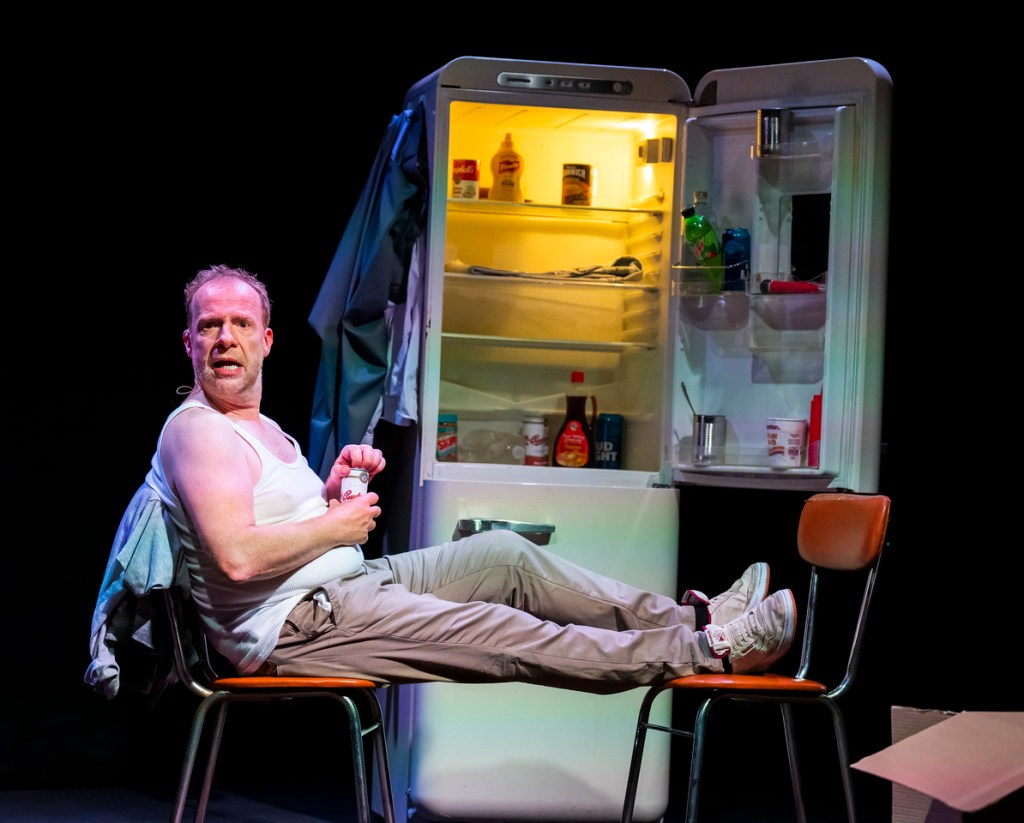
Oliver Reese’s direction, like his adaptation, is confident. He uses the accumulating junk of the set, which fills with crushed cans and detritus as Scott descends through mounting layers of chaos. The scenery consists of simple props – a carpet rolled out to become an apartment. Scott pulls costumes from a fridge freezer, changing on stage between scenes, pulling costume after costume from its shelves and discarding each one. The subtle use of music, from bluegrass banjo to moody slide guitar, builds atmosphere without ever overwhelming it.
Jonathan Slinger relishes a challenging part, playing the role in a Virginian accent and occupying the stage throughout. He treads a fine line between charm and neediness, elation and sentiment, and utter selfishness. He seems dowdy and unremarkable but his face cracks into an impossibly wide grin, like the ghost of his RSC Richard III. Then the smile vanishes, leaving nothing. His performance is layered and slippery, and he keeps the audience guessing. We never feel we have a handle on who he really is, or why we are listening to a man who destroys everyone around him.
Slinger is highly compelling, but the uncertainty at the heart of the script limits the show’s success. Scott’s character is very hard to like, despite his relentless attempts to make us complicit in his story. He relates his despair to the parade of loss that is non-negotiable for all of us but his charm convinces no-one, and he is clearly in the business of self delusion, so the audience is left questioning the value of his story. There is charm in flashbacks to the early days of his relationship with Sarah, before the drinking, but we only have Scott’s word for it. The script is also episodic, moving from set piece to set piece in a way that sometimes seems contrived. We may not believe Scott, but we have to believe in him to be fully invested in his story – especially when he claims to be telling us something about ourselves.
The Coronet is doing us all a big favour by bringing exciting practitioners and ambitious artistically programming to one of London’s best, most characterful spaces. Sarah is a sophisticated attempt to create drama that speaks to us, telling us things we do not want to hear. Scott’s greatest fear is boredom, but there is nothing boring about this flawed but fascinating show.
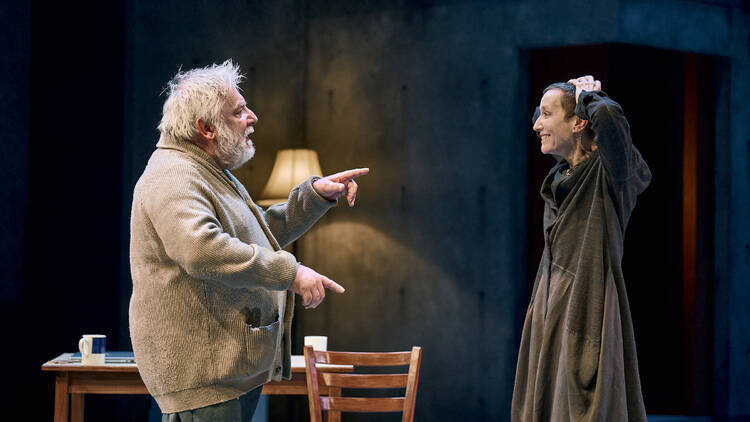
Ibsen’s penultimate play, John Gabriel Borkman is rarely performed but, unlike his final play When We Dead Awaken, it is hard to understand why. It is a highly dramatic study of what happens to a family when it is disgraced, a subject of perennial fascination, full of great roles. The patriarch, known in his heyday as ‘JG”, is played by Simon Russell Beale, who has become a connoisseur of the best leads for the older actor. His wife, Gunhild, is played by Claire Higgins and sister-in-law Ella by Lia Williams. This heavyweight cast, deployed to great effect by director Nicholas Hytner, are the successors to the great trio of Paul Schofield, Vanesa Redgrave and Eileen Atkins who played the roles in its last major London revival, more than 25 years ago at the National Theatre.
The play’s title character, known as ‘JG’ in his heyday, lost his position as a mover, shaker, and head of a bank when he was jailed for fraud. The money was, of course, just resting in his account. In eight the years since his release he has lived in the same house as Gunhild, but separately. In the opening scenes, while she broods downstairs he can be heard relentlessly pacing the room above. Their son, Erhart, is Gunhild’s obsesssion, and she schemes to push him towards greatness to show that the family can redeem itself. Erhart (Gabriel de Souza) is desperate to escape the poisonous home atmosphere and make his own life, somewhere a long way off. Then Ella turns up, Erhart’s surrogate mother during his childhood, carrying the matches that will ignite the tinderbox.
Staged on a cleverly Nordic set by Anna Fleischle, the play is apparently biographical, in that Ibsen and his wife fought each other all the time, and competed through their son. Although the play is ostensibly about JG, it focuses just as much on the dynamic between the two sisters who, it emerges are fighting each other for both father and son. Claire Higgins plays Gunhild as comfortable in her role as the embittered, betrayed wife, but also terrifyingly needy and vulnerable when Erhart comes into the picture. Lia Williams, one of the most under-rated actors of her generation, is thin and jumpy, but far more robust beneath the surface, a force to be reckoned with because she is capable of adapting and, unlike Gunhild or JG, seeing beyond herself.
As the latter, Simon Russell Beale gives one of his best performances. He is full of bluster about getting his business and influence back, especially in front of one-despised lackey Vilhelm (an excellent Michael Simkins), now his only friend, but there is a brittleness to everything he says that reveals his inner despair. Paul Schofield played the character as a man who had lost his mind, with awful consequences. Russell Beale is more human, more calculating and, ultimately more affecting when he decides to take his own path after all. This path leads, as so often in Ibsen, to the top of something tall from which there is no coming back, alive at least. The symbolism in the drama plays against its social realism, with the Norwegian mountains representing both damnation (JG is obsessed with mining the iron they contain) and salvation (climbing to the very summit is the only release from the misery of the world below). The production is a very fine piece of work, and includes several of the finest performances you will see on a stage. Not to be missed.
‘Not Now’ is the third new David Ireland play staged at the Finborough Theatre since 2017, in what is becoming a partnership of significance. First seen in a Glasgow pub earlier this year, the two-hander comes to London in a new production directed by Max Elton, who was also responsible for last year’s Ireland/Finborough venture, ‘Yes So I Said Yes’. Both plays are set in contemporary Belfast and deal with the search for masculine identity in a post-conflict Northern Ireland. They could not be more different.
Ireland is known for his hilariously dark comedy, seen to general acclaim in ‘Cyprus Avenue’ and ‘Ulster American’. His work bears some similarity to Martin McDonagh’s plays of the 1990s, in which horrified laughter is the only possible response to the absurdity of sectarian conflict. Ireland’s provocations reached a peak with the epically offensive ‘Yes So I Said Yes’, which contained some of the darkest material seen on a UK stage in recent years. ‘Not Now’ is the calm after the storm: a deceptively simple play that conceals multiple levels of meaning. Ireland has, perhaps, written a perfect play about Northern Ireland post-conflict, post-peace, post-Brexit and post-truth.
The play opens with the young Matthew (Matthew Blaney) practising the opening soliloquy from ‘Richard III’ and making a meal of it, dragging one leg around the kitchen table like a comic Olivier. Ray (Stephen Kennedy) catches him at it, and an awkward conversation begins across the divide. Ray is Matthew’s uncle, and his unnamed brother, Matthew’s father, has just died. Matthew has an audition at RADA that morning and is about to fly to London and, potentially, an entirely new future. Ray is a painter and decorator, a recovering alcoholic, with no apparent future. Their discussion is equal parts hilarious and troubling. Ray’s inability to remember names leads to some very entertaining exchanges about the actors “Ciaran Farrelly” (Colin Farrell) and “big Liam thingy”. Ray also has problems with the conceptual difference between Richard III and Hamlet. If Hamlet kills just as many people, why is Richard the baddie? Is it because he didn’t mean to? There is much more to these conversations than we first realise. Family secrets start to emerge and no-one, dead or alive is what they seem. They are all pretending, even Matthew who plans to audition in an English accent rather than his natural Belfast, but has problems with the first word in his speech, “now”.
Both Matthew Blaney and Stephen Kennedy give excellent performances, neither putting a foot wrong. Blaney is direct yet confused, at the exact moment in his life when identity is shaped one way or another. Kennedy is equal parts funny and sad. Stocky and older, but not as old as he seems, he is worn away by hiding and by his secret which, we discover, is more shameful than anyone could imagine. Max Elton swirls the action deftly around the central table that occupies the Finborough’s tiny stage, framed by designer Ceci Calf’s lovely 1970s estate buttresses.
In a taught 50 minutes, nothing happens without a very good reason. The Hamlet/Richard III discussion, for instance, becomes directly relevant to the secret the two men must face. Every word revolves, implicitly or explicitly, around what it means to be Northern Irish and Protestant, what to do about the past, and how to create an identity that is neither charming Irishman, nor Loyalist throwback, but real. It is all here: colonialism, violence, masculinity, shame, sexuality, history, culture, honesty, truth. ‘Not Now’ is a small but exquisite work, and in some ways the logical extension of David Ireland’s more flamboyant writing. He and the Finborough which, under its Artistic Director Neil McPherson, won London Pub Theatre of the Year only a couple of weeks ago, continue to deliver must-see new writing.
The Royal Shakespeare Company’s collaboration with Studio Ghibli, and their composer Joe Hisaishi, is a big deal. It breaks new ground, looking unlike anything the company has staged before and entering risky territory. The much-loved 1988 film My Neighbour Totoro has a devoted fanbase who would never forgive a stage show that messed it up. Fortunately the production team is perfect. Writer Tom Morton-Smith delivers a subtle adaptation that respects the film’s character. Phelim McDermott, of Improbable Theatre fame, directs with a very clear sense of why the film is special, while making it stage spectacle. Hisaishi provides a strong thread of authenticity. And designer Tom Pye, with puppet master Basil Twist, delivers a masterclass.
In short, My Neighbour Totoro is a delight. It is an artistic triumph: a musical and a family show, but without any of the condescension that often implies. The production is beautiful and wistful, nothing is rushed and everything feels real, even when it is a 20ft high furry puppet. The story follows a difficult time in the life of young Satsuki and her sister (“I am FOUR years old”) Mei, who move to the country with their father Tatsuo to be nearer their mother Yasuko, ill in hospital. The girls take consolation from the forest spirits they find in their new, rural home, first an infestation of soot sprites and then Totoro’s smaller sidekicks, and finally Totoro himself, a furry, benevolent owl/bear/cat combination with a huge grin and a giant roar, who helps them when they’re in need.
The main challenge of putting the film on theatre is staging Studio Ghibli’s fantastical beings, and this is where the production really shines. A team of puppeteers, dressed in black, manipulate everything from soot sprites to butterflies to a flock of very animated chickens on the end of stiff wires, entrancing the audience every time. They move characters to set, shuffling across the stage tending rows of rice plants, attached to their feet. In a memorable scene they drift around Mei as moving rows of maize as she becomes lost in a field. And then there are the creatures themselves, made by the Jim Henson Creature Shop. Heralded by two smaller friends who scuttle across the set, chased by Mei, Totoro himself is a triumph – first appearing as a vast sleeping yawning mound of fur, and then as a perfect representation of the film’s character, mesmerising the audience with his every grin. And then there’s the Cat Bus, a 12-legged flying cat and bus combination that provides a magical transport service. It glows brightly from within, and looks amazing.
It would be easy to imagine the cast struggling to compete with such wizardry, but their performances give the show its heart. As Satsuki and Mei, Ami Okumura Jones and Mei Mac draw us right in both with their energetic game-playing and their touching attempts to cope with the shadow of their mother’s illness. Mei Mac pulls off the very tough job of playing a young child in a way that does not seem forced. Michael Phong Le, as their father, is the perfect combination of together and lost. The show does not shy away from the story’s darker side, notably during a scene where Mei goes missing and a cast of farmers search a pond with long bamboo canes in a sort of dance, both beautiful and very sad. The upbeat moments are all the more significant for being hard-won, and although the evening does not do easy happy endings, it is filled with the positivity that comes from people looking after one another.
Totoro is already sold out at the Barbican, and must surely be in line for a West End transfer. It thoroughly deserves to run for a long time, providing both delight and essential income in equal measure. Although the RSC’s incoming artistic directors Tamara Harvey and Daniel Evans have yet to take the reins, this inspired collaboration feels like the foundation for an exciting new era in Stratford and London.
Sarah-Louise Young is a performer with a distinctive line in one woman shows that combine theatre, comedy and song in subtle and rather innovative ways. The Silent Treatment, her show at the 2022 Edinburgh Festival about her life as a performer was moving, ingenious and entertaining. Her show about Kate Bush wears its accomplishments very lightly, but is unmistakably a very clever show. Performed cabaret style in a late night slot downstairs at the Soho Theatre, where the comedians are usually found, the evening is all about shared enjoyment with the audience.
Sarah-Louise is a big fan of Kate Bush as unsurprisingly, is almost the entire audience, but she is no humourless fan. She performs a perfect fan’s selection of Kate Bush songs, ranging from the obvious (‘Running Up That Hill’) to the obscure (‘James and The Cold Gun’) and the unflashy but essential (‘The Man With the Child in His Eyes’). She is very happy to wield a giant cape-cum-fan for a very amusing dance parodying the ‘Never for Ever’ era, breaking down the classic Bush dance moves. She sings ‘Babooshka’ in Russian as an affronted grandmother, and ‘This Woman’s Work’ in a mop repurposed as a surprisingly effective wig. There is also a very silly impression of Lindsay Kemp. Two couples from the audience are cheerfully integrated into the show, providing backing vocals for ‘Don’t Give Up’ with the ‘boring Peter Gabriel bits’ removed. Young, a seems to particularly enjoy the audience interaction and improvisation that goes with it. However, she takes Kate Bush entirely seriously too, and makes it entirely clear just how exceptional a song-writer and performer she is, easier to parody than to understand. She also weaves in material that, although lightly presented, hits home including a rather shocking account of being shamed by her convent school nuns for performing a Kate Bush song at a school assembly.
Young is a delightful singer, but she doesn’t overdo it. She completely convinces an excited audience by performing the songs in her own way, avoiding Kate Bush impressions, but with teasing glimpses of how she could sing like Bush if she chose. Her range and style makes the music a pleasure, but the show’s climax comes with the song she doesn’t sing. She spends the show building up to ‘Wuthering Heights’ but, when the moment comes, turns the microphone to the audience who sing the entire thing, joyfully and almost entirely accurately. It is a moment of communal connection that has everyone leaving with a smile on their face, and tribute to the simple but highly effective theatricality that Young seems to have at her fingertips.
Performed on a bare stage that contains only a trunk and a suitcase as a set, it is immediately clear that Sami Ibrahim’s play is about movement, boundaries, displacement and home. The central character, Elif (Sara Hazemi), seems to lead an existence from a fairytale as a shepherdess, looking after her flock on a nameless island in an unknown time, shearing their fleeces which float up to make the clouds and bring the rain. If this sounds twee, it is not what it seems. Reality barges into Elif’s story, and we discover that she is an illegal immigrant at the mercy of her employer (played by Princess Khumalo), and the life of a shepherdess is poorly paid and brutal. She has come to the island having been forced to leave her mother and her home by war. And then she gets pregnant with her employer’s son (Samuel Tracy) leading her into a struggle for official recognition for her and her daughter, Lily.
Ibrahim writes in a layered and intriguing style, in which the characters are also narrators, constantly stepping back from the story to question their own and others accounts of what happened, and to challenge their motives. It gives the play a constantly shifting surface in which no-one can settle, reflecting its core theme. Comforting parables come up hard against a Kafka-esque immigration system designed to destroy people systematically over many years. The system is that of the UK. As Lily grows up (with Princess Khumalo in this role too) she rebels as teenagers do and questions her mother’s decisions, leading to conflict. The progress of the story reveals systemic inhumanity in the way we have set up our society and how, “under the same sky” as Ibrahim puts it, people have no rights, status or respect.
The way we treat refugees is an urgent political question, and the play’s focus is powerful. However, its combination of politics and quirky fairytale is not a complete success. Elif defends her daughter and herself from reality through stories. They put her in control, making the weather, releasing pigeons to shit on the heads of the people who torment her and, eventually, making a whole new social order in her head. This illustrates both the power of stories to change reality and their limits, including the way people without power can retreat into fantasy, but the whimsy starts to grate. Elif’s minimum wage job hoovering up the rain or her cultivation of her daughter in a plant pot seem more related by the play’s aesthetic than to its impact and meaning. The constantly refocusing narrative also makes it hard for the audience to feel fully committed to the story or its characters.
The production, by Yasmin Hafesji, has been developed with the Rose Theatre, Kingston and Paines Plough, who toured it during the summer in their Roundabout mobile auditorium. She works well to create movement and dynamism to bring events to life that are occurring in the characters’ memories. Events are acted out with toy sheep and wooden castles on top of a travelling trunk, a simple but effective device. Ryan Dawson Laight’s design makes the most of limited resources, creating clever images with tethered balloons, splattered handfuls of soggy cloth and a trunk full of soil. The performers are fully committed to a demanding script, constantly switching roles perspectives. Sara Hazemi in particular is an engaging and convincing performer, and the focal point for everything that happens on stage.
Elif’s climactic speech in which she imagines an impossible future in which she fences a field, declares independence and conquers the UK by marching on London from the south-west is fuelled by a level of desperation that hits home. However, her social vision is fundamentally compromised. She cannot see a way to run a country that does not include making war on neighbours and sacrificing the lives of her citizens. This leaves us in a dark place, with little to suggest a better way forward. Perhaps this is a realistic view of the way inhumanity infects by constraining possibility, a sobering and uncompromising message. A Sudden Burst of Violent Rain, while not a triumph, is certainly a provocative and imaginative piece of theatre.
The show’s opening in Camden is particularly significant as it marks the first production at Teatro Technis by the famed Gate Theatre, which has moved from its tiny, atmospheric and wildly inaccessible home above the Prince Albert pub in Notting Hill. The Gate will now share the space on Crowndale Road with Teatro Technis. The venue is certainly a more practical place to make theatre, and every discerning audience member will want to wish the Gate, and its interim Artistic Director Steff O’Donnell, all the best to one of London’s most important fringe theatres in its new home.
Australian company Back to Back Theatre are touring the UK with their show about understanding, perception and togetherness. Seeing their work on these shores is an important and exciting experience, and it’s unlikely you’ll have seen anything like it before. This fact in itself is at the heart of the evening, because Back to Back’s performers have perceived to have learning disabilities (although the language used to group and define them is in an area of disagreement among the performers themselves). The three actors in The Shadow Whose Prey The Hunter Becomes, Simon Laherty, Sarah Mainwaring and Scott Price, have a range of different disabilities including brain injury and autism, unrelated conditions that nevertheless place them into the same box. People who do not fit our intellectual expectations are not often visible on our stages (although this year’s York Mysteries cycle provided a notable exception). A company that is driven by actors who fall into these categories is something entirely different to what we expect to see on stage. The results are a revelation, a piece of theatre that, like the best stage work, makes everything seem different afterwards.
Laherty, Mainwaring and Price convene a town meeting, set in Geelong, Victoria, with a row of plastic chairs and a speech-to-text display above. They wish to talk to us, the audience, about who we think they are and, more importantly, who we think we might be. The show reveals grim, fundamental truths about the way intellectually disabled people are abused, denied opportunity, enslaved and killed. It tells us things we really should already know, including the grim story of the way people living in the Magdalen Laundries of Ireland were forced to assemble board games for Hasbro. This is dark history, but in the hands of the performers (and their co-writers Michael Chan, Mark Deans, Bruce Gladwin and Sonia Teuben is become Beckettian theatre. Laherty and Price list games implicated in this scandal – Buckaroo, Mousetrap, Monopoly – in an increasingly surreal fashion. The patterns of speech are far removed from standard acting delivery, and draw us into a different rhythm of expectation where everything is slowed down, and people have different needs. They may, for example, need to send the rest of the cast off stage while they compose themselves, or not be able to deliver a speech in front of an audience, but it just becomes part of the way the show is delivered. No-one is in a rush, but there is plenty of discussion around what mutual respect involves.
The Siri-like subtitles are also a character in the show, sometimes misinterpreting speech and eventually getting involved in debate with the actors. Their presence is resented by the performers, who suggest with some accuracy that the real reason they might be hard to understand is not because they have disabilities, but because they are Australian. The relationship between technology and people gradually emerges as the real theme of the show. We are lulled into imagining we have been invited to see people we imagine to be ‘other’ explaining themselves but, as they point out, the technology they are obliged to use highlights their inadequacies. So how will we feel when AI develops to the point that makes everyone intellectually disabled? However hard we try, none of us will be able to catch up either, and we’ll be constantly exposed as not being good enough.
It is a stark and compelling thought. However, Back to Back have much more to offer than a lesson in schadenfreude. Their show is funny, unpredictable, clever and multi-layered. Director Bruce Gladwin has brought together something that only these performers could have produced, and it is enough to make us want not just theatre, but society, to be very different. We need to truly learn to see one another. At the end of the show the performers break into a series of very individual dances, which are a pure expression of self – real joy to be found among difficulty and doubt. The Shadow Whose Prey The Hunter Becomes as a short run at the Battersea Arts Centre, then tours to Brighton, Cambridge and Leeds in early November. If you want to know about the future of theatre, you need to see this.



 Tom Bolton