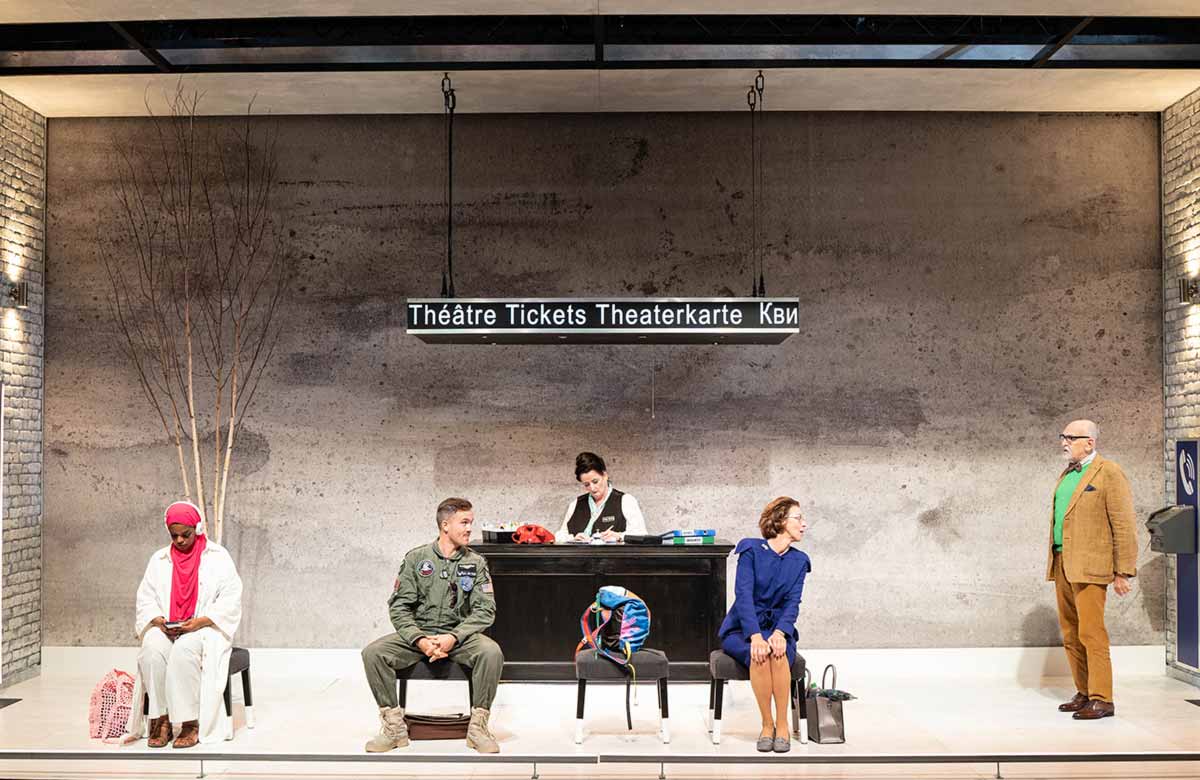
Naima Swaleh, Fionn Ó Loingsigh, Anna Healy, Fiona Bell and Bosco Hogan. Photo: Lottie Amor
The Last Return by Sonya Kelly – Traverse Theatre, Edinburgh
Sonya Kelly’s play is set in a ticket queue imhabited by two cartoonish characters – a reticent professor and a passive aggressive middle aged Umbrella Woman who works in “an open plan office”. In the background, the formidable ‘ticket person’ controls who gets the returns they are desperate for. The show has a highly stylised tone, inhabiting a world of comic types that soon also includes an unlikely US marine and a silent Somalian woman. The purpose of the play emerges gradually, as colonial power relations are reflected in the self-regard and desperate manoeuvrings of the queuers. Most of the stage time is occupied by a strangely heightened atmosphere created by the stereotyped characters. If this sounds like a criticism it isn’t, on the whole. Some genuine comedy emerges, much of it focused on Anna Healy’s formidable ticket person who, as we discover is not only stern but heavily armed. Fiona Bell’s Umbrella Woman teeters on the edge of hysteria with her manic politeness, while Bosco Hogan’s Professor starts patient but is clearly heading for a meltdown in slow motion. Sara Joyce’s production for Druid Theatre is carefully choreographed and absorbing. Kelly has re-imagined Ionesco for the post-colonial era, and leaves us feeling we’ve seen something we won’t forget in a hurry, even if its exact meaning is elusive.
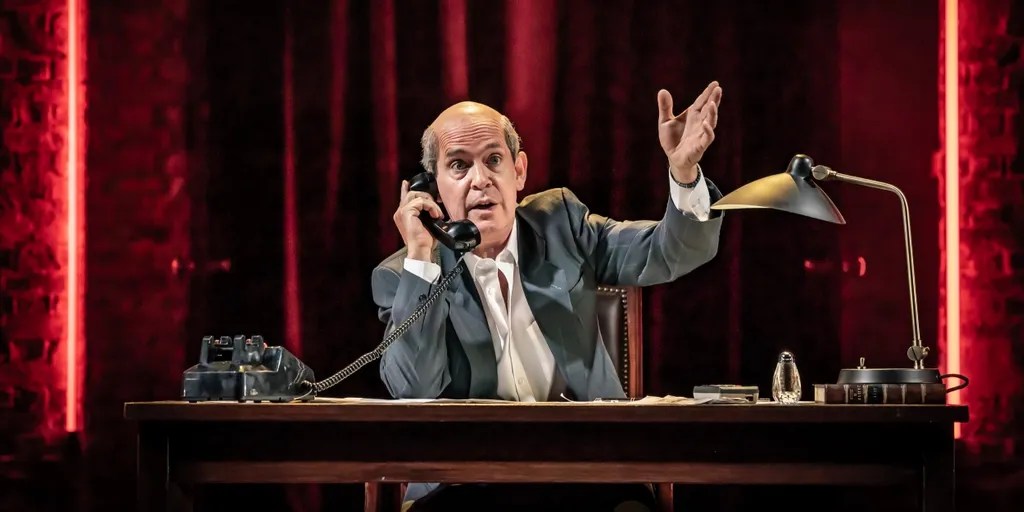
Patriots by Peter Morgan – Almeida Theatre, London
Peter Morgan’s new play is a history lesson, filling in the gaps in our understanding of how we ended up where we are now. Specifically, it connects events in Russia after the fall of Communism with the high profile deaths in the UK of Russians who had fallen out with Vladimir Putin and, more implicitly, with the invasion of Ukraine and the state of Russia today. There is no doubt that the story of Boris Berezovsky is fascinating, providing important insight into how Russia ended up led by a brutal autocrat. It is, however, a story without sympathetic characters. Tom Hollander, in a fairly remarkable physical transformation, plays Berezovsky as a balding Richard III – a charming bully used to having things his own way, whose inevitable downfall is as much part of his character as his success. He is very watchable, but there is no hiding the fact the Berezovsky was a greedy, ruthless criminal and a complete bastard, just not as ruthless as Putin.
Morgan flashes back to Berezovsky’s childhood as a maths prodigy, with Ronald Guttman as the professor who took him under his wing, and highlights his decision to turn away from a self-contained life of equations on blackboards (mathematics on stage must always involve chalk) to engage with the world as it opened up under Boris Yeltsin. However, he doesn’t manage to get to the heart of why the world he chose to join was the post-Communist gangster capitalism of the 1990s, where he made a fortune from importing and illegally reselling cars. His role, however, in putting Putin where he is now is well told. Will Keen plays Putin as so reserved as to be almost tongue-tied when Berezovsky plucks him from an obscure role as Deputy Mayor of St. Petersburg and has the Yeltsin family appoint him head of the FSB then, when Yeltsin resigns on millennium eve, makes him Prime Minister. Keen’s subtle, increasingly terrifying portrayal shows him growing in confidence while remaining in the shadows until he can seize his moment, and reject the man who expected to control him. Berezovsky’s downfall begins here and ends with his 2013 suicide in luxury exile in the UK.
Elements of the story connect in ways that surprise: for example, the notorious murder of Alexander Litvinenko (Jamael Westman) in London in 2006 is an inherent part of the story. As Berezovsky’s head bodyguard his killing was a message for the exiled oligarch. Director Rupert Goold draws a great deal of entertainment from a dark story of increasingly desperate political and criminal gambles. Miriam Buether’s set has a pair of catwalks set at right angles, with characters on these but also on high stools beside them at ground level, partially hidden from circle seats and a complicated arrangement that doesn’t obviously serve the production. Patriots struggles, as plays that try to document history over long periods often do, with the balance between teaching the audience about events and allowing the characters to live. In this case, the result is too much telling and not enough showing.
Lucas Hnath’s play is part of a long tradition of sequels to Henrik Ibsen’s A Doll’s House. By walking out on her husband and, more particularly, her children Ibsen’s Nora ignited a furious debate that is, remarkably, still smouldering. From George Bernard Shaw to Stef Smith, writers have been tantalised by the question of what happened to Nora after she closed that door behind her. Hnath’s play is set 15 years after her departure, and to some extent is a gloss on events during the play. It is difficult to find fault with James Macdonald’s production for the Donmar, but the reason this play needed to be written never becomes clear. It doesn’t give us much that we couldn’t already have imagined as possible futures for Nora, and it indulges a tendency to lecture the audience. As a result, Nora becomes a strangely unsympathetic character, and the drama focuses becomes about her insensitivity towards people, and her inability to relate to others. This seems a restrictive gloss on Ibsen, which closes down the character rather than opening her out.
Nevertheless, the staging is very effective. With the Donmar auditorium in a rare in-the-round configuration, designer Rae Smith fills the stage with a house that is dramatically lifted away to reveal the interior of Torvald’s living room, which Nora (Numa Dumezweni) re-enters as the play begins, for the first time since her fateful departure. Dumezweni is commanding and magnetic in the role, although it is difficult to like the Nora Hnath has written for her. Brian F. O’Byrne is exceptional as the aged, embittered Torvald – every inch a man defeated, disappointed and scarred by his wife’s departure. June Watson is glorious as Anne-Marie, Nora’s former nanny who brought up the children Nora left behind. Her accusation that Nora has only returned because she wants something from her rings true, as does her sadness at her inability to make things right in the family she has served all her life. And Patricia Allison as Emmy, Nora’s now adult daughter, is self-possessed and sharp, choosing marriage with her eyes open, to Nora’s horror.
While the production is of a particularly high quality, the experience of watching A Doll’s House, Part 2 is too much like having the original play explained at length. Nothing is left unsaid, and everything is told rather than shown, in contrast to Ibsen’s writing. Nora’s unpacks her feelings and motivations to everyone in turn, like a walking Cliff’s Notes, and in the process renders the character shallower, more selfish and more emotionally obtuse than Ibsen intended. Torvald doesn’t come out the play particularly well either, but if Hnath is fascinated with the possibilities that Nora presents it seems reductive and redundant to create a new version that shows her to be a lesser person than we would hope.
Strindberg’s The Dance of Death has a reputation, encouraged by its title and the troubled life of the author, as a full-blown exercise in turn-of-the-century Scandinavian nihilism. This is unfair. The National Theatre’s ’60s production with Laurence Olivier and Geraldine McEwan revealed its blackly comic potential, pursued even further up by Ian McKellen and Frances De La Tour in Sean Mathias’ 2003 London production. Now Lindsay Duncan and Hilton McRae reveal the full depths of its ambiguity in a production that is funny and strangely touching. Directed by the Arcola’s own Mehmet Ergen, the couple – married in real life – interact with a naturalness that takes the edge off their barbed attacks on one another, even as they push one another further and further and, almost, over the edge.
McRae, as aging, disaffected Army captain Edgar, is fragile and thin-skinned but, crucially, also self-aware. He slides incredibly easily into the role of the grumpy old man, just as Lindsay Duncan’s Alice deploys her frustrated performing talents (her stage career, she claims, was ended by Edgar) in playing dark games with Edgar, and then her cousin Katrin, with a glee discernible through her unnatural composure. Rebecca Lenkiewicz’s adaptation gender-swaps the role of Kurt, the outsider who unwittingly acts as the grist in the marital mill. It’s an interesting move, and fits the dynamics for the most part very well. Emily Bruni plays her as virtually a nun, dressed in black and engaged in charitable work, both practical in managing domestic crises and hopelessly hidebound. Her sexual move on Alice is all the most wild and shocking as a result. Lenkiewicz also updates the language, including plenty of swearing, which gives the conflict a new credibility.
The treat in this production, though, is watching Duncan and McRae up close, applying their skills to the portrayal of a relationship. Beginning and ending with a game of cards, it is clear that these two know how to survive and how to live together. The way they interact with outsiders could easily, however, give quite the opposite impression. They bait one another with practised ease, and make dramatic claims about cruelty as soon as the other leaves the room. But it is others they are cruel to because, while they might not mean what they say, their self-centred way of living poisons others. No-one, however isolated they might imagine themselves, can separate themselves from their effect on others. This is the play’s true darkness, but the way in which Edgar and Alice very nearly go too far to retreat – particularly Edgar, claiming he has filed for a divorce – is unavoidably hilarious.
This is a high quality staging, featuring two seriously fine performers who absolutely inhabit their roles. A touring production in partnership with theatres in Bath, Cambridge, Northampton and Oxford, Ergen has reworked a classic to reveal it as fresh and current, and given it a dream cast. It is definitely the kind of theatre we need: not easy answers, no escape, just life in all its darkness, frustration, extremity and glory.
The Lesson by Eugène Ionesco – Southwark Playhouse, London
It says something about national cultures that the French equivalent of The Mousetrap is Eugène Ionesco’s short play, The Lesson. It has been running at Théâtre de la Huchette in Paris since 1951, and is as far from the contained, comforting threat of Agatha Christie as drama has to offer. The Lesson, Ionesco’s second play and an early example of post-war ‘theatre of the absurd’, remains a thoroughly disconcerting experience. Icarus Theatre Collective’s production, now at Southwark Playhouse, revels in undermining expectations. The audience struggles to comprehend what they are seeing, and the laughter becomes increasingly hollow as it becomes apparent what they are seeing is not entertainment.
From the opening moments, as The Pupil (Hazel Caulfield) rings at an invisible front door, the atmosphere is manic. Caulfield, blonde hair in plaits, is dressed as a model student in an apron and dirndl-esque dress. She is wildly over-excited at the prospect of her lesson, but The Maid (Julie Stark) is a forbidding gatekeeper and, when he eventually emerges, The Professor (Jerome Ngonadi) is a shambling, begowned caricature of a schoolmaster. Each seems to be playing an absurd stereotype, and the lesson is also a sham. The Professor lavishes praise on The Pupil as she struggles to name the four seasons. Soon, however, her faults become more specific – she can add, but does not understand the concept of subtraction. Meanwhile, The Maid issues mysterious warnings to The Professor about what might happen if he gets overexcited. It is no surprise when things take a darker turn. The Professor starts to insist, didactically, that all languages are the same. The pupil-teacher relationship becomes tense, painful, with constant complaints of toothache, and then violent.
Max Lewendel’s production is tightly choreographed and highly absorbing. Hazel Caulfield plays The Pupil with a distinctive physical presence, bounding and tripping around the set like an automaton. Jerome Ngonadi is a creepy combination of bumptious and childlike as The Professor, but with the charisma to fix a front row audience member in a long, uncomfortable stare before pronouncing the word ‘pepperpot’ with undisguised lascivious intent. Julie Stark is a tweed-skirted tyrant, the ego to The Professor’s id. Together they form a destructive force, but the production has a fourth character – the blackboards that line the set. These, designed by Christopher Hone, are cunningly interactive and do far more than provide surtitles for the performers. They function both as conventional blackboards, with the cast writing on them in chalk, and as an autonomous entities, illustrating and embellishing the text in playful and then more menacing ways. It is an innovative, and rather brilliant device.
It is difficult to discuss the true significance of The Lesson in a review. Much of the play seems unlikely, unrealistic, and irrelevant to real life. Its purpose only becomes apparent in the final moment of the play, in one of theatre’s ultimate shocks. Only then we can understand how and why twisting knowledge and manipulating truth can have deadly consequences. The Lesson is not nearly as well known here as it is on the Continent and in a time when truth in public life is particularly opaque, Icarus’ revival is very timely. Their production is a clever, shocking, top quality theatre, and it shows Ionesco still has the power to scramble our minds.
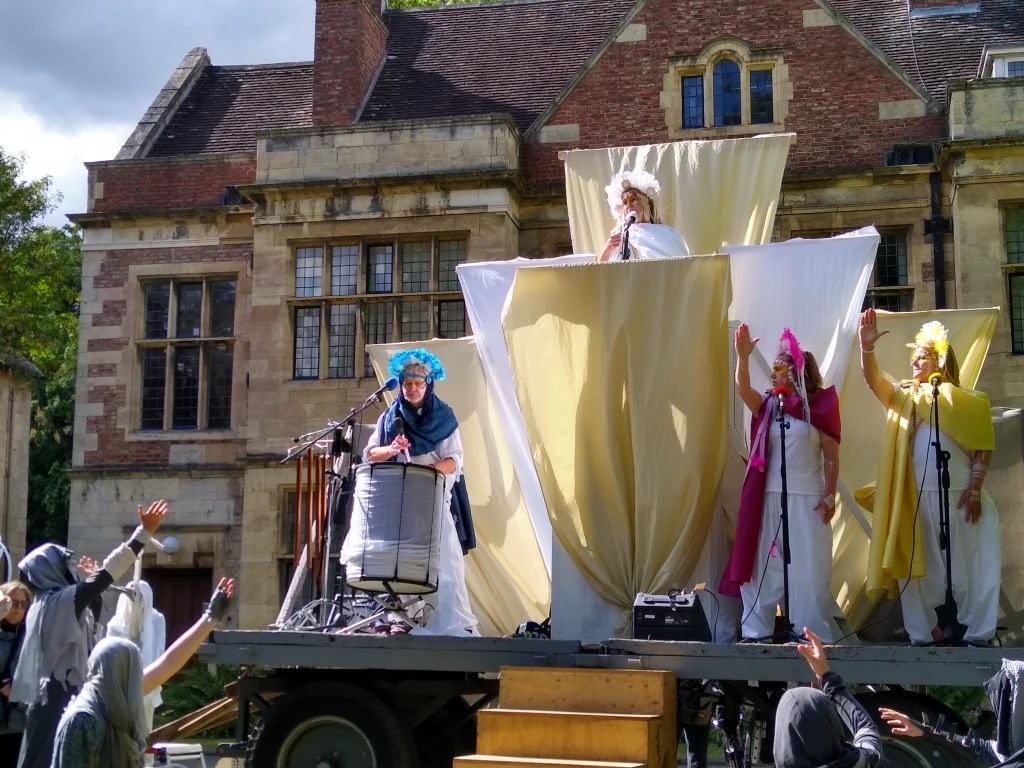
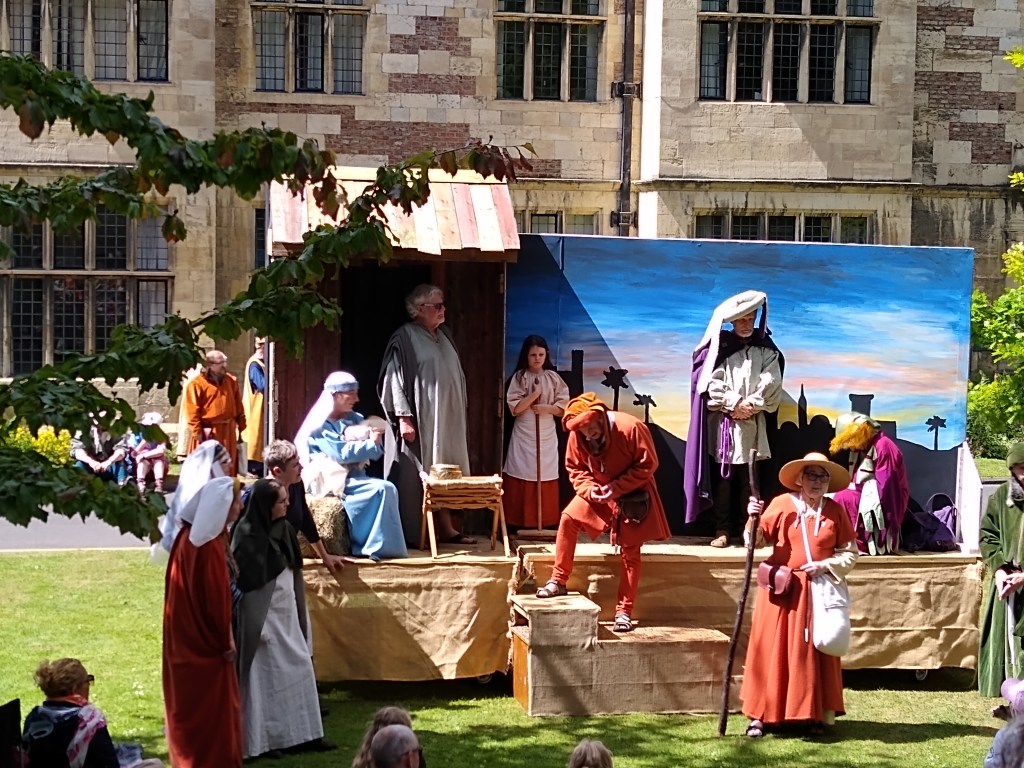
The York Mystery Plays (or York Waggon [sic] Plays) are a series of short medieval dramas re-enacting scenes from the Old and New Testaments. Regularly performed by the city’s guilds during the Middle Ages, they fell out of fashion in the late 16th century and lay dormant for 400 years until a revival for the Festival of Britain in 1951. Even then they didn’t do the plays in their original form, and they have only been performed as they are now from 1998, staged every four years. This year’s cycle explodes onto the streets of York, where it demonstrates exactly why performance has been missed so much since these plays were last staged, and why it matters.
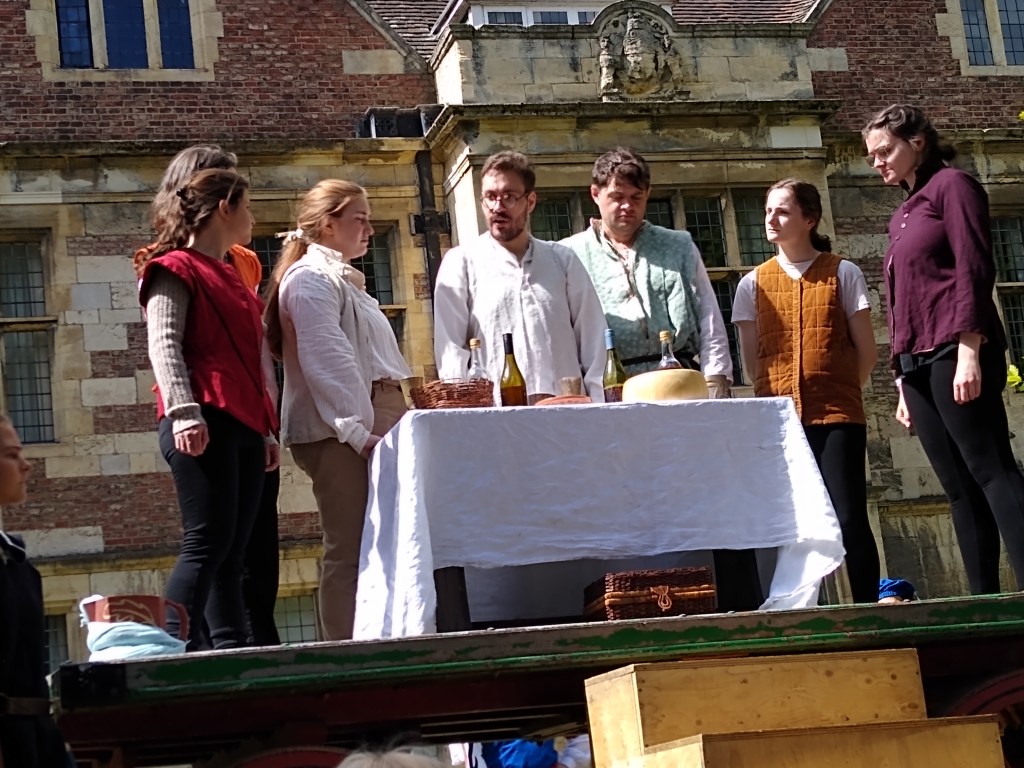
The full York cycle contains 50 plays, of which only around ten are performed each time. The lead role is taken by the guilds, still a presence in York which remains, undoubtedly, the most medieval city in the country. This year, the Guild of Building ‘brought forth’ (as they put it) ‘The Creation to the Fifth Day’, The Gild of Freemen ‘The Fall of Adam and Eve’, The Company of Merchant Taylors ‘The Last Supper’, The Guild of Butchers ‘The Crucifixion of Christ’, The Guild of Media Arts and the Guild of Scriveners ‘The Appearance of Christ to Mary Magdalene in the Garden’ and the Company of Merchant Adventurers ‘The Last Judgement’. The full 2022 cycle was performed for a seated audience in the garden of King’s Manor, next to the art gallery, after working the city street. Guild members process in full regalia accompanied by the wagons on which performance take place. Each is accompanied by a group of musicians, known as ‘waits’, playing medieval instruments in full Tudor costume, who come not just from York, but across the country.
So far, so entertaining – but what makes the York Mysteries special is their complete, inherent inclusiveness. The plays really do belong to the people of York and everyone takes part, just as they do at some other long-standing communal pageants, for example the Lewes Bonfire parade. The Guilds work with multiple York organisations to bring forth the plays. ‘Adam and Eve’ is performed by 14-year olds from Vale of York School. ‘The Crucifixion’ – which features some daredevil physical work as a full-size cross is raised on a wagon using counterweights, with Christ already attached – is performed by members of the Riding Lights Acting Up company, with a range of disabilities. ‘Herod and the Three Kings’, the only play not involving a guild, is performed by the congregation of St. Luke’s Church who have been involved with the Mysteries from the start. The afternoon (the eight plays take four hours to present) is full of moments that show what this means to those involved, from the careful way a cast member cues in the actor playing Christ with a tap on the foot, to the presentation of honorary guild membership to the teacher who has directed the Vale of York production for years – with which she is clearly delighted.
The plays themselves are presented in varying styles, from a pop-up Creation which allows the Guild of Building to show off their cycloramic skills, to a Last Judgement described as “Art Deco meets dieselpunk” which has drumming archangels, Mad Max demons on stilts and musicians playing the last trumpet, which in this case are medieval and five feet long. The plays culminate with a substantial section of the audience being led through the gates of hell in an impromptu role as ‘the damned’. The performers whisper the instruction “kneel to the Lord God, if you can”. It is an intriguing combination of the extreme and the pragmatic.
The sight of a peasant woman sitting under a tree, texting, and an angel melting into the Saturday afternoon shopping crowd underlines the way these plays, full of people speaking medieval English as though it was a normal thing to do, are part of the way things work in York. At the conclusion, thanks were given to the director, Tom Straszewski who was somehow able to corral this impossible combination of ideas and performers into a coherent whole. True to the spirit of the occasion, he refused to emerge from the shadows where he stood watching, but he will have known that there is nothing quite like people coming together to make something unique happen, and then going back to their modern day lives as though nothing had happened. This is the perfect advertisement for theatre: an unpatronising ritual that assumes everyone has the capacity for the extraordinary, and in doing so unleashes it.
Chris Bush’s new play Rock is part of an exciting, ambitious and slightly deranged project to celebrate the Crucible Theatre, Sheffield’s 50th anniversary. Rock is performed alongside Paper and Scissors, by a shared cast, simultaneously in three theatres – the Crucible, the Studio and the Lyceum. While the first two share a building and the Lyceum is next door, it is still a feat of astonishing complexity and, as far as I know, unprecedented. The model is surely Alan Ayckbourn’s House and Garden, a pair of plays that share a cast and are performed simultaneously, but Bush goes one better. The first achievement, therefore, is that these plays work and that no-one seems out of breathe. Director Anthony Lau must take a great deal of credit simply for getting these works on stage.
The Crucible’s ambition also generates an appropriate level of excitement around the anniversary of a an important regional theatre with a fine 1970s auditorium. Bush’s plays concern Sheffield: its declining manufacturing, the burgeoning redevelopment and gentrification of ex-industrial spaces, and the tensions caused by changing expectation. Rock is also about energy, and the central character Susie (Denise Black) uses the first law of thermodynamics as her reference point – that energy cannot be created or destroyed, only transferred. Her father, owner of the failing family scissor works in which all three plays are set, used it as his mantra, but Susie fights back against this and other social assumptions. She is now a faded music scene-ster whose 1980s heyday is over. Held back, partly by her gender, she wants to make something happen for younger generations by turning the factory into a music venue. This brings her into conflict with the factory manager, Omar (Guy Rhys), who thinks it has a future and her sister Faye (Samantha Power) and sister’s wife Mel (Natalie Casey), who plan to redevelop the site. These characters make strategic appearances in Rock but are, we surmise, the focus of the other two plays. Susie, with her frustrations and her thwarted energy, is the focus of Rock, and Denise Black does a very good job of holding the stage, effectively designed by Ben Stones as the cavernous interior of a disused factory.
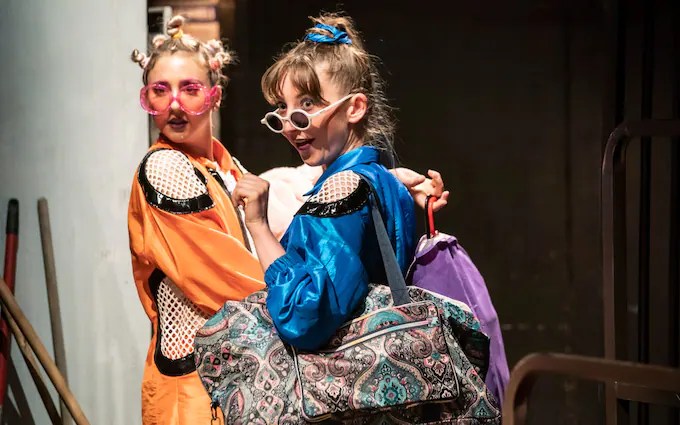
Despite the careful structuring of themes, there is a sense at times that the action in Rock is being stretched, presumably while something else happens on a different stage. Without seeing all three plays, it is hard to know whether this is a problem in the other two but, despite the remarkable technical achievement of writing and staging the trilogy, it is not entirely obvious that the format serves the material best. There are moments when we would like to hear more from characters who stand and listen to Susie, including her old friend Leo (Andrew MacBean) and photographer Billy (Alastair Natkiel), and perhaps have their say in other scenes on nearby stages. The simultaneous events create a sense of missing out, which is almost unique in theatre which is specifically designed to show the audience the best bits. Rock begins like a farce, with a succession of misunderstandings, and this atmosphere occasionally revives (notably in the form of the two caricatured young singers, who give Generation Z a very bad name indeed). However, the mood seems inconsistent, and the farcical potential is never entirely followed through. Greater commitment to chaos would have been welcome.
Nevertheless, Chris Bush and the Crucible have created a theatrical landmark, an achievement that serves the Crucible’s radical reputation well, and sets a strong marker for the next decade and beyond. This is also the only play I can imagine watching from outside the theatre, tracking the frantic comings and goings between the new building and Lyceum, which must be a performance in themselves.
(This review consists almost entirely of spoilers)
The nudge-nudge cover story for this play – that it’s the debut by someone who has worked in ‘the security industry’ for 38 years – is fairly transparent, and suspicions are confirmed when the Royal Court’s shop won’t sell you the text before the show starts. Immediately, surtitles confirm this is a ruse, and that the play being performed is actually Lucy Kirkwood’s new piece, ‘Rapture’. However, the misdirection doesn’t stop here. The surtitles claim that an injunction prevents the play from being openly performed because it concerns a real couple and contested events. This too is fictional, but Kirkwood and the Royal Court have gone to great lengths to build mystery around this show because it is concerned with the fate of a couple, Noah and Celeste, whose vague tendency towards conspiracy theories leads them down an increasingly dark path.
Rapture, or whatever the play is really called, has interesting overall intent, but doesn’t quite deliver on its promise. The central couple, with Sienna Kelly as Celeste and Jake Davies as Noah hit it off on a Guardian-style date, at which references to conspiracies such as chemtrails seem just asides. They move in together and have a baby but Noah, without a job, switches to earning a living from running a paranoid Youtube channel. Celeste, a nurse, is drawn in and soon they are refusing the COVID vaccine, becoming recluses and heading into a dead end. The two performers build a convincing sense of mounting disorientation, and the play works hard to undermine a single narrative. The third cast member, Priyanga Burford, plays Lucy Kirkwood, who frames the narrative, lurking on stage to provide explanatory context. (There is a surprise fourth cast member who appears at the very end, but revealing her identity is perhaps a spoiler too far, even for this play.) From Burford, we discover the couple were under surveillance for reasons that are unclear, and that the state may have played a role in their fate – a conspiracy that would justify their paranoia if it could ever be proved which, by definition, it cannot. Naomi Dawson set is rotated by stage hands, revealing the mechanisms behind society’s façade in a way reminiscent of the National Theatre’s 1990s production of J.B. Priestley’s ‘An Inspector Calls’.
Kirkwood’s ambition is admirable and the evening is absorbing in parts but frustrating in others. The fake author and title seems a step too far, more of an in-joke than a contribution to a play that aspires to investigate a modern condition. Similarly, the bugging of the couple which Burford as Kirkwood cannot entirely explain, also plays like a slightly flippant explanation of the playwright’s omnipotent knowledge. Similarly, having Burford on stage as the writer is amusing, but undermines the impacts of the story she tells. These meta-narrative, pseudo-documentary elements deflect from a tragic story, on the whole believable, of ordinary people who look for explanations of what is wrong with the world, and are destroyed by their search – a narrative for our times.
Jerusalem by Jez Butterworth – Apollo Theatre, London
Jerusalem is a big deal. Beginning life at the Royal Court in 2009, it became the most fêted new play of the century, and took off to the extent that Mark Rylance’s performance as John ‘Rooster’ Byron is routinely described as the greatest of our times. So why had I not seen it before its return this summer, with Rylance and Mackenzie Crook reprising their roles? It has many things I appreciate in theatre – an examination of Englishness, rural weirdness and retooled folk culture being three of them. But, after the Royal Court run sold out, it transferred to the Apollo Theatre, one of Shaftesbury Avenue’s Victorian auditoriums which I always find diminish the experience of watching anything, however good, so I avoided it. And then, lured by a similar buzz, I saw Jez Butterworth’s follow-up, The Ferryman, in just such a theatre and hated it to a degree I was not expecting. So I went to see the revived Jerusalem to see if it provided a different perspective on Butterworth’s work. I enjoyed it much more than The Ferryman, but it’s a play with some major problems too.
On the upside, Mark Rylance is remarkable. He undergoes the kind of physical transformation Olivier was famed for, sticking out his chest and cocking his back like a rooster, strutting with a spliff in his mouth. He is very funny, at his best in exchanges with the excellent Mackenzie Crook as Ginger. He is also lost and desperate, a man who’s running out of drugs and dodges. And there is a remarkable moment when he asks Dawn, the mother of his child, who tries to get him to face up to his approaching eviction, to look into his eyes. What she sees there convinces her she needn’t worry – whether it’s the ancient giant he claims to have met near a Little Chef on the A338, or just the depth of his determination. Rooster as a character is very morally ambiguous indeed – selling drugs, ignoring his own young son, using women, living in a fantasy world, and making amusing anecdotes of incidents that are, in reality, grim. This complexity gives Rylance a great deal to play with. The character of Rooster was apparently based on Mickey Lay, of Pewsey in Wiltshire, who spent a lot of time in its many pubs (including The Moonrakers, referenced in the play). Trumping anything Butterworth could invent, he died of a heart attack in 2014, waiting for it to open.
Crook is great too. Jerusalem seemed to launch him into a new, fertile phase of his career leading on to The Detectorists and Worzel Gummidge, two minor tv masterpieces, each examining the pastoral underbelly in different ways. He is a thoroughly likeable, but somewhat tragic figure, deluding himself and doomed to be pushed away by Rooster, for his own good. He is the most sympathetic rogue imaginable.
The set by Ultz is a sight to behold. It’s hard to imagine real trees looking more convincing than the full sized grove filling the stage while the detritus scattered around Rooster’s caravan, from sports car seats to the flag of Wessex, is fascinating in itself.
The play is a riot at times – almost literally when Rooster’s friends form a barricade behind his abandoned sofa and convince themselves they will rampage through the town and burn the ‘new estate’. When the group dynamics click on stage, it works exceptionally well. Ian Rickson, directing, manages the chaos with an expert hand.
On the downside, at three hours it really is too long. With an event-light plot, the running time is an indulgence and the pace sags considerably at various points, including during the final act when the dramatic urgency traditionally picks up. Butterworth seems to be putting off the inevitable resolution (or lack of resolution) which is flagged from the very first scene, when council officers arrive to serve an eviction notice, because the play has to end before the police move in.
The female characters are very limited: two identikit teenagers getting drunk, another dressed as a fairy, and Rooster’s ex-partner Dawn. The impressive Indra Ové makes a great deal of her one real scene, during which Rooster suddenly seems like a wrecker of lives rather than an eccentric. And then there is Wesley’s offstage, nagging wife – a stereotype apparently still alive and kicking. This is at best a missed opportunity and, at worst, regressive writing that will only continue to date this play.
Rooster’s friends are intended, at least in part, to be funny but sometimes what we’re supposed to be laughing at really isn’t amusing. They lech over ‘slappers’, and hold stereotype rural views. Davey doesn’t see the point of going anywhere beyond Wiltshire, and explains how he read about a murder in the paper and realised he didn’t care, because it happened in Wales. The likeability of Rooster’s hangers on is skin-deep, but so is their believability as characters – especially in the first act, when the writing resembles sketch comedy more than stage drama, and they seem like small town types there for us to laugh at. We’re expected to laugh along with their little England views and indulge their destructive behaviour.
I was also troubled by the liberal use of the term ‘gyppo’, by sympathetic and hostile characters alike. It was highly offensive in 2009 and still is. I don’t think Butterworth would consider normalising any other racial slight in the same way. I’m not sure the play can be staged again without edits, which should probably have been made before this run.
However, despite its defects Jerusalem has a performance from Mark Rylance which really lives up to its billing. He, on his own, is reason enough to see the play… if you can get a ticket.





 Tom Bolton