A Midsummer Night’s Dream

A Midsummer Night’s Dream by William Shakespeare – Wilton’s Music Hall, London

Henry Maynard’s Flabbergast Theatre is an unapologetically physical theatre company, building a reputation for staging Shakespeare in a style that owes a lot more to Grotowsky than it does to the Globe. Flabbergast’s Macbeth, seen last year at the Southwark Playhouse, delivered energy and imagery at the expense of the text. They have followed it up with A Midsummer Night’s Dream, staged in the much-loved Wilton’s Music Hall. The result is the same, only more so.

There are things to like about the production. The setting, designed by Maynard who also directs, is dominated by a hay wain, a cart used like the York Mystery Plays waggons as both stage and set. It fits the play beautifully, with Titania and Bottom nestled above the action watching the lovers in the woods. Costumes, also Maynard’s work, are striking, with the Mechanicals wearing half masks, and an exciting profusion of tartan trousers, dressing gowns, periwigs and golden ram’s horns in evidence (although Oberon’s gold mankini very much outstays its welcome). However, although the physicality of the performances and the commitment to clowning is unquestionable, the result is to make the show less rather than more accessible.

Performances ratchet up to 11 from the first lines, and stay there for two and half hours. There is no departure from full-on mania, from every character in the play. In the opening scene Hermia’s father, Egeus, in crazed 18th century dresses, lurches, bounds and leers around the stage, a grotesque parody of… what? The connection between the characters and any recognisable reality is instantly severed, and from then on the audience struggles to understand what it is seeing, or why. There is no value in picking out performers, but the entire company performs in a way that is mannered in the extreme. Almost every single line is illustrated by the performer acting it out in capering dumbshow. Combined with the masks and the exaggerated accents on display, it makes much of the text inaudible and the rest incomprehensible. It really is impossible to follow what is going on, as characters set fire to the best know poetry in the language and push it over a cliff. It is an exhausting watch.

Flabbergast Theatre are not about the text, that is understood. Their physical style promises much, and anyone who takes a different approach to Shakespeare deserves respect. Unfortunately though, A Midsummer Night’s Dream really does not work. The lack of variation in tone, and the absence of character or nuance, rapidly diminishes the effect of the full octane clowning. Physical theatre is a subtle, powerful tool but, in one of the most atmospheric plays ever written, Maynard’s show has no room for mood. That really is a mistake.

Big Finish

Photo by Rosie Powell

Big Finish by Figs in Wigs – Battersea Arts Centre, London

Published at Plays International

As Figs in Wigs point out, it takes a lot of development and rehearsal to create this level of chaos. ‘Big Finish’ is about endings: humanity hitting a climate iceberg, theatre driving over a funding cliff, the company doing its final show. The five Figs have built a career which is, in many ways enviable. They are highly respected in the fringe theatre scene if, as they note, they have never actually won a prize. After ten shows, starting out in the queer cabaret scene and graduating to the heights of Battersea Arts Centre’s Grand Hall, Figs are respected and beloved. They also have a total of £5,000 in their bank account, and run a game of musical beach towels to decide who gets paid each night. If there is no money or future in theatre, why do they keep coming back?

The Figs – Ray Gammon, Suzanna Hurst, Sarah Moore, Rachel Porter and Alice Roots – are experts in controlled stupidity, very silly things taken very seriously, which are not nearly as silly as they would like us to think. Their performance style is sometimes reminiscent of contemporaries such as Sh!t Theatre, which whom they share a home-made aesthetic. This includes building sets and costumes from whatever they can afford. Crab costumes, for example, are red bike helmets, puffa jackets and skirts made from plastic sheets. The setting is blue PVC and silver foil ducting. They read a last will and testament, which bequeaths all the detritus from past shows to the UK’s great venues, attempting to save it from landfill.

This is where Figs really come into their own. Behind a consistent front of incompetence, they deliver a comprehensive state of the nation report on the performing arts and on radical expression, filtered through their own experience. Their conclusions are not encouraging. Who would choose theatre in a country that not only fails to support its own cultural heritage, but treats it as the enemy, and making a living is not options. Figs stage a succession of hilarious set pieces as they work through their, and our, futures. A Kraftwerk-esque crab dance takes creatures who adapt to survive climate disaster and turns them into symbols for performers who want to escape the arts, but cannot. A crab bucket has no lid, because the crabs keep each other inside. Online prop purchasing comes to the fore again when the Figs, golf wear and dinosaur masks, manoeuvre a golf buggy precariously around the stage. They become a string quartet who scrape out the Titanic theme, very badly, over and over, sitting on weird exo-skeleton stools, strapped to their legs.

As they say, it takes a lot of work to create such barely controlled anarchy. The show culminates in two fabulously silly and clever scenes. The Figs are interviewed by a ‘professor’ who turns out to be the real thing: Jen Harvie, Professor of Contemporary Theatre, their real-life tutor at Queen Mary’s. Reality and performance become indistinguishable as she conducts a hilariously awkward interrogation of their careers. Then, the company performs a final, absurd, contemporary dance sequence in wetsuits, sliding all over the foamy floor, elbows in faces.

If ‘ Big Finish’ is Figs in Wigs’ final show, it is a triumph. They wear their physical performance skills, strange creative imaginations and complete commitment very lightly, but they are clever, original and hugely entertaining. It probably isn’t their farewell because, as they say, how else can they make a difference. But work like theirs, which is precisely what we need in times of unanswered questions and uncertain futures, is under threat like never before. ‘Big Finish’ is the first production in Battersea Arts Centre’s 50th anniversary season, and the perfect show to illustrate what South London’s most essential venue is about, and why it matters. In their Grand Hall, Figs in Wigs are remaking theatre in their own image, and it is fun, generous, surreal and brilliant.

Player Kings

Player Kings by William Shakespeare, adapated by Robert Icke – New Wimbledon Theatre, London

Warming up for the West End, Sir Ian McKellen’s appearance as Falstaff in Robert Icke’s compressed Henry IVs created real excitement on a Wimbledon Friday night. Some actors seem fated to play the fat knight, Michael Gambon or Desmond Barritt for example, while for others, notably Antony Sher, the role comes as a surprise to both actor and audience. McKellen is in the latter category. As they await his first entrance, everyone is silently wondering whether such a lean, vulpine actor can really carry off a fat suit. Of course he can. McKellen is the UK’s greatest living actor, and his decision to take on a demanding role at a stage in his life and career when he can do what he pleases, is a gift to us all.

McKellen’s decision to work with Robert Icke is a canny one. Icke is in demand as a reimaginer of the classic, and he has taken the radical, but entirely logical, decision to combine Henry IV Parts 1 and 2 into a single play. Althought it’s the kind of thing John Barton used to get up to at the RSC, this type of heavey editing has fallen out of fashion. But anyone who has seen the two plays in full will have experienced a slump in Part 2, when repetition seems to set in. Icke’s edits strip the plays back, to largely good effect, keeping all the best bits but cutting back on scenes such as Northumberland’s follow-up rebellion, and Pistol’s lengthy rants. The downside is a four-hour running time, but the production is very well-paced and the evening speeds by, a real achievement with the first half alone 2 hours long.

Hildegard Bechtler’s set is simple – two curtains that pull across the width of the stage – but good for switching between echoing court and cosy tavern. Other than the text changes, Icke’s production is clear and direct, giving text and performers room to breathe. The exception is an amusing staging of Falstaff’s confrontation with the Lord Chief Justice (Joseph Mydell) following the Battle of Shrewsbury. Falstaff, in a wheelchair and looking like Captain Tom, is accosted at a drinks reception in his honour, from which he methodically steals all the booze. McKellen is backed by a strong cast, including the dignified Mydell. Richard Coyle’s King Henry is a troubled man who is clearly ill from the start, and knows how little he has achieved. Toheeb Jimoh is a posh boy Hal, who seems motivated by cynical self-entertainment. The play is driven by his parade of schemes to humiliate Falstaff, but we see a glimpse of his real self in his alarming intense reaction to trying on his father’s crown.

Samuel Edward-Cook makes Hotspur a shaven-headed force of nature, and then channels a similar energy as Pistol, a clever piece of double casting. Justice Shallow is delightfully played by Robin Soans, while James Garnon is both a trouble-making Worcester and Shallow’s cousin Silence, who turns out to have a remarkable drunken singing voice. Clare Perkins makes Mistress Quickly London, and very real. Annette McLaughlin’s Warwick has hints of Theresa May, Mark Monero’s Peto is a real chancer, with no choice but to live on his wits, and Geoffrey Freshwater was born to play Bardolph.

The cast is strong, and the evening is not all about Falstaff, but he provides the plays with a deep, complex centre. McKellen, in flat cap, cravat and leather jacket, is dressed for a different era, which offers a key to his interpretation. His Falstaff is a seasoned villain, used to being top of the heap – but he has become lazy and, above all, old. Falstaff is losing his powers, and as the play progresses starts to realise that he is past it, and his time is coming. Each of Hal’s humiliations, which he shrugs off to amuse his followers, cuts deeper. He keeps being found out, and his life of sitting in the pub being deferred to is coming to and end. McKellen makes it clear that Falstaff is an aristocrat slumming it, like Hal, but far past the point of return. He is vicious and doesn’t hesitate to exploit weakness, but he is also loveable and, his physical weakness – trying and failing to rise from his tavern seat, as Mistress Quickly rushes to support him – is a heart-stopping moment, as is the final rejection scene, when he choses continued self-delusion over facing the truth. Icke incorporates his death scene from Henry V, just as Orson Welles did in ‘Chimes at Midnight’, which works well.

McKellen’s performance is a triumph – both physically menacing and vulnerable, charming and nasty – a multi-layered interpretation certainly as good as anyone who has played the role in recent memory. Icke’s production doesn’t reinvent the play with the brilliance of his Hamlet, but provides much more than a vehicle for McKellen, spawning a world that allows his performance to flourish. It’s an evening to cherish.

Dear Octopus

Photo by Marc Brenner.

Dear Octopus by Dodie Smith – National Theatre: Lyttleton, London

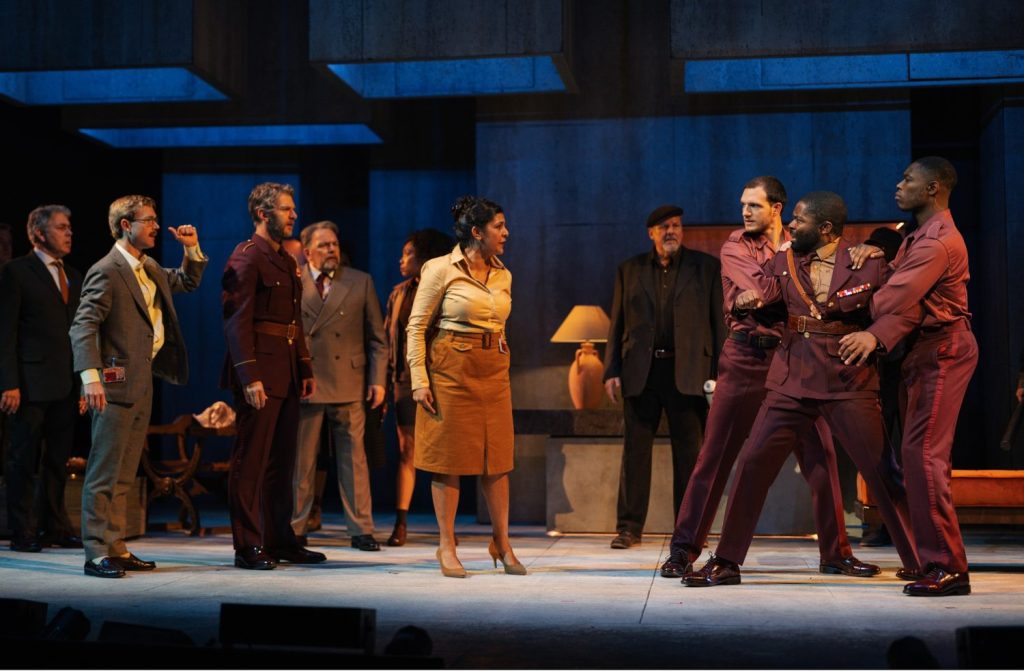
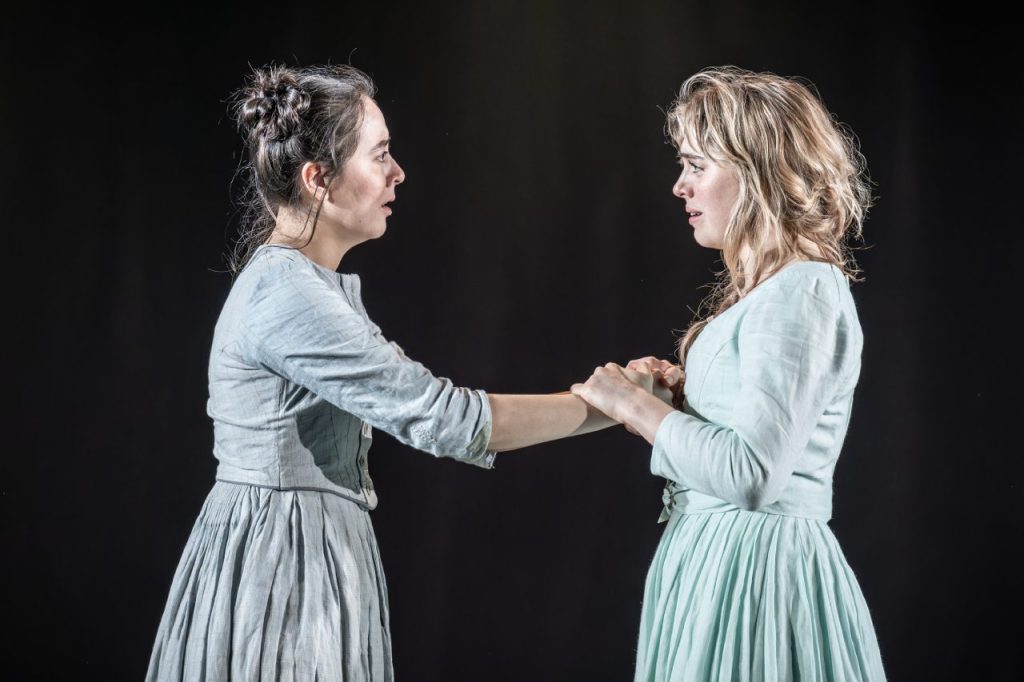
While ‘I Capture the Castle’ remains much-loved, Dodie Smith’s stage work is rarely revived. Emily Burns’ production at the Lyttleton demonstrates why, but also shows the value in revisiting a play that is very old-fashioned, but is also dominated by excellent parts for women. The play, set during a weekend reunion of the Randolph family for the golden wedding of Dora (Lindsay Duncan) and Charles (Malcolm Sinclair), is on many levels very uneventful. People resolve sometimes fraught relationships, with the shadow of the First World War, and the death of eldest son Peter, in the background, and the subsequent, unexplained death of Nora, one of twins. The play was written in 1938, but only the cccasional radio broadcasts hints at the war to come. It is all about personal relationships, and about social ones too – although, Smith was not really concerned with the power balance in an upper-middle class household enabled by servants.

Frankie Bradshaw’s set flies in huge chunks of wall and staircase to create hall, dining room and nursery in a house that is substantial in every respect. There are also real fire burning in grates, a very impressive effect. Also substantial is Lindsay Duncan’s performance as the matriarch, a proper tour-de-force. Early in the play, she is domineering, constantly ordering everyone off to do jobs for her, but her charm and sincerity is never in doubt either, lending full credibility to her reconciliation scenes with her daughter Cynthia, a troubled Bethan Cullinane. The cast is the show’s strongest suite, with a host of excellent performances. Malcolm Sinclair is tender, and very convincingly devoted to his wife, as Charles. However, here are no weak cast members. The ensemble relationship is what makes the show. The family relationships require a diagram to unpick, but Bessie Carter as ‘companion’ Fenny, Kate Fahy as reprobate elder aunty, Belle, Billy Howle as brother Nicholas and Amy Morgan as sister Margery are all highly watchable.

As this is Dodie Smith, there is also a clutch of clever and amusing children – three of them, played by a rotating cast of young actors. These are very demanding parts, requiring performers who can really mix it with the adults and, along with the size of the cast, presumably one of the reasons this play is rarely seen. Smith’s ability to charm, and to conjure up the kind of family which, despite their troubles, you want to be part of, is unrivalled. Her social milieu is a lost world, which dominated the inter-war stage and now often seems unrecognisable. However, ‘Dear Octopus’, despite being sometimes preachy on the subject, shows family dynamics in a way that still speaks to us. And Smith writes about women with a skill that is entirely natural, yet highly unusual. This is very much the kind of play that the National Theatre exists to re-examine – technically demanding, unfashionable, but with qualities missed before that we can now value .

Macbeth

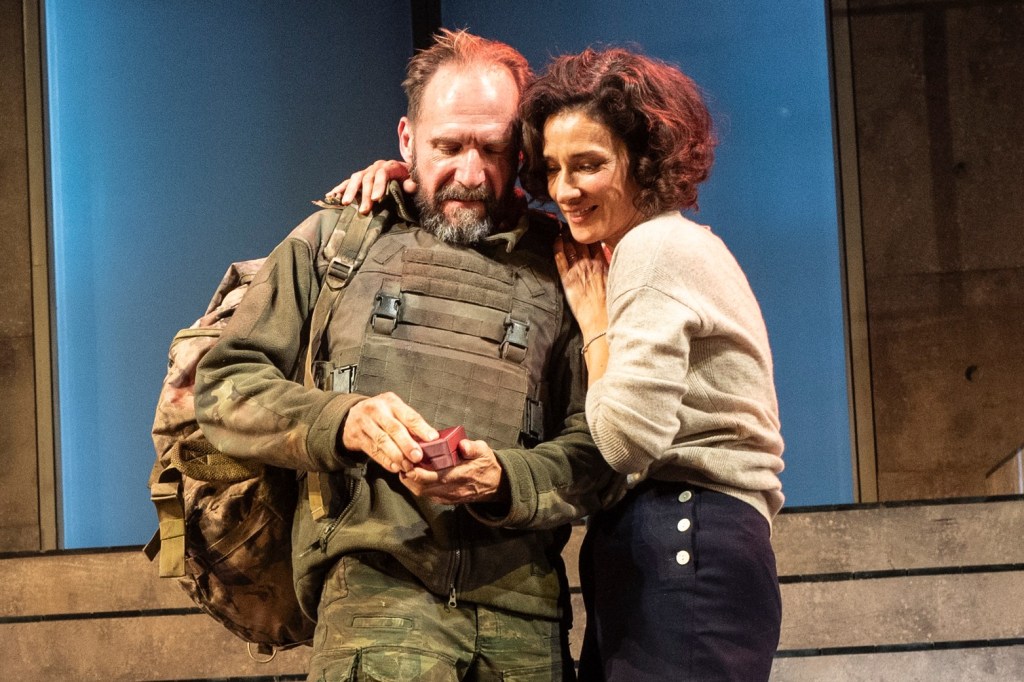
Ralph Fiennes and Indira Varma. Photo by Matt Humphrey.

Macbeth by William Shakespeare – Dock X, London

Simon Godwin’s production of Macbeth, starring Ralph Fiennes, touring non-traditional venues, is reminiscent of the Almeida’s double-header of Richard II and Coriolanus, staged in the pre-conversion Gainsborough Studios, with Fiennes playing both leads. That was in 2000, and Fiennes is still bringing in the crowds, burnishing his reputation as one of the great actors of his generation. This record includes, but does not depend upon, his Shakespearian work, with Mark Antony in both Antony & Cleopatra and Julius Caesar, Richard III, and Coriolanus (in the 2011 film) all performances of the highest calibre. His Macbeth is another major achievement, a portrayal that offers a persuasive account of a man veering rapidly into evil.

The show’s London venue is the Surrey Quays warehouse, Dock X, which provides a very successful auditorium with a large capacity, but excellent sight lines all the way to the back row. There is a gesture at immersiveness, with the audience entering through a miniature war zone with burned out car, but the production is surprisingly traditional in the right ways. Frankie Bradshaw’s concrete stepped set is simple but entirely effective, adapting with minimal fuss while creating the impression of Scotland as a militarised landscape. Soldiers wear battle fatigues so, when different costumes appear, they make a big visual impression: Lady Macbeth in a vivid green gown, Macbeth in a purple robe. The witches hover between ordinary and scary, three young women in dungarees and puffa jackets who might be hanging around on any street corner – a strong approach that normalises the extreme.

Fiennes himself is evidently an efficient soldier partly because he is single-minded to the point of lacking social skills. He is awkward and abrupt in the opening scenes, while Indira Varma plays Lady Macbeth as an influencer, who knows how to present people in their best light. It makes sense that these two are together, and that Lady Macbeth is in control. She can shape and direct her husband to make the most of his opportunities. But the production makes the tipping point clear, when her plans start to spin out of control. As soon as she tells her husband he is ‘lily-livered’, having declared that Duncan’s murder would make him a man, their pact is broken. After this betrayal, Macbeth is unleashed to live his worst life.

Godwin’s production is based around notably clear verse speaking, that makes the text sound fresh in a way that only the best productions can pull off. Fiennes leads the way in this, making all the great moments, especially the ‘brief candle’ speech, revelations. He is mesmerising, the best and most believable Macbeth I’ve had the good fortune to see, and Indira Varma is a match for his performance, making Lady Macbeth a great deal more comprehensible than is often the case, a woman who will give all in exchange for the rewards she confidently anticipates, only to disastrously miscalculated the cost.

The production also gives the wider cast weight and presence. Making the unusual, but understandable, decision to cut the Porter scene pays off through enhanced narrative drive. Another of Godwin’s achievements is to make the Macduff/Malcolm scene in England, often dismissed as an aberration, actually work. Malcolm (Ewan Black) is genuinely wrestling with self-doubt about his fitness to rule, not playing games, but it is swept away by the terrible revelation that Macduff’s (Ben Turner) family has been murdered. This moment is centre of the play’s second half, balanced against the murder of Duncan in the first, and showing how it can be played makes it complete.

A strong cast also features Steffan Rhodri as a poetically Welsh Macduff, Rebecca Scroggs as a justifiably furious Lady Macduff, and Jake Neads and Michael Hodgson as the two murderers. The ungainly presence of the latter, is used cleverly as the witches (Lucy Mangan, Daniella Fiamanya and Lola Shalam) channel their visions of the future through Hodgson’s twitching body. Christopher Shutt’s sound design creates an eerie backdrop to the action, with hints of The Exorcist that make this production not so much bewitched, as possessed. The combination of characters destroyed by their own personalities, excitingly portrayed by Fiennes and Varma, and a war-ravaged setting in which people are not what they seem, makes this a production to savour.