Krapp’s Last Tape / Godot’s To Do List

Photo by Jack English

Godot’s To Do List by Leo Simpe-Asante / Krapp’s Last Tape by Samuel Beckett / – Royal Court Theatre, London

The Royal Court’s production of Krapp’s Last Tape is generously prefaced by a new short play written by Leo Simpe-Asante, which won the inaugural Royal Court Young Playwrights Award last year. Shakeel Haakim plays a flustered, bowler-hatted Godot who is at the mercy of a recorded female voice highly reminiscent of Alexa, voiced by Flora Ashton. Directed by Aneesha Srinivasan, the show takes place in front of the chaotic set for Krapp’s Last Tape, piled with boxes. Godot is apparently unable to do anything other than peform the endless tasks set by the voice, many of which are ridiculous or ill-advised. Haakim has the engaging presence of a natural comic, although the play does not develop far beyond its basic premise, which is a good joke but perhaps doesn’t tell us much that we don’t expect to hear.

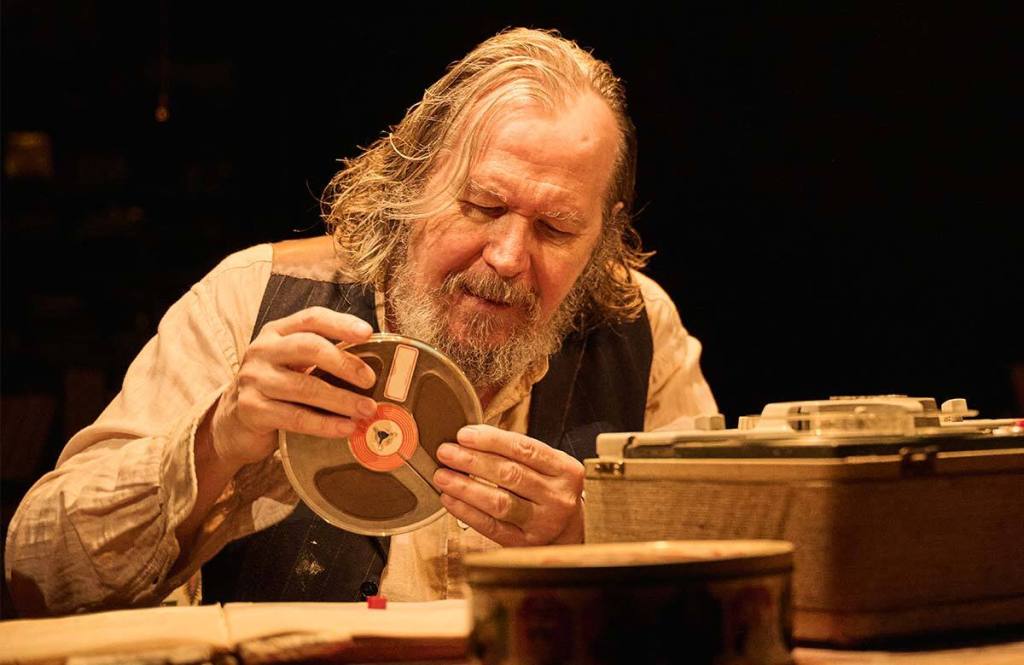
The main attraction is Gary Oldman’s Krapp. Oldman has directed and designed the production as well, of course, as playing 69-year old Krapp as he confronts his younger self, addressing him from Reel 3, Spool 5. Oldman begins in a good humour, which rapidly dissipates as he realises the extent of the changes that happen while we are looking elsewhere. Beckett’s work is masterfully focused, every word hitting home hard. It is one of the greatest male roles in theatre and, as such, there is doubtless a temptation for an actor to make it their own, and leave their mark. This is evident in Oldman’s production and performance. He is very good, and anyone seeing his interpretation as their first will have a very worthwhile evening, but it feels like a crowded performance.

The set is very literal – a hoarder’s cavern of piled boxes of junk and teetering shelves, which Krapp roots through to locate the relevant spool. Alongside, Oldman gives the impression of playing an old man. This is not necessary. Beckett, surely, intends the actor to play themself. It’s only through being entirely oneself, on the surface unaltered from the 39-year old on tape, that the true horror of passing time is revealed to the actor and the audience. Stephen Rea understood this better in his 2025 Barbican performance, which left space all around for the darkness and, perhaps, a little hope to seep in.
Cascando

Photo by Greta Zabultye

Cascando by Samuel Beckett – Jermyn Street Theatre, London

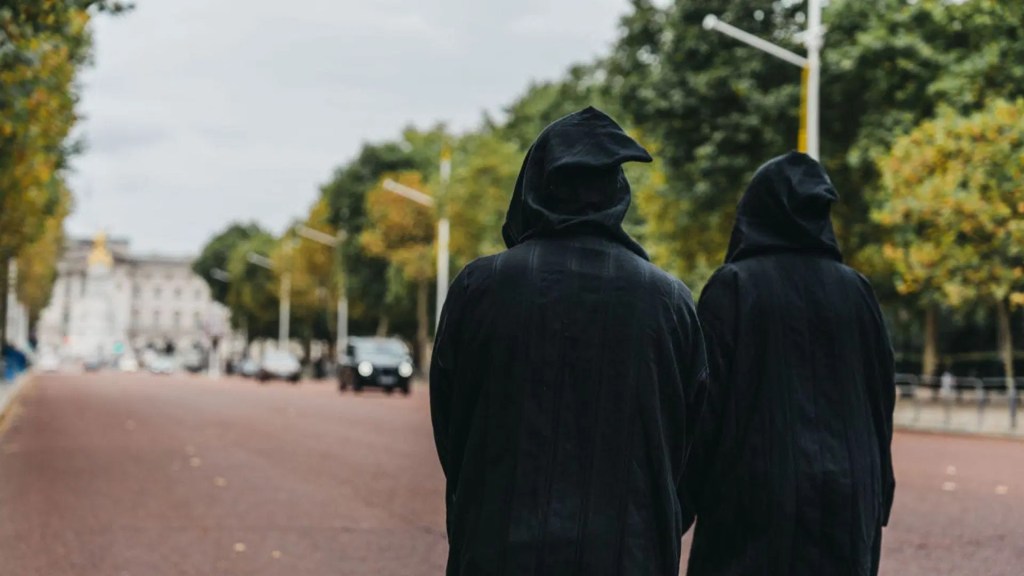
Irish company Pan Pan’s production of Beckett’s radio play, Cascando, is a promenade piece. The audience gathers at the theatre to put on hooded black cloaks and an mp3 player with headphones. With the tech hidden under their hoods, they walk at a measured pace through the streets of, in this case, St. James’s for half an hour while the piece plays in their ears. It is both an intense experience, immersive in the true sense, and a public performance.

Audience members are directed to walk in single file, heads down, focusing on the feet of the person in front ‘as if you were slightly depressed’. The result is a quietly disruptive experience, as a procession of, apparently, monks files slowly through the central London rush hour, amusing and bemusing passers-by, stopping both them and the traffic. The experience of becoming the performance is both very simple, and exhilarating. It is a fundamental twist in the audience contract which turns everything on its head. And that’s without the play itself. Cascando was written for radio and first broadcast in 1963. There are two male voices – Opener (Daniel Reardon) and Voice (Andrew Bennett) – whose rich tones fill our heads. They tell a disjointed story in language stripped to the essentials. Opener sets the scene for Voice, who is apparently trying to finish a story about a man called Woburn, on a journey, ‘same old coat’. The journey seems to be a pilgrimage of sorts, and the Opener a God-like presence. There are also intervals of music by Jimmy Eadie.

The overall production, which premiered in 2016 and has since been performed in venues around the world, is directed by Gavin Quinn. It is quietly astonishing, bringing Beckett disconcertingly alive in a new, modern ritual. As Woburn drifts out to sea clinging to a boat, we know that there is only one way the story will end for all of us, but we measure our steps anyway, one foot in front of another, along the pavements.

Krapp’s Last Tape

Krapp’s Last Tape by Samuel Beckett – Barbican Theatre, London

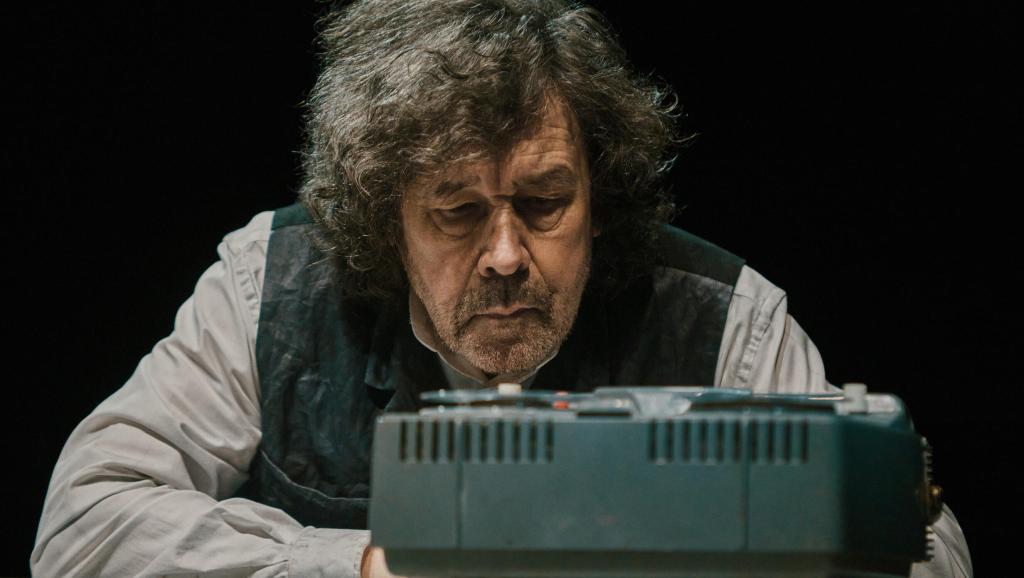
With the pre-announcement of not one, but two future productions of Krapp’s Last Tape scheduled for the mid-2030s (when Sam West and Richard Dormer reach 69, the age of Beckett’s main character), it’s reasonable to ask what makes actors want to play this role so much. To some extent, it could be that recording the lines for younger Krapp at 39 represents a solid investment in future work. But there is also a clear sense that this is one of the big roles, a defining part, and one that suits unconventional actors better than classic leads. Stephen Rea is very much the kind of performer suited to Krapp. Actually 78, although he very much does not look it, Rea bring a hangdog comedy and a deep sadness to a role others have approached with more rage and less stillness. He also met Beckett himself, who attended rehearsals for the Royal Court’s 1976 production of ‘Endgame’ with Rea in the cast.

Vicky Featherstone’s production is designed by Jamie Vartan, who places Krapp’s desk in a square of light beyond which lies only darkness. A path of light leads from the desk to a door, beyond which lies smoke, the drink which Krapp retires periodically to consume, with a comic sloshing sound, and who knows what else. The set also aids the silent comedy at the heart of Beckett’s play, in the form of a ludicrously long desk drawer which Krapp pulls out further and further to reach his hidden bananas. Rea plays the sad clown very well, dialling down the slipping on banana skins but emphasising the shambling walk, which looks both exaggerated and weirdly familiar. The inevitable comedy of decay is inseparable from the sadness, loneliness and failure that haunts Krapp, in the form of his naive 39-year old self, still seeking and possibly expecting happiness. His writing, unlike that of Beckett, faded away despite his epiphany in a storm, which he can not longer bear to hear about.

Stephen Rea recorded the Krapp tapes in his 60s, but they sound like the work of a younger man. The weighted precision of his delivery makes very word matter a great deal, to Krapp and to Beckett as writers and to us as an audience. His performance is heartbreaking without ever needing to fully express the emotions we know he is feeling. This play, so slight, remains a work of remarkable power that can bind the entire audience of a large theatre into the unravelling existence of one man.