Photo by Jack English
Godot’s To Do List by Leo Simpe-Asante / Krapp’s Last Tape by Samuel Beckett / – Royal Court Theatre, London
The Royal Court’s production of Krapp’s Last Tape is generously prefaced by a new short play written by Leo Simpe-Asante, which won the inaugural Royal Court Young Playwrights Award last year. Shakeel Haakim plays a flustered, bowler-hatted Godot who is at the mercy of a recorded female voice highly reminiscent of Alexa, voiced by Flora Ashton. Directed by Aneesha Srinivasan, the show takes place in front of the chaotic set for Krapp’s Last Tape, piled with boxes. Godot is apparently unable to do anything other than peform the endless tasks set by the voice, many of which are ridiculous or ill-advised. Haakim has the engaging presence of a natural comic, although the play does not develop far beyond its basic premise, which is a good joke but perhaps doesn’t tell us much that we don’t expect to hear.
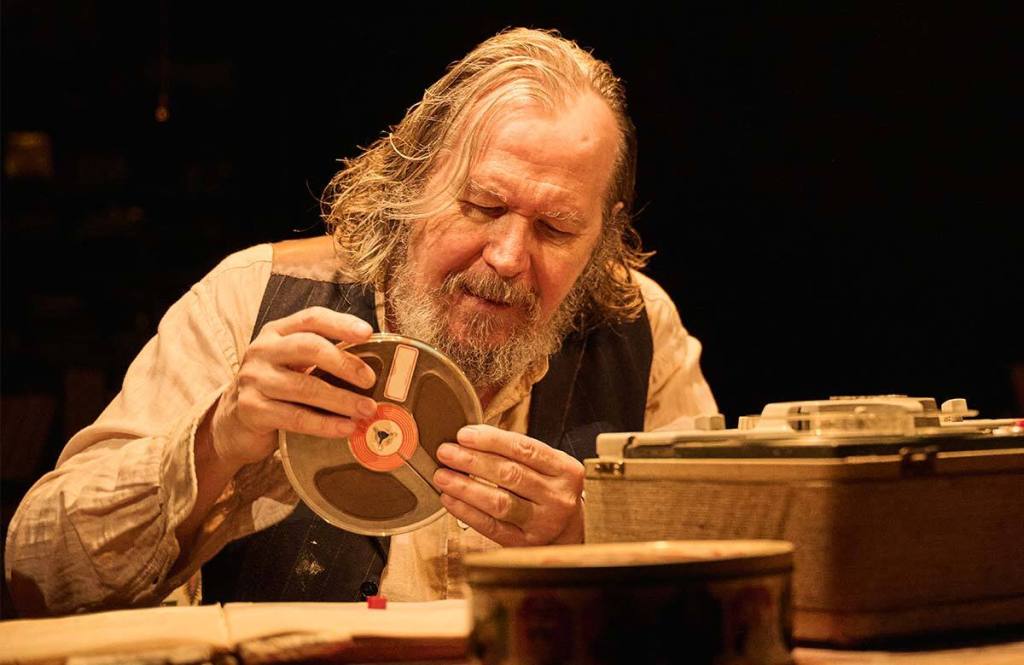
The main attraction is Gary Oldman’s Krapp. Oldman has directed and designed the production as well, of course, as playing 69-year old Krapp as he confronts his younger self, addressing him from Reel 3, Spool 5. Oldman begins in a good humour, which rapidly dissipates as he realises the extent of the changes that happen while we are looking elsewhere. Beckett’s work is masterfully focused, every word hitting home hard. It is one of the greatest male roles in theatre and, as such, there is doubtless a temptation for an actor to make it their own, and leave their mark. This is evident in Oldman’s production and performance. He is very good, and anyone seeing his interpretation as their first will have a very worthwhile evening, but it feels like a crowded performance.
The set is very literal – a hoarder’s cavern of piled boxes of junk and teetering shelves, which Krapp roots through to locate the relevant spool. Alongside, Oldman gives the impression of playing an old man. This is not necessary. Beckett, surely, intends the actor to play themself. It’s only through being entirely oneself, on the surface unaltered from the 39-year old on tape, that the true horror of passing time is revealed to the actor and the audience. Stephen Rea understood this better in his 2025 Barbican performance, which left space all around for the darkness and, perhaps, a little hope to seep in.

