Blood Show by Ocean Hester Stefan Chillingworth – Battersea Arts Centre, London
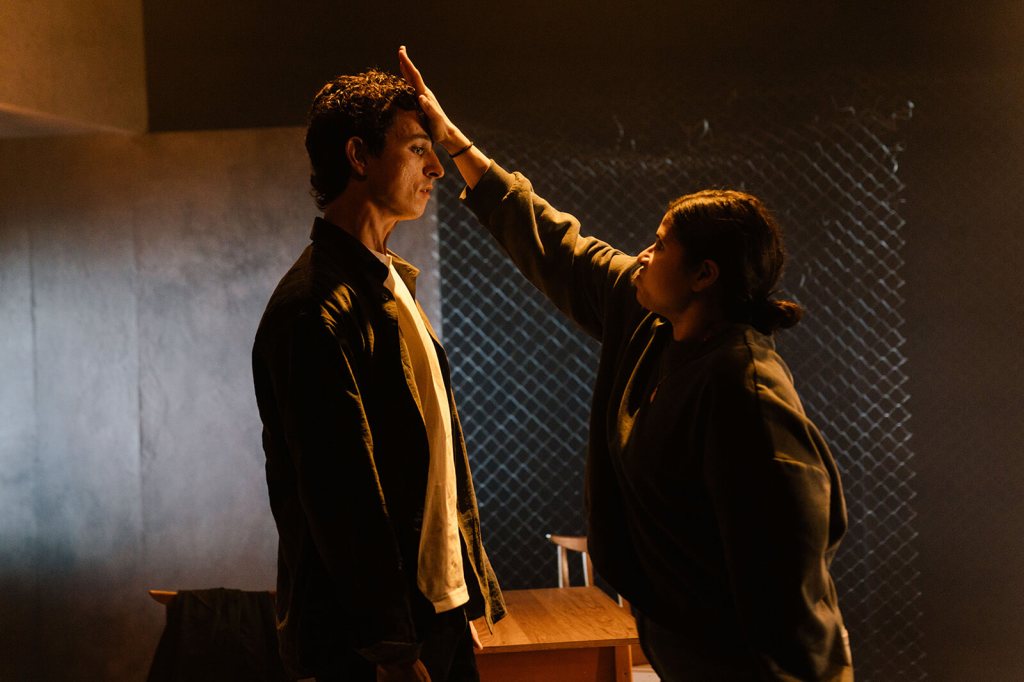
Blood Show comes with a spatter warning and plastic ponchos for the audience. The set, in Battersea Arts Centre’s small Member’s Bar room, consistsnof a pristine white carpet with a chair, a plant and a drinks flask filled with stage blood. The show, performed by the writer Ocean Hester Stefan Chillingworth, with Tim Bromage and Craig Hambling, is a surreal exercise in mimed violence. Hambling and Chillingworth stage a fight, the former painted all over in white, the latter slathered from head to toe in stage blood. It is a nasty and very believable fight with kicking, biting and gouging, and it ends with Chillingworth strangled to death in an alarmingly realistic manner. The white carpet, by this time, is smeared in blood. Then they do it again, and the shock of the violence wears off a little. Then again, and again, and each time the impact is reduced while the set becomes bloodier. There is also a ghost, adding unnerving comedy in a head-to-toe sheet costume, who glides around and sometimes sings – played by Tim Bromage I assume, although we never see his face.
The idea of repetition desensitising us to violence is a good premise, but the show takes a different course. The fight scenes end and Chillingworth becomes the sole performer, enacting a series of increasingly bloody and comic effects – including slamming plastic cups full of blood into their body foley-style. The volumes of blood grow, and it emerges from props and comes on stage in buckets to be sloshed around.
Blood Show is promising, but frustrating. It perhaps references violence against the trans body, violence in film, complacency about violence in society, or all of those things – but we never really know. The show seems to lack a driving rationale, and feels more like a scratch exercise than a coherent, finished production. The performers are physically committed to an impressive extent. However, the blood is a distraction and becomes the whole point. The need to produce more and more blood derails and defocuses the evening. And it turns out that when you examine it too closely, stage blood looks like stage blood, not the real thing,
Jodie Whittaker as the Duchess. Photo: Marc Brenner.
The Duchess (of Malfi) by John Webster, adapted by Zinnie Harris – Trafalgar Theatre, London
Zinnie Harris has modernised John Webster’s classic revenge tragedy with a bold production that gives a new perspective on a wild, brutal story, while also stripping it of the language that has given its place in the repertoire, 400 years later. There are many good things about the production. Tom Piper’s modernist set is stripped back to concrete, with metal walkways, a suitable backdrop for slaughter. Jodie Whittaker is an appealingly defiant Duchess, a woman who will not give way to what men demand of her, however huge the price. In fact, she continues to haunt her brothers, Paul Ready’s Cardinal and Rory Fleck Byrne’s Ferdinand, after death. Ready stands out as the lascivious Cardinal, plausible but depraved, unable to resist humiliating his mistress Julia (Elizabeth Ayodele), as soon as she shows weakness. Fleck Byrne’s Ferdinand is convincingly unhinged, his sexuality tearing him apart. He appears, dramatically, wearing his sister’s red dress after ordering her murder. Fleck Byrne is generally watchable, but loses marks for tossing away the character’s most famous speech, “Cover her face. Mine eyes dazzle. She died young”, which an actor is surely contractually obliged to have fun with.
There is also a powerful performance from Jude Owusu as the murderer Bosola. Owusu’s ambiguity is subtlety delivered, keeping us guessing throughout as to who he really is. Harris’ version emphasises his role, letting him live at the denouement, unlike almost all the other characters, to regret his past and promise to look after the Duchess’ young son. She also highlights his class position as someone who cannot afford to turn down work, however grisly. In this, he is allied with the maid Cariola, who Matti Houghton plays with a great deal of character. In one of Harris’s best lines, she reveals that women wear make-up to hide their rage at the misogyny around them.
The production is an interesting and enjoyable evening, a valuable and committed experiment with a play that is usually hidden in the shadows. Harris brings it out into the light, shining an unforgiving fluorescent light on its themes like an autopsy. She makes the brutal treatment of women uncomfortably apparent, and the deep corruption that fuels the power of the few the unmissable cause of society’s ills. Unsurprisingly, it’s a play for our times. The use of music in the play, with Whittaker and Houghton delivering Webster’s songs with aplomb to the accompaniment of white-suited guitarist, contrasts nicely with the grim imagery – the bodies of the Duchess, Cariola and her young daughter left sprawled on the stage throughout the following scene. Whittaker death scene is delivered in astonishingly gruesome fashion, strangled unsuccessfully at length with a rope by incompetent goons before Bosola finishes the job himself, drowning her in a bath. However, it’s a shame about the poetry which, when it surfaces from time to time brings the show suddenly to life. For the most part it is missing, and an essential element in the play’s appeal disappears with it.
As part of Forced Entertainment’s continuing 40th anniversary celebration, co-founder Tim Etchells has devised a two-hander in which reality is pushed to its breaking point through the basic mechanism of a classic farce set-up. A restaurant customer sits down at a table, the waiter offers him wine, pours a little, he tastes it and nods approval, then the waiter pours him a glass – but he carries on pouring until the glass overflows across the table. There’s mild panic from customer and waiter, when he realised what he’s done, he sweeps up the tablecloth with everything on it. Then they begin again.
From the moment they walk on stage, the performers, Bert and Nasi, are a comic timebomb always threatening to go off. Bert is English, bluff, matey, confident, and usually wrong. Nasi is French, smooth, conciliatory, and also usually wrong. Together, the pair are a well-oiled machine displaying comic skills that it is a joy to behold. Much of L’Addition is very funny. The comic scenario breaks apart continually under examination, becoming more and more ludicrous and hilarious. The performers know how to hold back comic gratification so that, when it comes, it is a true release. At one point Bert as the waiter, constantly laying and relaying a tablecloth, finally loses it completely and performs a strange, wild dance with the cloth which seems to continue for several minutes as Nasi looks on, astonished. The audience are beside themselves.
However, like all classic comedy L’Addition is buoyed on a tide of existential sadness. The underlying themes in Etchells’ piece are barely stated, but it becomes apparent that the show is concerned with , existence, ritual and death. There is a moment that stops everyone in their tracks when the pair fast forward to a point 50 years in the future, when they are still performing their skit. Then it dawns on them that much of the audience will no longer be alive, at which point it sinks in with each of us too. The process of ritualising and mythologising existence is examined too, as the scene becomes something different through constant repetition, a tribute to its original self enacted by people who cannot remember the original, or why they are doing it. But they know they have to, just as we know we have to eat, sleep, repeat to exist.
L’Addition, which was originally presented in French at last year’s Festival d’Avignon, is a brilliant piece of theatre. Tim Etchells, Bert and Nasi work together with a precision that most performers can only aspire to. In the influential tradition of Forced Entertainment, the show’s power is in inverse proportion to budget, complexity or pretension. It belongs to the tradition of silent film comedy, of Samuel Beckett, and of entertainment that takes nothing seriously, but means everything. It is assured, side-splitting and unmissable.
The title of Jon Berry’s new play is the Welsh word for November which, as well as the month, suggests a time of year when the mood darkens. In a rural context, it is also when the animals are fat enough to slaughtered. The foreboding title is a fair representation of the drama, which is ambitious, era-spanning and disturbing. Set in a single location – a farm house somewhere near Trawsfynydd in Snowdonia – it takes place in five time periods, from pre-history to the present. The stories in each are connected by the influence, generally malign, of their shared place. The show opens with the cast of four scooping up handfuls of the earth and eating them, sending the unambiguous message that the place is within them, whether they want it or not.
The play concentrates on four stories: a young man trying to escape his farming inheritance in 1758; a grim tale of power and sexual abuse in 1902; worklessness and a failing marriage in 1975; and a writer winning fame by exploiting family tragedy in 2024. The all-Welsh cast of four give appealing performances, and switch very effectively between their various roles, which are neatly indicated by small changes in costume. Saran Morgan plays a series of young women, always fighting back against expectations. The young men played by Bedwyr Bowen are trapped by society, place and expectation, in capable of getting out. Carri Munn’s characters range from self-deluding and dangerous, to furious at the restrictions of place and society . Glyn Pritchard’s older men are similarly varied, by turns predatory, self-destructive, and possessing all the power and authority. The set, by Rebecca Wood, is a crescent of tall slats which can channel blinding light towards the audience, or focus beams like a stone circle, connecting events beyond their time.
Jon Berry’s ambition is impressive, and Tachwedd is reminiscent of Alistair McDowall’s similarly time-hopping play, The Glow. The impressionistic prehistoric scenes, involving a wild boar hunt, add an exciting element of the mysterious and undefined to the social history that powers the main scenes. It is difficult to weave themes together across such large timespans, and the play’s thesis is not entirely clear. Berry’s describes the play as being like “a distintegration tape” running in a loop until it becomes “saturated” and falls apart. Events layer up in a single location across time, creating shadows that cannot be erased. However, the drama would benefit from stronger shared threads to justify the telling of these particular stories, than just the soil that connects them.
Nevertheless, Tachwedd gives us a defiantly unpretty social history of North Wales. It is a serious play that, despite its tragic events, has strong characters and humour too. Berry has fun, for example, unpicking the hypocrisies of literary agents. Well-managed by director Jac Ifan Moore, the play is an entertaining, and often powerful evening which thoroughly defies expectations. It is also a testament to Theatre 503’s crucial work developing new writing for the stage, and giving London exposure to creative artists from Wales.
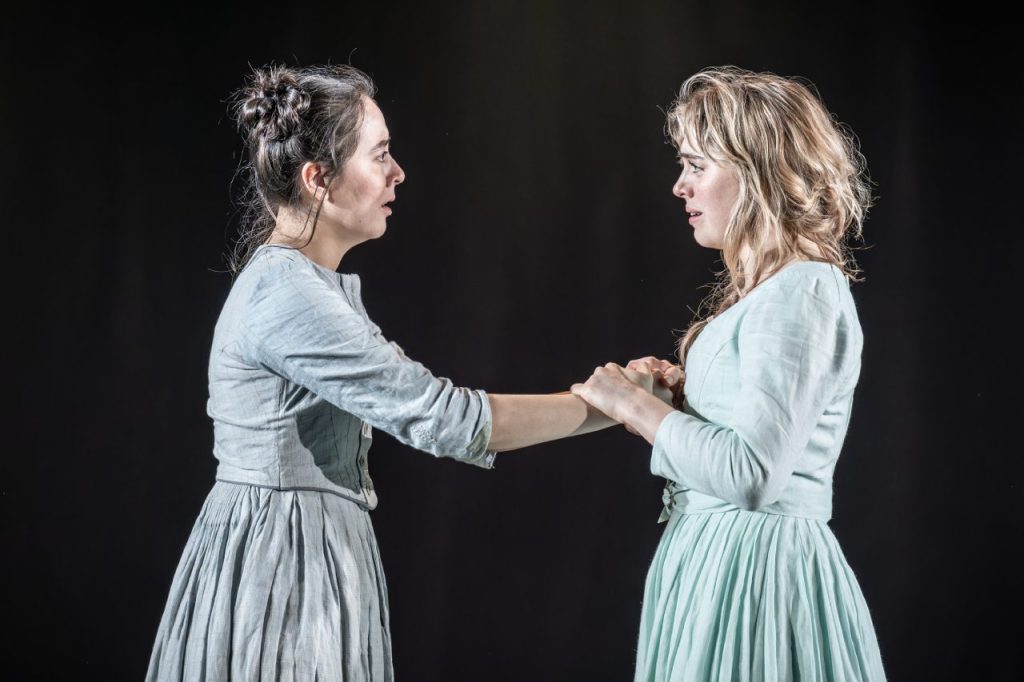
Sonali Bhattacharyya’s new play, directed by Milli Bhatia, is an indictment of the UK immigration process, designed to destroy people, but it is no mere documentary. The grinding injustice of a system that uses people rather than treating them as humans has been widely and deservedly exposed on stage in recent years. Bhattacharyya, though, takes her story in an expected and memorable direction. Two sisters, Nikita (Zainab Hasan) struggles to help her sister Riya (Safiyya Ingar), who has spent her whole life in the UK, stay ahead of deportation for want of a piece of paper from fifteeen years ago. She can’t prove that her late mother lived continuously in the UK because she worked in an undocumented job. Nikita also works at a charity, where she is powerless to help refugee and friend Tahir (Diyar Bozhurt) as his hopes of asylum are brutally dashed. But then things get very weird indeed. Her mother’s ex-colleague Mrs B (Ayesha Darkar) gives Riya an mysterious vial and a set of scribbled instructions, from which she creates a sort of golem: The Fawn (Dominic Holmes).
The arrival of The Fawn as a Frankenstein’s Monster-type character takes the show into exciting territory. Holmes gives a disturbing, electrifyingly physical performance as he learns to move, uncoiling like a spring. Soon he becomes a presentable companion and lover, who can speak the language of those who get what they want. He serves Riya’s needs, transforming into her protector, throwing their rapacious landlady (Dharkar again) off her stride and then more. Riya discovers that she can get what she wants, but at a price.
Bhattacharyya’s play is fascinating if lacking in focus, taking some time to set the scene, and ending rather abruptly, but her ideas are impressively unsettling. Bhatia draws a fine performance from Dominic Holmes in particular, who has the kind of eerie stage presence that will surely have drawn the attention of casting directors. Ayesha Dharker also stands out for her gleeful, sinister performance as Mrs B, drawing on dark powers to fight back against the country she is obliged to live in, and her contrastingly turn as the snobbish, money-grabbing landlady, Shashi. King Troll has a lot to recommend it, and the New Diorama continues to develop the new writing we need.
Ami Tredrea and Bella Mclean. Image by Marc Brenner.
London Tide by Ben Power, music by PJ Harvey – National Theatre: Lyttleton, London
Ian Rickson’s production of London Tide is both a delight to watch, and a significant achievement. The challenge of adapting Charles Dickens’ weird, labyrinthine novel for the stage is enough in itself, but turning it into a musical to boot, seems like a risky venture. Fortunately, the adaptation is by Ben Power and the music by PJ Harvey, an inspired pairing. Together, they have conjured up coherent, direct and involving theatre, judiciously updated, with songs that are on a whole different level of quality to standard music theatre fare.
Rickson’s staging, with sets by Bunny Christie, is sparse but effective and original. A void at the front of the stage is the Thames, which shapes the lives of Dickens’ characters. The entire cast climbs out of it at curtain up, and characters are cast in, pulled out sometimes dead, sometimes alive. The stage is a huge dark space edged with giant river piles, with a watery, translucent sheet at the rear used for some impressive silhouette scenes. What makes this something different is the way that the stage floor moves, rising and tilting like the river, and so does the lighting rig, which hangs low enough for it to lift one character into the air, has he grabs it with both hands. The gantries move rhythmically up and down, like in ripples like water, the first time I have ever seen a theatre’s fittings used almost as an extra character.
The story, stripped back expertly by Power, who also gives the gender roles a carefully judged 21st century boost, is pure London noir. Dicken’s novel is pretty absurd but its strength, and that of the stage show, is the filthy London atmosphere – a city of mud and shadows, poverty and fate, to which its inhabitants are, nevertheless, fiercely devoted. PJ Harvey’s songs, backed by a three-piece band on stage, underscore the noir themes rather than reiterating the story. With lyrics by Power, they are properly impressive, written in styles that range across Harvey’s fine career. At times songs sound like ‘Stories From the City, Stories from the Sea’, at others like ‘White Chalk’, or ‘Let England Shake’. When the cast lines up at the front of the stage, singing directly to the audience “This is a story about London and death and resurrection”, it sounds like a number from ‘The Threepenny Opera’.
London Tide is worth it for the music alone, but there’s a lot more. Dickens’ characters offer some excellent roles, which are grabbed with both hands by a young cast. Bella Mclean as the entitled Bella Wilfer, makes a convincing transition to self-awareness, and has a particularly excellent voice. Ami Tredea’s Limehouse girl, Lizzie Hexam, is full of character and determination. Jake Wood, as Gaffer Hexam who fishes bodies from the Thames for a living, has real menace. Ellie-May Sheridan makes a great deal of the small part of doll’s dressmaker, Jenny Wren. Tom Mothersdale is suitable distracted as heir-in-disguise, John Rokesmith. Peter Wight, always hard to beat in any role, makes Noddy Boffin clumsy and likeable. As principle baddie Bradley Headstone, Scott Karim is lugubrious and frightening. And Crystal Condie, as Miss Potterson, plays an important role as a landlady standing up the depredations of the men who strew damaged people in their wake.
London Tide is a seriously high quality evening. Ben Power, PJ Harvey and Ian Rickson make the show seem simple, and logical, but it really is nothing of the kind. Epic Dickens adaptations like the RSC’s Nicholas Nickleby were once era defining. Now they sneak into the National Theatre’s repertoire, and it is a credit to the current management that shows of this quality can, to some extent, be taken for granted.
Henry Maynard’s Flabbergast Theatre is an unapologetically physical theatre company, building a reputation for staging Shakespeare in a style that owes a lot more to Grotowsky than it does to the Globe. Flabbergast’s Macbeth, seen last year at the Southwark Playhouse, delivered energy and imagery at the expense of the text. They have followed it up with A Midsummer Night’s Dream, staged in the much-loved Wilton’s Music Hall. The result is the same, only more so.
There are things to like about the production. The setting, designed by Maynard who also directs, is dominated by a hay wain, a cart used like the York Mystery Plays waggons as both stage and set. It fits the play beautifully, with Titania and Bottom nestled above the action watching the lovers in the woods. Costumes, also Maynard’s work, are striking, with the Mechanicals wearing half masks, and an exciting profusion of tartan trousers, dressing gowns, periwigs and golden ram’s horns in evidence (although Oberon’s gold mankini very much outstays its welcome). However, although the physicality of the performances and the commitment to clowning is unquestionable, the result is to make the show less rather than more accessible.
Performances ratchet up to 11 from the first lines, and stay there for two and half hours. There is no departure from full-on mania, from every character in the play. In the opening scene Hermia’s father, Egeus, in crazed 18th century dresses, lurches, bounds and leers around the stage, a grotesque parody of… what? The connection between the characters and any recognisable reality is instantly severed, and from then on the audience struggles to understand what it is seeing, or why. There is no value in picking out performers, but the entire company performs in a way that is mannered in the extreme. Almost every single line is illustrated by the performer acting it out in capering dumbshow. Combined with the masks and the exaggerated accents on display, it makes much of the text inaudible and the rest incomprehensible. It really is impossible to follow what is going on, as characters set fire to the best know poetry in the language and push it over a cliff. It is an exhausting watch.
Flabbergast Theatre are not about the text, that is understood. Their physical style promises much, and anyone who takes a different approach to Shakespeare deserves respect. Unfortunately though, A Midsummer Night’s Dream really does not work. The lack of variation in tone, and the absence of character or nuance, rapidly diminishes the effect of the full octane clowning. Physical theatre is a subtle, powerful tool but, in one of the most atmospheric plays ever written, Maynard’s show has no room for mood. That really is a mistake.
Player Kings by William Shakespeare, adapated by Robert Icke – New Wimbledon Theatre, London
Warming up for the West End, Sir Ian McKellen’s appearance as Falstaff in Robert Icke’s compressed Henry IVs created real excitement on a Wimbledon Friday night. Some actors seem fated to play the fat knight, Michael Gambon or Desmond Barritt for example, while for others, notably Antony Sher, the role comes as a surprise to both actor and audience. McKellen is in the latter category. As they await his first entrance, everyone is silently wondering whether such a lean, vulpine actor can really carry off a fat suit. Of course he can. McKellen is the UK’s greatest living actor, and his decision to take on a demanding role at a stage in his life and career when he can do what he pleases, is a gift to us all.
McKellen’s decision to work with Robert Icke is a canny one. Icke is in demand as a reimaginer of the classic, and he has taken the radical, but entirely logical, decision to combine Henry IV Parts 1 and 2 into a single play. Althought it’s the kind of thing John Barton used to get up to at the RSC, this type of heavey editing has fallen out of fashion. But anyone who has seen the two plays in full will have experienced a slump in Part 2, when repetition seems to set in. Icke’s edits strip the plays back, to largely good effect, keeping all the best bits but cutting back on scenes such as Northumberland’s follow-up rebellion, and Pistol’s lengthy rants. The downside is a four-hour running time, but the production is very well-paced and the evening speeds by, a real achievement with the first half alone 2 hours long.
Hildegard Bechtler’s set is simple – two curtains that pull across the width of the stage – but good for switching between echoing court and cosy tavern. Other than the text changes, Icke’s production is clear and direct, giving text and performers room to breathe. The exception is an amusing staging of Falstaff’s confrontation with the Lord Chief Justice (Joseph Mydell) following the Battle of Shrewsbury. Falstaff, in a wheelchair and looking like Captain Tom, is accosted at a drinks reception in his honour, from which he methodically steals all the booze. McKellen is backed by a strong cast, including the dignified Mydell. Richard Coyle’s King Henry is a troubled man who is clearly ill from the start, and knows how little he has achieved. Toheeb Jimoh is a posh boy Hal, who seems motivated by cynical self-entertainment. The play is driven by his parade of schemes to humiliate Falstaff, but we see a glimpse of his real self in his alarming intense reaction to trying on his father’s crown.
Samuel Edward-Cook makes Hotspur a shaven-headed force of nature, and then channels a similar energy as Pistol, a clever piece of double casting. Justice Shallow is delightfully played by Robin Soans, while James Garnon is both a trouble-making Worcester and Shallow’s cousin Silence, who turns out to have a remarkable drunken singing voice. Clare Perkins makes Mistress Quickly London, and very real. Annette McLaughlin’s Warwick has hints of Theresa May, Mark Monero’s Peto is a real chancer, with no choice but to live on his wits, and Geoffrey Freshwater was born to play Bardolph.
The cast is strong, and the evening is not all about Falstaff, but he provides the plays with a deep, complex centre. McKellen, in flat cap, cravat and leather jacket, is dressed for a different era, which offers a key to his interpretation. His Falstaff is a seasoned villain, used to being top of the heap – but he has become lazy and, above all, old. Falstaff is losing his powers, and as the play progresses starts to realise that he is past it, and his time is coming. Each of Hal’s humiliations, which he shrugs off to amuse his followers, cuts deeper. He keeps being found out, and his life of sitting in the pub being deferred to is coming to and end. McKellen makes it clear that Falstaff is an aristocrat slumming it, like Hal, but far past the point of return. He is vicious and doesn’t hesitate to exploit weakness, but he is also loveable and, his physical weakness – trying and failing to rise from his tavern seat, as Mistress Quickly rushes to support him – is a heart-stopping moment, as is the final rejection scene, when he choses continued self-delusion over facing the truth. Icke incorporates his death scene from Henry V, just as Orson Welles did in ‘Chimes at Midnight’, which works well.
McKellen’s performance is a triumph – both physically menacing and vulnerable, charming and nasty – a multi-layered interpretation certainly as good as anyone who has played the role in recent memory. Icke’s production doesn’t reinvent the play with the brilliance of his Hamlet, but provides much more than a vehicle for McKellen, spawning a world that allows his performance to flourish. It’s an evening to cherish.
Dear Octopus by Dodie Smith – National Theatre: Lyttleton, London
While ‘I Capture the Castle’ remains much-loved, Dodie Smith’s stage work is rarely revived. Emily Burns’ production at the Lyttleton demonstrates why, but also shows the value in revisiting a play that is very old-fashioned, but is also dominated by excellent parts for women. The play, set during a weekend reunion of the Randolph family for the golden wedding of Dora (Lindsay Duncan) and Charles (Malcolm Sinclair), is on many levels very uneventful. People resolve sometimes fraught relationships, with the shadow of the First World War, and the death of eldest son Peter, in the background, and the subsequent, unexplained death of Nora, one of twins. The play was written in 1938, but only the cccasional radio broadcasts hints at the war to come. It is all about personal relationships, and about social ones too – although, Smith was not really concerned with the power balance in an upper-middle class household enabled by servants.
Frankie Bradshaw’s set flies in huge chunks of wall and staircase to create hall, dining room and nursery in a house that is substantial in every respect. There are also real fire burning in grates, a very impressive effect. Also substantial is Lindsay Duncan’s performance as the matriarch, a proper tour-de-force. Early in the play, she is domineering, constantly ordering everyone off to do jobs for her, but her charm and sincerity is never in doubt either, lending full credibility to her reconciliation scenes with her daughter Cynthia, a troubled Bethan Cullinane. The cast is the show’s strongest suite, with a host of excellent performances. Malcolm Sinclair is tender, and very convincingly devoted to his wife, as Charles. However, here are no weak cast members. The ensemble relationship is what makes the show. The family relationships require a diagram to unpick, but Bessie Carter as ‘companion’ Fenny, Kate Fahy as reprobate elder aunty, Belle, Billy Howle as brother Nicholas and Amy Morgan as sister Margery are all highly watchable.
As this is Dodie Smith, there is also a clutch of clever and amusing children – three of them, played by a rotating cast of young actors. These are very demanding parts, requiring performers who can really mix it with the adults and, along with the size of the cast, presumably one of the reasons this play is rarely seen. Smith’s ability to charm, and to conjure up the kind of family which, despite their troubles, you want to be part of, is unrivalled. Her social milieu is a lost world, which dominated the inter-war stage and now often seems unrecognisable. However, ‘Dear Octopus’, despite being sometimes preachy on the subject, shows family dynamics in a way that still speaks to us. And Smith writes about women with a skill that is entirely natural, yet highly unusual. This is very much the kind of play that the National Theatre exists to re-examine – technically demanding, unfashionable, but with qualities missed before that we can now value .