The Winter’s Tale

Photo by Marc Brenner.

The Winter’s Tale by William Shakespeare – Royal Shakespeare Theatre, Stratford-on-Avon

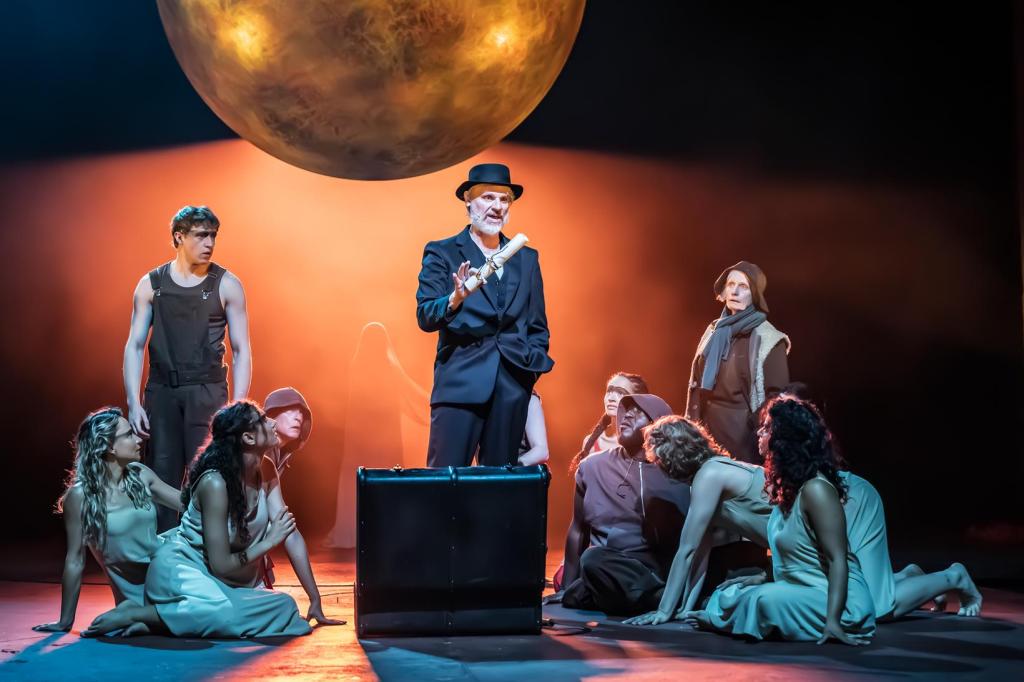
Yaël Farber’s production of The Winter’s Tale is played against the backdrop of a giant, three-dimensional moon. It glows pale white or blood red to signify the contrasting locations in the play: Sicily and Bohemia. Soutra Gilmour’s designs, both set and costumes support an interpretation which has pace and coherence, which can easily vanish with the complete shift in setting and characters that occurs between Act III and Act IV. The early scenes of jealousy, as Leontes pulls apart the lives of those around him, are staged in an almost noir context, with a barefoot king and queen in loose grey clothing. The intensity is completely gripping, in some of Shakespeare’s most driven and desparate scenes. Bertie Carvel’s Leontes is rangy and wired, his paranoia entirely convincing. John Light’s Polixenes, the object of his irrational hatred, is outwardly jovial but wary just below the surface. Madeleine Appiah’s Hermione is full of goodwill, which makes her destruction all the more unbearable. Her trial scene, where she defends herself with patches on her dress from lactation, having just given birth, is very upsetting.

Farber combines the characters of Time and Autolycus to create an rogue / thief / everyman character, played with Geordie accent by Trevor Fox, who ranges around the action, sitting on the edge of the stage smoking a cigarette and linking the two settings. His ballad singing is augmented by Farber with additions from Brecht, which do not neccessarily clarify the play’s themes. Nevertheless, the Bohemia scenes combine pagan and rave themes, and are exciting and tense, which is rarely the case. Lewis Bowes as Florizel and Leah Haile as Perdita are both young, energetic and naïve. Polixenes’ violent fury in this scene, as he exposes their planned marriage, has clear parallels with Leontes’ destructive rage. It is clear that male coercion and violence is the driving theme of the play, and Farber emphasises this by using the same actors to play a band of women around Hermione and around Perdita.

At the centre of the female resistance is Paulina, played by the excellent Aïcha Kossoko who brings power and fearlessness as she stands between Leontes and his victims, then implements 16 years of penance as he submits himself to her authority. The final statue scene, an exercise in standing still for the actor playing Hermione, is played beautifully and plucks the heart strings of everyone in the audience. Farber reveals the play as a complex fable with simple ideas of human love and kindness at its heart, the reason it still makes us weep.

Macbeth

Cush Jumbo and David Tennant. Photo by Marc Brenner.

Macbeth by William Shakespeare – Donmar Warehouse (in cinema)

Max Webster’s production of Macbeth, screened in cinemas from the Donmar Warehouse, has a set by Rosanna Vize which places much of the action on a raised white square that looks like a sacrificial table. It is kept clean from blood until the very last moments of the show, when David Tennant’s Macbeths lies slain, finally staining the pristine surface with a lake of blood. The exposed stage is countered by a balcony, behind glass, where events outside Macbeth’s consciousness take places – the slaughter of the Macduffs for example, and where a Celtic folk band both play haunting music and transform into the witches and other characters, banging frantically on the transparent barrier. The spotlight arena emphasises the Macbeths’ terrifying internal world, which is clearly a toxic marriage. Cush Jumbo’s Lady Macbeth manipulates her husband in a way that is clearly the basis of their relationship while Macbeth himself responds habitually. passive-aggressively – until the murder of Duncan releases his own inner darkness. He rapidly transforms into something that scares even his wife, and there is no way back.

The intensity of the production is heightened by movement techniques by Shelley Maxwell which are reminiscent of Japanese horror films, with sinister walks that parody the human body and reveal the unnatural world into which the play descends. Tennant is a sociable, likeable Macbeth who performs his place in the Scottish aristocracy until he is no longer able to keep up the pretence. His performance is sophisticated and multi-layered, up there with the best of recent times. Cush Jumbo is force to be reckoned with, but her vulnerability is never far from the surface and she spends more of the play terrified than in charge. Other strong performances come include Cal MacIninch’s Banquo, one step ahead of his friend even as he becomes king. Rona Morison’s Lady MacDuff is justifiably angry at her abandonment, while Ros Wat plays Malcolm against type, physically small but fully equipped to root out evil. Jatinder Singh Randawa gives a good account of The Porter, with genuine laughs from his updated dialogue and audience interaction.

The production is known for its sound world which, in the theatre, is delivered through headphones. Although some of the intimacy is lost in the cinema, Gareth Fry’s sound design is still the defining feature. Alongside snatches of live music, it takes us into Macbeth’s head where the witches who, more often than not are invisible, make their presence known with layered, genuinely disturbing whispered and gasped dialogue. The sound complements the bleak interior world of the design with aural hallucinations which are more alarming than anything visible could ever be.

This is an intellectually rigorous Macbeth, stripping away distractions to focus on the unstoppable descent of its main character. Its simplicity and impact makes the play’s difficult reputation seem hard to fathom. Max Webster, whose concurrent production of The Importance of Being Earnest could not be more different, is revealing himself to be a director with a rare talent to bring out the value in plays we already think we know.

A Midsummer Night’s Dream

Andrew Richardson and Sirine Saba. Photo by Pamela Raith.

A Midsummer Night’s Dream by William Shakespeare – Barbican Theatre, London

Eleanor Rhode’s production for the RSC brings a wave of enjoyment to the Barbican on its transfer to the Barbican. A Midsummer Night’s Dream has darker aspects – at least those that appears so to 21st century audiences – but this is the not the production to reveal those. Instead, we are presented with a high calibre, high spectacle Dream which fits consciously into an RSC lineage. The show’s design by Lucy Osborne takes a gleefully 1980s approach to costumes, and a fanastical approach to the fairy scenes in the woods. The costumes are particularly well-observed, with echoes of John Caird’s punkish 1989 RSC production, and of the recent tv adaptation of Jilly Cooper’s ‘Rivals’. Demetrius (Nicholas Armfield) is in full Barbour, while Lysander (Ryan Hutton) is a working class upstart in red braces, tight slacks and brogues. Meanwhile, Helena (Boadicea Ricketts) roams the woods in a pierrot top. The detail is very enjoyable, and wandering lovers even have a 1980s sleeping bag and an Eveready torch.

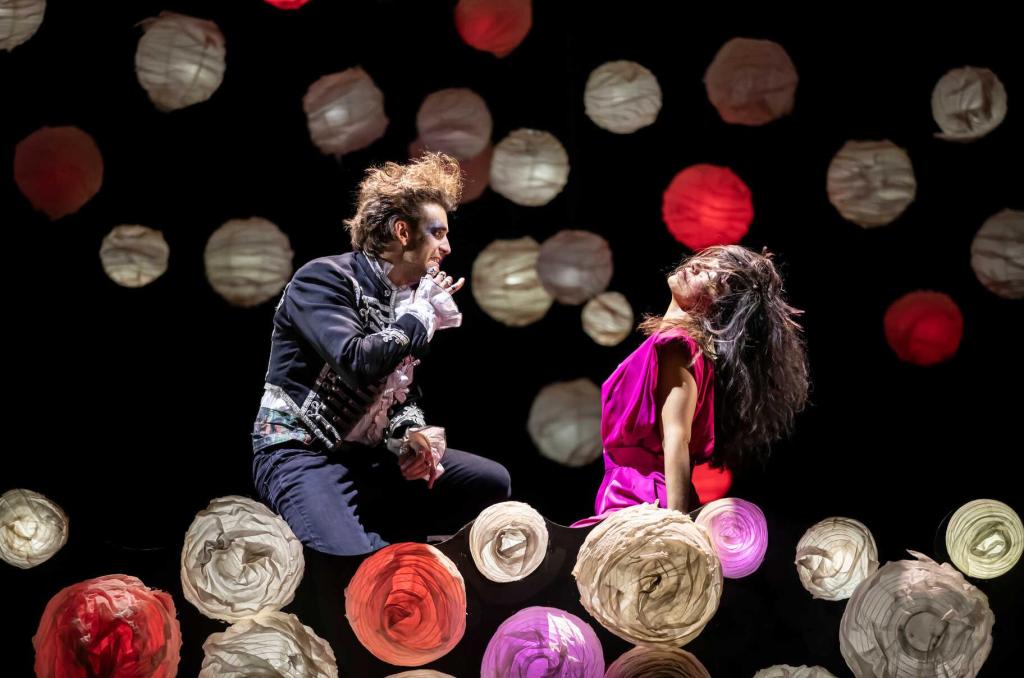
The transition from the mortal to the fairy realm is managed in a delightful fashion, as Snug (Laurie Jamieson) enters a changing cubicle in her tailor’s shop and vanishes, replaces by Puck (Katherine Pearce) who picks up a ringing desk phone to find a fairy on the other end. All the fairies, in a unusual move, are voices represented by flitting, Tinkerbell-style lights, caught and held by the actors. This works remarkably well, and fits into a world of light, with the woods becoming a forest of dangling paper lanterns. Oberon (Andrew Richardson) also inhabits a dramatic forest of ladders, which rise from under the stage. The 1994 Adrian Noble production, with its dangling light bulbs and umbrellas designed by Anthony Ward, feels like an inspiration.

Although the show delivers spectacle in spades, it is subservient to the performances – an impressive achievement from Rhode. Matthew Baynton is effortlessly funny as Bottom, all long, prancing legs and physical presence. He is a more sympathetic Bottom than is often the case, less of a bombastic bully and more of a hero to his fellow mechanicals. His final death scene as Pyramus, in which he knifing himself in the heart, then proceeds to dramatically disembowel himself, ending the job by stabbing a knife into his head, is a tour de force. The Mechanicals are strong, but Helen Monks’ excitable, Midlands Rita Quince is particularly good. The lovers are a strong foursome, with Dawn Sievewright’s Hermia delivering frantic physicality, contrasting nicely with the elegant, angry Ricketts. Ryan Hutton’s Lysander stands out with a notably leggy, wild interpretation – going further over the top than seems reasonable with excellent results.

Sirine Saba’s performance as Titania / Hippolyta has shades of Clare Higgins 1989 performance. She is fired with energy, but of a different kind to Andrew Richardson’s Oberon / Theseus, who is dressed in full dandy highwayman gear and is willowy and volatile. The only interpretation that perhaps falls short is Katherine Pearce’s Puck. Usually the coolest character in the play, which sets up their failure, this Puck is out of their depth, out of breath from rushing to serve her master, mugging to the audience for laughs. It seems a missed opportunity. However, the production is a undoubted success: a thoroughly entertaining evening, deploying the RSC’s impressive resources – including the skills of illusionist John Bulleid – to bring the play’s strange, impossible world to life and to suspend our collective disbelief through traditional theatricality and spectacle.

A Midsummer Night’s Dream

A Midsummer Night’s Dream by William Shakespeare – Wilton’s Music Hall, London

Henry Maynard’s Flabbergast Theatre is an unapologetically physical theatre company, building a reputation for staging Shakespeare in a style that owes a lot more to Grotowsky than it does to the Globe. Flabbergast’s Macbeth, seen last year at the Southwark Playhouse, delivered energy and imagery at the expense of the text. They have followed it up with A Midsummer Night’s Dream, staged in the much-loved Wilton’s Music Hall. The result is the same, only more so.

There are things to like about the production. The setting, designed by Maynard who also directs, is dominated by a hay wain, a cart used like the York Mystery Plays waggons as both stage and set. It fits the play beautifully, with Titania and Bottom nestled above the action watching the lovers in the woods. Costumes, also Maynard’s work, are striking, with the Mechanicals wearing half masks, and an exciting profusion of tartan trousers, dressing gowns, periwigs and golden ram’s horns in evidence (although Oberon’s gold mankini very much outstays its welcome). However, although the physicality of the performances and the commitment to clowning is unquestionable, the result is to make the show less rather than more accessible.

Performances ratchet up to 11 from the first lines, and stay there for two and half hours. There is no departure from full-on mania, from every character in the play. In the opening scene Hermia’s father, Egeus, in crazed 18th century dresses, lurches, bounds and leers around the stage, a grotesque parody of… what? The connection between the characters and any recognisable reality is instantly severed, and from then on the audience struggles to understand what it is seeing, or why. There is no value in picking out performers, but the entire company performs in a way that is mannered in the extreme. Almost every single line is illustrated by the performer acting it out in capering dumbshow. Combined with the masks and the exaggerated accents on display, it makes much of the text inaudible and the rest incomprehensible. It really is impossible to follow what is going on, as characters set fire to the best know poetry in the language and push it over a cliff. It is an exhausting watch.

Flabbergast Theatre are not about the text, that is understood. Their physical style promises much, and anyone who takes a different approach to Shakespeare deserves respect. Unfortunately though, A Midsummer Night’s Dream really does not work. The lack of variation in tone, and the absence of character or nuance, rapidly diminishes the effect of the full octane clowning. Physical theatre is a subtle, powerful tool but, in one of the most atmospheric plays ever written, Maynard’s show has no room for mood. That really is a mistake.

King Lear

Clarke Peters and Danny Sapani. Photo by Marc Brennan.

King Lear by William Shakespeare – Almeida Theatre, London

Yaël Farber’s directs King Lear on simple but very effective set by Merle Hensel – a round, black circle backed by a curtain of chains. With dramatic lighting by Lee Curran, it is the perfect space for a hard-edged, menacing production that brings out the violence that courses through the play. Danny Sapani’s Lead is a big, intimidating man. His anger cows those around him, and he rules through physical presence. But Farber suggests that this is also the basis of his relationship with his daughters. For the first time I saw Lear’s actions as those of an abuser: controlling, threatening and micro-managing his children’s lives. The opening scene leaves the impression that Goneril (Akiya Henry) and Regan (Faith Omole) are equally uncomfortably with their father’s egotistical antics, but it is Cordelia (Gloria Obianyo) who has been driven to the point of resistance. Later, in a supremely uncomfortable moment, Sapani forces Regan, his adult daughter, to sit on his knee in front of her husband. Whatever has happened before the play begins, the father-daughter relationship is undoubtedly dark and destructive.

The violence Lear demonstrates when he still has power – smashing news conference microphones to ground in his rage – is visited on him in turn by children brought up in his image. Henry and Omole are superb are Goneril and Regan, taking destruction of others and themselves as the only way out of the situation they can imagine. Obianyo’s Cordelia is detached and angry, her recourse to violence taking the form of a full-scale invasion with a foreign power’s army, which makes her embrace of love and forgiveness all the more dramatic and moving when it comes. It is impossible to sympathise with Sapani’s Lear in the first half, as he rages in the heath scene, but his transformation, which comes only through the complete disintegration of his ego, is startling. His Lear is entirely compelling, and he is a huge stage presence, an actor coming to the part as though made for it.

Farber production is both well-paced – 3 and a half hours feel like much less – and well cast. Michael Gould’s Gloucester is a reasonable man in a mad world, and his scenes with Lear are a high point. Matthew Tennyson’s Edgar is an ingenue from another world, much more at home as Poor Tom than himself. Fra Fee’s Northern Irish Edmund is the opposite – a lifelong charmer whose over-confidence will always be his downfall. Alec Newman’s Kent, likewise, channels his inner, fight squaddie with suspicious ease. Hugo Bolton’s uptight Oswald and Edward Davis’ louche Cornwall are also highly watchable.

The most controversial element of the show is Clarke Peters’ Fool, played as a manifestation of Lear’s inner voice, who no-one else can see. While theoretically interesting, this approach tends to sterilise the action by removing social context, and Peters’ style seems to belong to a different production. His singing talent is put to good use though, and the use of music, composed by Matthew Perryman and making use of an on-stage piano and repeated snatches of ‘A Hard Rain’s Gonna Fall’, is seriously eerie. This Lear is of the highest class, and brings new insight to one of the world’s most pored-over plays.