Who Cares?

Who Cares? by Matt Woodhead – Summerhall, Edinburgh

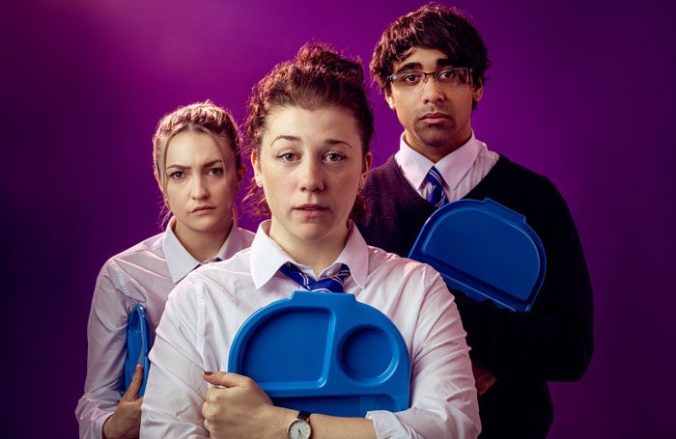
A fierce indictment of cuts and callous indifference, Who Cares? comes straight from the mouths of young carers in Salford. Verbatim specialists LUNG have taken interviews with schoolchildren who have the weight of the world on their shoulders, and turned them into heartbreaking theatre. Three actors play young people who spent years caring for their parents stricken by injury, illness, depression or misfortune – all while trying to keep up with school. An incredibly isolating experience is unpacked in dark detail, as they are ignored and sidelined by adults, bullied by classmates, and then punished for by teachers for being late because they’ve been dealing with a crisis.

LUNG make it clear, through segments where we hear from councillors and social workers, that Government cuts of more than 50% to local authority budgets have left young carers without support, cueing up a disastrous social legacy and failing the youngest and most vulnerable. The show is campaigning – there’s a petition to sign – but it’s also lively, compelling and beautifully performed by its cast of three, who switch between roles with ease to give a voice to those who need it most.

Equus

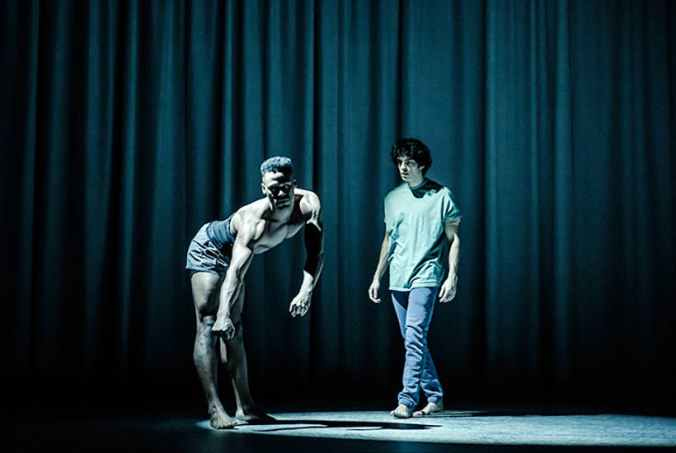
NEW-TheatreIra Mandela Siobhan as the horse Nugget, and Ethan Kai as Alan.

Equus by Peter Shaffer – Trafalgar Studios, London

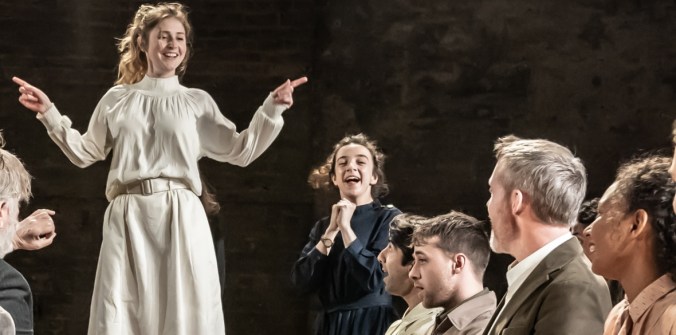
Ned Bennett’s production of Equus reveals a play that is still troubling and involving as it must have been when first staged at the National Theatre, in 1973. A psychiatrist, Martin Dysart, attempts to communicate with a teenager, Alan Strang, who has committed a horrific crime. Their conversations, and scenes from Alan’s past, are played out in an empty space surrounded by white curtains – an interior space invaded by memories  that burst through the curtains, or slide out suddenly from under them, for example four sandcastles that instantly transform the scene into play’s central memory on a beach. The designs, by Georgia Lowe, help the audience see the isolation of both Alan, the patient, and Martin, the doctor, whose coffee mug surrounded by an open expanse of stage is the only indicator of authority.

Martin, in a remarkable performance by Zubin Varla, is the epitome of a buttoned up, professional of his era, on the brink of collapse and smoking incessantly as the only way to stave it off, while longing for Ancient Greece. He sees in Alan, whose inexplicable blinding of six horses horrifies everyone, a reflection of himself. Martin is increasingly oppressed by normality, and starts to believe that helping Alan to become ‘normal’ could be worse, even, than what Alan has done. Ethan Kai brings a thoroughly believable teenage uncertainty and intensity to Alan, but Bennett’s production highlights a theme that seems to have been missing from previous versions. By showing the horses – usually played by actors in masks – as muscled and gagged hunks of sexuality, it becomes clear that Alan’s repressed attraction to men is at the play’s core.

Alan’s family is tied up by religious and social constraint, and there is a delightfully awkward scene in which Alan and his girlfriend Jill (Nora Lopez Holden) run into his mortified father (an excellent Robert Fitch) at a porn cinema. The moment that haunts him, standing between him and ‘normality’ and causing him to mutilate the horses, who have seen his failed attempt to have sex with Jill, was on a beach. A man riding a horse swept him into his arms and onto its saddle. Horses, whose flanks he strokes and whose sweat he licks, are a metaphor and substitute for a sexual connection with men. This makes direct sense of a play which has been seen as concerned with more abstract themes of freedom in a modern society. Bennett has created an entirely compelling evening, which reveals new layers to Peter Shaffer’s play that we can now only see because we have changed as a society since it was first performed – a sure sign of a classic.

Tao of Glass

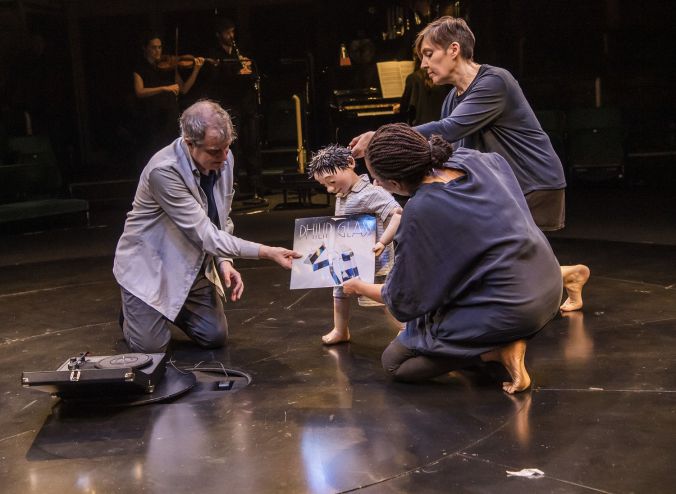
5.Tao_of_Glass_Phelim_McDermott__Sarah_Wright__Janet_Etuk__MIF2019__c__Tristram_KentonImage: Tristram Kenton

Tao of Glass by Philip Glass & Phelim McDermott – Royal Exchange Theatre, Manchester

Better known as a director and creator of theatre with Improbable, Phelim McDermott performs Tao of Glass as a one-man show with puppets and musicians. His account of developing he work with Philip Glass is a strangely old fashioned affair, full of inconsequential detail that detracts from the original music, composed by Glass, which accompanies the play. The show is the story of its own making, a genre that is by no means original. At one point Glass, who McDermott is courting in New York for a joint show, notes that he has a thesis for a show. He is spot on, and McDermott’s approach is a rambling, biographical account of inherently uninspiring events loaded with his research into eastern concepts of reality. The title refers partly to a glass coffee table that gets broken by builders, an event that fails to gain in significance when it is narrated in detail on stage. McDermott is a likeable presence, but the feeling persists that Glass was happy to be involved at a distance in a show that is self-indulgent and lacks a core rationale. McDermott gives up little of himself in his harmless, self-deprecating anecdotes and there is no sense of danger at any point. The show’s puppetry, involving scrunched up sheets of music, also offers little new. The one point where everyone holds their breath comes when a player-piano rigged Steinway grand plays back Glass’s improvisation, as though he were in the room. He is not (his agent features a lot, batting away demands) and his declaration, reported by McDermott, that he is “a Steinway artist” and they have an new piano suggests a man fulfilling his sponsorship requirements rather than committing to a creative process.

The Nico Project

The-Nico-Project-at-Manchester-International-Festival.-Credit-Joseph-Lynn.Image: Joseph Lynn

The Nico Project by Maxine Peake & Sarah Frankcom – Stoller Hall, Manchester

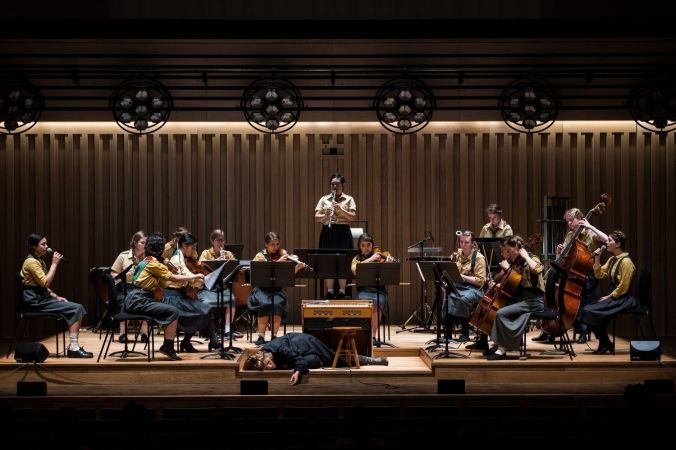
A disconcerting figure in a long black coat wanders the stage, smoking a cigarette. She seems to be making contact with former Manchester resident and counter-culture enigma, Nico. When an orchestra of girls in Hitler Youth uniforms join her on stage, the performance becomes officially haunted. An intricate and highly original performance revolves around the relationship between the troubled-yet-uber-cool Nico and an increasingly anxious orchestra.

The exceptional playing of the girls from the Northern College of Music delivers subtle but punchy versions of Nico’s intense, disturbing songs, but they are also integral to the action. When Nico’s deep voice floats out of the ether over the strings, it takes a moment to realise that the sound is coming from two singers on stage, in their teens. Together they produce a sound they have no right to make. Gradually, as Maxine Peake’s captivating performance becomes more agitated, the orchestra starts to act as one. They take their shoes off and their hair down, and stand on their chairs. Their collective possession reflects the demons in Nico’s life – Nazism and heroine being just some of them – without running through her biography. Frankcom and Peake, whose continuing collaborations are producing a series of exceptional productions, have created original, experimental and unclassifiable theatre that gets inside your head.

Juliet and Romeo

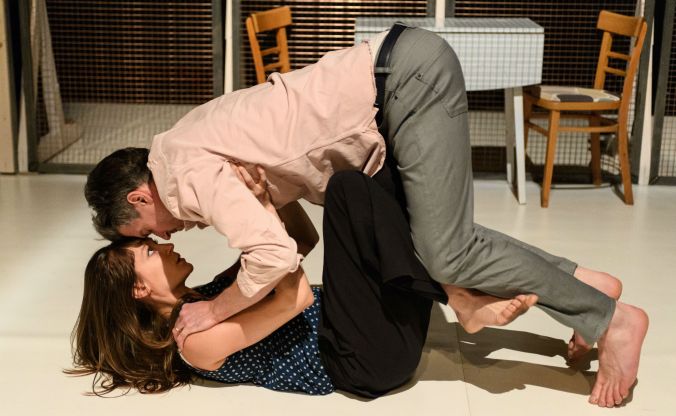
Juliet-and-Romeo-by-LOST-DOG-photo-by-Jane-Hobson-2Photo by Jane Hobson

Juliet and Romeo by Lost Dog – The Place, London

Lost Dog’s productions are unmistakable, effortlessly combining drama and dance across the divide between conventional theatre and dance. It seems so natural that it’s easy to forgot they are pulling off something extremely difficult. Their latest show, Juliet and Romeo, is sophisticated, multi-layered and utterly engrossing. It is funny, sad and, above all, deeply original. Directed by Ben Duke and performed by him and Solène Weinachter, the pair are Romeo and Juliet. They are in their mid-40s and, it turns out, never died. Shakespeare sexed up their story for effect, and their relationship has been haunted by the failure to live up their legend. They suffer from the standard problems of middle-aged couples growing apart from one another, dealing with the pressures of raising children and the disappointments of reality. This clever take unpicks fame, self-mythologising, and the qualities required to deal with life as it is, not as you wish it were.

This inquisition is delivered with irresistible lightness, and a number of dance set pieces that are simply brilliant. The couple perform a clumsy arm-in-face bed wrestle, cleverly catching the experience of sleeping with the same person for years. Juliet likes to reenact Shakespeare’s version of their story, meaning that Duke dances with a dead weight Weinachter, leaving no doubt about how hard work it is, despite her petite form. The two have rather different recollections of the moment their eyes met across the room. Duke dances a very funny, very ludicrous swagger accompanied by The Beatles’ ‘I Want You (She’s So Heavy)’, while Weinachter wants him to glide across the floor to ‘Wild is the Wind’. The humour is balanced by particularly moving scenes, including one in which Romeo tries to distract a dead-eyed Juliet, following a miscarriage. The show is exceptionally accomplished, a top quality performance that disregards art form definitions to leave the audience delighted by Lost Dog’s conceptual insight, physical expression and instinct for theatre.


Wife

wife1200-1008x529

Wife by Samuel Adamson – Kiln Theatre, London

Wife begins with the famous final moments of Ibsen’s ‘A Doll’s House’ – Nora leaving her husband, children and marriage, to the astonishment and outrage of audiences from the moment of its 1879 opening. As Dan Rebellato’s fascinating programme essay explains, the play is part of a long tradition of ‘Doll’s House’ rewrites and sequels which began with Ibsen’s own changes to his ending, softening the social blow. His genius was to leave the outcome ambiguous: does Nora relent and return to her family, develop a new understanding with her husband, or strike out for a life on her own? Writers have queued to fill in the gaps and the latest, Samuel Adamson, pushes off from Ibsen into a survey of changing attitudes to relationships from 1959, via 1989, to 2019. It is an ambitious play, sometimes overly so, which delivers fascinating moments but has an unfortunate tendency to fall short of what it aims to achieve.

Indu Rubasingham, who has fun beginning each segment with the final moments of ‘A Doll’s House’ performed in the style of the era, directs charged performances that sometimes tend towards caricature, not least in the first segment. Sirin Saba’s bohemian actress has just come off stage from playing Nora when a dressing room visit from Karen Fishwick’s tense 1950s housewife, Daisy, and her disdainful husband (Joshua James). The women are having an affair, so horrifying to husband and society that the only solution is to pretend it never happened. It is hard to believe in these clipped ’50s stereotypes, but the 1989 segment seems more real. Daisy’s son, Ivar, played by James with a hint of Rik Mayall, sees her as the enemy. He is gay, a campaigner for equal rights, acutely aware of the constraints around his relationship with Calam Lynch’s uncomfortable Eric. He is fired up by the ‘Doll’s House’ they have just seen, but how many of their problems are caused by the homophobic attitudes that are all around and how many by his self-absorption?

By 2019 and the final section, gay marriage is legal, relationships are apparently open, but Adamson asks whether we’ve gained as much as we supposed. The argument is bold, but delivers limited insight. Eric’s daughter confronts an older Ivar (Richard Cant this time), by now married to an egotistical younger actor called Cas. The generational overlaps are contrived by this point, and the suggestions that 2010s people are self-obsessed and not as free as they imagine seem to provide a starting point for further questioning that does not take place.

Adamson’s play does not fully live up to its clever concept. Much of the dialogue is over-explicit, and lacking in space. On two occasions a scene that seemed finished returns, in a kind of coda, as characters continue to explain things that the audience had already surmised. The lack of ambiguity, and the apparent need to state arguments in full throughout, undermines the plays effectiveness in pursuing its fascinating themes of personal freedom versus social constraint. There is no doubt these play out through the concept of marriage just as they did in 1879, a time that is not as long ago as we might like to think. Adamson’s plea to listen to previous generations is the strongest, possibly wisest, conclusion.


Freeman

Freeman_StrictlyArts_pressimage3-1030x729.jpg

Freeman by Camilla Whitehill and Strictly Arts – Streatham Space Project, London

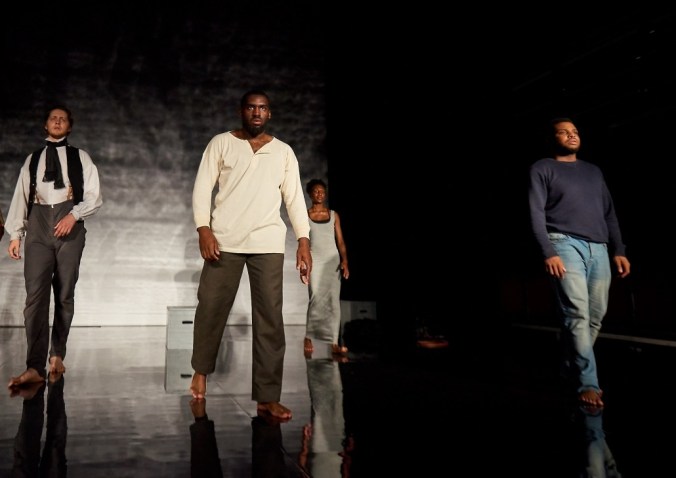
Freeman is a startling and exceptional piece of theatre, and its run in Streatham is a coup for the still relatively new Streatham Space Project theatre is a coup. Winner of a Spirit of the Fringe award at Edinburgh last summer, the four-hander packs a devastating critique of racism and mental health provision in Britain and the US into a whirlwind hour. We soon realise that the four characters addressing us through their pain are dead, one only two years ago and another as far back as 1846. Their stories, gradually unwound, are not as different as we might imagine. In fact, they are grimly similar. Three are black and the fourth white, but deep discrimination runs through their mistreatment. The play aims at the failure to care for those suffering from mental health problems in prison, based around two pioneering cases in which the accused pled not guilty through reason of insanity. In doing so, it lays open the raw wound of racism across western society.

One of the cases is William Freeman, brain damaged from beatings in prison where he was sent by authorities who neither knew nor cared whether he was guilty. After release, he murdered an entire family. The play deals with some of the darkest material that could be imagined on a stage, and all of it is true. The stories laid before us shame the system, which continues to deal out appalling mistreatment. The play also deals with the heartbreaking harassment to death of a blameless black motorist in 2017. However, despite the harsh material the company delivers performances the audience cannot turn away from. Operating on a compact stage, the actors make movement an integral part of the show including some extraordinary physical feats. The acting from all four is also subtle and moving as they switch confidently across characters, accents and centuries.

The show’s atmosphere flicks from graveyard menace to a Lagos party scene to an intimidating encounter with a police officer as though as the touch of a switch, helped by strong sound a simple but clever set with a floor that reflect the action, ghost-like, on to a back sheet. Freeman’s verdict is that a failure to treat everyone with the same respect has infected our society. Mental healthcare failings, often overshadowed by more obvious acts of violence, cannot be ignored.

Freeman has now closed at Streatham Space, but is touring until the end of June and is highly recommended.

Three Sisters

Three Sisters. CENTRE - Ria Zmitrowicz. Photo credit Marc Brenner (8)-2.jpgRia Zmitrowicz and Patsy Ferran. Photo: Marc Brenner

Three Sisters by Anton Chekov – Almeida Theatre, London

Rebecca Frecknall’s production of Three Sisters for the Almeida is pared back and relatively traditional. The new adaptation by Cordelia Lynn sounds natural and modern without forcing it, and the setting is a mostly bare stage, supplying the space for the actors to fill. They do this very well, with a succession of distinctive, individual performances. It is character that makes Chekhov so special. He had an instinct for writing people who feel unfamiliar and just like themselves, without a hint of types. This is partly because he never gives anyone a free pass. All the characters in Three Sisters, without exception, are a combination of loveable and hateful, in different proportions throughout the play. This even applies to the villain of the piece, new wife Natasha who takes the beloved brother Alexander and destroys him. It is impossible to imagine how anyone could marry happily into such a self-obsessed, clique of a family, although Lois Chimimba delivers a particularly spiky performance that shows she’s a match for anyone.

Yet the sisters, despite their chronic inability to escape themselves and each other are also captivating, usually when they are together as a group. The party scenes, and the scenes where they lie around playing cards, seem like brief moments of perfection. Of course, none of the characters realises this and each is ultimately only capable of carrying on – just like the rest of us. Patsy Ferran as the responsible, motherly teacher Olga is the most powerless to influence her own destiny, drifting helplessly to her destiny as headmistress. Pearl Chanda as Masha seems the most free-spirited, but is the most tied down, through her ill-advised marriage to older teacher and bore Fyodor, played with terrifying familiarity by Elliot Levey. Ria Zmitrowicz, as the youngest sister , gives the stand-out performance in a strong ensemble, her unmistakable voice making Irina sound like a being from another world.

Hildegarde Bechtler’s design tears the floor up halfway through to reveal the soil beneath, in a neat coup de theatre reminiscent of Benedict Andrew’s more revisionist 2012 production at the Young Vic, which also had an earth floor. Less successfully, Alexander occupies a sort of shelf above the action for much of the play. The design colour codes the sisters, in blue, black and white, as the centrepieces of the decor, surrounded by drifts if men in brown and army khaki. The most colourful thing in the play is the spinning top that famously mesmerises Irina’s birthday party guests, its fascination contained in the knowledge that, however much it moves, it is going nowhere. Frecknall’s rich production takes place in a bubble of unreality, both alluring and doomed to burst.

Human Jam

Human-Jam-CPT-700x455Brian Logan and Shamira Turner in Human Jam. Photo: Tristram Kenton

Human Jam by CPT/Euston community – Camden People’s Theatre, London

Getting to Camden People’s Theatre is becoming more complicated. The direct route from Euston is blocked by HS2 barriers, and soon lorries will start rumbling up and down Drummond Street, one of London’s most likeable street. The behemoth railway project will reshape this part of town, perhaps for better but undoubtedly for worse if, as the local residents do, you will have to endure the destruction of local amenities and many years of building works, with no compensation – unlike those who live in the Chilterns.

Camden People’s Theatre tackles HS2 head on with an ingenious, chaotic and highly enjoyable lecture-cum-performance-cum-community-theatre show. Artistic director Brian Logan takes the stage to deliver what appears to be a rather untheatrical HS2 primer, explaining how the show takes its title from Thomas Hardy’s poem ‘The Levelled Churchyard’, written as he supervised excavation of bodies from Old St. Pancras Churchyard, around the corner, for an 1860s railway. HS2 includes the removal of St. James’s Gardens, the graveyard of a former church next to Euston Station. It is said to be the largest exhumation in European history – 63,000 bodies.

‘Human Jam’ soon veers off its powerpoint course and, in Ghostwatch style, the graveyard takes over. Enter Shamira Turner, channelling a remarkable number of those buried at St. James’s from Protestant rabble rouser Lord George Gordon to auctioneer Henry Christie and Antipodean explorer Matthew Flinders. However, the character who dominates is forgotten 18th century radical Thomas Spence who advocated common ownership of land. Now robbed of the only land he owned, his burial plot, Spence confronts the right to develop and profit from the land that is part and parcel of HS2.

Turner is excellent, giving a skilled and spirited performance. The show then opens its doors to its neighbours, literally, as a group of local take the stage to make their feelings known and to sing a protest song by Richard Ryan, another occupant of St. James’s, powered by Turner’s gorgeous voice. ‘Human Jam’ is precisely the type of show Camden People’s Theatre should be producing: fully engaged with its community, angry but imaginative, chaotic and messy, and shining a strong, searching light on those in power.