Ulster American

image

Ulster American by David Ireland – Traverse Theatre, Edinburgh

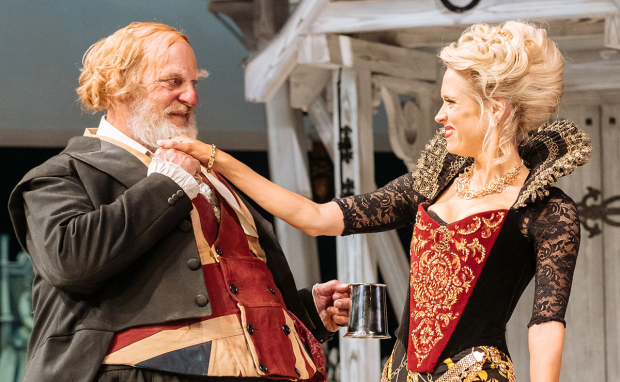
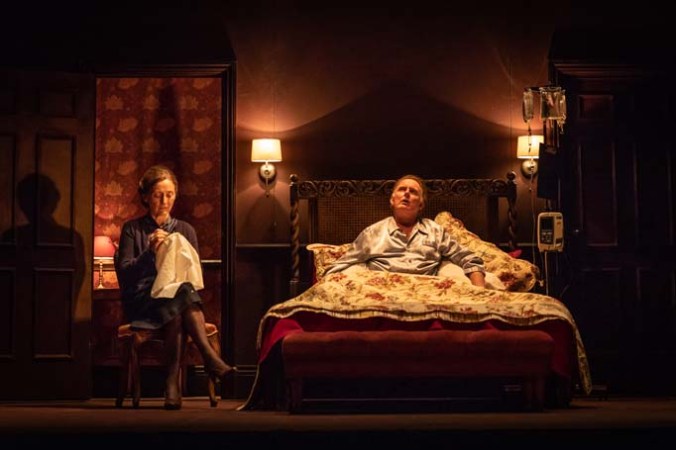
David Ireland’s play, about Hollywood actor arriving in Britain to play the lead in a play by an Ulster Protestant writer, is a riot. From the moment bearded, open-shirted Darrell D’Silva strides on stage the audience is laughing, and it doesn’t stop, even as the humour becomes increasingly, outrageously dark. D’Silva, as Jay, has a plumb part which he attacks with relish. His character is an Oscar-winner makes up with charisma what he lacks in basic intelligence. His deeply serious, unsuccessful attempts to understand Northern Ireland are hilarious. However, his ego is always one step ahead of him, and he is a complete mismatch with his putative director, Leigh, played by Robert Jack. Leigh is nervous, northern and slightly camp, and Jack plays him with more than hint of Alan Bennett. They circle one another warily until Jay makes a macho suggestion of such heroic offensiveness that the play is blown open.

Enter Ruth, the playwright, who is late due to a set of complex and unlikely circumstances which she relates at full speed, with Irish-level candour. Played by Lucianne McEvoy, her character is instantly a match for Jay, in terms of charisma and humour. All three performances delight as the character dynamics shift, and tip into a disastrous vortex of Martin McDonagh proportions. Ireland’s play is one of the funniest pieces seen on stage for a long time, but it has more than laughs to offer. While many aFringe production wrestles awkwardly with the big issues of the moment – rape, sexism, Hollywood hypocrisy, political tribalism, the future of Northern Ireland – David Ireland takes them all on at once with gleeful abandon. The two male characters are brutally skewered – the pious left-wing cliches of Leigh and the egoistic delusion of Jay (“I’m one of the nicest men in the business!”). Meanwhile, it is Ruth they should both have been watching. An irresistible play, in a triumphant production.


DUPed

JOHN-MCCANN-H-700x455

DUPed by John McCann – Sweet Grassmarket, Edinburgh

John McCann is a playwright, born in Portadown, but now based in Fife. Frustrated both by the bigotry of the Democratic Unionist Party back home and by the ignorance and indifference of his friends in Scotland, he sets out investigating who the DUP are, how they came to hold the balance of power in Britain and, most importantly, what he feels about them as someone who left Ulster. As a rigorous theatre-maker, he travels to Northern Ireland to interview people who have come into conflict with the DUP. He discusses the doctrines of hatred that have spawned and driven the DUP, particularly towards gay people and Muslims. A recent example involves Peter Robinson, former First Minister of Northern Ireland, qualifying an Islamophobic sermon by a local pastor, by explaining that he would trust a Muslim in certain circumstances, such as serving him in a shop.

DUPed is staged as a monologue, in a carpeted hotel conference room, with only a Bible and a megaphone. These highly symbolic props are used to good effect: whenever McCann picks up the megaphone, he becomes Rev. Ian Paisley, and it is hard to disagree with his focus on the baleful influence the late preacher still casts over Northern Ireland. McCann highlights important political questions that slide beneath the radar, as Great Britain ceases to take a close interest in Ulster. Meanwhile, religious divisions remain as powerful as ever. McCann’s discussions with those caught up in continuing cultural conflict lead him to the conclusion that there is hope. The popular majority for equal marriage and abortion rights in the Republic of Ireland is a new dynamic for change. He also feels that confrontation will resolve nothing: talking to the DUP is the only answer. The show is a low-key but important monologue, fascinating in itself but something that also feels like the notes for something bigger to come.


Blackthorn

Blackthorn-Harry-Egan-Charlotte-Bate.-Photography-by-Anthony-Robling-4Harry Egan and Charlotte Bate in Blackthorn. Photo: Anthony Robling

Blackthorn by Charley Miles – Summerhall, Edinburgh

Charley Miles’s debut play was first staged in 2016 and she has already received recognition for it. Decor-free and in-the-round at Summerhall, there is no place to hide, but Blackthorn stands up as a well-structured and powerful work. The two characters, Him and Her, appear as children, the first born to their Yorkshire village for 20 years, and then in scenes that leap forward in time as their turbulent relationship plays out. While Him (Harry Egan) stays in the village and becomes a farmer, Her (Charlotte Bate) struggles with the restrictions of village life, leaves for London bu eventually returns. Their failure to connect despite their deep links, recurs again and again over thirty years and more. It embodies the deepening disconnection between urban and rural in Britain, and the uprooting of generations from the place where they were born, whether they stay or not.

Miles’ themes would not work unless they were embodied in believable, complex characters, and they are. Egan’s character is aggressive, confrontational and unable to communicate, while Bate’s is self-deluding and incapable of settling. The two actors put in performances that are a joy to watch, effortlessly using their physical presence to transform the small stage into a field, a pub, a wedding.  Their roots, like the blackthorn, are invisible but every bush is connected under the surface by a network that is very hard to drag from the earth. Miles has written a harsh, tender and, at times, heart-breaking play which identifies her as one to follow.

Prehistoric

prehistoric-yunis-tmeizeh-10-LST306191

Prehistoric by Marcel Dorney – Summerhall, Edinburgh

It is not well known in Britain that Queensland, in the late 1970s, was run by an   authoritarian state government lead by right-wing governor Joh Bjelke-Petersen. His police task force tackled anything they saw as youth rebellion by stripping off their badges and wading in with their fists. The sinister oppression, which Marcel Dorney’s play claims went as far as rape, coincided with the rise of punk in the western world, of which Australia felt itself a part. Prehistoric tells the story of the era through two girls and two boys who form a band, bringing them into conflict with the out-of-control police state.

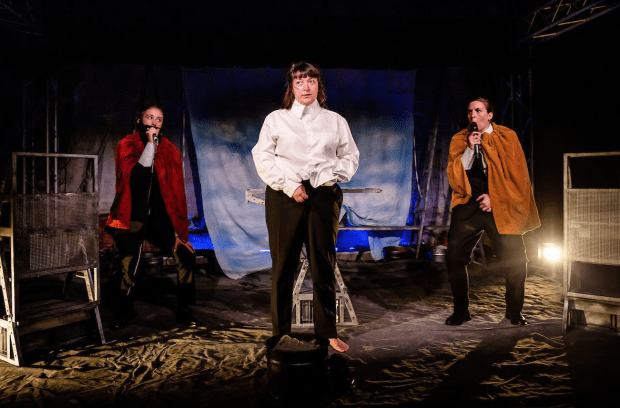
The play features live songs, and is performed muscially and dramatically with great conviction. The four actors – Grace Cummings, Brigid Gallacher, Zachary Pidd and Sahil Saluja – are accomplished performers who create distinctive, contrasting characters from a range of backgrounds. The play is a wild ride, taking the audience from awkward teen encounters to the sweaty terror of raided gigs. A wide range of political issues are brought naturally and cleverly into the drama, from attitudes to race and sex discrimination in the workplace to the conflicted identity of Australians all too aware of  colonial privilege, while cut off from most of its benefits. Prehistoric is an impressive drama, which delivers a forgotten history as part of a compelling account of growing up, physically, culturally and politically.

Cezary Goes to War

CezaryIdzieNaWojne_21_fotPatMic-1080x675

Cezary Goes to War by Komuna/Warszawa – Army Reserve Centre, Edinburgh

Four men in an Army drill hall, clad in Adidas tracksuit tops and shorts, sing lieder and dance in an athletic, chorus line fashion. A woman accompanies them on the piano. All five claim to be called Cezary, and they have a bone to pick with the Polish military c.1994, which has classified them as ‘Category E: unfit for military service.’

Cezary Goes to War is a strange and unforgettable piece that combines high camp with the songs of Polish composer Stanisław Moniuszko. It is often funny, as the performers cartwheel across the stage while singing or line up for physical inspection in their pants. However, its awkward, endearing surface conceals a piece with strong political purpose. The story is autobiographical, written by classical musician and director Cezary Tomaszewski, who is also one of the performers. The criteria for physical categorisation which flash up on the screen are both absurd and disturbing, with echoes of the Nazis. The underlying assumption is that Cezary was rejected by the army because he is gay. This show is a clever, unclassifiable queer response, identifying and examining discrimination while delivering some very fine songs. The Army hall setting, with uniformed territorial personnel tearing tickets, only adds to the impact.


Notorious Strumpet and Dangerous Girl

NSDG_Credit-Brig-Bee-3

Notorious Strumpet and Dangerous Girl by Jess Love – Summerhall, Edinburgh

Jess Love is a circus performer, with skills on the trapeze and with hula hoops that make ordinary mortals gasp. However, her show is in the setting of an AA meeting. Love, from a strict Christian family of teachers, went the other way and became addicted to drink and drugs while touring Europe in various circus shows. Her story is a catalogue of grim blackouts and gathering despair, and Notorious Strumpet is her attempt to come to terms with the way her life has gone.

The show is multi-layered, too much so at times. At the heart of the show are Love’s remarkable circus skills, as she performs a trapeze sequence while pissed, terrifying the audience. There is also audience participation, as Love is sometimes too drunk (in her story) to read out the AA pronouncements that now guide her life. She serves tea and biscuits as we file in. There is family history as Love uncovers a drunken great-grandmother, the ‘notorious strumpet’ of the title. And there is science, with an attempt to track addiction genes using bingo. While there are excellent scenes, which make the evening memorable, the whole does not hang together well. Questions are left hanging, particularly how Love went from being in a very bad place only six months ago, to touring a fringe show. The audience would love to know.

The Spinners

webcrop-900x600spider.jpg

The Spinners by Limosani Projekts – Dancebase, Edinburgh

A collaboration between Scottish director Al Seed and Australian choreographer Lima Limosani, The Spinners is an enthralling dance piece that shows us The Fates in action. The three women –  Limosani herself, with Tara Jade Samaya and Kialea-Nadine Williams – occupy a sort of workshop hung with woven dolls, each representing a human life. They conduct repeated rituals drawing out and tying threads to create, and snipping the threads before casting dolls into a deep cauldron to end what they began. The three dancers work beautifully together, hinting a combined series of female creation myths beyond the Greek narrative. They are birthed from one another, forming a line of three that never ends, and perform miraculous sequences tangling and disentangling threads with their limbs and a set of giant knitting needles.

The story involves conflict and dissent, but the women work together always. They creates images by using their bodies as trio, with sequences of shapes flowing as they merge and combining. The soundtrack by Guy Veale is electronic, suggesting churning activity emerging from this strange room. The Spinners is a show of the highest quality, with a range of exceptional skills creating something captivating and original.

Coriolanus Vanishes

Coriolanus Vanishes 1

Coriolanus Vanishes by David Leddy – Traverse Theatre, Edinburgh

The first thing you notice about Coriolanus Vanishes, is the way it looks. A woman in a suit sits at a desk against a background that is a shifting field of colour. When she opens the desk drawer, a strange light emerges. Her glass glows from the inside. She illuminates herself and the audience with a fluorescence tube and lamps with shaped beams of light. The lighting, by Nich Smith, in combination with Becky Minto’s deceptively simply set, is distinctive and fascinating. However, it does not dominate, but complements Irene Allan’s one-woman performance as Chris, in prison for reasons that only eventually become apparent, after three people close to her have died.

When it premiered last year Coriolanus Vanishes was performed by its author, David Leddy. The switch to a woman is such a success that it is hard to imagine a different version, and it creates an unusual lead role in which the character’s bisexuality is not the focus. Irene Allan tells us a story, scene-by-scene, which encompasses personal and political moral conflict, the theme of private versus public examined in Shakespeare’s Coriolanus. The play neatly incorporates quotes from its antecedent, but the story belongs to Irene Allan. Her character has a sweet Scottish charm which, increasingly disintegrates as she reveals her grim background and the things she has done. The writing is pin-sharp, dealing with grief, anger, addiction and death in ways that are  entirely believable and, as a result, all the more terrifying. The play links Chris’s personal turmoil with her politically toxic job selling arms to the Saudis. Leddy works hard to integrate the elements of home and work that we, in the West, have the luxury of keeping separate. The production is visually stunning and driven by Irene Allan’s powerful performance. It ends with a feat of physical theatre which takes the audience completely by surprise, and leaves them open-mouthed.

Everything Not Saved

everythingnotsaved_lowres-25

Everything Not Saved by Malaprop Theatre – Summerhall, Edinburgh

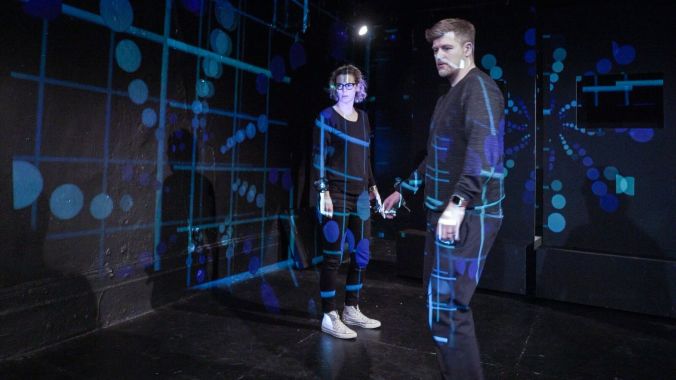
Malaprop Theatre’s new show is about the unreliability of memory in a time of relentless recording. Although the digitised world generates endless versions of ourselves, we have come to realise they only serve to obscure any idea of truth. We will exist after we have gone, but Everything Not Saved aims to show that any version of the self we recognise will be long gone.

The show questions our ability to distinguish reality in any meaningful way at all. While the subject has potential, Malaprop’s approach seems underdeveloped and lacking focus. Three performers act out tangentially related scenes, on a set with stage manager who continually intrudes. They skip from the recreation of Princess Elizabeth’s first broadcast, to an training interview for officers interviewing children about abuse to an audition to play Rasputin. This eclecticism, while entertaining, reveals the fundamental problem behind the show, that it cannot decide what it wants to say. A range of semi-related subjects, including competing versions of history, conflicting memories of experience events, the nature of digital memory and the playing of roles. Too much ground is covered for any clarity to emerge, and the dancing Rasputin finale does not provide enough distraction to make up for this.