Square Go

Square-Go-FR-1024x1024.jpg

Square Go by Kieran Hurley and Gary McNair – Summerhall, Edinburgh

Writers Kieran Hurley and Gary McNair have strong Edinburgh records, and they join together at Summerhall for a play which generates serious late night energy. The round auditorium becomes a wrestling ring, as Max (Scott Fletcher) and Stevie (Gavin Jon Wright) prepare for a school fight. Playing teenagers with a love of 1980s wrestling stars, the two wear singlets but the opponent Max is preparing to face (in a ‘square go’) is school bully Danny, who he has accidentally upset.

The writing is very tight, effortlessly recreating the ’80s Scottish school experience, rich in dialect. We are immersed in a world where nothing is more terrifying or more important than facing up to Danny in the right way. The performers relish the area-like space, bringing the audience onside and demonstrating how easily the mob mentality can be triggered. The Roundabout’s mini-lighting rig is at full stretch, and the soundtrack pounds. However, the play has no illusions about the damage caused by macho posturing. Its compassionate clear understanding of the family background that leads to a boy becoming a bully leads to an inevitable conclusion, that the ‘square go’ is not the sacred school ritual it seems, but a pointless spectacle that must be overcome.

Margo: Half Woman, Half Beast

55988e0ccb

Margo: Half Woman, Half Beast – Assembly Rooms, Edinburgh

Margo Lion was a singer and cabaret performer in Weimar Berlin, who loved Marlene Dietrich and Marcellus Schiffer, her partner whose songs she sang. Cabaret was the symbol of the era, dark but liberated performance in a city sliding unstoppably into fascism. As the Nazis took power, Margo took refuge in booze and cocaine, but her song offered up a continuing resistance.

A little known figure, her story is expertly performed by singer Melinda Hughes, as a cabaret show. From the relative safety of her apartment, Margo observes unrest on the streets and sings the songs that once made her famous. Margo is essentially a cabaret show,  and the story is a vehicle for Hughes’ dark-hued voice, accompanied by pianist Michael Roulston. Songs include new material alongside songs of the time, by Schiffer and Kurt Weill. It is a classy, if polite, evening that deservedly revives the story of a woman whose appeal to be “Sincere and queer in Berlin” is, sadly, more suited to the 21st century than the notorious era when she was in her prime.

Chase Scenes

Chase-Scenes_HERO-Image-e1526546317470-1022x1024

Chase Scenes by Ming Hon – King’s Hall, Edinburgh

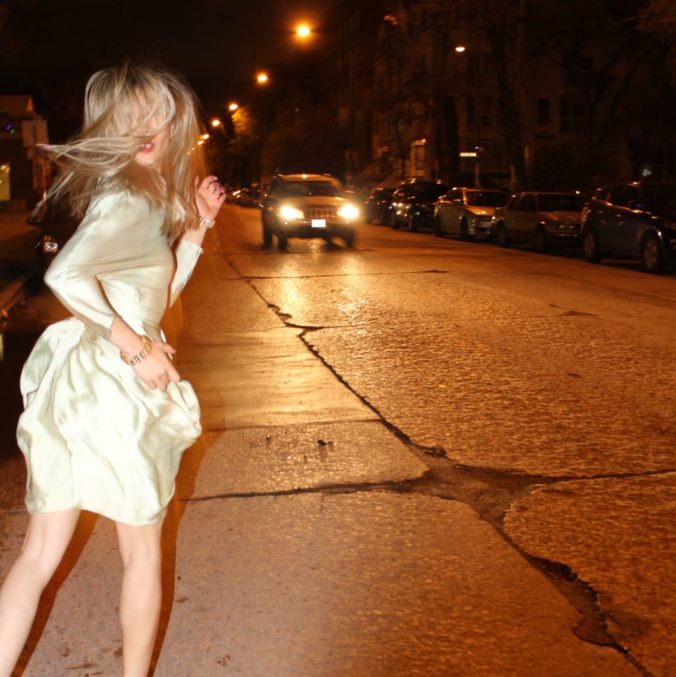
Three women spend an hour recreating, with barely a pause, sixty separate movie chase scenarios. They dash from one set-up to the next, scattering costumes and scenery, while filming each other on mobile phones, the footage projected on screens behind. Each scene is announced with a title – such as ‘Axe’ or ‘Nightmare’ – but removed from its context. The production literally cuts to the chase again and again, focusing on the physical process not only of being chased – in terror, determination, play, or transgression – but also on the process of filming each scene.

While the ambience is home-made and, on the surface, amateurish, it soon become clear that the show is a miracle of timing and coordination. Intensely choreographed, Chase Scenes is more than just a piece of fun. The low budget aesthetic is often very funny, from toy police car chases to the strategic use of plastic fronds to simulate a jungle. The centrepiece of the show is ‘Parkour’, a very silly attempt at simulating parkour that spills off stage onto the balcony and then out into the foyer.

The inherent misogyny of cinema is also played out for the audience, as the nature of a chase is inevitably examined. A substantial proportion of the scenes involve a woman being chased, with violent intent. Devised by Ming Ho and performed by her with Hilary Crist and Alexandra Elliott, Chase Scenes is conceptually brilliant and ingeniously performed. It succeeds simultaneously as entertainment and critique, like a piece of installation art.

How to Keep Time: A Drum Solo for Dementia

download

How to Keep Time: A Drum Solo for Dementia by Antosh Wojcik – Summerhall, Edinburgh

Antosh Wojcik is a poet and a drummer, an unusual but logical combination. In his one-man Summerhall show, he brings his skills to a performance that is highly distinctive – both experimental and emotionally powerful. He tells the story of his attempts to connect with his grandfather – ‘dziadek’ in Polish –  who is suffering from advanced dementia and apparently out of reach, from behind his drum kit.

With an astonishing ability to improvise on the drums while performing scenes with his father and grandfather, he conjures up a piece that is all about rhythm. Fresh from band practice, he shows up in the care home ward with his drum kit and plays for his grandfather, reminding him of shared memories. Images from the his childhood repeat, such as eating a gooseberry given to him by his dziadek. His expressive playing recreates the stuttering replies he receives, and accompany his own thoughts.

The show is also funny with ideas, such as a future in an old people’s home full of aging metalheads, trying to recall riffs of the past, amusingly played out. As a performer Wokcik’s style lacks a little naive and his craft can develop, but his shows is entirely charming, and his open, creative response to the closing down of conventional communication channels is very moving. Wojcik is a talented writer and performer who seems to have invented a genre that is all his own, and we are sure to see more of him.


The Political History of Smack and Crack

KYddhElg-e1533575391491

The Political History of Smack and Crack by Ed Edwards – Summerhall, Edinburgh

Ed Edwards’ new play takes the hopeless territory of addiction, a never-ending round of petty crime, near death, recovery and decline, and places it a remarkable geo-political context. The Political History of Smack and Crack is a two-hander that cleverly combines an alarming conspiracy theory with a study of the impact of addiction on individuals. Edwards’ follows Neil and Mandy, friends, sometime lovers and smack addicts whose lives in Manchester are on a route to catastrophe that lasts 35 years. The pair reconstruct scenes from their lives together from drug-fuelled capers to the height of the 1981 Moss Side riots. Both characters witnessed the chaos on the streets, but also the organised resistance to the police that followed.

Edwards’ bombshell claim is that the disorder seen in every major British city during the  summer of 1981 prompted the Conservative government to turn a blind eye to the mass sale of heroin, which was funding the Mujahideen in Afghanistan, on inner city streets. Before July 1981, smack was available only to the few; afterwards, it was for sale on street corners across Britain, and the modern epidemic of dealing, crime and addiction began. Was the government complicit in unleashing mass destruction to head off a working class revolt?

The theory is disturbing and little-known, albeit supported by only circumstantial evidence. However, it is expertly woven into a story of the destruction wrought on ordinary lives. The two performers are excellent. Eve Steel, as Mandy, is brittle and fierce, and Neil Bell is a shambling, street-addled Shaun Ryder. In the round at Summerhall, with no decor and only for a crutch as a prop, they jump eras, conjuring up  the streets of Manchester and the full sweep of social decline with energy and commitment. Remarkably enough, it is also a play about hope. Edwards, a former addict himself, knows that there is a way out, but it is only for the lucky few.


£¥€$ (Lies)

L3A8201-Credit-Thomas-Dhanens-1024x620

© Thomas Dhanens

£¥€$ (Lies) by Ontroerend Goed – Almeida Theatre, London N1

Ontroerend Goed may be based in Belgium, but their varied and inventive work is an invaluable part of the British theatre scene. Their show £¥€$ (Lies), a hit at last year’s Edinburgh Fringe, continues the strand of their work that puts the audience in the spotlight. While not as directly confrontational as previous shows such as Audience (sexual harassment) and Fight Night (division through democracy), £¥€$ is an immersive and unsettling experience. The audience spends two hours divided into groups at a series of bespoke gambling tables (beautifully designed by Nick Mattan). Everyone hands over the money in their wallet which is exchanged for chips, and the dealing commences. Each table is managed by a cast member, in croupier-like attire, who pushes the audience to risk more in order to win more. As the dice roll and fortunes are made and lost, the options increase. Soon you can short your neighbours or yourself, buy bonds or merge resources. Everything costs, but the times are good. Credit ratings, shown on a central board, climb.

Inevitably, a crash is coming. When bond issuers default, panic sets in and the pressure is on to make big decisions quickly. The drama is orchestrated by the casino-clad cast who constantly gather data and update data on the global market, sounding a gong to make announcements. As a piece of theatre, £¥€$ is remarkably absorbing. Drawn into the increasingly complex decision-making, the evening is over before you know it. Director Alexander Devriendt and his cast pull off a miracle of coordination, in which ten separate improvised shows effectively follow their own course with a single structure.

£¥€$ is also a cleverly constructed critique of the global financial markets. Although simplified, the show explains and demonstrates obscure but important instruments that are used around us every day (for example, fractional interest trading, a technique for simply creating money). It also reveals the febrile nature of the global economy, which can collapse as soon as trust is undermined, or fall apart on the back of a baseless panic. Above all, £¥€$ allows us to see for ourselves how completely dependent we are on one another. This is, oddly, both terrifying and reassuring, leaving just a glimmer of hope that we may choose to succeed together. However, it asks troubling and important questions, including about how much we really understand the world and the systems that govern our lives.

Exit the King

128391

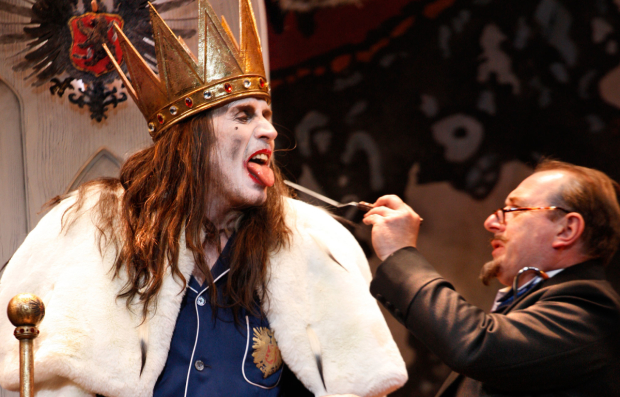
Rhys Ifans and Adrian Scarborough © Simon Annand

Exit the King by Eugene Ionesco – National Theatre (Olivier), London

Ionesco wrote Exit the King when he thought he was dying. As it turned out, he wasn’t and lived for another thirty years. However, his brush with mortality let loose this highly allegorical play about the death of a king and a society which is as absurd as you would expect from the monarch of absurdist theatre, but also a humane account of the fear and the process of death.

The National Theatre brings a fascinating cast to the story of King Berenger, who has lived and ruled for 400 years. A despot who has committed genoicide, he is played by Rhys Ifans, a wild and unruly actor who is becoming more interesting with age. In a long, lank wig and alarming spiky crown, he sprawls and leers over the stage, in complete denial about his demise, predicted by Queen Marguerite and his doctor for the end of the play, in 140 minutes’ time. Not only is his life ending, for reasons as much theatrical as physical, but his kingdom is being conquered, his subjects vanishing, and the wall of his throne room has split in two, in Anthony Ward’s dramatic set. Each of the characters remaining in his dwindling realm is played with both verve and subtlety, a tricky balance to maintain in a play that is both allegorical and realistic and the same time.

Marguerite, a haughty and snobbish Indira Varma who eventually turns out to be the one person in control, is not the only queen. She has been usurped by a younger, dizzier model (Amy Morgan) whose dismay increases as she realises that her world is, literally, collapsing. Adrian Scarborough, who never disappoints, is a fussy doctor who appears to be also a mage, and claims to have “only been obeying orders” when his involvement in a past massacre is brought up. Debra Gillett’s general dogsbody, Juliette, steals the show whenever she appears, doing the dirty work for the King. Derek Griffiths plays a sergeant major-style guard whose public pronouncements on the King’s health (“The King is gagging”) become increasingly strange.

The play is a challenge to stage, simply a progression towards an ending we know is coming from the very start. However, Patrick Marber’s direction drives a developing narrative to the fore as the tyrannical King who names his cat “The Jew” is, remarkably, also shown as a man whose experience of death unites him with everybody else. Ifans comes into his own as he leaves behind his grotesque behaviour, casting off his status and ego to accept the end. This view of redemption is, perhaps, over-optimistic, but a fascinating way for Ionesco, as he thought, to sign off with a final message. Ward’s set collapses into the Olivier Theatre’s void and Ifans walks into the distance and out of sight, leaving the audience to contemplate a play that is much more than a curiosity – a structurally and thematically ambitious attempt to resolve the horrors of the 20th century.


Queens of the Coal Age

RET-QUEENS-OF-THE-COAL-AGE-L-R-John-ElkingtonDesDanielle-Henry-LesleyEve-RobertsonElaineJane-HazlegroveDotKate-AnthonyAnne-image-Kei

The cast of Queens of the Coal Age at Royal Exchange Theatre, Manchester. Photo: Keith Pattison

Queens of the Coal Age by Maxine Peake – Royal Exchange, Manchester


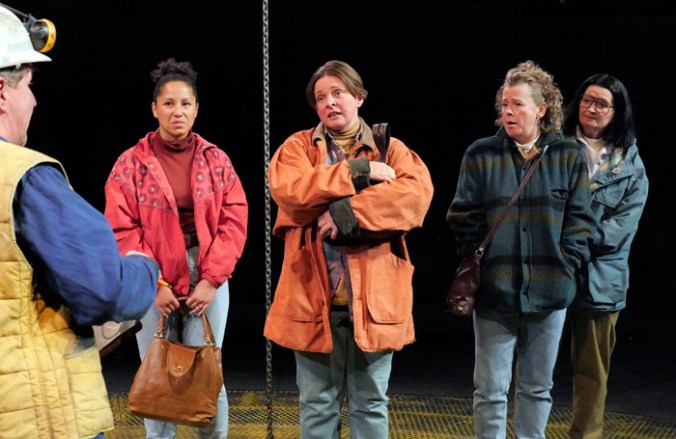
Playing at her spiritual home, the Royal Exchange Theatre in Manchester, Maxine Peake’s play about women and the mines is both a political corrective and a highly entertaining night out. Fresh from playing Winnie on the same stage in Beckett’s Happy Days, Peake steps off the boards and into the rehearsal room. She tells the story of a protest by four women who, in 1993 during a wave of pit closures, occupied Parkside Colliery for four nights in protest. They were members of Women Against Pit Closure, a pressure group forged in the Miner’s Strike a decade earlier, and one of their number was Anne Scargill, the wife of Arthur himself.

Peake has chosen a perfect historical moment for reexamination. The events of the Major era only remain vivid for those who have reached middle age, and the time is ripe to understand the enormous social shifts generally associated with the 1980s, but still underway in the 1990s. She focuses on a moment when the focus was, unusually, on women rather than men. As Anne points out, can you imagine what it must be like sometimes being married to man called King Arthur. Each woman has her own perspective, strengths and weaknesses, and reasons for spending four nights in the cold. Together, they keep each other going and find meaning in a protest that, on the face of it, might seem futile.

The core cast – Anne (Kate Anthony), Elaine (Eve Robertson), Lesley (Danielle Henry) and Dot (Jane Hazlegrove – play out highly convincing relationships as they veer from hilarity to despair. The four women are excellent comic actors, and the sometimes farcical nature of their protest creates genuinely funny moments. Peake also works through the wider issues surrounding mining, protest and political opposition with consummate ease. The lightness of touch in her writing means that discussions of, for example, the volatile future for ex-mining communities, with few constructive opportunities to direct the energy of young men, seems highly prescient. Bryony Shanahan’s direction makes the Royal Exchange’s in-the-round stage the natural home for a play set in a mine shaft. Peake has an exceptional ability to communicate potentially dry debate in an entirely human way. Queens of the Coal Age is the latest in a body of Manchester-based, politically progressive work that continues to grow in importance.


Pigspurt’s Daughter

Daisy Campbell in Pigspurt's Daughter Image 1.jpg

Pigspurt’s Daughter by Daisy Campbell – Hampstead Theatre, London

Daisy Campbell, daughter of legendary theatre maverick Ken, has quite a legacy to live up to. It was equally exciting and confusing to have a father who whisked you off, aged 11, to Robert McKee’s legendarily intense, 3-day story structure seminar in Hollywood, or who took you out of school to tour the Cathar sites of Europe. In the ten years since Ken died he has been celebrated by people who find him impossible to forget, including by Terry Johnson in Ken earlier this year and last year’s Campbell extravanganza Cosmic Trigger, directed by Daisy herself. Already a writer and theatre maker of note, Daisy’s one-woman show about her father confirms her as touched by inherited genius, but with her own, exceptional ability to hold an audience in the palm of her hand.

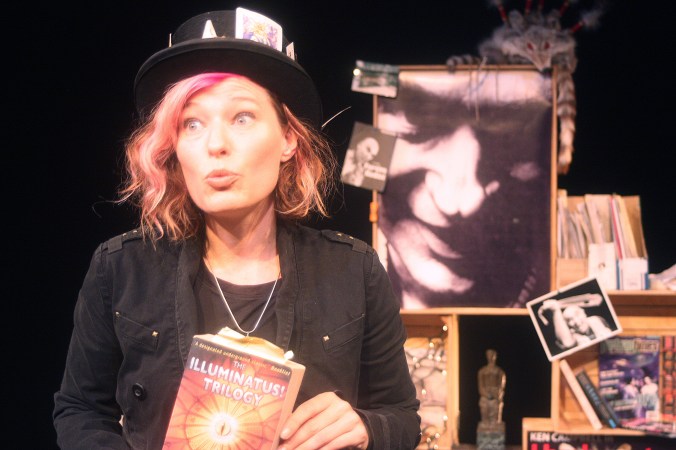
Pigspurt’s Daughter is a wild ride, expertly written and delivered by Daisy alone over the course of two hours. It is an attempt to make sense of the storage unit full of Ken’s belongings she been unable to tackle – everything from his talismanic wooden tie to his gruesome fat suit and photographs (see above) taken to demonstrate that his nose look like a woman’s arse. Daisy is well aware of the symbolic weight of these objects, dogging her life long after Ken’s sudden death, and the need to deal with her father’s complicated legacy. The show included multiple arse metaphors as a result, Daisy trying to escape from Ken’s, while his demonic spirit manifests in her insides, as ‘Pigspurt’. She tries to separate out the ‘storyteller’ half of her brain, and understand how it directs her life, deploying neurological research and philosophy, and the Cathars keep getting involved, as do hidden mycellium networks that mirror underground culture.

The combination of antic performance and intellectual obsession is in the spirit of Ken, but the show is more than a tribute. Daisy’s conflicted feelings about her father are unflinchingly explored too, from his demanding nature (“What have you done of note?”) and lack of interest in her, to his list of goals for her that are both funny and terrifying (“Become a Chinese violinist. Supervise a breakthrough at CERN.”). As she explains, Daisy spent timein an asylum in her twenties, and her unconventional upbringing came at a price. Her portrait of a man who was both brilliant and impossible is something of a corrective to any  tendency to assign theatrical sainthood to Ken – a moving, fascinating account of a relationship with a bafflingly real person. ‘Pigspurt’s Daughter’ also features an astounding final sequence, in which Daisy lights on an unbeatable plan to tame her father’s legacy, involving exhumation, which leaves the audience gaping. Ken Campbell was entirely himself, a rare and precious quality for a performer. So is Daisy Campbell. There is no doubt that, just like her father, whatever she chooses to do next will be unclassifiable and unmissable.