Box Clever

boxclever_small

Box Clever by Monsay Whitney – Summerhall, Edinburgh

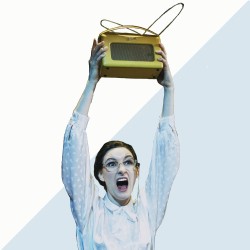
Performed in the round, portable Paines Plough auditorium, Box Clever lays open the frustrations of a woman caught in the system. Writer Monsay Whitney tells the story of disastrous relationships, drug problems and the beleaguered life of a single mother escaping domestic violence, in dry South East London tones. All the other characters in her story are played by Avi Simmons, dressed as a clown, with guitar and prop trolley. Assailed on all sides – by her devious mother, patronising care worker, and unpredictable, fire setting residents of a women’s refuge – her situation is disastrous and bleakly funny.

It turns out to be a play of two halves. The story segues into a involved very specific sequence of social worker appointments and hearings, in which it becomes convenient that Whitney should take the blame for others actions. Pretty much everyone else in the play is painted as shameless and self-serving, not only abusive boyfriends but everyone in authority. Social workers and police are all not only arrogant but utterly uninterested in the people they care for. This makes us question the objectivity of Whitney’s perspective and, while Box Clever tells a dark and heart-breaking story with humour, it lacks the wider political resonances that would give it real power.


Road

05121de8-75f7-11e7-a3e8-60495fe6ca71Faye Marsay, Liz White and Lemn Sissay © Johan Persson


Road by Jim Cartwright, Royal Court Theatre, London

The Royal Court is not known for reviving its own history, so the decision to restage Jim Cartwright’s Road, a triumph when premiered here in 1986, is very deliberate. Thirty years on, we are invited to confront what has changed and what has not since a generation on from the heights of Northern post-industrial decay. Inevitably, the issues of joblessness and hopelessness at the heart of Road seem highly relevant to the 2010s. It may be about zero hours contracts rather than jobs in open cast mines, but still the same as it ever was. It is more of a surprise, perhaps, that Cartwright’s writing still seems so fresh – mesmerising and confrontational – and the staging as inventive as it must have done at the height of the Thatcherite 1980s.

A picaresque romp through the front rooms, street corners and chips shops of an unnamed road in an unnamed Lancashire town, Road is a series of interconnected vignettes. These range from the riotous to the staggering bleak. The audience is given a guided tour by ringmaster Scullery, a street-dwelling, rum-swilling carnivalesque presence who not only observes but takes part, indulging in the occasional burglary and the odd knee trembler. He is played by poet Lemn Sissay, who follows the tradition of casting an occasional actor in a part originally played by Ian Dury. His linking scenes catch just the right level of leery conspiracy, as he dives into living rooms as the inhabitants of the Road get ready to go out for the night.

At first these scenes appear conventional – a mother and daughter arguing over the ironing board, a man reminiscing about better times – stock scenarios from kitchen sink drama. But there is something more direct, more brutal and more strange about the way characters behave, and what they have to say. Carol asks her alcoholic mother, “Are you still going with that ragman?” Jerry talks about being “poor, no good, no use”. A skinhead delivers a hallucinogenic monologue on his dharmic conversion from street fighting. Life on the Road is dictated by industrial collapse, unemployment and lack of prospects. The first half culminates with Clare (Faye Marsay) and Joey (Shane Zaza) sharing a bed and a hunger strike in a heart-rending, beautifully written scene, so jaw-droppingly grim that a noticeable section of the audience did not return after the interval. They made a very poor choice.

Road is both richly written and gloriously unpredictable. It is as though John Cooper Clarke’s post-punk state of the nation song, ‘Beasley Street’, had come to life and rampaged through the theatre, disgorging characters right, left and centre. Saturday night hook-ups become scenes of intense, shared despair and flash front collapses as the drink takes hold. Scenes are so tightly written that not a word seems superfluous. Somehow a balance is maintained between themes of deep social decay and the human warmth of a town out and about.

Road includes an array of fantastic parts, but the key is in the ensemble. John Tiffany directs a fine cast, who expertly double up across roles. Faye Marsay and Liz White play frustrated young women, Michelle Fairley desperate middle-aged ones, Mark Hadfield the desperate and drunk, Mike Noble loners, Dan Parr a man looking for escape, June Watson old women singing older songs, and Shane Zaza the unforgettable Joey, attempting to leave this terrible world. If that sounds like a tough evening’s theatre, it is anything. The quality of Cartwright’s writing is such that it is impossible to look away, as perfectly crafted scenes follow one after another. The Royal Court has revived Road because, thirty years on, there is still nothing like it. John Tiffany’s production updates the play to make its time period clear to a modern audience. Although now a play about the past, it still speaks to us in an urgent, foul-mouthed, irresistible tones.

Mosquitoes

Mosquitoes-Dorfman-NT-700x455Olivia Williams and Olivia Colman. Photo: Tristram Kenton


Mosquitoes by Lucy Kirkwood – National Theatre (Dorfman), London

From the title onwards, Lucy Kirkwood’s new play is absorbed with the connection between the insignificant and the cosmic. Mosquitoes, tiny vectors of destruction, are a not-entirely-subtle metaphor for the play’s characters, principally a contrasting pair of sisters. Olivia Williams is serious, intellectual and works on the Large Hadron Collider in Geneva. Olivia Colman is, according to herself and her mother, stupid, hopeless and works in a bar. Already this might seem like enough of a symbolic framework for any play, but Kirkwood has plenty more up her sleeve.

Mosquitoes is very keen to demonstrate that it is a serious play about big subjects. It does this by covering just about every issue of the 2010s, and a few more for good measure. It spends significant time on fake news, the MMR vaccine, phone sex, generational divides, dementia, caring, women in science, the Higgs Boson, the future of the planet, parallel dimensions, hacking, missing persons, and bullying. Additional topics float through the script. The play is so current, it will have dated before the end of its run. No play, even one written by Tom Stoppard, could successfully address such a range, and the result is sometimes infuriating. However, Kirkwood is a talented writer and, despite its gaping flaws, Mosquitoes is an entertaining evening.

The most involving scenes are down to the performers, particularly Colman and Williams, and the dialogue Kirkwood provides. Their relationship is unconvincing on a symbolic level – Colman’s character Jenny is far too funny and sharp to be her sister Alice’s intellectual inferior. However, their tempestuous yet dependent sisterly relationship is entirely convincing and very amusing – the heart of the play. Alice struggles with her unhappy teenage son Luke, while Jenny is blamed and blames herself for the death of her daughter from measles after refusing the MMR vaccine. This scenario is typically over-complicated, but the play comes to life whenever the two share a scene, incessantly winding each other up but mutually protective in the face of external threat.

The play’s other triumph is the character of Karen, their mother, played as an old lady by the definitely younger Amanda Boxer. She is hilarious and infuriating in equal measure, marauding around CERN and both emotionally supporting and destroying her children. Other characters are less successful, with the storyline involving Luke and schoolfriend Natalie, something of a teen soap by numbers. Alice’s vanished husband, played by Paul Hilton, is described as The Boson and has apparently merged into the cosmos, from which he reappears at intervals to conduct physics lectures. These are impressively staged, with the Dorfman experiencing the kind of light show usually reserved for the wider spaces of the Oliver auditorium. However, the use of astrophysics as a metaphor for human affairs feels neither as original nor as exciting as the staging implies. The coda, a dizzying zoom out from the play’s timline, provides wow factor but reduces the clarity even further.

The quality of casting available to the National gives Mosquitoes the best possible presentation, and the combination of Colman, Williams and Boxer is worth an evening of anyone’s time. However, Mosquitoes does not convince as the best playwriting on offer in 2017. At its core, it is a play about the relationship between two sisters and their mother – funny, touching and real. Everything Kirkwood adds to this triangle dilutes the play’s effectiveness, leaving the audience feeling bombarded and unsatisfied. Less is more.

The Tempest

the_tempest_production_photos_2016_press_call_2016_photo_by_topher_mcgrillis_c_rsc_207549-(1).tmb-img-820Mark Quartley and Simon Russell Beale – image by Christopher McGrillis


The Tempest by William Shakespeare – Barbican Theatre, London 

It is thirty years since the RSC last staged The Tempest in the hull of a broken ship. Since Derek Jacobi’s 1982 Prospero, with Mark Rylance as a particularly unworldly Ariel, theatrical fashion has swung decisively away from elaborate, literal settings. Greg Doran’s production, luring Simon Russell Beale back to the company for the first time in only 23 years, is a self-declared spectacle. The Imaginarium Studios technological innovation in the form of a motion capture suit for Ariel, but the production ends up paying tribute to the theatre of a previous generation. Fortunately, this includes not only overly elaborate staging, but also unforgettable performances. It is impossible for the audience to take its eyes off Russell Beale’s Prospero who, shrugging off the special effects, masters the role and absorbs it into his peerless repertoire.

The set, by Stephen Brimson Lewis, is the ideal setting for the opening storm scene, vast and terrifying. The island is contained in the hold of a wrecked vessel, and within the imagination of Prospero. Russell Beale’s magician is traditionally cloaked and staff-wielding, consciously part of a lineage of Stratford performers. He is, however, notably agitated and vulnerable, struggling with the unavoidable decision to dissolve the world he has created and lose his daughter. His love for Jenny Rainsford’s gawky, mischievous Miranda is touchingly real, but he has clearly prevented her from growing up and growing away from him. When Duke of Milan, Prospero had shut himself away from society and responsibility, and a fantasy world clearly suits him only too well. Russell Beale lays his internal conflict out for us to see and, as a result, is riveting even when Prospero is simply standing and watching at the side of the stage.

The strength of the cast gives this production its power.  Daniel Easton’s Alexander Armstrong-esque Ferdinand is an unlikely partner for Rainsford’s Miranda, raising the possibility that her choice of the third man she ever saw will prove a mistake, and that her father’s closeting has made it impossible for her live an independent life. The traditional RSC elder’s role of Gonzalo fits Joseph Mydell like a glove. James Hayes is a magnificent, Stephano, wig askew, as sober as any spectacularly drunk man has ever been. Simon Trinder sources his bitter clown performance as Trinculo from Reece Shearsmith in The League of Gentlemen.

In the 1982 production the great Bob Peck played Caliban. Joe Dixon, a hump-backed, figure clutching a fish, combines humour and menace to comparably memorable effect. Mark Quartley as Ariel has the toughest job of all, often doubled up by a motion-captured apparition of himself projected above the stage which looks unfortunately like computer game graphics from the late 1990s. When not impeded by the tech he is twitchy like an animal, a force of nature in his Mark Rylance-esque skin suit. There is no repeat of the notable ending to the RSC 1993 Tempest when Ariel, played then by Russell Beale, spat in Prospero’s face when finally released from his duties.

The Tempest is both a satisfying and frustrating experience. Doran demonstrates that the RSC can pull together an exciting cast of fine actors who deliver serious performances. His recapture of Russell Beale gives the finest Shakespearian of his generation the chance to deliver one of the few lead roles he has not yet touched, and he does not disappoint. If only his unrivalled talent had been trusted to do the job, without the need for distracting and ultimately trivial embellishments.