Adam

Cropped10.20Neshla20Caplan20and20Adam20Kashmiry-700x455.jpg

Adam by Frances Poet – Traverse Theatre, Edinburgh

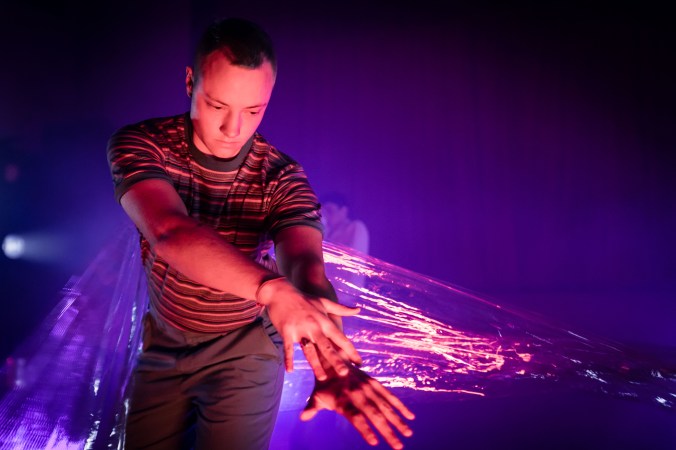
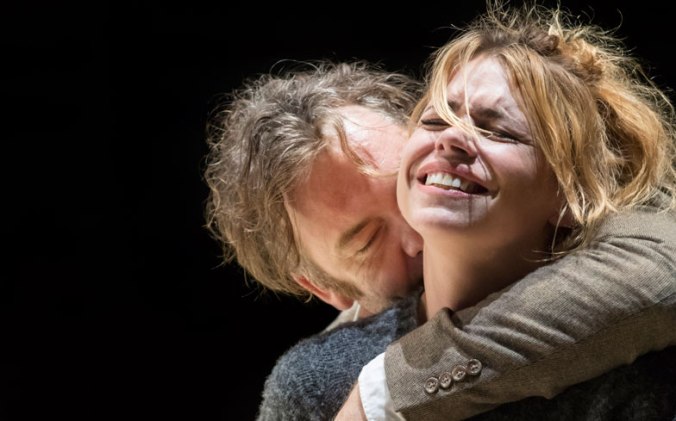
It is only gradually that the audience at the Traverse realises what it is seeing. Adam narrates the struggles of a girl fleeing Egypt for Glasgow in 2011, escaping not only the bloody Arab Spring but also the constrictions of gender. A cast of two, a young man and a young woman, play out the two sides of the fraught conversation in Adam’s head as he struggles with the attitudes of his family and Egyptian society to his conviction that, although born a woman, he is a really man. Played on a clever set (by Emily James) with props that unfold from the tiled floor, it seems like conventional theatre until it dawns on us that none of this is fiction.

The central character, played by Adam Kashmiry, is himself and his story is astonishing and heartening. The trauma of coping with refugeee status while injecting testosterone to induce a second puberty and become a man is both terrifying and horribly ordinary. Yet the story is a one of great hope. Adam’s performance, and that of Nesha Caplan as his female alter ego, is powerful. Some of the detail of the story seems to stretch credibility, yet any criticism of narrative or structure is rendered embarassingly irrelevant by thetruth of the events. A final Skype appearance from his real life mother in Egypt, provides an emotional denoument, while the internet plays a crucial role in showing Adam he is part of a community. This is a play that is direct and real, and it leaves the audience astonished.

Q&Q

4f29224cd5620bbd9877c148d75d24781de45497-original-LST249484

Q&Q by Liwaa Yazji – Traverse Theatre, Edinburgh

A new play presented in a rehearsed breakfast reading, Yazji’s work packs an overwhelming emotional punch. Three women caught up in various ways by the war in Syria are interviewed by administrators, from NGOs and governments, in the places to which they have fled. Each has a story as disastrous and distressing as anything you may have read or heard, in a war of mulitiple personal tragedies. Their particular experiences relate to the particular experiences of being female a war, and to the spirals of rape and prostitution which have entrapped them, and of childbirth.

The play is extremely sharply written, and if anything gains from the simplicity of its presentation. The three women are angry, traumatised and forced to struggle not only with attackers in Syria and people smugglers, but with the controlling and patronising systems that dictate their lives in Western refugee camps. One of four plays produced by Birth, a childbirth campaigning organisation, Yazji’s work is difficult but captivating, and will surely receive the much greater exposure it deserves.

Ivona, Princess of Burgundia

d21834ac-136a-42ef-a394-353feb931f74.jpeg

Ivona, Princess of Burgundia by Tibaldus – Summerhall, Edinburgh

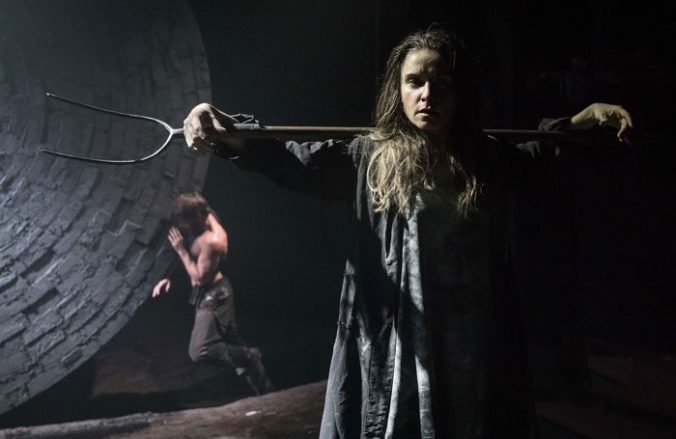
Belgian company The Tibaldus Collective has reworked a classic of Polish theatre, a dark allegory written in 1938 by Witolds Gombrowicz (‘the Polish Shakespeare’) using a mixture of drama and dance. Surrounded by the audience seated in a circle, they play out a bizarre and gruesome nightmare of fairytale in which a girl who is apparently such an ugly, awkward social embarassment that she makes people uncontrollably ugly destroys the royal court without speaking a word. Faced with her inability to be anything other than herself, the King, Queen, Prince and courtiers are driven to confront their own dissembling, and are brought down by their demons.

The material is fascinating, but Tibaldus presents them a in performance style best described as alienating. Dialogue is in English-as-a-second-language style, and dramatic tension is constantly deconstructed through strange pauses and awkward delivery. There is a certain black humour in this, but running at 1 hour 40 mins, it becomes an endurance test. The sporadic outbursts of movement are expressive and committed, but there is not enough of it for a company definitely at its best when dancing.

Get A Round

Get-A-Round-credit-Roshana-Rubin-Mayhew-700x455

Get A Round by Eggs Collective – Summerhall, Edinburgh

Eggs Collecive aren’t messing around. They promise a legendary night out – a night of hard drinking, hard dancing, and hard throwing up. Summerhall has give them alcohol training, so they can liberally dose their audience with something that might be Hooch. Dressed to hit the town, Leonie Higgins, Lowri Evans and Sara Cocker take the audience with them, assigning roles such as ‘Hugh What’, the guy who needs everything explaining to him very slowly.

The party tunes and clubbing confessions seem familiar at first, but Eggs Collective are subtle performers. Experts at drawing the audience in, they play gently with the stereotypes and shared experiences of three young women on a night out together. Recreating something we recognise, they also show us a darker side. Could it be that we are only able to express our real insecurities head in a bucket at 2am? Are friends the only people who can rescue us? A hugely enjoyable evening, Get A Round shows off the talents of three watchable, clever performers who together make up a strong and subversive ensemble.


A Girl With A Gun

Screen+Shot+2017-03-21+at+09.36.00.png

A Girl With A Gun by Louise Orwin – Summerhall, Edinburgh

Louise Orwin’s eerie, enticing show is a Hollywood movie gone awry. Beginning with Jean-Luc Godard’s cynical quip that all you need to make a movie is a girl and a gun, it spins into a dream sequence of disconnected scenes and off-kilter move tropes, deconstructing the assumptions behind movies, audiences and the act of watching. Orwin works with an actor who has never seen the script before, and he is drawn through his strange, halting role by an autocue. But Orwin is autocued too and, as a drawling, cherry stone-spitting, gun-toting Southern moll she seems suspended in Hollywood dreamtime. Meanwhile, her cohort looks increasingly awkward as hard man posing, always with a weapon, leads into cowboy style domestic abuse.

A Girl With a Gun is a sharp critique of the deeply rooted sexism and violence at the heart of Westerns, war movies and gangsters, leaving a nasty taste in the mouth and an empty cultural core. It is also a sequence of David Lynch scenes of disconnection, repetition and general weirdness. It is an unpredictable, compelling and highly memorable piece of theatre driven by the dark imagination and performance skills of the highly talented Orwin. Proper fringe theatre, it packs more into an hour than we have any right to expect.

The Believers Are But Brothers

042017transformthebelieversproductionphotos027

The Believers Are But Brothers by Javaad Alipoor – Summerhall, Northern Stage

At the outset of his exploration of the rise of online extremism Javaad Alipoor points out that as a Muslim, he sees a narrative played out every day in the news that he cannot control, and that is not his story. His attempts to make contact with radicalised young men and Isis brides meet with no success whatsoever. After all, what does he have in common with these people, or they with him? The Believers… deals with the wider consequences of this separation, between people sitting behind screens, whether ‘Alt Right’ or jihadi. However, despite using a vareity of media, it is not clear what new insight is on offer.

Alipoor combines pre-recorded sequences with fictionalised narrative and internet video. He also Whatsapps the audience, although when we attended the ushers failed to give us the login instructions so those sequences remained a mystery. Alipoor steps out of the action frequently to tell us what he did and why. This includes relating information that is already well known, for example an extensive explanation of the history of 4chan. This contextualisation is not enough to authenticate the parallel stories he tells of young British Muslims heading to Syria. While these are well written, it is not clear whose experiences they represent. There is also a suspicion that 4chan and its ilk do not deserve the credit the show gives them for their influence on the zeitgeist. The Believers… takes on current concerns and pores over recent events, but despite Alipoor’s best intentions we end up little the wiser about why they have occurred.

Camille O’Sullivan

Camille_OSullivan_Where_Are_We_Now-18823_750x490.jpg

Camille O’Sullivan – Where Are We Now, Underbelly Circus Hub, Edinburgh

A genuine fringe star, Camille O’Sullivan can be found in an Edinburgh tent at most festivals, singing her red wine-fuelled, femme fatale covers of Jacques Brel and his spiritual successors. Her voice is astonishing, soft and powerful in equal measure, and she clearly loves her audience, who love her back. However, her success does not come from repeating the same tricks. Her show changes and develops with the times, and this year she reflects on global uncertainty through the songs of her recently departed heroes, David Bowie and Leonard Cohen.

O’Sullivan’s performances are show-stopping, and she ranges across Radiohead, and Nick Cave as well as Bowie and Cohen. Her emotional commitment leaves her breathless at the end of Brel’s Marieke, sung mostly in Flemish. She delivers eerily prescient versions of Cohen’s The Future and Bowie’s Five Years, foretelling end times, but also finds comfort in the former’s perspective on the cyclical nature of turmoil. Then she sends us all back out on to the Meadows with a communal version on Cave’s Ship Song, slipping out to look after her CD stall.


Mouthpiece

Mouthpiece-1024x1024.jpg

Mouthpiece by Quote Unquote Collective – Summerhall at King’s Hall, Edinburgh

Two women in white swimsuits harmonising in a bath in the dark is the prelude to a heartfelt and compelling, but rather unfocussed show about mothers and daughters. The sudden death of her mother leads single, flat dwelling writer Cass to question her identity and choices, and to ask whether she really knew her mother at all. Her failure to get out of the bath and write a euology for the funeral becomes an examination of the roles of women in society, and whether have really changed for the better.

The show is expertly performed by Amy Nostbakken, who also directs, as Cass and Norah Sadava as her alter ego, conscience and self. They use their fine voices and physical theatre skills to shape the story, but the variety of techniques does not always improve their clarity. While some ideas illuminate, the profusion of comic voices and operatic bathtub duets clouds the piece. Mouthpiece takes on important, uncomfortable themes, but is at its best when dealing with the awful banalities of bereavement. The everyday expresses the universal most effectively, and Mouthpiece feels as though it is trying to hard.

Power Ballad

Power+Ballad+HERO+[full]

Power Ballad by Julia Croft – Summerhall, Edinburgh

Until you’ve had a New Zealander dressed in mime costume shouting “Feminist Theatre!” at you in a former veterinary demonstration room, you’ve not experienced the Fringe. Fortunately, Julia Croft’s unnerving and wonderful show delivers in this respect and a number of others. Part dance, part sound art, Croft confronts the issues of gender that are dominating this year’s Fringe, but in a way that is entirely her own. Transitioning from woman to man and back again, she leaves the audience with absolutely no idea what to expect next.

Croft is a physical performer, using in turn her body and her voice to unsettle and then win over the Summerhall crowd. She turns words over and over, using repetition to strip out and question meaning. It’s an amazingly effective technique. She builds tracks with a loop machine, stroking herself and audience members with a microphone. And there are power ballads, which somehow seem much more profound when Croft is miming along. An entirely original show, delivering just the right combination of originality, inventiveness and emotional punch.