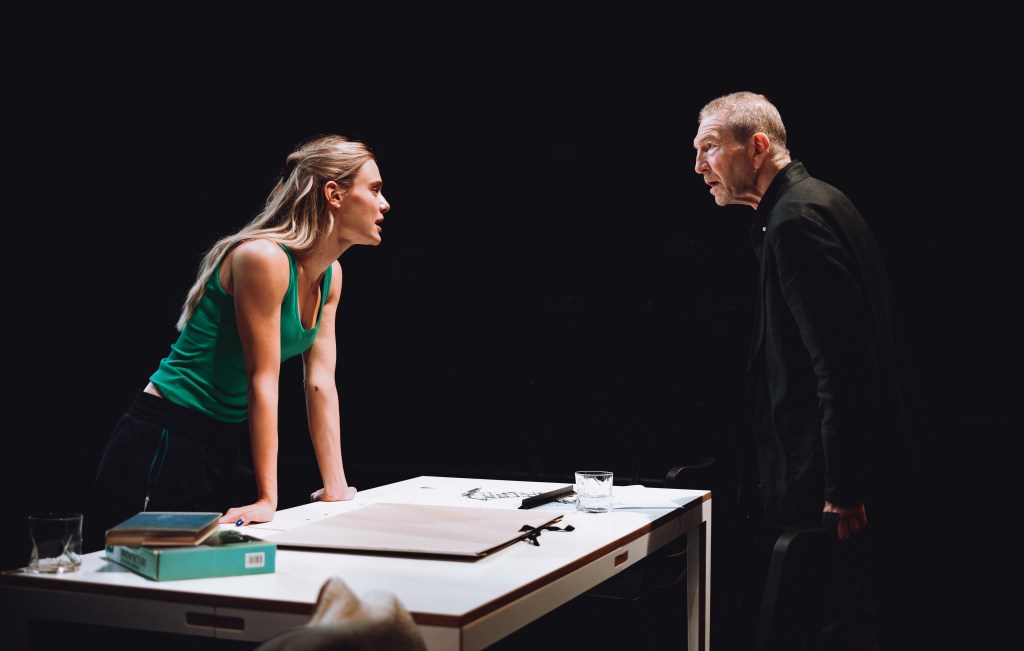
The Master Builder by Henrik Ibsen – Arcola Theatre, London
Published at Plays International
The Arcola stage is an architect’s office, complete with plywood desks and display models. Robert Innes Hopkins’ set places the production firmly in the 21st century design world of demanding clients, big egos and office politics. When Greg Hicks’ Halvard Solness walks in, the picture is complete. He is a charismatic, successful, demanding, senior architect in every way: a fully recognisable type. It is no surprise at all that, within minutes, he is exercising his power with his subordinates, and pursuing a surreptitious affair with his office manager, Kaja Fosil (Jade Williams). When his wife, Aline (Sally George), walks in she watches his excruciating attempts to behave normally with Kaja with disgust, and weary familiarity.
However, The Master Builder is a much more complex play than it first appears. One of Henrik Ibsens’ late plays, it combines realism and symbolism in a disconcerting manner, prefiguring his final work, When We Dead Awaken. Solness is soon playing a different kind of game with a different, younger woman – Hilde Wangel (Louisa Binder) – who walks into his office in her climbing gear to claim a promise she says he made her ten years ago, when she was 13. Solness kissed her and promised her a kingdom, then she watched him ascend the steeple of his new church for the only time in his life, overcoming crippling vertigo to hang a wreath on the weathervane. He doesn’t remember, but she’s very certain, and has come for her kingdom. She seems like a figure from a fairytale, calling in an awful bargain. It will clearly not end well.
The challenges of the play, and there are many, include finding a way to prevent this alarming encounter between a child and a grown man, and his enthusiasm for younger women, dominating our response to Solness. It is also tricky to balance the play’s contrasting tones. Mehmet Ergen, directing, overcomes these hurdles in an exemplary manner. Other productions lean further into the fairytale aspects of the work but, by allowing them to intrude into an entirely credible modern setting, Ergen allows an eerieness to grow which draws us along with the characters. He is helped by a series of riveting performances. Greg Hicks is a masterful actor with an highly impressive CV, and he oozes quality. He slips from egotistical dominance into a cringing fear in a moment in the presence of Hilde, showing us all of the self-doubt that has poisoned not only him, but all those around him. His exceptional performance is a privilege to watch close-up, in such a small space.
Hicks is matched by Louise Binder’s Hilde, who exudes confidence until the bitter end, effortlessly dominating those around her with her personality, and physically. Her reaction when Halvard tells her to sit, walking slowly along a bench to tower over him before lowering herself slowly down, is perfectly timed. Sally George, as Aline, presents a hard shell which hides impossible guilt about the death of her twin babies. Peter Guinness is excellent, slightly creepy as her more-than-friend, Doctor Herdal. Jade Williams makes the used and abused Kaja abject, while Ryan Wichert as her boyfriend Ragnar is on the verge of an explosion throughout. His father, Knut (Robin Hooper) is a desperate, powerless and dying, yet still winding Halvard up the wrong way.
Ergen’s classy production is made by its clarity and focus on the text, using David Edgar’s 2011 adaptation with its direct, casually earthy English. He makes sense of the overlapping histories and emotions which complicate each character’s relationships. Halvard’s ambition is matched by his belief that he does not deserve success, and must be unhappy to pay for it. Aline’s unresolved grief is terrible, while Ragnar is young but already embittered, and Kaja has sacrificed her happiness for nothing. Knut will die a broken man. Only Hilde will get what she wants, because her needs are cold and terrifying. Ergen makes the supernatural aspects of the play seem inevitable, because none of the earthbound humans can solve the tangle they are in for themselves. Halvard makes his final, fatal climb because he cannot exist in normality any longer. In a fine account of the play, it seems like the only possible choice.

