Blood of My Blood by Joy Nesbitt – Royal Court Upstairs, London
What happens to places where slavery took place, to the descendants of the enslaved and of the enslavers who live there now? Joy Nesbitt’s fascinating play looks at the legacy of the antebellum US South in an unusually nuanced and intriguing way. The setting is a former plantation, now available for booking as an Airbnb, a scenario which is both dark, comic and entirely credible. Talulah (Jodie Campbell) is a Black British woman, booked in for a stay to, as we discover, trace her family roots on the plantation. She wants advice from her ancestors. The plantation is run by the cringingly eager-to-please Nora (Hannah Morrish), whose awkwardness at dealing with a Black visitor has to be seen to be believed. Her husband, James (Patrick Vaill), is spectacularly thin-skinned, on the defensive as soon as he discovers Talulah may be a relation.
Alongside these present day scenes, parallel events take place in the same place during the Civil War. Ginnie (Ronkẹ Adékọluẹ́jọ) is Talulah’s great-grandmother. She has children with John Goode, the plantation owner, also played by Patrick Vaill. Ginnie’s friend Bertha (Karene Peter) has hope for the future with Lincoln’s proclamation freeing slaves coming into force, but Ginnie has hard decisions to make. And Hannah Morrish makes a climactic appearance as John Good’s forbidding wife, Amanda.
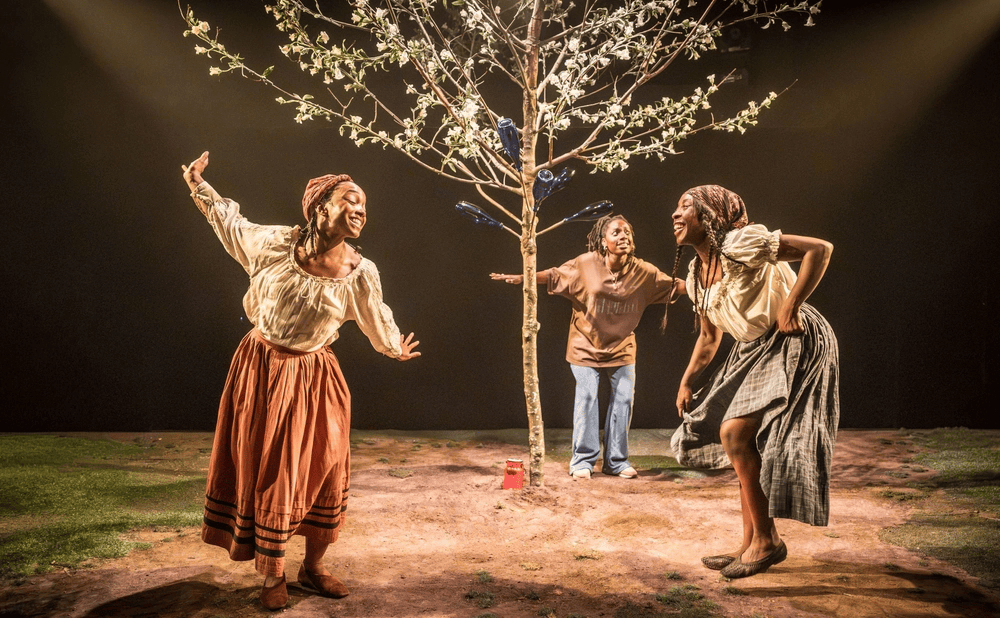
Director Tatenda Shamiso makes the piece flow like a thriller, and it never feels as thought we are being lectured,. Although the dilemmas faced by the characters who do not fit the neat separations between right and wrong we like to picture are complex, Nesbitt communicates them through admirably believable individuals. Performances are excellent, including Campbell’s low key Talulah, Adékọluẹ́jọ’s fiery Ginnie and some impressive doubling of roles from both Valli and Morrish, who are nuanced in both eras. Set and costumes by Natalie Pryce occupy the small Upstairs stage with a highly convincing cabin, impressive patchy grass flooring, and a full size tree. It is an appropriately ambitious setting for a play which, calmly and confidently, reveals the complexity and continuing personal cost of one of history’s most notorious periods.

