Hadestown

1.-André-De-Shields-as-Hermes-in-Hadestown-at-National-Theatre-c-Helen-Maybanks-960x640.jpg

André De Shields as Hermes. Photo: Helen Maybanks

Hadestown by Anaïs Mitchell –  National Theatre (Olivier), London

Singer-songwriter Anaïs Mitchell‘s ‘folk opera’, Hadestown, is based on the Orpheus and Eurydice myth, the ultimate ancient story about music. It has evolved from a song cycle for just Mitchell and her guitar to become a theatrical production, first touring regional US venues, then Off-Broadway and now in the wide, open spaces of the Olivier Theatre. ‘Folk’ was always a misleading description for music that it is as much influence by New Orleans jazz and blues. However, in the ten years it has taken to reach London, Hadestown has become a surprisingly conventional musical. It does not provide enough of the unexpected, and somewhere along the line has mislaid its edge. The end result is a rather middling entertainment with high points and low points, but ultimately a lack of coherence.

The show, directed by Rachel Chavkin and designed by Rachel Hauck, is set in an underground night spot that surrounds the Olivier with tiers, tables and chairs for the onstage band. The drummer plays behind the bar in a perspex chamber. Apart from general atmosphere, the setting contributes nothing more to the evening than filling the space, which is a disappointment. The idea of a nightclub as portal to the underworld is mostly represented by silver-suited André De Shields, as the messenger god Hermes. His glorious voice makes all his numbers a delight. He is one of the show’s highlights, another being Eve Noblezada as a backpacking Eurydice, with a singing voice that commands the material. Meanwhile Persephone, Queen of the Underworld is a raucous Amber Gray who likes to party. And Hades himself, Patrick Page, has the world’s deepest voice which astonishes the theatre. In the stand-out number, ‘The Wall’, he asks “Why do we build the wall, my children?” They reply, “We build the wall to keep us free.” Written some time before the advent of Trump Mitchell’s song hits home hard, and Page sings it like Tom Waits.

However, while these are highlights the show is uneven. It is undermined by the portrayal of Orpheus (Reeve Carney) who is written and played as a sort of Justin Bieber character in a denim jacket, who carries a guitar everywhere and singing annoying, lightweight ballads at the drop of a hat. It is a tough task to write songs for a legendary musician who can charm the very stones, but the entire approach seems misconceived. With the rest of the show seeking an after hours atmosphere, he does not belong at all.The wider setting is also incoherent. Hades and Persephone, perched on a balcony above the bar, seem ready to go in ‘Cat on a Hot Tin Roof’. Hell is revealed as a 1930s ‘Metropolis’ nightmare rather than addressing 21st century concerns, which defuses the political impact. Meanwhile, Eurydice and Orpheus have blown in from the early 2000s, Hermes is an all-purpose MC for hire. The show is also obsessed with the Olivier’s revolve, which spins and counterspins at the slightest excuse, concentrating all the action into a small circle in the middle of the stage. While Mitchell has written some barnstorming numbers, they do not come together to form a show with the same consistency or impact as her music at its best.


Moonlight / Night School

Brid-Brennan-and-Robert-Glenister-in-Pinter-Four.-Photo-credit-Marc-Brenner.-DRESS-80071

Brid Brennan and Robert Glenister in Moonlight. Photo: Marc Brenner

Moonlight & Night School by Harold Pinter – Pinter Theatre, London

The fourth installment in Jamie Lloyd’s consistently enjoyable season of Harold Pinter’s short plays contrasts plays from either end of the writer’s career. ‘Moonlight’, perhaps surprisingly, is performed first. It’s the heavyweight of the evening, a play from Pinter’s final 1990s career surge when his Almeida premieres were the hottest tickets in town. ‘Night School’ is a much earlier work, a radio play from 1960 that was not performed on stage for another twenty years, and a slighter work. Both, however, provide a combination of dark humour and precisely honed language for which most playwrights would kill.

‘Moonlight’, which has a Tempest-like late career feel, takes place around the death bed of Andy (Robert Glenister), a civil servant beset by memories. His Bel (Brid Brennan) sits by his bed, but the characters and timelines from his life constantly shift and overlap. It is as though Andy is hallucinating fragments of Pinter’s oeuvre. There is partner swapping, underworld characters, social ritual as absurd comedy, language as surface, film imagery and the impossibility of substantiating memory or meaning. Andy loved Janie Dee’s glamorous Marie while Bel, either in reality or fantasy, loved a football referee called Fred (Peter Polycarpou). Meanwhile he has children, but they won’t come to his bedside. Can it really because they are a pair of Pinter-effete gangsters who claim to run a Chinese laundry. And why do the same actors (Dwane Walcott and Al Weaver)  sometimes morph into civil servants who engage in high-Pinter wordplay involving parades of colleagues who they refer to only by their surnames? And why is Andy haunted by his daughter who only appears as a young woman, a refugee from ‘Don’t Look Now’? Glenister makes the most of the role, rude to everyone in sight but with his influence over what remains of his life gone. Brennan, as his wife, exudes dangerous calm as she is, finally, in complete control. Polycarpou is a treat as the chummy ex-referee, whose reality keeps eluding Andy. Lyndsey Turner directs an excellent revival of this compelling play.

‘Night School’ is an oddity, a play with all the characters of an early Pinter play,but none of the double meaning. It has the boarding house setting of ‘The Birthday Party’ with a pair of landladies, played with glee by Janie Dee and Brid Brennan, and a supposedly perfect house guest, a school teacher called Sally played with very funny directness by Jessica Barden. Walter (Al Weaver) turns up, fresh from prison, wanting his room back. The sexual tension ratchets, and Robert Glenister’s crime boss landlord gets involved. Glenister, in more familiar, menacing mode, discovers Sally is not a school teacher, and Peter Polycarpou has another very enjoyable cameo as a nervous club owner. It’s fun, but all the secrets are systematically revealed in way that is most untypical. Ed Stambollouian, who directs, uses an on-stage drummer to provide the text with the rhythms it otherwise lacks. The play is definitely more of a curiosity than an essential piece of viewing, but even Pinter’s ephemera is well worth the effort. Continuing thanks are due to Jamie Lloyd for staging a rare treat for London theatregoers that keeps on giving.

Thirteen Cycles

JJtSnT0g.jpeg

Image (c) Guillaume Querard

Thirteen Cycles by Project 2 – Rosemary Branch Theatre, London

Project 2 – Katy Schutte and Chris Mead – are improvising thirteen shows, a different one for every night of their run at the Rosemary Branch Theatre. Their theme is sci-fi and, triggered by a spacey location chosen from a list shouted by the audience, they are off with the assistance of Star Trek-esque space uniforms and a small selection of set-building blocks. On the night in question, the story took shape in “a garage where spaceships and things are mended”. Schutte and Mead rapidly spin out a generation-spanning futuristic sitcom scene set in a garage from nothing, with a grandfather and grandson, hidden family tension, thwarted dreams and a spacecraft called an Omni Machine (Model 400) which is having problems with its “elevation”.

The idea of using sci-fi as a context for improvisation is clever, because it allows scope for futuristic deus ex machina solutions whenever the performers are in fix. A “robot heavy lifting machine” (Mead, providing his own sound effects) supplies both light relief and plot lubrication. Sci-fi is also a nebulous concept, and its defining characteristic is usually that it analyses the time in which it’s written, while pretending not to. This provides scope to reflect on the here and now, but the focus of ‘Thirteen Cycles’ seems too unclear to make effective use of this freedom. Lacking a social context, the darker aspects of the show (violent rebellion, laser execution, assassinations, inequality, injustice), which were fully explored by the performers, carry very little weight or wider meaning.

The boundary between improvisation and pre-planned structure is also unclear. While the first scene is entirely off the cuff, seemingly pre-planned break points and storylines became apparent and the evening settles into a series of surprisingly conventional dramatic scenes. When the performers were clearly making the entire show up on the spot, the audience was engaged and willing to forgive them anything. As soon as that feeling of danger dissipated, the limits to the quality of the drama began to dominate.

Thirteen Cycles benefits greatly from its soundtrack and lighting design. The former is a low-key, expertly concocted brew of electronics, performed lived by musician Fred Deakin (of Lemon Jelly fame). The retro-futuristic laser-style projections by Guillaume Querard were clever and effective, adding serious atmosphere. The show is certainly enjoyable, Schutte and Mead are engaging and no-one will feel short-changed. However, it lacks the conceptual clarity needed to make it something more than a fun night out.

This show was seen with a free ticket.


The Wild Duck

methode_times_prod_web_bin_fc31937a-d6da-11e8-926d-96790161a92a

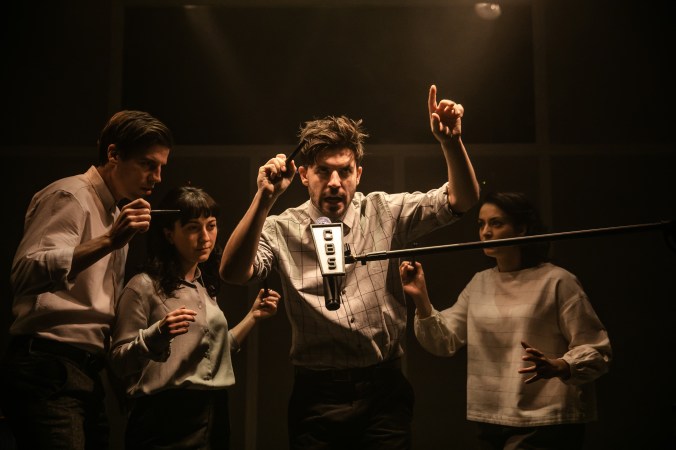
Edward Hogg, Lyndsey Marshal and Clara Read. Image by Manuel Harlan.

The Wild Duck by Henrik Ibsen – Almeida Theatre, London

Robert Icke’s run at the Almeida Theatre has been game-changing. Most recently his Hamlet with Andrew Scott was probably the best of the decade, and his lead-swapping Mary Stuart with Lia Williams and Juliet Stevenson a show to treasure. These productions were special because they convinced the audience they were seeing well-known texts for the first time, both an incredibly difficult thing to do and a sure sign of real innovation. Icke’s new production of ‘The Wild Duck’ is bold and controversial, but  delivers an interpretation that strikes home very hard indeed

Icke’s approach is to present the play as explicit fiction, with interludes of narrative reflection from the characters including discussion of Ibsen’s own life, with its revealing parallels to the action. The play, although sometimes regarded as Ibsen’s masterpiece, is much less performed or known in Britain than, for example, ‘Hedda Gabler’. There is therefore less expectation around the play and more room for radical presentation, although plenty of scope to offend doyens of theatre criticism. The play presents two incomplete families, darkly and fatally entwined. The production begins with the house lights up and a bare stage, the actors addressing the audience with a microphone. Almost imperceptibly, the show acquires a set and morphs into a traditional production, but the direct focus on people creating characters by talking to one another establishes an intensity which runs through the remainder of the evening, and highlights the roles in which everyone seems trapped.

The play is full of rich parts, and the cast is more than up to the task. Edward Hogg’s James Ekdal (character names are updated, and the cast pruned) is prickly, immature and self-destructive. The underrated Lyndsey Marshal is heart-breaking as his wife Gina, capable and determined mother with a secret she knows will tear down her life as soon as it is exposed. Nicholas Farrell is perfect as Ekdals’ drunken fantasist father, a lovely grandfather and a terrible father. Perhaps the stand-out performance comes from Kevin Harvey as Gregory Woods, sane on the surface but entirely unhinged not far beneath, his peculiar idealism a danger to everyone. The only character in the play who can really see what’s going on is Rick Warden’s doctor, Relling, who drinks to avoid the truth but still knows right from wrong. ‘The Wild Duck’ needs a very strong young performer to play the Ekdal’s daughter Hedwig, and Clara Read (on the night I saw the show) has the exactly the right combination of insight and vulnerability.

The play concerns truth and lies: whether the truth is a more destructive force than the lies that allow us to managed our lives. Icke brings in Ibsen’s own biography, revealing that he fathered an illegitimate daughter whom he supported until she was thirteen, then never contacted again. Hedwig, whose thirteenth birthday is the play’s tragic climax, is misled about her real parents. The conflation of a writer’s own life with their fiction is risky, these events seem particularly telling. While apparently distancing the audience, the production  opens up Ibsen’s work for closer inspection and brings us very close indeed to the characters. The result is eccentric and, as technique, probably unrepeatable. However, it results in a spell-binding evening in which the anguish of the characters as they wrench apart stays with us, long after we leave the theatre.

It’s True, It’s True, It’s True

128685

Image © The Other Richard

It’s True, It’s True, It’s True by Breach Theatre – Diorama Theatre, London

Artemisia Gentileschi, who lived in Florence during the first half of the 17th century, was a pioneer: an accomplished painter who was the first woman to be admitted to the drawing academy in Florence. Her life, full of Medicis, Baroque artists, affairs, and European travel, is a fascinating slice of Renaissance life. However, she is remembered not only for her paintings – the National Gallery has just bought her self portrait as Saint Catherine – but for the trial of the man who raped her when she was 15. The transcripts of the 1612 trial survive for the most part, and form the basis of Breach Theatre’s show.

Three performers present the events of the trial, necessarily condensed, in verbatim form, something like the Tricycle Theatre’s tribunal plays of the 1990s and 2000s. With the language updated, the events described in court sound highly contemporary, and the treatment of Artemisia disturbingly familiar. Her rape, by the painter Agostino Tassi who was employed as her tutor, came after a lengthy period of harassment and intimidation by Tassi and his friend, who used their positions of power to take advantage of Artemisia. threaten her, and use her for their own ends.

Breach Theatre stages the action on a minimal set consisting of studio equipment repurposed as docks and witness stands. Ellice Stevens, as Artemisia, keeps her anger under a remarkable level of control, determined to redress such a blatant wrong. Harriet Webb plays Tassi as a posh-boy bully full of self-regard, confident that his connections (he paints for The Pope, yeah) will get him out of any fix. Webb makes him thoroughly, convincingly, nasty. Kathryn Bond plays Tuzia, Artemisia’s friend and protector who betrayed her, as weak but understandably, unable to stand up to the threats of rich men. Artemisia is, remarkably, tortured in court with thumb screws to test the truth of her testimony to save the painter’s hands of the accused, her own art being of no consequence to the authorities. Although Tassi was eventually convicted, his punishment was light and justice was only grudgingly done.

The story in itself is fascinating and highly relevant to current concerns, but director Billy Barrett and dramaturg Dorothy Allen-Pickard have created much more than a simple retelling. The most remarkable scenes are those in which Artemisia’s pictures come to life, conventional Biblical scenes restaged as angry tableaux. Her ‘Judith and Holofernes’, the former sawing off the latter’s head, has a different edge painted by a woman while ‘Susanna and the Elders’ is case study in sexual harassment. These paintings become telling, dramatic interludes in the trial that show us what is happening to Artemisia behind what she reveals in court.

The production’s use of music is also bold and effective, cutting through the 17th century setting to place the action simultaneously in the moment. The show culminates in a cathartic rendition of Patti Smith’s ‘Gloria’, taking the place of the final, missing pages of the trial record. The key moment, however, is Artemisia’s forced declaration under torture, as she cries out ‘It’s true, it’s true, it’s true” again and again as she did in court, a moment of affirmation for her and for women facing the same ordeals today. A skilled, surprising and visceral piece of theatre, with an urgent story to tell.

Tamburlaine

king

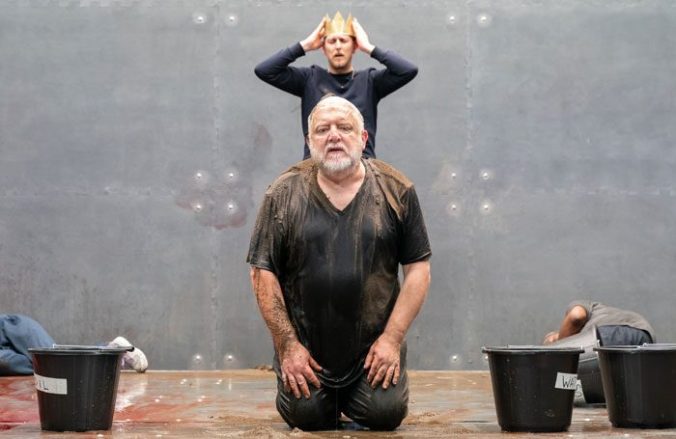
Jude Owusu (Tamburlaine) and captives . Credit: Ellie Kurttz, RSC

Tamburlaine by Christopher Marlowe – Swan Theatre, Stratford-upon-Avon

For those who remember the RSC’s 1990 Tamburlaine with Anthony Sher, the revival of this once-in-a-generation play is both a rare treat and an alarming marker of passing time. Marlowe’s works are not frequently performed because, while they include exquisite poetry, their plotting, pacing and characterisation are still works in progress. Tamburlaine, dating from 1588, is a spectacular, sprawling historical epic that clearly prefigures Shakespeare’s Henry VI trilogy of only a few years later. It is flawed, but Michael Boyd’s production in the Swan Theatre makes a triumphant case for its presence on the modern stage.

Tamburlaine is a shepherd from Scythina (now Uzbekistan), based on the 14th century Central Asian emperor Timur, who conquered a vast empire. Tamburlaine defeats the Egyptians, the Ottomans and the Persians, conquering much of Africa, Asia and the Middle East. Eventually he dies en route to China. Tamburlaine’s feats are performed with an unremitting brutality: he simply slaughters anyone in his way, drowning entire cities and overthrowing the mightiest of emperors. This is a tough part to play, as there is little insight available in Tamburlaine’s inner life as he performs these colossal deeds. It requires an epic, assured lead performance, exactly what Jude Owusu delivers. With one previous appearance at Stratford behind him in a small part, this is a break-through role for Owusu who bestrides the stage like the scourge of God he proclaims himself to be. Onstage throughout, he radiates unearthly calm as, smiling, he snaps necks, slaughters virgins and murders his own son for not liking war. He speaks the ornate complex verse with a naturalness that does not undermine the delights of Marlowe’s poetry. He also takes the limited opportunities Marlowe provides to reveal the man behind the killing machine. In an astonishing scene he flails around the stage in grief, hauling the slack-limbed corpse of his wife as the audience watches in horror. It is an epic performance that drives the entire play.

Boyd’s direction makes reference to his famous cycle of Shakespeare’s Histories for the RSC. The many killings are stylised as characters are daubed with blood, or have a bucket of it emptied over their heads by a small boy. When their scenes are done they rise and walk from the stage to join the swelling ranks of ghosts. Recurring performers help to make sense of the repetitious events, as successive mighty emperors are overthrown. Mark Hadfield plays self-satisfied, cowardly rulers inclined to foot-stamping tantrums. James Tucker reappears under several regimes as an unscrupulous, opportunistic civil servant. Sagar I M Arya delivers a fine performance the grandest of all the rulers, Bajazeth, who falls the furthest, bashing his own brains out on the bars of his prison cage, in an infamous scene. Even more striking is Zanab Hassan as his wife Olympia, whose death in the manner follows a wild, hallucinatory soliloquy. Tamburlaine’s henchmen, especially David Rubin, are violent, physical assured presences.

Rose McEwen, who plays Tamburlaine’s queen Zenocrate, kidnapped and forced to marry him, succeeds in suggesting an ambiguity that overshadows her role as wife, a tough ask in a play that seems to pass over her violent abduction. In a powerful moment, Boyd has her stiffened corpse jerk back in to life and become Callapine, Bajazeth and Olympia’s avenging son. The play is staged against little more than a backdrop of plastic sheets, but the characters and set pieces provide the scenery in Tom Piper’s design. Doomed kings wear gilt brocade in their coats and their golden circlets tumble from their heads as Tamburlaine’s desert camouflaged thugs cut them apart. In a famous scene the stage becomes a calvacade of death as defeated Asian kings, harnessed to Tamburlaine’s cart, draw him like horses followed by his capering retinue and the embalmed corpse of his dead wife, seated in a chair. This grim carnival brings the wonder and the terror of Marlowe’s shepherd emperor to life in a production that gives an almost faultless account of a defective but fascinating play.

A Very Very Very Dark Matter

2936

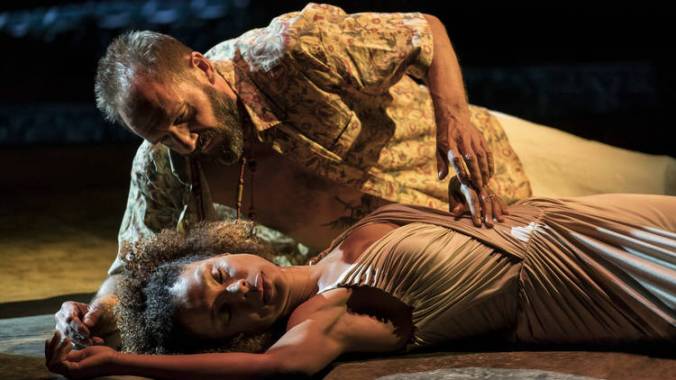
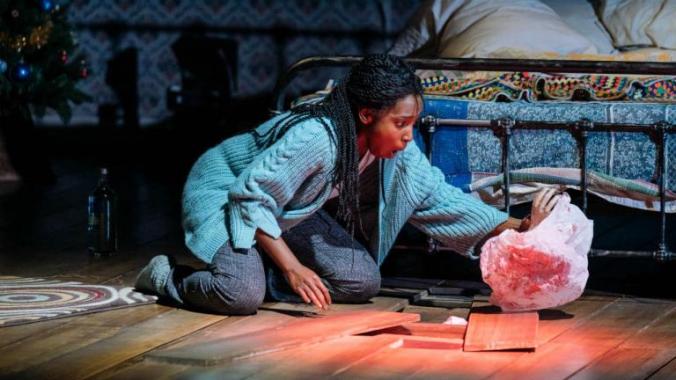
Jim Broadbent as Hans and Johnetta Eula’Mae Ackles as Marjory in A Very Very Very Dark Matter. Photograph: Manuel Harlan

A Very Very Very Dark Matter by Martin McDonagh – Bridge Theatre, London

Martin McDonagh has made his impatience with theatre clear in the past, chafing at the constraints of the medium, its conventions and its expectations. Apart from Sam Mendes, few recent figures have made such a triumphant transition from the British stage to Hollywood. ‘Three Billboards Outside Ebbing, Missouri’ was nominated for seven Oscars earlier this year, winning one. So what brings him back to the stage? Despite his frustrations, theatre still seems to be the medium he needs to confront, provoke and assail his audience and critics. ‘A Very Very Very Dark Matter’ is perhaps the least complete of his plays, but its fierce anger and gleeful South Park-style offensiveness makes it unlike anything else on a stage right now, in London or anywhere else.

Even an explain of the premise is both hilarious and offensive: Hans Christian Andersen keep a Congolese pygmy woman, who he insists on calling Marjory, imprisoned in a cage in his attic so she can write his stories. Immediately, we’re in the realms of of political metaphor and of the fairy-tale-gone-wrong. McDonagh is venting uncontrolled fury at the depredations of 19th century colonialism in general, and the genocidal Belgian Congo regime of Leopold II in particular. Hans Christian Andersen and, later, Charles Dickens, are written as grotesque parodies whose flailing, self-obsessed, child-like behaviour renders the society they symbolize absurd. This aspect of the play is expressed through streams of sweary, gasp-inducing dialogue which has the audience unsure whether they can laugh without transgressing the limits of acceptable behaviour.

The play is short and, in truth, underdeveloped. The connection it draws between literary theft and cultural oppression is strongly stated but hard to pin down, floating somewhere within McDonagh’s fantastical rewriting of history. The acting talent on display goes a long way, though, to make up for these shortcomings. Tom Waits provides a deliciously drawling narration, sadly not in person. Jim Broadbent plays Andersen as a beaming, dementedly self-centred child of a man, unashamedly brutal and cruel. He is also very funny, and much of the play resembles Armstrong and Miller’s sketches about uptight Second World War pilots who talk in incongruous street language. A scene when Broadbent reads a letter from ‘the King of the Spanish’, who entirely misses the point of Andersen’s ‘Emperor’s New Clothes’ and does so like a very rude 10-year old, is hilarious. His visit to Charles Dickens (who he repeatedly calls Charles Darwin) brings in Phil Daniels, as an especially foul-mouthed version of the author, to great comic effect. His wife and children family behave in the same vein (his young daughter, for example, exclaims “Is daddy banging the broads again, mummy?”). The scene is in fact based on a genuine visit Andersen made to Dickens, in which he stayed for five weeks despite Dickens’ increasingly desperate hints.

This shock and awe comedy would be fairly pointless without the character of Marjory, played by Johnetta Eula’Mae Ackles, making her professional debut. She is African American, small in stature, and has one leg. Her performance is a sharp reminder that people fitting her description do not generally appear on stage. The absurd lengths to which McDonagh has gone to create a role for her makes this point even clearer. Marjory (not her real name) has been kidnapped from the Congo to write Andersen’s tales, which he occasionally edits for European consumption (notably ‘The Little Black Mermaid’). This being McDonagh, there is vengeance and gore: two blood stained Belgians stalk the play and, eventually, Marjory marches off, heavily armed, to rewrite history back home.

Anna Fleische’s puppet-ridden attic provides a delightfully unpleasant setting. Matthew Dunster, who directed McDonagh’s previous play, ‘Hangmen’, presents the nasty events with sickening polish. ‘A Very Very Very Dark Matter’ is a much slighter play than its predecessor and lacks the clarity and precision of the context that gave ‘Hangmen’ extra weight. It is, nevertheless, outrageous, establishment-baiting and very very very funny, and possibly the only logical response to the bizarre political context of the late 2010s.

Macbeth

macbeth-1

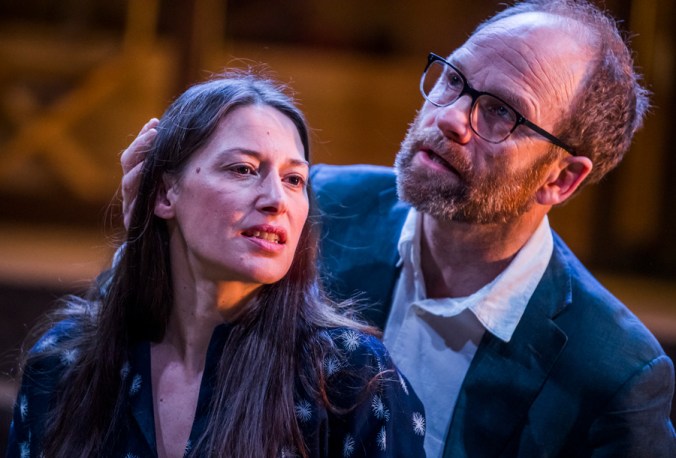
Christoper Eccleston and Niamh Cusack in Macbeth at Royal Shakespeare theatre. Photograph: Richard Davenport/The Other Richard

Macbeth by William Shakespeare – Barbican Theatre, London

In contrast to Rufus Norris’ National Theatre Macbeth, with Rory Kinnear and Anne-Marie Duff, the RSC’s current production is focused and direct. This ensures that it is more of a success, but also proves its weakness. Polly Findlay’s production is certainly the more coherent, and features strong leads. Christopher Eccleston, making his RSC debut, is a warrior through and through. Since the Stratford run he has lost his beard, and appears even more like the kind of man you would not like to run into in a dark glen. He radiates physicality, self-assurance and an ability to confidently misread a situation. David Acton plays Duncan as an aged and capricious, wheelchair-bound king, an annoying and eminently murderable figure. He snubs Macbeth in the act of congratulating him, lavishing the greater praise on Macduff whom he clearly prefers. Eccleston steps forward expectantly as he names his successor, and the combined disappointments lead directly to what follows.

If this seems a little directive, it is. Director Deborah Findlay leaves nothing to chance and, as a result a significant amount of subtlety is stripped from the play. Macbeth is short but layered, difficult to do well because there is no space to recover. Therefore, the device of placing a digital clock on stage that counts down from Duncan’s murder to Macbeth’s death, undermines the actors, as well as proving highly distracting to the audience. It is a case of show not tell. The advertised pace has a problematic effect on performances, not least Niamh Cusack’s Lady Macbeth. While highly watchable, as always, Cusack seems hampered by the decision to play the character as wired and manic from the very start. She appears more unhinged than calculating, leading ultimately to a great deal of rushing around the stage during the sleepwalking scene, which reduces its impact.

Eccleston delivers a highly creditable performance, once which is in many ways a success. However, it too is limited by an uncomplicated style. As his plans implode, he becomes mocking and fatalistic, and delivers the ‘brief candle’ speech as a piece of deep sarcasm, driving any ambiguity or wider resonance from the speech, a moment of connection beyond the play from a character who is, at least in this version, entirely unsympathetic. Findlay’s idea of a cycle of violence, implying at the very end that Fleance will continue the line of tyranny, also seems strange, suggesting that there is nothing special about the Macbeths after all – sacrificing the gimlet gaze of the play for a much vaguer message.

However, the director’s sometimes scattershot invention includes some effective touches. In a strange echo of Rufus Norris’ Macbeth, the Porter (Michael Hodgson) is a Geordie and also appears throughout. He is a murderer and a general overseer of the action, chalking up deaths on the wall or, seated next to a water cooler, just watching. He is truly sinister. Edward Bennett’s Macduff is a bureaucrat not a soldier, making his eventual agony the more powerful. The witches are played by three young girls who, Shining-style, are dressed identically and speak in unison, which both connects to horror film tropes and works in its own right. Background scenes take place behind a glass screen in an upper gallery which, as in Robert Icke’s Hamlet, underlines the psychological alienation of the main character. Strong performances throughout also include Mariam Haque’s Lady Macduff, furious at her husband’s betrayal, and Raphael Sowole as a ragged and powerful Banquo. Findlay’s production is an enjoyable evening, with much to admire, but sells the play somewhat short.

The Lover / The Collection

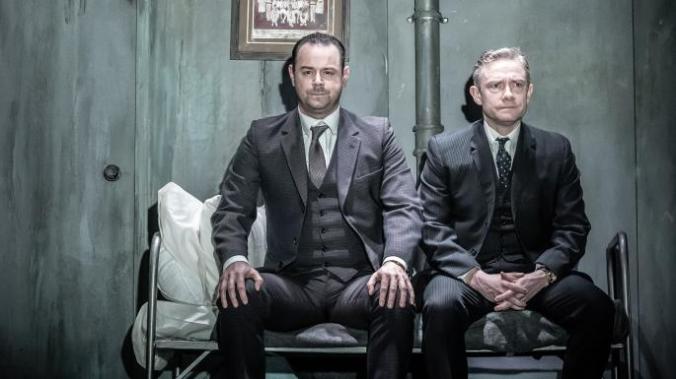
David-Suchet-in-Pinter-Two-Marc-Brenner-1024x538

David Suchet, image copyright Marc Brenner

The Lover / The Collection by Harold Pinter – Harold Pinter Theatre, London

Both these plays, part of Jamie Lloyd’s ingenious idea for a complete season of Harold Pinter’s short works, are from the early 1960s. Nearly 60 years later any normal playwright’s work would be showing its age, but as time passes it becomes increasingly apparent how effortlessly Pinter’s writing transcends its time. Both plays remain thoroughly disconcerting, gleefully dismantling conventional assumptions about sexual and power relations. They are also both very funny, and Pinter’s under-rated humour is given more space than usual to breathe in a pair of sharp, fresh productions, both directed by Lloyd.

The Lover, the better-known of the two, is a two-hander in which it quickly becomes clear that the perfect couple can only express themselves through their elicit alter egos. Set in a pink-walled, ideal home box of a living room, Lloyd consciously locates the piece in its specific era. He directs the piece as something nearer to a farce than the usual, slower pace and brooding naturalism that is standard for Pinter. It’s a controversial decision but a clever one, highlighting an affinity with Joe Orton while also taking the play out of its customary, setting in the sort of internal Pinter time where his plays are usually located. If Pinter’s plays are to remain current, new approaches are needed to test the possibilities and limits of the text. In The Lover, John Macmillan and Hayley Squires perform with a self-consciousness verging on the frantic, which jars at first. However, the style soon jels with the text which conceals complete desperation behind a very brittle curtain of normality. Squires is the calmer presence, in control of the situation throughout, initiating and directing the uninhibited sexual transgression that hilariously mocks and subverts the basic concepts of a conventional relationship.

The relationships are even less conventional in The Collection, a four-hander which takes three men and a woman and draws desire line between them with no regard for the socially acceptable, or even definable. Again it’s the woman who is at the centre of the sexually fluid scenes, enabling the boundaries to be broken. Squires seems to have slept with Russell Tovey’s Bill, at a threateningly banal Pinter-esque conference in Leeds Bill lives with bitchy, older dress designer Harry (David Suchet). Husband John Macmillan comes round to play the heavy, but his interest in Bill is not that of a rival. The play contains some irresistible parts in which Tovey and Suchet, in particular, revel. Tovey is a classic, cocky, muscular Pinter thug who provides both needle sharp put-downs and the promise of physicality, whether violent, sexual or both. Suchet makes absolutely every line count, rolling his description of Bill as a ‘slum slug’ around his mouth with equal portions of disgust and relish, and playing power games over a morning newspaper. A delicious set of performances cap an evening that makes a very strong case for seeing how  Pinter’s other short plays seem when presented afresh.