The Legends of Them

Sutara Gayle. Photo by Harry Elletson

The Legends of Them by Sutara Gayle AKA Lorna Gee – Royal Court Theatre, London

Published at Plays International

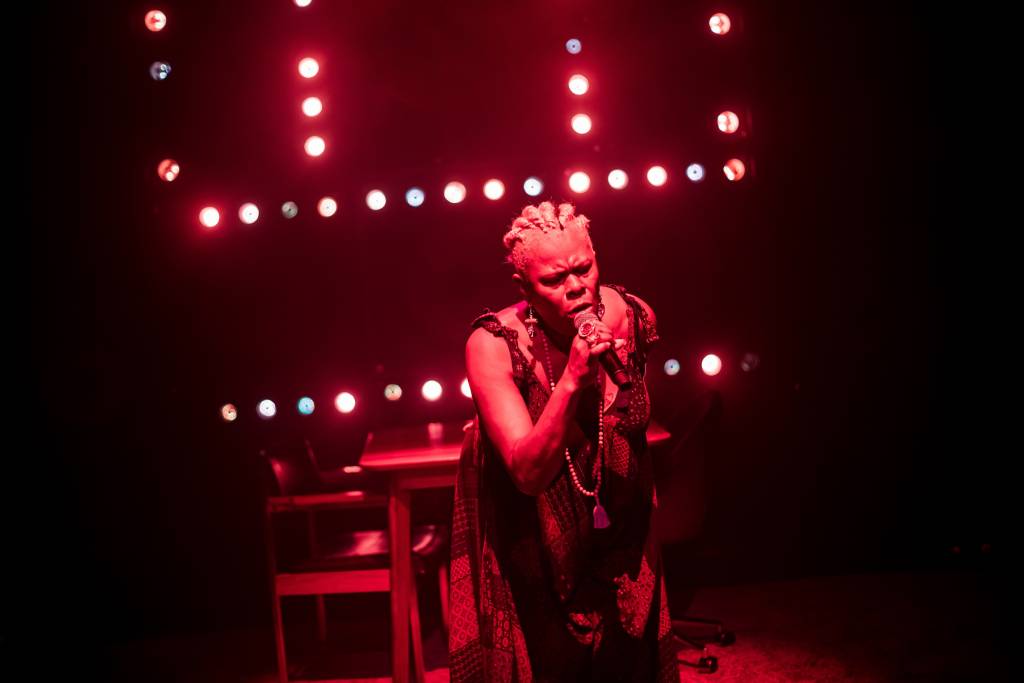
Sutara Gayle has had quite the life. Her one woman show expresses remarkable experiences through powerful, focused theatre. Gayle, born in Brixton, is a musician, singer, DJ and British reggae pioneer. She has lived in New York, opened for Shabba Ranks, spent time in Holloway Prison, and changed her name during a spiritual retreat in India. Her brother Mooji is a Hindu guru. Her sister Cherry’s shooting by police triggered the 1985 Brixton Riots. The Legends of Them combines music, film (projections by Tyler Forward and Daniel Batters) and a swirling array of characters, all played by Gayle, into a journey of awakening and discovery.

Gayle is also an actor, with a long career on stage and in film and television. This is the one aspect of her life she does not mention, and there is no need because it is obvious. Legends of Them is a performance tour de force. Gayle plays a long list of people she meets across eras and places – from Linton Kwesi Johnson to school friends, taxi drivers, dominoes players and policemen – who pass across the stage and through her life in sometimes dream-like fragments. She conveys each scene with minimum fuss and the maximum skill, using a vocal intonation, a tilt of the head, or a flick of the wrist. Gayle makes it look easy, but her performance is a masterclass in storytelling, from which other, far less subtle one-person shows could learn at lot.

The Legends of Them conjures up lost eras and events, knotting them loosely together as the bigger picture emerges, piece by piece. Although Gayle is the connecting presence, the show is explicitly about four legends in her life: her mother Euphemia, sister Cherry, brother Mooji, and the 17th century Jamaican freedom fighter, Nanny of the Maroons. Euphemia, who came to Brixton from Jamaica, brought up eight children, and pounded out living from her sewing machine. Cherry, who died in 2011, found herself thrust into the national news in disastrous circumstances, which she handled with great dignity. Her older brother Mooji is her guiding light, imparting Buddhist wisdom that helps Gayle see beyond tragedy and turmoil in her life. And Nanny is part of a suppressed history of resistance to empire, fighting the 17th century British occupation of Jamaica, and giving identity to those fighting the same battles today.

She threads together their stories expertly, never over-explaining but giving the audience enough to understand what is happening and why it matters. It is a high-wire act completed with supreme confidence, co-created with director Jo McInnes and dramaturg Nina Lyndon. Then there is the music. Gayle is a highly versatile writer and singer, and she sings at key moments. The set is dominated by a vast speaker stack covered in disco lights, which flash a backdrop to the action. Gayle strides on stage and immediately shows us what she’s capable of with her trademark reggae MC delivery, immediately raising excitement levels to eleven. Having established her formidable skills, she uses her full range, singing charming numbers influenced by pop and gospel, written with composer and musical director Christella Litras. She expresses herself directly and truthfully through music, which is clearly an essential part of her existence, and drives the show.

Gayle, with her collaborators, conjures an evening which is subtle, carefully woven, and at times exhilarating theatre, but it is more than that. The Legends of Them is a big success for the still-relatively-new Brixton House theatre, where it was first performed before moving the Royal Court – taking a show which is Brixton through and through into Belgravia. But it is more than a theatre production. Sutara Gayle’s life tracks the Black experience in Britain, through the terrible personal impact of racism and sexism, to personal fulfilment and self-knowledge. She is a local heroine, but her voice reaches far beyond SW9. She speaks from long, tough experience, and The Legends of Them sends a message which is proud, loud and clear.

The Importance of Being Earnest

Photo by Marc Brenner

The Importance of Being Earnest by Oscar Wilde – National Theatre: Lyttleton, London

In Max Webster’s new production intentions clear are from the opening moments. The play begins with a dance sequence. Ncuti Gatwa, playing Algernon, drapes himself over a grand piano wearing a shocking pink ballgown, split to reveal boxer shorts underneath. It sends an unambiguous message that this will not be The Importance of Being Earnest we have become familiar with, but a high camp, high glitter entertainment… and much more beside. Webster opens the play up to a much-need re-examination. One of the best known and loved – and overquoted – plays in the repertoire is reclaimed as the brutal social critique it has been all along.

For the National Theatre to stage Oscar Wilde’s best known play is a balancing act. It’s a sure audience pleaser, which is why every amateur group in the country has done it at some point, but there needs to be a reason to give it a major new production. Webster delivers this triumphantly, and his show is a revelation. The play has an excellent, highly entertainingly and disruptive cast. Gatwa is suave, shameless and very funny, with a commanding stage presence and a knack for comedy. He is matched with Hugh Skinner’s apparently more vulnerable Jack Worthing, constantly struggling to match his mental self image. The ingenue Cecily Cardew is played by Eliza Scanlen who channels Miranda Richardson to fine effect. And the excellent Ronkẹ Adékọluẹ́jọ́ is very funny as Gwendolen, teetering throughout between comic social propriety and crotch-grabbing sexual meltdown. Richard Cant and Amanda Lawrence, as Canon Chasuble and Miss Prism, deliver supporting performances of an exceptionally high calibre, while Julian Bleach has fun as two butlers: the scary Merriman and his derelict country counterpart, Lane.

However, every production of ‘…Earnest’ pivots on its Lady Bracknell. The part has become an old-fashioned star turn, somewhat divorced from the play itself. It is mystifying that Wilde has become so cosy, as though his annihilation by the society who had fêted him happened to someone else. ‘…Earnest’ is packed with bitter social recrimination fed to the audience in sugared pills. Sharon D Clarke’s Lady Bracknell undoes all that. Casting actors of colour in the key roles challenges some assumptions, and Clarke’s forbidding, stereotypical Caribbean matriarch works perfectly for the part. Wearing dramatic costumes combining western and Afro-Caribbean styles, by Rae Smith, she puts up a fierce resistance to her daughter’s wishes, but we gradually realise that this a façade relates directly to her origins. The key moments in the play are when she reveals that she had no money before she married Lord Bracknell; and when she discovers that Jack is very wealthy, and becomes suddenly supportive of his marriage to Gwendolen. She knows what it means to have nothing, and what it takes to stay afloat when you don’t belong. She can compete with any of the great Lady Bracknells, but her performance reinvents the part.

The entire play is explicitly about dissembling and façades. Nobody says what they mean, while revealing what they really think. We see clearly from Webster’s production that no-one can afford to be who they actually are. Wilde certainly couldn’t. But he devised a way to say things in a way that allowed his plays to become accepted and mainstream, all the while presenting an unequivocal condemnation of the British social order. Gatwa’s Algernon is certainly not a straightforwardly heterosexual character, but neither is anyone else. Algernon and Jack seem as interested in each other as their fiancees, and so do Celia and Gwendolen. Webster stages a spectacular pile-on in which they all seem on the brink of engaging in a foursome. On Rae Smith’s slightly psychedelic sets, reality is heightened and pushed to the brink of absurdity, which is where the truth lies. The show is as funny and entertaining as any production of the play, but it shows us what’s been lying in plain sight. Wilde deserves to be fully understood, and his work given the freedom of interpretation it could never receive at the time, and that has eluded it since. The evening ends with a masque dance, with all the characters in feathers and frills. It is a moment of joy, releasing us from the terrifying constraints of a world that forces everyone to pretend in order to survive.

The Duchess (of Malfi)

Jodie Whittaker as the Duchess. Photo: Marc Brenner.

The Duchess (of Malfi) by John Webster, adapted by Zinnie Harris – Trafalgar Theatre, London

Zinnie Harris has modernised John Webster’s classic revenge tragedy with a bold production that gives a new perspective on a wild, brutal story, while also stripping it of the language that has given its place in the repertoire, 400 years later. There are many good things about the production. Tom Piper’s modernist set is stripped back to concrete, with metal walkways, a suitable backdrop for slaughter. Jodie Whittaker is an appealingly defiant Duchess, a woman who will not give way to what men demand of her, however huge the price. In fact, she continues to haunt her brothers, Paul Ready’s Cardinal and Rory Fleck Byrne’s Ferdinand, after death. Ready stands out as the lascivious Cardinal, plausible but depraved, unable to resist humiliating his mistress Julia (Elizabeth Ayodele), as soon as she shows weakness. Fleck Byrne’s Ferdinand is convincingly unhinged, his sexuality tearing him apart. He appears, dramatically, wearing his sister’s red dress after ordering her murder. Fleck Byrne is generally watchable, but loses marks for tossing away the character’s most famous speech, “Cover her face. Mine eyes dazzle. She died young”, which an actor is surely contractually obliged to have fun with.

There is also a powerful performance from Jude Owusu as the murderer Bosola. Owusu’s ambiguity is subtlety delivered, keeping us guessing throughout as to who he really is. Harris’ version emphasises his role, letting him live at the denouement, unlike almost all the other characters, to regret his past and promise to look after the Duchess’ young son. She also highlights his class position as someone who cannot afford to turn down work, however grisly. In this, he is allied with the maid Cariola, who Matti Houghton plays with a great deal of character. In one of Harris’s best lines, she reveals that women wear make-up to hide their rage at the misogyny around them.

The production is an interesting and enjoyable evening, a valuable and committed experiment with a play that is usually hidden in the shadows. Harris brings it out into the light, shining an unforgiving fluorescent light on its themes like an autopsy. She makes the brutal treatment of women uncomfortably apparent, and the deep corruption that fuels the power of the few the unmissable cause of society’s ills. Unsurprisingly, it’s a play for our times. The use of music in the play, with Whittaker and Houghton delivering Webster’s songs with aplomb to the accompaniment of white-suited guitarist, contrasts nicely with the grim imagery – the bodies of the Duchess, Cariola and her young daughter left sprawled on the stage throughout the following scene. Whittaker death scene is delivered in astonishingly gruesome fashion, strangled unsuccessfully at length with a rope by incompetent goons before Bosola finishes the job himself, drowning her in a bath. However, it’s a shame about the poetry which, when it surfaces from time to time brings the show suddenly to life. For the most part it is missing, and an essential element in the play’s appeal disappears with it.

L’Addition

Bert & Nasi. Photo by Vincent Zobler.

L’Addition by Tim Etchells / Bert & Nasi – Battersea Arts Centre, London

Published at Plays International

As part of Forced Entertainment’s continuing  40th anniversary celebration, co-founder Tim Etchells has devised a two-hander in which reality is pushed to its breaking point through the basic mechanism of a classic farce set-up. A restaurant customer sits down at a table, the waiter offers him wine, pours a little, he tastes it and nods approval, then the waiter pours him a glass – but he carries on pouring until the glass overflows across the table. There’s mild panic from customer and waiter, when he realised what he’s done, he sweeps up the tablecloth with everything on it. Then they begin again.

From the moment they walk on stage, the performers, Bert and Nasi, are a comic timebomb always threatening to go off. Bert is English, bluff, matey, confident, and usually wrong. Nasi is French, smooth, conciliatory, and also usually wrong. Together, the pair are a well-oiled machine displaying comic skills that it is a joy to behold. Much of L’Addition is very funny. The comic scenario breaks apart continually under examination, becoming more and more ludicrous and hilarious. The performers know how to hold back comic gratification so that, when it comes, it is a true release. At one point Bert as the waiter, constantly laying and relaying a tablecloth, finally loses it completely and performs a strange, wild dance with the cloth which seems to continue for several minutes as Nasi looks on, astonished. The audience are beside themselves.

However, like all classic comedy L’Addition is buoyed on a tide of existential sadness. The underlying themes in Etchells’ piece are barely stated, but it becomes apparent that the show is concerned with , existence, ritual and death. There is a moment that stops everyone in their tracks when the pair fast forward to a point 50 years in the future, when they are still performing their skit. Then it dawns on them that much of the audience will no longer be alive, at which point it sinks in with each of us too. The process of ritualising and mythologising existence is examined too, as the scene becomes something different through constant repetition, a tribute to its original self enacted by people who cannot remember the original, or why they are doing it. But they know they have to, just as we know we have to eat, sleep, repeat to exist.

L’Addition, which was originally presented in French at last year’s Festival d’Avignon, is a brilliant piece of theatre. Tim Etchells, Bert and Nasi work together with a precision that most performers can only aspire to. In the influential tradition of Forced Entertainment, the show’s power is in inverse proportion to budget, complexity or pretension. It belongs to the tradition of silent film comedy, of Samuel Beckett, and of entertainment that takes nothing seriously, but means everything. It is assured, side-splitting and unmissable.

Coriolanus

Photo by Misan Harriman.

Coriolanus by William Shakespeare – National Theatre (Olivier), London

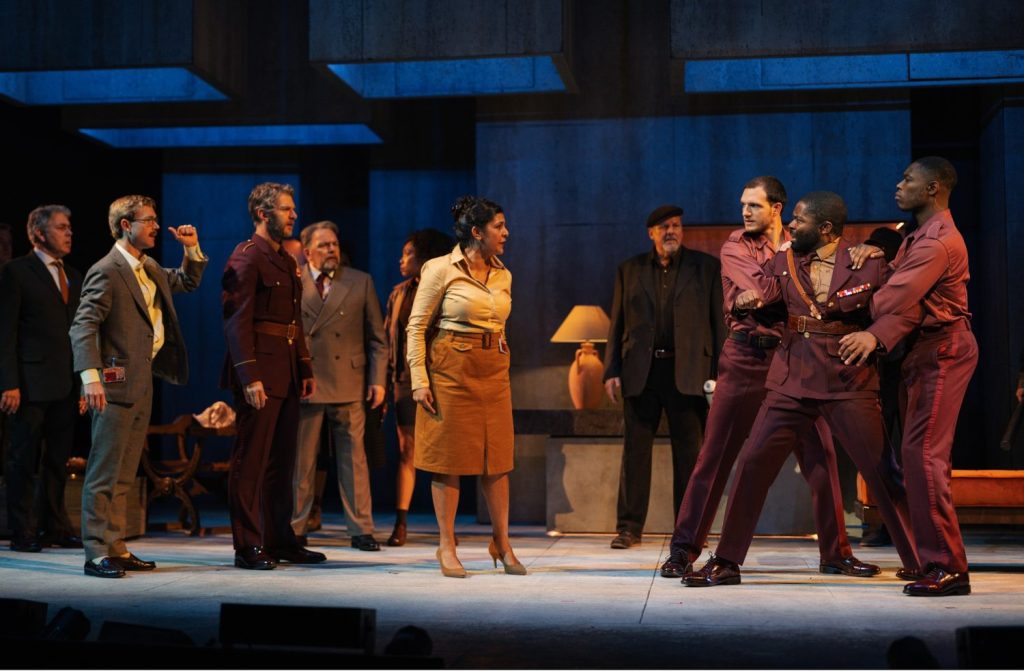
Lyndsey Turner’s production of Coriolanus begins not in the street, but in a high-end museum of antiquities where a reception is being held for wealthy dignitaries. The revolting citizens spray graffiti on a Roman wolf statue and confront a suited figure with a glass of champagne: David Oyelowo at Coriolanus. His initial appearance is more mild-mannered than the traditional portrayal, but it is a clever piece of direction. Clearly one of the patricians from the start, Oyelowo is an operator who fits in with the system, but soon begins too lose his cool. His transformation into a demagogue, bringing down everyone with him as he heads towards ultimate disaster, is a brilliant performance.

It is a long-overdue return to the British stage for Oyelowo who, having played Henry VI in the RSC’s early 2000s histories cycle and a breakthrough in Spooks, left for the US where it was much easier for a black actor to find work. The fact he is back is cheering, and Coriolanus shows how much we have missed his skills. He finds ways to make one of Shakespeare’s least likeable characters sympathetic, and also increasingly disturbing. Patricia Nomvete, as his mother Volumnia, is a cold and self-interested character, more interested in the theory of war and heroism than her son, and ultimately motivated to save herself. It seems that Coriolanus is seeking a father, who Shakespeare does not mention. His love/hate relationship with mortal enemy Aufidius – Kobna Holdbrook-Smith, who seems to know Coriolanus will be the death of him – is often played as sexual attraction, but it could be that he is seeking a father figure to validate his reckless behaviour.

There are consistent ensemble performances all round from a play that is always about the reaction of the crowd. Peter Forbes plays a helplessly torn Menenius, who cannot fill the gulf in Coriolanus’ life depsite his best efforts, and Kemi-Bo Jacobs brings cold fury to the rather thankless part of his ignored wife, Virgilia. Es Devlin’s stunning set is also a star. She has created brutalist a concrete frame, mirroring the National Theatre, which hovers above the stage to create a chic, yet looming, gallery, or lowers to the ground to become a hidden labyrinth of claustrophobic chambers. Turner’s staging of the play’s final moments, with a Christ-like image of the dead Coriolanus projected onto the sheer concrete wall of the set, boldly advance the play from its grim final scene. Oyelowo, stabbed to death by a mob second before, is immediately transformed in death into a hero. A statue of him appears in the museum of classical antiquities, and a 21st century child stops to stare. It is not what happened that matters: it is how the story is presented.

London Tide

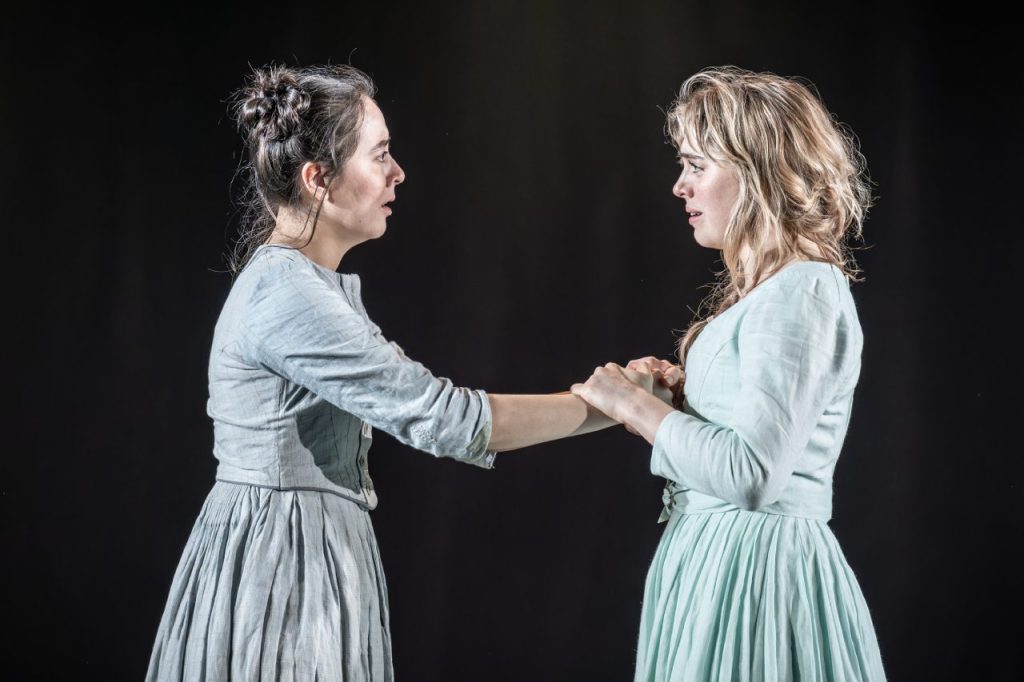
Ami Tredrea and Bella Mclean. Image by Marc Brenner.

London Tide by Ben Power, music by PJ Harvey – National Theatre: Lyttleton, London

Ian Rickson’s production of London Tide is both a delight to watch, and a significant achievement. The challenge of adapting Charles Dickens’ weird, labyrinthine novel for the stage is enough in itself, but turning it into a musical to boot, seems like a risky venture. Fortunately, the adaptation is by Ben Power and the music by PJ Harvey, an inspired pairing. Together, they have conjured up coherent, direct and involving theatre, judiciously updated, with songs that are on a whole different level of quality to standard music theatre fare.

Rickson’s staging, with sets by Bunny Christie, is sparse but effective and original. A void at the front of the stage is the Thames, which shapes the lives of Dickens’ characters. The entire cast climbs out of it at curtain up, and characters are cast in, pulled out sometimes dead, sometimes alive. The stage is a huge dark space edged with giant river piles, with a watery, translucent sheet at the rear used for some impressive silhouette scenes. What makes this something different is the way that the stage floor moves, rising and tilting like the river, and so does the lighting rig, which hangs low enough for it to lift one character into the air, has he grabs it with both hands. The gantries move rhythmically up and down, like in ripples like water, the first time I have ever seen a theatre’s fittings used almost as an extra character.

The story, stripped back expertly by Power, who also gives the gender roles a carefully judged 21st century boost, is pure London noir. Dicken’s novel is pretty absurd but its strength, and that of the stage show, is the filthy London atmosphere – a city of mud and shadows, poverty and fate, to which its inhabitants are, nevertheless, fiercely devoted. PJ Harvey’s songs, backed by a three-piece band on stage, underscore the noir themes rather than reiterating the story. With lyrics by Power, they are properly impressive, written in styles that range across Harvey’s fine career. At times songs sound like ‘Stories From the City, Stories from the Sea’, at others like ‘White Chalk’, or ‘Let England Shake’. When the cast lines up at the front of the stage, singing directly to the audience “This is a story about London and death and resurrection”, it sounds like a number from ‘The Threepenny Opera’.

London Tide is worth it for the music alone, but there’s a lot more. Dickens’ characters offer some excellent roles, which are grabbed with both hands by a young cast. Bella Mclean as the entitled Bella Wilfer, makes a convincing transition to self-awareness, and has a particularly excellent voice. Ami Tredea’s Limehouse girl, Lizzie Hexam, is full of character and determination. Jake Wood, as Gaffer Hexam who fishes bodies from the Thames for a living, has real menace. Ellie-May Sheridan makes a great deal of the small part of doll’s dressmaker, Jenny Wren. Tom Mothersdale is suitable distracted as heir-in-disguise, John Rokesmith. Peter Wight, always hard to beat in any role, makes Noddy Boffin clumsy and likeable. As principle baddie Bradley Headstone, Scott Karim is lugubrious and frightening. And Crystal Condie, as Miss Potterson, plays an important role as a landlady standing up the depredations of the men who strew damaged people in their wake.

London Tide is a seriously high quality evening. Ben Power, PJ Harvey and Ian Rickson make the show seem simple, and logical, but it really is nothing of the kind. Epic Dickens adaptations like the RSC’s Nicholas Nickleby were once era defining. Now they sneak into the National Theatre’s repertoire, and it is a credit to the current management that shows of this quality can, to some extent, be taken for granted.

A Midsummer Night’s Dream

A Midsummer Night’s Dream by William Shakespeare – Wilton’s Music Hall, London

Henry Maynard’s Flabbergast Theatre is an unapologetically physical theatre company, building a reputation for staging Shakespeare in a style that owes a lot more to Grotowsky than it does to the Globe. Flabbergast’s Macbeth, seen last year at the Southwark Playhouse, delivered energy and imagery at the expense of the text. They have followed it up with A Midsummer Night’s Dream, staged in the much-loved Wilton’s Music Hall. The result is the same, only more so.

There are things to like about the production. The setting, designed by Maynard who also directs, is dominated by a hay wain, a cart used like the York Mystery Plays waggons as both stage and set. It fits the play beautifully, with Titania and Bottom nestled above the action watching the lovers in the woods. Costumes, also Maynard’s work, are striking, with the Mechanicals wearing half masks, and an exciting profusion of tartan trousers, dressing gowns, periwigs and golden ram’s horns in evidence (although Oberon’s gold mankini very much outstays its welcome). However, although the physicality of the performances and the commitment to clowning is unquestionable, the result is to make the show less rather than more accessible.

Performances ratchet up to 11 from the first lines, and stay there for two and half hours. There is no departure from full-on mania, from every character in the play. In the opening scene Hermia’s father, Egeus, in crazed 18th century dresses, lurches, bounds and leers around the stage, a grotesque parody of… what? The connection between the characters and any recognisable reality is instantly severed, and from then on the audience struggles to understand what it is seeing, or why. There is no value in picking out performers, but the entire company performs in a way that is mannered in the extreme. Almost every single line is illustrated by the performer acting it out in capering dumbshow. Combined with the masks and the exaggerated accents on display, it makes much of the text inaudible and the rest incomprehensible. It really is impossible to follow what is going on, as characters set fire to the best know poetry in the language and push it over a cliff. It is an exhausting watch.

Flabbergast Theatre are not about the text, that is understood. Their physical style promises much, and anyone who takes a different approach to Shakespeare deserves respect. Unfortunately though, A Midsummer Night’s Dream really does not work. The lack of variation in tone, and the absence of character or nuance, rapidly diminishes the effect of the full octane clowning. Physical theatre is a subtle, powerful tool but, in one of the most atmospheric plays ever written, Maynard’s show has no room for mood. That really is a mistake.

Big Finish

Photo by Rosie Powell

Big Finish by Figs in Wigs – Battersea Arts Centre, London

Published at Plays International

As Figs in Wigs point out, it takes a lot of development and rehearsal to create this level of chaos. ‘Big Finish’ is about endings: humanity hitting a climate iceberg, theatre driving over a funding cliff, the company doing its final show. The five Figs have built a career which is, in many ways enviable. They are highly respected in the fringe theatre scene if, as they note, they have never actually won a prize. After ten shows, starting out in the queer cabaret scene and graduating to the heights of Battersea Arts Centre’s Grand Hall, Figs are respected and beloved. They also have a total of £5,000 in their bank account, and run a game of musical beach towels to decide who gets paid each night. If there is no money or future in theatre, why do they keep coming back?

The Figs – Ray Gammon, Suzanna Hurst, Sarah Moore, Rachel Porter and Alice Roots – are experts in controlled stupidity, very silly things taken very seriously, which are not nearly as silly as they would like us to think. Their performance style is sometimes reminiscent of contemporaries such as Sh!t Theatre, which whom they share a home-made aesthetic. This includes building sets and costumes from whatever they can afford. Crab costumes, for example, are red bike helmets, puffa jackets and skirts made from plastic sheets. The setting is blue PVC and silver foil ducting. They read a last will and testament, which bequeaths all the detritus from past shows to the UK’s great venues, attempting to save it from landfill.

This is where Figs really come into their own. Behind a consistent front of incompetence, they deliver a comprehensive state of the nation report on the performing arts and on radical expression, filtered through their own experience. Their conclusions are not encouraging. Who would choose theatre in a country that not only fails to support its own cultural heritage, but treats it as the enemy, and making a living is not options. Figs stage a succession of hilarious set pieces as they work through their, and our, futures. A Kraftwerk-esque crab dance takes creatures who adapt to survive climate disaster and turns them into symbols for performers who want to escape the arts, but cannot. A crab bucket has no lid, because the crabs keep each other inside. Online prop purchasing comes to the fore again when the Figs, golf wear and dinosaur masks, manoeuvre a golf buggy precariously around the stage. They become a string quartet who scrape out the Titanic theme, very badly, over and over, sitting on weird exo-skeleton stools, strapped to their legs.

As they say, it takes a lot of work to create such barely controlled anarchy. The show culminates in two fabulously silly and clever scenes. The Figs are interviewed by a ‘professor’ who turns out to be the real thing: Jen Harvie, Professor of Contemporary Theatre, their real-life tutor at Queen Mary’s. Reality and performance become indistinguishable as she conducts a hilariously awkward interrogation of their careers. Then, the company performs a final, absurd, contemporary dance sequence in wetsuits, sliding all over the foamy floor, elbows in faces.

If ‘ Big Finish’ is Figs in Wigs’ final show, it is a triumph. They wear their physical performance skills, strange creative imaginations and complete commitment very lightly, but they are clever, original and hugely entertaining. It probably isn’t their farewell because, as they say, how else can they make a difference. But work like theirs, which is precisely what we need in times of unanswered questions and uncertain futures, is under threat like never before. ‘Big Finish’ is the first production in Battersea Arts Centre’s 50th anniversary season, and the perfect show to illustrate what South London’s most essential venue is about, and why it matters. In their Grand Hall, Figs in Wigs are remaking theatre in their own image, and it is fun, generous, surreal and brilliant.

Player Kings

Player Kings by William Shakespeare, adapated by Robert Icke – New Wimbledon Theatre, London

Warming up for the West End, Sir Ian McKellen’s appearance as Falstaff in Robert Icke’s compressed Henry IVs created real excitement on a Wimbledon Friday night. Some actors seem fated to play the fat knight, Michael Gambon or Desmond Barritt for example, while for others, notably Antony Sher, the role comes as a surprise to both actor and audience. McKellen is in the latter category. As they await his first entrance, everyone is silently wondering whether such a lean, vulpine actor can really carry off a fat suit. Of course he can. McKellen is the UK’s greatest living actor, and his decision to take on a demanding role at a stage in his life and career when he can do what he pleases, is a gift to us all.

McKellen’s decision to work with Robert Icke is a canny one. Icke is in demand as a reimaginer of the classic, and he has taken the radical, but entirely logical, decision to combine Henry IV Parts 1 and 2 into a single play. Althought it’s the kind of thing John Barton used to get up to at the RSC, this type of heavey editing has fallen out of fashion. But anyone who has seen the two plays in full will have experienced a slump in Part 2, when repetition seems to set in. Icke’s edits strip the plays back, to largely good effect, keeping all the best bits but cutting back on scenes such as Northumberland’s follow-up rebellion, and Pistol’s lengthy rants. The downside is a four-hour running time, but the production is very well-paced and the evening speeds by, a real achievement with the first half alone 2 hours long.

Hildegard Bechtler’s set is simple – two curtains that pull across the width of the stage – but good for switching between echoing court and cosy tavern. Other than the text changes, Icke’s production is clear and direct, giving text and performers room to breathe. The exception is an amusing staging of Falstaff’s confrontation with the Lord Chief Justice (Joseph Mydell) following the Battle of Shrewsbury. Falstaff, in a wheelchair and looking like Captain Tom, is accosted at a drinks reception in his honour, from which he methodically steals all the booze. McKellen is backed by a strong cast, including the dignified Mydell. Richard Coyle’s King Henry is a troubled man who is clearly ill from the start, and knows how little he has achieved. Toheeb Jimoh is a posh boy Hal, who seems motivated by cynical self-entertainment. The play is driven by his parade of schemes to humiliate Falstaff, but we see a glimpse of his real self in his alarming intense reaction to trying on his father’s crown.

Samuel Edward-Cook makes Hotspur a shaven-headed force of nature, and then channels a similar energy as Pistol, a clever piece of double casting. Justice Shallow is delightfully played by Robin Soans, while James Garnon is both a trouble-making Worcester and Shallow’s cousin Silence, who turns out to have a remarkable drunken singing voice. Clare Perkins makes Mistress Quickly London, and very real. Annette McLaughlin’s Warwick has hints of Theresa May, Mark Monero’s Peto is a real chancer, with no choice but to live on his wits, and Geoffrey Freshwater was born to play Bardolph.

The cast is strong, and the evening is not all about Falstaff, but he provides the plays with a deep, complex centre. McKellen, in flat cap, cravat and leather jacket, is dressed for a different era, which offers a key to his interpretation. His Falstaff is a seasoned villain, used to being top of the heap – but he has become lazy and, above all, old. Falstaff is losing his powers, and as the play progresses starts to realise that he is past it, and his time is coming. Each of Hal’s humiliations, which he shrugs off to amuse his followers, cuts deeper. He keeps being found out, and his life of sitting in the pub being deferred to is coming to and end. McKellen makes it clear that Falstaff is an aristocrat slumming it, like Hal, but far past the point of return. He is vicious and doesn’t hesitate to exploit weakness, but he is also loveable and, his physical weakness – trying and failing to rise from his tavern seat, as Mistress Quickly rushes to support him – is a heart-stopping moment, as is the final rejection scene, when he choses continued self-delusion over facing the truth. Icke incorporates his death scene from Henry V, just as Orson Welles did in ‘Chimes at Midnight’, which works well.

McKellen’s performance is a triumph – both physically menacing and vulnerable, charming and nasty – a multi-layered interpretation certainly as good as anyone who has played the role in recent memory. Icke’s production doesn’t reinvent the play with the brilliance of his Hamlet, but provides much more than a vehicle for McKellen, spawning a world that allows his performance to flourish. It’s an evening to cherish.