The Welkin

the-welkin-review-national-theatre-lucy-kirkwood-maxine-peake

The Welkin by Lucy Kirkwood – National Theatre: Lyttleton

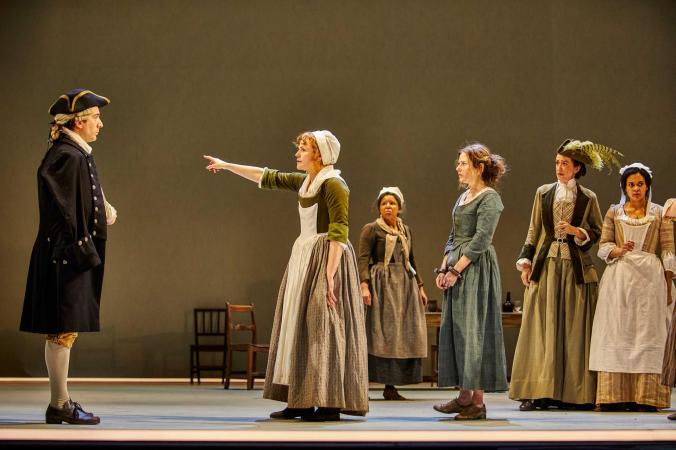
The title of Lucy Kirkwood’s new play is an antiquated term for the heavens – both the sky itself, and the heavenly judgement beyond. The condemned woman at the heart of this ambitious enthralling show, in the words of Haydn Gwynne’s Lady Cary, has no recourse on earth and “must look to the welkin” for her salvation. The year in 1759, and Lady Cary is one of a “jury of matrons” brought together to examine Sally Poppy (Ria Dmitrovic). Convicted of the brutal murder of a child, which she admits, she has “pleaded the belly” and twelve local women are summoned to confirm or deny her claim.

Kirkwood has lighted on a clever device, a little known historical setting that allows her to write a sort of ‘Twelve Angry Women’: a tightly woven, tense drama played out in a single room, with a cast consisting principally of twelve women. They are supervised by a male employee of the court who, symbolically, is forbidden to speak. Kirkwood’s writing is impressive, and she clearly relishes the task of teasing out the characters of the twelve and of using – and not over-using – the rich language of the time. From Maxine Peake’s midwife, Lizzy Luke – a woman in a position of responsibility, with more on her mind than she admits – to Mary Middleton (Zainab Hasan), who believes her house contains a haunted tankard, every character is real and often funny, as well as heart-breaking. It is difficult to single out performances, because the exceptionally strong ensemble work is the point of the show, but June Watson is inimitable as Sarah Smith, whose wisdom is based on experience.

The Welkin is a tragic story and the setting, with women in charge, is at odds with everything else outside the room. It provides a temporary respite from beatings, childbirth, never-ending hard work, and a constant status as a second-class being. Kirkwood uses this lens to focus important themes, but allows them to emerge naturally from the pressures placed on the women in the room, and the way they talk when they are alone together. Peake is excellent as the conflicted Lizzy, the play’s moral compass, while Ria Dmitrovic adds to her fast-growing reputation as a key actor of her generation with a performance full of spite and vulnerability. Haydn Gwynne is also a fine, haughty presence although her story arc is, perhaps, the play’s weakest aspect. Expertly directed by James Macdonald, the play opens with a tableau of women doing the domestic tasks from which events to come provide a brief respite, and is calmly staged with space for characters to breathe and the occasional, well-judged coup de theatre. These include an extraordinary scene with  the cast, in the only breach of the play’s setting, singing an home-made acapella version of Kate Bush’s ‘Running Up That Hill’, asking for the ‘deal with God’ that can never come. It is a moment of wonder, in a play that delivers on many fronts: as an epic, as a comedy, as a historical drama, as a voice for the voiceless, and as a thoroughly entertaining night out, with performers of the highest quality. Rufus Norris has just signed up for five more years in charge of the National Theatre and, judging by The Welkin, his mission to stage serious, new writing by women is properly on track.


The Incident Room

The incident Room Production photos.

The incident Room Production photos.

The Incident Room by Olivia Hirst and David Byrne – New Diorama Theatre, London

The grinding, five-year Yorkshire Ripper investigation was an essentially a filing problem. At the very end of the pre-computer age, even the largest inquiry team ever assembled could not find the answer, hidden all along in the mountains of data. Instead, West Yorkshire Police went through a  collective breakdown that laid the bare the failings of the 1970s social order, particularly the treatment of women, as brilliantly documented in Gordon Burn’s book ‘Somebody’s Husband, Somebody’s Son’. The Incident Room, acclaimed at the 2019 Edinburgh Fringe, takes us into the claustrophobic Millgarth Incident Room at the heart of the case, where the horrifying, and bizarre real life drama played out.

The play, devised by the whole cast, focuses on Megan Winterburn, an investigating officers and one of the first women on the West Yorkshire force. Hers is a story based on real life, just like the rest of the drama, and we eventually discover she went on to hold senior rank. In 1975, though, she is an overlooked for promotion in favour of inferior male colleagues, her contributions are overlooked and she is asked to do the typing. Her position in the force reflects the situation outside, where the police only start to take Peter Sutcliffe’s brutal murders seriously when he beings attacking ‘innocent women’ rather than prostitutes. As the killings continue and public panic grows, Assistant Chief Constable George Oldfield loses his perspective and makes disastrous decisions, driven by personal obsession. Women take the brunt and are subjected to a police curfew to keep them safe rather than, as is pointed out, the men who might attack them. The exponential growth of information that packs out the set, made principally of a floor-to-ceiling filing stack, represents the staggering proportion of men in the north using prostitutes.

Simply recounting the events of the time is fascinating. It is a time that seems stranger and further away by the moment. However, in Beth Flintoff and David Byrne’s production, The Incident Room does much more than that. A strong ensemble cast drives the show forward. Charlotte Melia, as Meg Winterburn, is on stage throughout – a strong, sympathetic pivot for the evening. Colin R. Campbell is excellent as the beleaguered Oldfield whose arrogant tips him over the edge. Kay Brittan puts in a pair of show stealing performances as an investigator and a victim – Maureen Long, the only person to survive an attack – who is tiny, fierce and heartbreakingly lost.  The writing is sophisticated, explicitly avoiding simplistic judgements and leaving the audience space to see the layers. Meg is dogged by a female journalist – played by Natasha Magigi – who constantly questions her decision to work within a failing, male-led system. The play frames events as a retelling, many years later, allowing Meg to ask why she didn’t question the way she was treated at the time, as the Hollywood version would have it.

The Incident Room is not only dramatic and engrossing – recreating the fevered claustrophobia of the time – but also multi-layered and satisfying drama, a proper assessment of a story that gripped, terrified and obsessed the nation. This excellent production confronts our dark past head on.


I, Cinna

img_1085Photo by Helen Murray

I, Cinna (The Poet) Write a Revolution by Tim Crouch – Unicorn Theatre, London

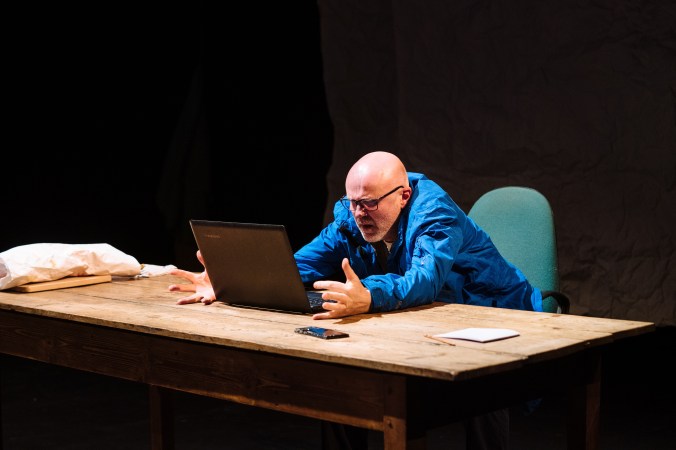
Tim Crouch has developed a line in one-man shows based on characters from Shakespeare show do not get their dues. I, Cinna is his fifth and is based on the character who, perhaps, has the toughest time of all. Cinna (the poet), has a single scene in Julius Caesar in which he is mistaken for Cinna (the conspirator) and murdered by a blood-thirsty mob. He is, as Crouch puts it, in brackets. This unpromising material quickly becomes a multi-layered exploration of the power of words and writing, the influence of rumour and social media, and the question of whether the poet has a duty to be politically engaged.

Crouch’s performance as the anxious poet, who wears a ‘This is what a poet looks like’ t-shirt, is subtle and highly persuasive. He draws the audience into his attempts to write an explanation of the charged political events outside his front door as Caesar offered the crown of a republic. The small things (“Mark Antony – with no ‘h’. What’s that about?”) combine with the unstoppable flow of events that we know will lead to his death, even if he does not. As footage of street violence is projected onto a huge sheet of crumpled paper, Cinna fills a wastepaper bin with discarded drafts as he fails to find his subject.

The familiar events from Shakespeare unfold on his laptop and phone, in a manner that is both dramatic and  entirely credible without straining for relevance. Cinna enjoys the Soothsayer’s online column, which warns about the Ides of March. He is amused by the reports of chaos the night before (“The graves opened up, thrusting up  their dead? No way!”). Then the ‘Breaking News’ alerts start to ping, as he sees live footage of Caesar’s assassins steeping their hands in blood, and Mark Antony winning over the crowd. Cinna is a republican, and his dismay when Antony’s propaganda works propels him outside to his scripted doom.

Cinna finds his subject, but so do we. Crouch uses audience participation in a sparing but effective way, giving us all a notebook and pencil and instructing us to write. It would give away too much to say what he asks, but the audience is asked to look into its soul in a way that is surprising, and revealing. The production, directed by Naomi Wirthner, is a small masterpiece of unshowy writing and performance that is some of the best small-scale theatre of its time, equally satisfying to audiences of young people and adults. Crouch makes theatre that punches way above its weight, and I, Cinna cuts to the heart of what it is to have a voice, and to decide how to use it.

Far Away

jessica-hynes-harper-in-far-away-at-the-donmar-warehouse.-director-lyndsey-turner.-designer-lizzie-clachan.-photo-johan-persson-12117

Simon Manyonda and Jessica Hynes

aisling-loftus-joan-and-simon-manyonda-todd-in-far-away-at-the-donmar-warehouse.-director-lyndsey-turner.-designer-lizzie-clachan

Aisling Loftus and Simon Manyonda

Far Away by Caryl Churchill – Donmar Warehouse, London

Caryl Churchill wrote Far Away in 2000 and, 20 years on, it feels more current by the moment. This is truth both of its setting – an unnamed dystopian location outside an identifiable time – and to its themes of oppressive, authoritarian governments who place people in opposition to one another, and to the natural world. At only 45 minutes and six scenes, Churchill does not waste a moment, making every word tell.  The precision of her writing burns each scene into the mind and, by saying only what is necessary, she leaves wide open spaces beyond the stage to be filled by the imagination.

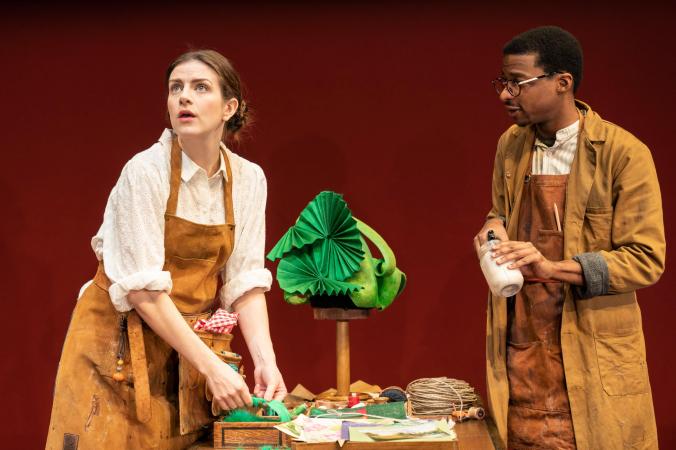
Lyndsey Turner’s direction and Lizzie Clachan’s design deliver moments of low key but devastating emotional impact. The entire play emerges from under a menacing steel box which lifts, lowers and lifts again to reveal new sets beneath. Apart from being technically very impressive, this containment reflects what seems to be going on beyond what we can see on stage. The play covers three time periods. A woman called Harper (Jessie Hynes) tries to shield her young niece Joan who has questions about the terrible things she has seen her uncle doing, involving children, cages and blood. Two milliners – Todd (Simon Manyonda) and the now grown-up Joan – are new colleagues. There is sexual tension and discussion of working condition before we see, in a devastating reveal, the context for their work. And finally, Harper, Todd and Joan are together and Joan is on the run, from a baffling realignment of nature in which nature has turned on people and formed alliances. Rivers may not or may not be on ‘our’ side, crocodiles are in alliance with the Latvians and dentists cannot be trusted. It is, in equal measure, funny and horrible.

The Donmar’s production is pitch perfect, with an intensity of focus that spotlights the universal elements in this dark story. While the scenarios play out ‘far away’, it is terrifyingly clear how this could be a portrait of our own future. The issues of our time, from the imprisonment of children to the collapse of our relationship with the natural world, are all in this darkly prescient work. Churchill writes her characters with a complete naturalism, enhanced by the performances which are uniformly excellent. This makes the strange context in which they find themselves all the more believable. Churchill’s writing is only now coming into its own as new creatives discover what she has left for them to find. This production is a mesmerising account of a play with a disturbing amount to tell us.

People Show 137

SB-People137Show-142 ©SheilaBurnettMark Long, Emil Wolk, George Khan, Bill Palmer. Photo: Sheila Burnett

People Show 137: God Knows How Many by People Show – Southwark Theatre, London

Longevity is the key to People Show. The numbering system tracking their performance history back to People Show 1 (1966) makes it the headline. The experimental theatre tradition that feeds their creativity involves physicality music and inventive stagings scraped together from very little. Their survival is, in itself, remarkable but the rationale for this most veteran of companies is live performance. The old shows are not forgotten, but they are gone, and the only thing that matters has to be what you are watching right now. It’s a curious tension and, despite their attempts to embrace age and change, God Knows How Many has the feeling of a show from a different time.

The two main performers are Mark Long, who has been involved with People Show from the very beginning, and two very long-term collaborators in Emil Wolk and George Khan. The show is delivered in sketch-like conversations and scenes with a pleasantly off-kilter atmosphere. An impressive animatronic doll opens with a chanson, Wolk as a customer in a French cafe has a prickly conversation with its proprietor (Long in a waitress costume), George Khan plays saxophone at a cabaret with the others on brass. And it is in French, or at least Franglais. People Show, it becomes clear, are performing at the behest of their big tobacco sponsors who make irrational demands and fine them for transgressions. Meanwhile, they are wrestling with the depredations of age, and can no longer perform their definitive gymnastic set-piece, the ‘Umsty Bumsty’, while a sinister tennis ball keeps dropping above bringing forebodings of death.

There is no lack of inventiveness in the evening, and the company have an admirable ability to conjure moments that capture the audience’s attention, and to deliver about turns that keep the audience intrigued. However, there is little sense that this show is urgent or current. It is a very male-dominated enterprise with the exception of the animatronic chanteuse, complete with with jokes about sexy ladies and sex crimes, and a strange digression on Whitney Houston based around mispronouncing her name as ‘Wendy’. These skits feel tired, and the jazzy musical interlude has surely not been seen on a fringe stage for many a decade. While People Show 137 has dark 21st century corporate influence in its sights, it feels too unfocused and too caught up with in-jokes to hit its targets.


Richard III

7Dectheatre

Richard III by William Shakespeare – Sam Wanamaker Theatre, London

Seeing Richard III the night after the Globe’s Henry VI is quite a contrast. While the valiant efforts of Sean Holmes and Ilinca Radulian to wrangle two parts of the Henry VI saga into one evening do not entirely succeed, their production of Richard III is irreverent and full of ensemble energy. The play is better than the Henrys – more coherent and focused, with a towering, magnetic figure in the legendarily evil king. Legend is indeed what this is – the portrayal of Richard a shameless Tudor propaganda exercise – and this production gleefully presents the play as grotesque caricature, Sophie Russell’s Richard bounding from one unbelievable act to the next, daring the audience to follow. Russell comes into her own with a thoroughly watchable yet nuanced performance exploring Richard’s many moods, from honeyed dissembler to brutal dictator.

The eclectic mix of costumes, colour-coded to indicate York or Lancaster, is continued from Henry VI but less as a device to keep track of events and more part of the deep black comedy that drives the show. When Clarence is murdered, with excruciating delay, his two killers strip to reveal shirts marked ‘Murderer 01’ and ‘Murderer 02’. Richard himself adorns his body with fashions – all-white outfits – which become increasingly outré as he appears at the scene of the many killings he orders, crooning Kris Kristofferson’s ‘For The Good Times’, as a cowboy and as Elvis (shades of Rupert Goold’s influential 2000s Vegas Merchant of Venice at Stratford). The deaths themselves are hilariously awful – Clarence is stabbed to death at great length with a pair of scissors, others suffocated with plastic bags or smothered in the thick earth blanketing the stage. Later, the only way to deal with the body count is to cover the entire stage and back wall in plastic sheeting.

Sophie Russell is excellent, but this by no means a one-woman show. Steffan Donnelly reprises his unnerving Queen Margaret from Henry VI, this time lurching around with a shopping bag full of body parts. Jonathan Broadbent’s Buckingham, a bureaucrat swept off his feet by Richard, is both amusing and dark, as he realises much too late what he has done. The horror of Colin Hurley’s Hastings is all apparent as he is comprehensively outmanoeuvred. Sarah Amankwah is both a fearful, petulant Edward IV and an all-seeing Duchess of Gloucester. Philip Arditti and Donnelly pull off a hilarious double act as the two numbered murderers. Murderer-in-chief, though, is John Lightbody whose Sir Richard Ratcliff, who lurks in the shadows, carrying his bag of tools and wearing an oddly sinister, too-tight velvet suit – both funny and very nasty, and an interesting contrast with his reflective Clarence. The cast cover multiple roles, which is cleverly used at the end when Lightbody and Matti Houghton transform from Richard’s henchmen back to their previous roles as his murdered brother and wife.

The Globe’s Shakespeare history cycle goes out with a bang, as the eclectic production style comes together to deliver a Richard III that succeeds in delivering maximum entertainment, a production full of ideas and clever touches and a set of performances that hold the audience rapt for two and half hours.

Henry VI

5090Steffan Donnelly and Jonathan Broadbent in Henry VI. Photograph: Marc Brenner
Henry VI by William Shakespeare – Sam Wanamaker Theatre, London

The three parts of Henry VI can be both compelling and frustrating, containing the best and worst of Shakespeare often in quick succession. Modern directors have often felt the need to apply heavy edits to render them suitable for audiences, beginning with the RSC’s early 1960s Wars of the Roses cycle which condensed the plays into two – Henry VI and Edward IV. For the Globe’s histories cycle, co-directors Sean Holmes and Ilinca Radulian has gone one further, giving us everything in a single evening. In fact, he achieves this by dropping Part One in its entirety, probably a wise decision as it is the weakest of the three parts. It is not missed, despite the absence of the rose plucking scene that kicks off the conflict. However, this radical surgery does not entirely succeed in making what remains any more effective or easier to follow.

Holmes and Radulian’s production is gleefully bloodthirsty, but these moments are played more for comic effect than for the sheer horror than washes over the plays. Severed heads bounce around the stage, Queen Margaret staggers around covered in blood, and her son Prince Edward is choked to death with a lollipop. The war begins with a courtroom brawl full of tooled up posh boys, going at one another with baseball bats and snooker cues. Allegiances, constantly shifting, are signalled by football shirts in red or white, labelled ‘Henry 04’ and so on. This is a neat trick, and the design plays entertainingly with a crazy range of colour-coded costumes – Henry VI in rose embroidered hoodie and red trainers, York in a club crooner’s fancy white jacket, and Eleanor of Gloucester dressed like Dolly Parton. However, the compression of events leaves no space beyond the constant changes of side and fortune to place them in any context, or understand their impact beyond the throne room.

The casting, which is fully gender-mixed, is uneven. Sarah Amankwah stands out as both Eleanor and Edward IV, defiant as the former and enthusiastically sleazy as the latter, goaded by brother Richard in to keeping up the boys. John Lightbody, as the elder Gloucester, as Old Clifford and as Clarence lurches through the chaos with a strong physical presence that exudes awkward arrogance. And Steffan Donnelly as Margaret puts in a magnetically unhinged performance as the doom harbinger of a queen, and must be the first man to play one of Shakespeare’s best female roles for centuries. Jonathan Broadbent’s Henry VI, on the other hand, seems underpowered – his helplessness as he is manipulated and ignored comes across as absence, and he seems more inconvenienced than tortured by the disastrous sequence of events.

The Globe’s staging is ambitious, and there is no right answer with these unwieldly plays. However, the adaptation and the style of the production seem to have stripped away much of its mystery – the small moments that remind us in all Shakespeare’s histories that the chaos induced by rulers has its real impact on ordinary people. As a result, it is hard to stay engaged with the personal tragedies of nobles who have only themselves to blame.

Antigone

nh2hXvIgImage by Ali Wright

Antigone by Sophocles adapted by Lulu Raczka – New Diorama Theatre, London

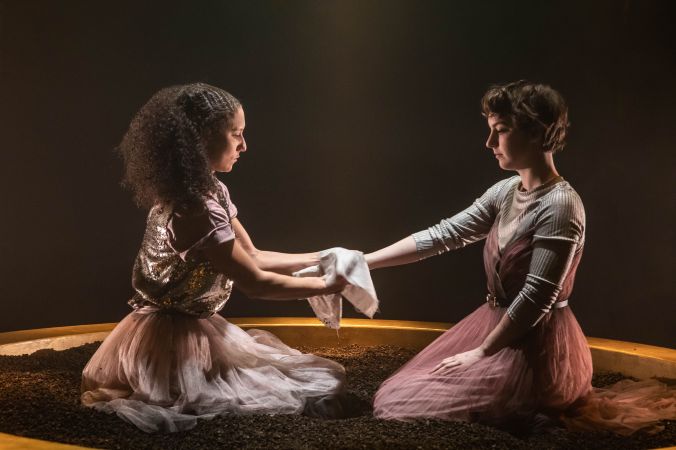
Holy What’s version of Antigone is about the two teenage girls at the heart of the play, Antigone herself (Annabel Baldwin) and her sister Ismene (Rachel Hosker). In Lulu Raczka’s new version, the two play out a fantasy teen life – drinking, parties and sex – in what we come to realise is a prison – their uncle Creon’s home, where they are forced to remain while their brothers, Eteocles and Polynices fight a civil war over their city. When both are killed, Creon prohibits all from burying the body of the rebel Polynices, abandoned outside the city walls, on pain of death. Antigone does so anyway, and no-one can quite believe it when Creon insists on enforcing the penalty – starvation in a cave.

These events are seen through the eyes of the sisters, released by Raczka to tell their story. This refocusing of the classics through  female perspectives is a growing trend, both in books such as Pat Barker’s The Silence of the Girls and in the work of other companies, in particular By Jove Theatre. It provides a thrilling new perspective on a story that is ancient, but always current. Antigone’s principled, suicidal refusal to apologise to her uncle is driven by a particularly teenage moral certainty. The question of whether it is more adult to stick to your principles regardless of consequences  – or to make sure, above all, that you are there for others – seems entirely modern.

Lulu Raczka’s free-as-the-wind adaptation expresses the action in utterly convincing millennial language, full of dead-pan qualifications, hesitancy and apparent lack of self-confidence. It is something of a revelation to hear actors on stage speaking in the way people of their age talk every day, presenting us with a way of talking so familiar we scarcely notice it. The simplicity of Rackza’s writing is masterful not least when Antigone,  contemplating the reality of death, rewrites “To be, or not to be” for the 21st century: “What if there’s, like, thinking about it, once it’s happened?”

Directed by Ali Pidsley and staged in a Greek theatre circle filled with cinders, the production is confident, absorbing and thoroughly impressive. The two performers, Baldwin and Hosker, hold the audience’s attention effortlessly. Baldwin is plays Antigone as much younger than she thinks she is, but heartbreakingly determined to overcome her fear of death. Hosker’s Ismene grows up very suddenly indeed, as the games the two played together at home become real and it becomes clear that her sister is no longer playing. The play’s ending, as Ismene stands alone on stage shedding her teen glitter and relating the rest of her married, adult life is a powerful moment and testament to the shadow Antigone has left that will never fade. Holy What’s production is excellent – filled with energy, imagination and originality – and it sets a high bar for the new decade.


A decade of theatre – the 2010s on stage

The ‘best of the decade’ lists, ubiquitous at the end of 2009, are not nearly as popular this time round. The idea of a canon sealed with the nod from a small group of mostly white, male journalists seems much less influential. The 2010s have seen changing expectations over whose voice matters, and who sets the cultural tone. On stage, it has been a time of inspiring diversity and energy, despite the predominant mood of the 2010s as a time when everything was disrupted but nothing solved. I started reviewing theatre for Londonist in 2010, and now do so on my own blog. In that time I’ve seen, counting back, 528 shows – a sensible rate of one per week – including many stunning evenings, and a number of properly formative experiences. A ‘best of’ is not a helpful way to analyse what all this amounts to because, apart from anything else, there is so much to write about. Instead I’ve chosen a few areas for reflection. These are the people, places and shows that stay with me after roughly 1000 hours sitting expectantly in varying levels of comfort, waiting for something to happen – divided into sections in the hope no-one will realise just how long this is.

My first show of the 2010s was the rarely performed A Yorkshire Tragedy at the White Bear Theatre, Kennington. As a Shakespeare completist, I grabbed the chance to see one of the most obscure plays attributed to his part authorship. It was a crude play with little to suggest the Bard’s involvement, but the White Bear’s record of reviving lost theatre above a Young’s pub is a minor miracle of London theatre. We don’t know how lucky we are to be able to take this stuff for granted. 

My last show of the 2010s was Sh!t Theatre’s Sh!t Actually at the Camden People’s Theatre, an absolute delight. The rise of Sh!t Theatre has definitely been a highlight of the decade. Letters from Windsor House, Dollywould and Sh!t Theatre Drink Rum with Expats have all focused the many powers of fringe theatre into a powerful, illuminating beam. No-one else could have made these shows, which are as personal as they are political. No-one bemoans the lack of political theatre anymore, but during the 2000s it was a constant theme. Now, for better or for worse, the personal and the political can no longer be separated and Sh!t Theatre reflect the times perfectly with their engaged stagecraft. 

The show I can’t forget is Edward Bond’s last play to date, Dea, which premiered in 2016 in Sutton, on the south-west borders of London. Few people saw this sequel to Medea, which remains the most furious and extreme thing I’ve seen on stage. Bond was a hero of 1960s post-censorship theatre, but his writing felt desperately out of time and place by the 2010s and played to virtually no-one, at the soon-to-close Secombe Theatre. It felt like the death throes of an entire stage culture, Bond railing against the establishment like an exploding sun as the regional theatre collapsed in around him. While I would struggle to recommend the show on any rational basis, it has left a permanent mark and this is perhaps the most important measure of all.

The venue that made my 2010s was, without a doubt, Summerhall in Edinburgh. I have been to every Edinburgh Fringe since 2004, drawn again and again to its never-ending variety. However, by the end of the 2000s it was feeling a little stale. Comedy was in charge, and weird theatre didn’t seem to be the priority for any of the big Fringe venues. All that changed when Summerhall emerged from the abandoned Royal Dick Vet School complex to supercharge the Fringe. In 2011 its staged just three events, but I remember very well the excitement of wandering around the strange, institutional spaces and seeing the amazing possibilities of the place. Since then it has become the undisputed centre of the Fringe, with an extraordinary programme of avant-garde performance from around the world. Theatre owes more than it can repay to Robert McDowell who, in an extraordinary act of generosity and foresight, bought the Royal Dick in the depths of the austerity years and conjured it into an arts centre. By contrast the Forest Fringe, which provided the Festival with a major experimental element for years, has finally succumbed to a lack of funding and a stable venue, highlighting the importance of the Summerhall spaces.

My top Shakespeare of the 2010s is a milestone in my theatre decade. I went to school in Stratford-upon-Avon, and Shakespeare has worked his way into my system. I am fascinated by the mutability of his work, and the way it carries as much weight as ever, apparently able to adapt to every social change. One show from the 2010s exemplified this above all: Phyllida Lloyd’s Julius Caesar, first staged at the Donmar Warehouse in 2012 with an all-female cast. All subsequent gender-blind casting in classical theatre stems from this astonishing production, which showed with absolute clarity that the best actors, regardless of sex, should play the best parts. Harriet Walter’s Brutus was vivid, conflicted and real and the production was thrilling. Cush Jumbo (a star in the making, whose 2020s I am looking forward to) was vulnerable and ruthless as Mark Antony. I had a cheap and lucky front-row seat, and therefore appeared on a video monitor looking alarmed as Frances’s Barber’s Caesar was assassinated on the seat next to me, a bottle of bleach forced down her throat. The show worked on its own terms, and opened up the thrilling possibility that the lack of roles for women in the classics could be turned on its head. Charles Spencer’s obnoxious, misogynistic review symbolised the end of an era, just as Lloyd showed us that the future had been staring us in the face all along.

My number two Shakespeare of the 2010s was Robert Icke’s 2017 Hamlet at the Almeida Theatre, with Andrew Scott. I feel I have a personal stake in the Hot Priest who, in 2004, won the Olivier Award for Outstanding Achievement in a Fringe Theatre as an unknown actor. I sat on the judging panel as a member of the public (you could apply in those days) and got to see just how good he was, in a low-key production upstairs at the Royal Court. He’s even better now. His epic performance in an insane production of Ibsen’s Emperor and Galilean (2011) at the National Theatre, directed by the late, lamented Howard Davies, was something else (the Telegraph hated that too). Icke brought a clarity to Hamlet that I have never seen before, and Scott’s ability to make Hamlet’s behaviour seem inevitable was a massive achievement. His Hamlet was, for me, definitive and it’ll be some time before I’ll be ready for another one.    

My least favourite show of the 2010s was Jez Butterworth’s The Ferryman (2018). I am not usually interested in tearing shows apart. It isn’t my motivation for writing reviews at all, and I think the amount of unseen work that goes into any stage show deserves respect, whether it comes off or not. However, I absolutely can’t ignore The Ferryman, a play with serious influence widely accepted as one of the decade’s best. I saw it in the West End, and was astonished at how bad it was. It was nothing to do with the acting or the production, all of which were absolutely fine – it was the writing. As far as I could see, it was nothing more than a parody of the ‘Irish play’, full of bizarre stereotypes perpetuating a strangely romanticised vision of Ireland, that has nothing to do with real Irish life or writing (The Guardian hated it too). Was it so popular because it gave audiences and critics exactly what they expected? Its status is a depressing reflection on the inward-looking conservatism of mainstream British writing. In contrast, Enda Walsh’s Arlington, staged at the same time at the Abbey Theatre, Dublin was uncomfortable, experimental and difficult and the audience gave it a standing ovation. English theatres writers should learn from the ambition across the Irish Sea.

My stand-out 2010s fringe theatre was a trilogy of shows by Ridiculusmus. I first saw their work 20 years ago, but The Eradication of Schizophrenia in Western Lapland at Summerhall in 2014 was the start of something special. It was followed by Give Me Your Love and Die! Die! Die! Old People Die!, both of which I caught at Battersea Arts Centre (the resurrection of which after the 2015 fire has been a huge relief). Turning rigorous research into cutting edge mental health treatment techniques into theatre sounds impossible, but Ridiculusmus made it seem natural. The precision of their performances, heavily influenced by physical comedy, is breathtaking. They have forged their own path and used their performance skills to create something completely original. And I loved their  dark and hilarious The World Mouse Plague

More shows I can’t forget from the last ten years. For lots of different reasons, these have stayed with me. 

  • Tim Crouch’s performance in I, Malvolio at the Traverse Theatre in 2011, when the audience was genuinely unnerved by what he might do next.
  • Daisy Campbell’s anarchic show 2017 Cosmic Trigger, the spirit of her father Ken Campbell glorious reborn for all the freaks to enjoy.
  • Jess Thom’s 2018 performance of Not I, her Tourette’s Syndrome giving Beckett new dimensions.
  • Two productions by Lost Dog Paradise Lost and Juliet & Romeo – which merged dance and experimental theatre as though they’d been the same thing all along.
  • Ian Rickson’s 2018 production of Pinter’s The Birthday Party with a gloriously perfect cast, including Zoe Wannamaker and Toby Jones.
  • Jamie Lloyd’s Pinter at the Pinter season, 2018/19, which reminded me how much I love Sir Harold’s work and re-established him as writer who still matters. I saw The Lover / The Collection, Moonlight / Night School and A Slight Ache / The Dumb Waiter. David Suchet… wow!
  • David Harrowver’s Knives in Hens (2017) at the Donmar – such an unsettling play.

The National Theatre took a lot of criticism during the second half of the 2010s, after Rufus Norris replaced Nicholas Hytner in 2015. Much of this I felt was unjustified. Norris avoided the easy route and staged more new work than the NT had before, and proportionately fewer classics, with a lower success rate. During a time when new writing became much more relevant to the national dialogue, he was trying to define a new role for the theatre – surely the only possible response in a time of turmoil. He delivered a number of essential shows, including Helen McCrory’s triumphant performance in Deep Blue Sea (2016), Ivo van Hove directing a remarkable Ruth Wilson in Hedda Gabler (2016), Annie Baker’s era-defining plays John (2018) and The Antipodes (2019). Hytner presided over some defining shows too, not least great work by the sadly missed Howard Davies – Bulgakov’s White Guard (2010) and Gorky’s Children of the Sun (2013) – and Norris’ own London Road by Alecky Blythe and Adam Cork (2011), the astonishing verbatim Ipswich serial killer musical. 

The Royal Shakespeare Company (my affection for them goes back to Derek Jacobi’s Prospero, in 1983) have had an inconsistent decade. I feel they have been at their best with shows that have broken free of the predictability that can hang around the company. For example, scene-setting montage sequences filled with actors running around trying to look busy, are a house style trademark that make me cringe. The risk is always that the RSC will settle firmly into the comfortable middle ground, where tickets can be easily sold and audiences given mostly what they expect. Some of this is inevitable for an organisation that needs so much money to operate, but too much is deadly. When Gregory Doran moves on, his successor will have the toughest challenge in theatre keeping the RSC where it belongs, at both the pinnacle and cutting edge of the art form, never mind sorting out the mess that is their London presence. Nevertheless, the best productions were as good as anything I’ve seen. They included Dunsinane, David Greig’s remarkable 2010 sequel to ‘Macbeth’; Sam Troughton and Mariah Gale in Rupert Goold’s 2011 Romeo and Juliet; Greg Doran’s 2012 Julius Caesar with its all-black cast starring Paterson Joseph as Brutus, which showed the way much as Phyllida Lloyd’s all-female version did; Doran’s 2014 Henry IV Parts 1 & 2 with the fine lead trio of Antony Sher as Falstaff, Jasper Britton as Henry and Alex Hassell as Hal; Doran directing Sher and Harriet Walter in 2015’s Death of A Salesman; Sher and Doran yet again in a top notch King Lear, 2016; Maria Aberg’s 2016 lead-swapping Doctor Faustus, the leads decided by a burning match; and Michael Boyd’s 2018 Tamburlaine, where Jude Owusu handled the massive role with thrilling assurance. 

The top shows from a decade at the Edinburgh Fringe are hard to choose. Despite the reputation of the Fringe, there are very few shows I regret seeing, but a few have really stood out. Flemish company Ontroerend Goed were responsible for three of them: Fight Night (2013) which actually goaded audience members into storming out; the astonishing post-apocalypse World Without Us (2016); and the mind-blowing technical achievement of show-in-reverse Are we not drawn onwards to new erA (2019). Also from the Flemish talent banks, I liked Maxim Storms’ and Lobke Leirens’ unclassifiable show Another One (2018) so much I went to Ghent to catch their next work, which did not disappoint. Elsewhere, Ellie Dubois’ all-female No Show (2017) reinvented circus at a stroke. David Ireland’s Ulster American (2018) was the funniest show I’ve seen for years but Gina Moxley’s The Patient Gloria (2019) took it very, very close. Nassim Soliemnampour’s 2014 White Rabbit, Red Rabbit, performed sight unseen by a different actor every night, was an unforgettable statement against oppression. Olwen Fouéré’s performance of part of Finnegan’s Wake – Riverrun (2015) was acting of the highest class. And performance artists Julia Croft has produced two pieces which, with their own irrefutably strange logic, drew me in completely – Power Ballad (2017) and Working on My Night Moves (2019).

Endings and beginnings during the 2010s included the death of one South London venue and the birth of another. The last show I saw at the Warehouse Theatre in Croydon, the closest venue to my home, was the mysterious Cardenio in 2010 – a mirage of a play perhaps partly by Shakespeare. It was staged on a shoestring, costumes and set from the local department store, and pre-empted the RSC’s big budget version. The closure of the theatre, which had staged the ambitious annual International Playwriting Festival, was a huge loss to the area. It disappeared as Croydon Council cut funds to all its arts venues, as austerity arrived. On the upside, Streatham finally regained a theatre in 2018 when the Streatham Space Project opened. A theatrical black hole since the 1960s, the arrival of a new studio theatre as part of a development agreement brought something fresh and exciting to my neighbourhood. I really hope it finds a way to keep going on a sustainable basis.  

Favourite 2010s people

Caryl Churchill, bestriding the decade with new plays including Love and Information (2012), Escaped Alone (2016), and Glass. Kill. Bluebeard. Imp. (2019), not to mention revivals of her best work such as Light Shining in Buckinghamshire (2010). We were still looking to her to explain our ever-confusing decade as it ended, and she was still delivering. 

Rupert Goold is the artistic director the RSC were never going to choose. He’s far too individual a figure, and his vision has instead been transmitted uninterrupted from the Almeida, which he has run since 2013. Keeping the theatre’s identity intact, he has constantly challenging the well-heeled audiences with a string of clever, non-traditional productions. These have included his Las Vegas Merchant of Venice (2014) a declaration of intent, revived from the RSC who failed to transfer it; his Richard III with Ralph Fiennes (2016); American Psycho (2013) – Charles Spencer hated it; Robert Icke’s stunning Mary Stuart (2016); James Graham’s 2017 Ink; and Rebecca Frecknall’s excellent Three Sisters (2019).  

Daniel Kitson’s decade-long journey from stand-up comedian to theatre innovator with a string of shows that, at their best, held back the sentimentality and experimented with form from ‘it’s always right now until it’s later’ in 2010 all the way through the decade with ‘This Show Has No Title’, ‘Analog.ue’, ‘Tree’, ‘Polyphony’ and ‘Mouse (The Persistence of an Unlikely Thought)’.

Simon Russell Beale, who has been a constant pleasure to watch as he ascends into the pantheon of classical actors. His return to the RSC as Prospero in The Tempest (2016), and his National Theatre starring roles in Timon of Athens (2012), King Lear (2014), Lehman Brothers (2018) were masterclasses, but perhaps the most exciting was his 2019 Richard II at the Almeida directed by Joe Hill-Gibbins. Russell Beale can choose his parts, so his decision to play a radically reshaped Richard was important, and a big success (The Guardian hated it). 

Joe Hill-Gibbins was also three of my favourite productions of the decade, all at the Young Vic – The Changeling (2012), with Beyoncé on the soundtrack; Romola Garai in a dark, sex-obsessed Measure for Measure (2015); and A Midsummer Night’s Dream (2017) in a field of mud. Each played a part in changing expectations of the classics. 

Small, exceptionally clever company By Jove Theatre, who rework classical myth. Their 2017 shows Medea and Here She Comes were staged in the tiniest of venues, but made a big impact on me and anyone else lucky enough to see them.