Die! Die! Die! Old People Die!

die-825

Die! Die! Die! Old People Die! by Ridiculusmus – Battersea Arts Centre, London

Ridiculusmus – Jon Haynes and David Woods – have been crafting increasingly perfect pieces of theatre, based on impressive and sometimes unlikely research, for many years. Their new piece is the final instalment of a trilogy that has tackled innovative treatments for schizophrenia (The Eradication of Schizophrenia in Western Lapland), MDMA for post-traumatic stress disorder (Give Me Your Love) and now old age in the provocatively titled Die! Die! Die! Old People Die! The new show takes a different approach, concerned with ageing and grief rather than mental disorder. A show “in honour of our elders” might sound worthy but the pair deliver an astonishing show. They walk an inspired, unhinged tightrope between deep poignancy and riotous absurd comedy that leaves the audience at times incapacitated with laughter.

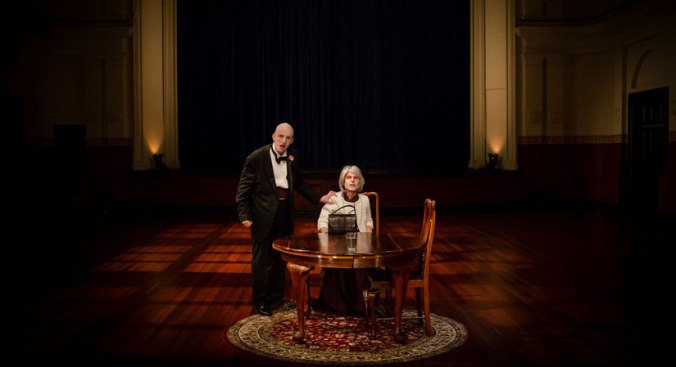
Haynes and Woods, having worked with various groups of elders to develop the show, have responded with pure physical comedy. The opening scene, with a ludicrously creaky old couple making their way inch by inch to the middle of the stage, is a piece of genius. During their journey, which take a very long time indeed, the viewer is at first convulsed with laughter, then struck by guilt at laughing over others’ physical limits, then visited by memories of older relatives ground to a halt by arthritis. It is both remarkably funny, and unexpectedly painful. This sets the tone for the show in which Haynes and Woods use their exceptional skills to recreate the constantly recognisable physical traits of the elderly, and to tip them into convulsive humour.

The pair reference classic comedy throughout, not least during a remarkable scene inspired by ‘Dinner for One’ with Woods bringing his wife (Haynes) a cup of coffee and attempting to lay a table cloth. The scene is performed in fast forward, and is both highly impressive and hopelessly funny. Woods even pulls off the ‘looking at a watch while holding a glass of water’ gag, using its perfect simplicity to round off a pill-taking routine which has the audience beside themselves. There are surely no better technical comedians working right now. Yet the value of ‘Die! Die! Die!…’ is the way it effortlessly harnesses the farce  constantly bubbling beneath ordinary life to a searching exploration of the meaning of age, and of love. Haynes plays a woman and a man, with equal brilliance, at the end of life-long relationships to Woods’s character and the power of these links is made entirely clear without a moment of sentimentality. Ridiculusmus are at the top of their game and ‘Die! Die! Die!…’ complete with fart jokes, is an absolute must-see for anyone who wants to be awed by what two men on a small stage can achieve.


The Long Walk Back

methode_times_prod_web_bin_98c9cdaa-4c16-11e9-b472-f58a50a13bbb

Image: Lisa Hounsome

The Long Walk Back by Dougie Blaxland – Greenwich Theatre, London

Once Chris Lewis was known as an extravagantly talented all-rounder, star of the England test and one-day cricket team. Now he is  remembered as a man who spent 6 and a half years in prison after a failed attempt to smuggle cocaine into Britain in his suitcase. Dougie Blaxland’s taut, probing and beautifully structured play explores Lewis’s rise and fall, one that is unique in the world of cricket and without many other sporting parallels. How could a man with such talents come to do something so utterly disastrous? Set in a prison cell, Blaxland’s two-hander probes the issues forensically, from inside Lewis’ own head.

Martin Edwards is a very convincing Chris Lewis, working his way through the realities of prison life – the fear, horror, disconnection, depression and the emotional toll of coming to terms with what he has done. Man mountain Scott Bayliss plays his cell mate, a constant figure who conducts Lewis’ internal dialogue. The pair slip expertly into numerous characters, including the trial judge, Lewis’ brother and mother, Chairman of the England selectors Ray Illingworth, drug dealers, county cricketers and more besides. Blaxland’s writing is smart and highly skilled, making a complex story involving multiple time frames seem entirely natural.

Lewis’s story is fascinating. By his own admission he got up people’s noses, roaring around in flash cars and being generally irresponsible. But he also played in a time when cricketers were beholden to the game’s old school tie authorities, treated with carelessness and frozen out if they refused to fit in. And Lewis is a black man, racially stereotyped by both players and the press as talented but lazy. His career was ended by a bizarre episode in which he reported a match-fixing approach, and was apparently fitted up by the press and driven from the game as a result. An attempted comeback at the age of 40 was a disaster, leaving him without a career or income and both desperate and foolish enough to accept a £50,000 payment as a drug mule.

Remarkably, Chris Lewis himself appears after every performance of The Long Walk Back for a question and answer session. He is thoughtful, open and self-critical, insistent on his own responsibility for what happened to him. However, although the play is supported by the Professional Cricketers’ Association, he has clearly not made friends with the cricket establishment, who must also take some blame for their treatment of their players, and their lack of concern for those who have retired. The presence in the audience of Mike Atherton, Lewis’ former test captain and one of the few to keep in touch while he was inside, is therefore to his credit. The play is a remarkable exploration of the pitfalls for those who become famous at a very young age, before their time comes to an abrupt, permanent end. It is also a rare and honest examination of mistakes, from small to very large, all made in the public gaze.


Tartuffe

tartuffe-203_1280x720

Tartuffe by Molière, adapted by John Donnelly – National Theatre: Lyttleton

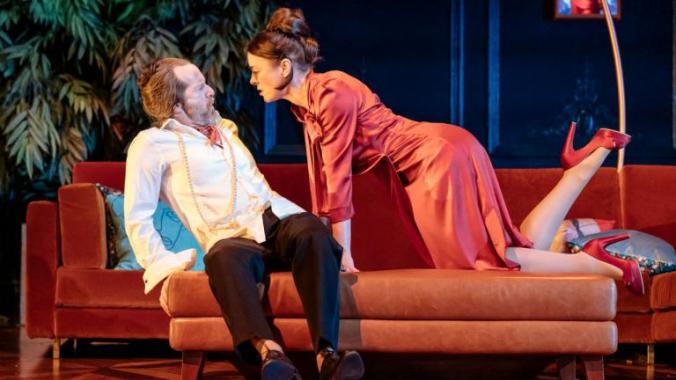
John Donnelly’s adaptation of Tartuffe locates the action in an obscenely large house, dripping with 2010s opulence in the form of outsized furnishing and a vast, golden statue of David. As a symbol of self-regarding excess, David Jones’ set could hardly be clearer and sets the tone for a production that updates Molière to show how the irresistible story of an imposter can strip our pretensions bare, as it has many others before.

A strong cast plays a collection of Molière’s types, characters updated to be familiar to us. Mariane is Orgon’s spoiled daughter, as charming as she is immature. Played by Kitty Archer she is very funny, as is her ‘street poet’ boyfriend who exists simply to be the butt of multiple jokes about his self-regard and terrible poetry. The caricatures hit home: they are too close for comfort to their real-life equivalents, coming soon to a London neighbourhood near you. However, Mariane is also capable, like all four women in the play, of changing and finds the self-awareness to pull herself out of her dependency on her father. Meanwhile Olivia Williams, as Orgon’s wife Elmire, combines deep reserves of frustration over her husband’s obsession with Tartuffe with a surprising, very entertaining talent for physical comedy. Susan Engel, as the mother Pernille steals both the start and the end of the show as the shameless matriarch, embarking on a stick-banging lecture at the drop of a hat. Kathy Kiera Clarke’s housekeeper Dorine is smart and in charge, but fated by her position as a servant to lose out

The play is ostensibly about the deluded Orgon and the deluder Tartuffe but, oddly, in this production their roles are the least convincing. This is partly due to the adaptation, which pitches Tartuffe as a complete charlatan – in this version a yoga teacher, naturally –  lacking even basic credibility. Only a complete fool could fall for his improvised pseudo-spiritualism, and that fool is Orgon. It is therefore hard to believe that Kevin Doyle’s Orgon, a manically upright Angus Deayton character, could ever have been a politically influential figure, which turns out to be crucial to the play. Doyle has a nice line in physical comedy too, but the person he was before he lost his senses is lacking. He is, however, neatly representative of our conspiracy theory driven times, becoming more desperate to believe in Tartuffe, the more his is confronted with proof he is a fraud. Denis O’Hare’s man-bunned Tartuffe gets the intense sincerity of the true charlatan spot on, but adopts an indefinable ‘foreign’ accent throughout which he never drops, which tends to make his character seem like nothing but performance.

In the end, the set weighs the production down. Most scenes involve two or three characters, who tend to disappear among the sofa cushions and parquet expanses, stripping away any intimacy. Although Blanche McIntyre works hard to populate the space, this is not a play full of spectacle. The final scene where Tartuffe becomes representative of the dispossessed street sleepers filling the stage as he threatens retribution on the self-regarding rich is memorable, but also conceptually dubious given that we know nothing he says should be taken seriously. An intriguing and inventive cast makes this an evening that, if not a complete success, is worth watching for its best performances.

Downstate

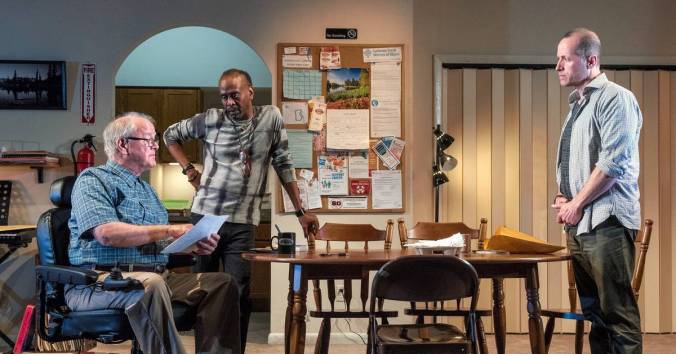
AR-181009532.jpg&updated=201810041039&imageversion=Facebook&exactH=630&exactW=1200&exactfit=crop&noborderFrancis Guinan, K. Todd Freeman and Tim Hopper. Image by Michael Brosilow

Downstate by Bruce Norris – National Theatre: Dorfman

In a co-production with Chicago’s Steppenwolf and the National Theatre, Downstate is a quietly, utterly, absorbing play about child abuse. Bruce Norris, previously best known for race drama Clybourne Park takes on social taboo issues without a pause. The premise – a victim visits his abuser in a group house for men who have served prison sentences for child abuse – sounds unwatchably grim, but the reality is entirely different. Norris handles material and character with a confidence that is a delight to watch, even when the subject matter is ostensibly horrific. This is his point: the demonisation of child abusers as indescribably evil has created draconian laws, at least in the US, that control people for the rest of their lives but protect no-one. Understanding that convicted abusers are individuals provides much more insight into what they have done, why and whether they will do it again. This perspective is balanced but hardly popular , but Norris convinced with a set of characters who are feel entirely real and, for the most part, deeply banal.

The supposed face of evil is aging abuser Fred, played with exceptional subtlety by Francis Guinan. Andy (Tim Hopper) was abused by Fred as a boy, and arrives to seek some sort of closure. He has a script, but reality doesn’t follow scripts and his attempts to have his say keep tipping into farce. The group house – a fine set by Todd Rosenthal recreating institutional decor in minute detail – is shared with men who have committed different types of crime: Dee (the remarkable K. Todd Freeman) with one of the Lost Boys in a touring Peter Pan, Felix ( Eddie Torres) with his daughter, and the intolerable, self-righteous Gio (Glenn Davis) with an underage girl. The various levels of defiance and repentance play out, but accept these people as real because Norris’ dialogue is masterful – subtle, unshowy and completely confident. His presentation of real life through unstylised dialogue is similar to the work of Annie Baker.

The company, with both US and British actors, is flawless. Cecilia Noble as harassed probation officer Ivy, left to manage an unmanageable situation, nearly steals the show and deserves a separate play about her character. Aimee Lee Wood delivers a very funny cameo as manic Staples employee Effie, and Matilda Ziegler provides a remarkable exhibition of middle class entitlement as Andy’s wife Em. Innocence and victimhood is another concern for Norris, who probes  arguments around the unquestionable status of the victim. Andy’s self-righteousness is important to the play’s structure, leading us into sympathy with the convicted villains, but it doesn’t change what happened to him. Norris is an expert at confronting the audience with thoughts it would prefer to avoid, and Downstate makes us question our easy assumptions about people we see as ‘other. Pam MacKinnon’s production delivers an evening of the highest quality, a play that asks the most difficult questions.


Cyprus Avenue

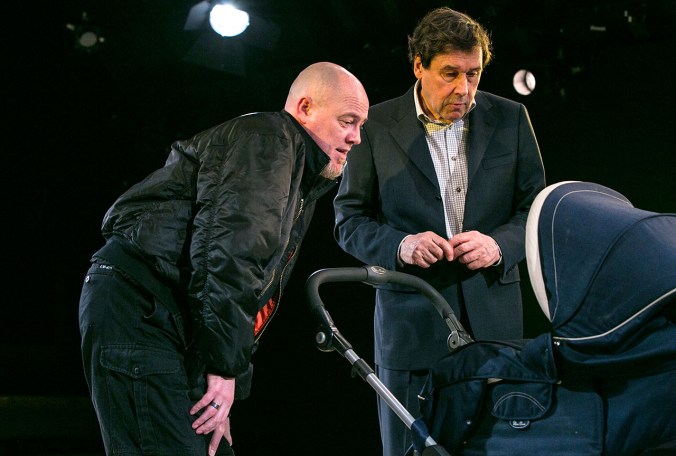
Cyprus_avenue_royal_court_stephen_rea_chris_corrigan-113Chris Corrigan and Stephen ReaImage by Pete Jones.

Cyprus Avenue by David Ireland – Royal Court Theatre, London

David Ireland’s 2018 Edinburgh hit Ulster American took up where his previous success, Cyprus Avenue, left off, exploring post-Good Friday Agreement Irishness through the medium of heroically offensive comedy. It was the best new play for a long time, probably since Cyprus Avenue first played at the Royal Court in 2016. Now the latter is back, giving audiences another chance to see exactly what caused such as stir. Judging by the exclamations of horror as the full blackness of Ireland’s comedy unfolded, plenty of people won’t be forgetting this in a hurry.

The premise is ludicrous: as ludicrous, in fact, as the Troubles. Eric (Stephen Rea) is convinced that his baby granddaughter looks like “dirty aul’ Fenian fucker” Gerry Adams. He puts tiny glasses on her and draws a marker pen beard to test his theory. Eric is not best pleased with the supposed resemblance because he is from East Belfast and, although he may claim not to hate Catholics, he definitely hates Fenians – none more so than Gerry Adams. Meanwhile, his wife and daughter think he is insane and his therapist questions his fundamental identity. Then things go really, really wrong.

Ireland’s play is a wicked satire on the ideas held sacred by both sides during the conflict. He strips the contradictions of Northern Ireland Protestant identity bare – Eric is definitely not Irish… he’s British… but he starts to lose it when he wonders whether he might not be Irish after all. Meanwhile, in London, the centre of the Empire, everyone pretends to be Irish and spends their time drinking the dark stuff in O’Neill’s. Ireland spares no-one, British or Irish, Catholic or Protestant. Eric is an absurd figure but also a terrifying one, a a casualty of a brutal war that is over but has spread trauma in its wake. Stephen Rea’s performance is a masterclass, and the play belongs to him. He brings a slightly shambling physicality Eric, showing him to be broken without knowing through small things like the way he holds his shoulders. Despite his absurd behaviour, he is entirely believable.

Vicky Featherstone stages the play expertly on the beige carpet of the therapist’s office, designed by Lizzie Clachan, which becomes irrevocably stained as the truth comes out. Ireland’s writing pays tribute to theatrical history – a key moment recalls a notorious Edward Bond play performed on the same stage more than fifty years ago – and Cyprus Avenue is also reminiscent of Martin McDonagh’s The Lieutenant of Inishmore. Ireland writes the same savage comedy, and has the same ability to make audiences laugh in horror, but has time has moved on. Eric cannnot, and the world has left him a long way behind. Cyprus Avenue uses shock tactics to show us the horror within, but it is a comedy with depth, perceptiveness and a touch of genius.


Shipwreck

132796

The cast of Shipwreck © Marc Brenner

Shipwreck by Annie Washburn – Almeida Theatre, London

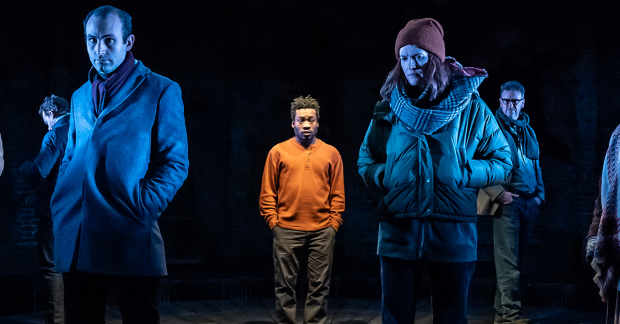
Annie Washburn’s new play is intended as a reckoning with Trump. The show pitches itself as a invitation to dinner with the 45th President, but unfortunately would be better described as an evening of meandering chat with a cast of confused New York liberals. The set-up is a snowed upstate weekend attended by three couples: two ultra-wealthy lawyers, two aging hippies and a pair who have just bought a farmhouse, and have only leftover hot dogs  in the freezer. The talk turns immediately to Trump, Jim and Teresa having arrived from helping their daughter give birth, for which she requested a “Trump-free 24 hours|. The setting is 2017, during the revelations that followed Trump’s dismissal of FBI Director James Comey. Stranded around a fire, the couples run through their disbelief, frustration and rage at the state of the country, and secrets begin to emerge. As a parallel plot strand, Mark discusses his adoption as a Kenyan baby by a white NY family, including scenes with his parents, and describes the process of understanding what slavery meant to black people in the US, and what it means to him. Finally, we get dinner with the President, as the talk is interspersed with grand guignol scenes presided over by a demonic, semi-clad Trump.

On the surface, this sounds like a compelling set of ideas, and the basis for an engaging drama, but it does not work out this way. The play is long – 3 hours – which is fine as long as the time taken seems necessary and inherent to the drama. Here it seems indulgent and, while there is plenty of sharp dialogue scattered throughout the evening, it could easily have been half the length without losing anything important. The tension simmers, very gently, below the surface of the campfire conversations, and some scenes are simply boring, especially a dialogue in which Mark reflects on a conversation with his parents about whether he is allowed MTV. It is an earnest attempt to explain the origins of the Trump mindset, but it is not clear why a stage is the place for it. The Almeida’s new, temporary revolve spins the play round on the spot, never reaching a destination.

The second half of the play breaks down into a series of monologues. Marks’s role is almost entirely speeches to the audience and, although well-written and pack an emotional punch, they seem disengaged from the rest of the play. This is not helped by an explanatory, rug-pulling twist which comes in the penultimate line of the evening, which far too late to be reorientating the audience’s perceptions of everything they have heard. The Trump scenes are also dull, which is unforgivable for carnivalesque satire. Shipwreck has a half-American, half-British cast who are uniformly excellent, including Raquel Cassidy as Jools, whose mildness finally lurches into fury, Khalid Abdalla as Yusuf, the lawyer who plays with the dark side, Justine Mitchell as Allie, whose activism is all talk, and Fisayo Akinade as Mark. However, the play is need of a serious edit, and it is frustrating that a well-intentioned attempt to skewer both the politics of populism, and the comfortable liberal assumptions that enabled it, cannot find the focus it needs.

Berberian Sound Studio

TELEMMGLPICT000188637398_trans_NvBQzQNjv4BqyILZCJqFaBEpuz3ivC4GSpxWLfs5mAvkbXYQqrLnBas

Tom Brooke in Berberian Sound Studio

Berberian Sound Studio by Joel Horwood – Donmar Warehouse, London

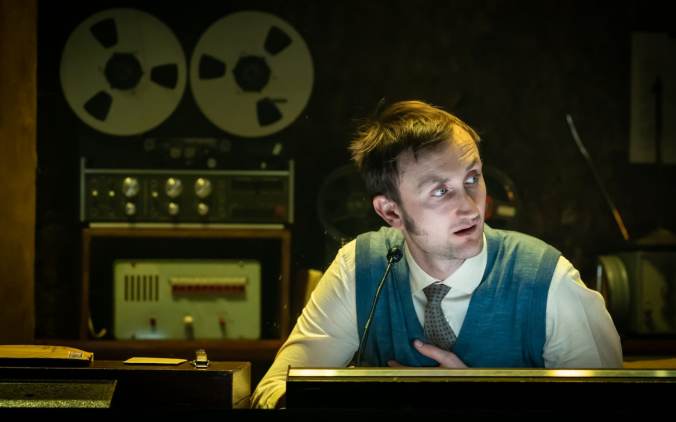
Berberian Sound Studio is a stage version of the 2012 film, about a repressed English sound engineer whose documentaries about rutting deer on Box Hill and the South Downs get him a gig in Rome, working on torture scenes in a Italian giallo horror production. Peter Strickland’s film was curious and strange, heavy on atmosphere, light on events and hard to forget. It is easy to see why a film set mainly in a recording studio is so  suited to the stage, and Tom Scutt has created a beautifully balanced and unusual piece of theatre.

The production values are a delight. Tom Scutt, also a designer, has created with Anna Yates a loving tribute to 1970s analogue technology, with a full-sized sound booth dominating the stage, all dark wood, tape reels and chrome switches. The sound team are dubbing a film directed by the legendary director Santini, and they gaze over the heads of the audience towards a supposed projection on the back wall. We never seen any film, but we hear everything and the sound design is a world in itself. Ben and Max Ringham create a pin-sharp soundscape in which the texture of a scream, analysed over and over, becomes compelling and thoroughly disturbing.

The casting of Tom Brooke, whose excellent stage work has often been in supporting roles, as the main character Gilderoy is a fine choice. His inability to cross the gulf between his life in Surrey with his mother and tape machines and the Gothic world of giallo is delivered with excruciating awkwardness. The play switches between moods in a disconcerting fashion from frustration and menace to choreographed comedy. Some of the best moments come when the two foley artists, Massimo and Massimo, perform increasingly elaborate sequences to accompany the film we cannot see – walking in high heels, splashing in buckets, wielding axes and chopping cabbages, all without a word.

As a sequential plot, Berberian Sound Studio doesn’t really go anywhere in particular, and this seems entirely natural, and an attempt in the dying moments to provide explanation and closure seems unneccessary.  The enclosed world of the sound stage filters the outside world, allowing Gilderoy to edit and balance reality to fit the fiction. Hints creep in of what is happening back in Surrey through his mother’s taped messages, in which the fate of a chiff chaff nest implies horror off screen, while the studio becomes a torture chamber of its own. In the end though, the sound of Gilderoy snapping celery seems more terrifying than the breaking bones it seems to represent. Scutt’s production draws the audience into its world, and keeps them there, listening.

Jesus Hopped the ‘A’ Train

Oberon_K._A._Adjepong_and_Ukweli_Roach_in_Jesus_Hopped_the__A__Train_at_the_Young_Vic._Photo_by_Johan_Persson_1551363491_crop_550x367

Oberon K. A. Adjepong and Ukweli Roach in Jesus Hopped the ‘A’ Train at the Young Vic. Photo by Johan Persson

Jesus Hopped the ‘A’ Train by Stephen Adly Guirgis – Young Vic, London

Published at The Quietus

The hexagonal Young Vic auditorium has been split down the middle, and the stage resembles a cat walk, long and narrow, with the audience on either side. The actors are trapped in the middle, exits blocked by glass security doors that slide up and down on rollers, controlled by unseen hands. Magda Willi’s sparse set leaves no hope of escape, and no hope of avoiding judgement. Stephen Adly Guirgis’ play, ‘Jesus Hopped the ‘A’ Train’ is a prison drama set (although we discover this only at the very end) in New York’s Riker’s Island Prison. It revolves around two central characters incarcerated in the jail: Lucius a serial killer awaiting extradition to Florida for execution; and Angel, who “shot the Reverend Kim in the ass” but did not expect him to die. A third character, a conflicted, morally opaque lawyer (Dervla Kirwan) represents Angel and pivots through his parts of the story.

Guirgis’ play was a hit when first performed in the USA in the early 2000s, and Philip Seymour Hoffman’s production came to London in 2003. Kate Hewitt’s revival for the Young Vic is a chance to see how well its stark, demonstrative look into the darkness of guilt and redemption has lasted, and whether it is the modern classic some suggested at the time. Unfortunately, the new production reveals a conceptually disjointed piece of writing, big on effects and lacking in coherence. Its most obvious drawback is a lack of dramatic drive which, in play that covers child murder, prison rape, cults, God, guilt, lies and the American justice system, is a strange failing. All the main characters have set piece speeches in which they confront their demons, and the play revolves around these, but they are all soliloquies. It soon becomes apparent that the play fits onto such an unusually shaped stage because there is almost no need for scenes involving more than two characters, and much of the time only one actor is performing. The play is essentially a set of monologues stitched together at the edges, and showing signs of fraying. 

This structural failing reflects the lack of a coherent relationship between the three stories that form the play. Lucius has done terrible things but now he has found God. He shares an isolation wing with Angel, placed there for protection after he was attacked and raped while on remand. A sadistic guard runs the wing, making life unpleasant for both of them. Angel debates guilt and faith with Lucius, but his concerns are entirely different. He shot the Reverend Kim character who ‘stole’ his friend by persuading him to join a ‘son of God’ cult, and is now in way over his head. His lawyer, who talks mostly to the audience, presents herself as reasonable, measured and in charge, but her ego will evidently lead to her client going to jail. She teaches him to lie to protect himself, but it is not apparent whether this is a good thing or not, and it does not work. These characters seem to belong to different plays, and Kirwan’s character has no contact at all with Lucius. Guirgis skips around topics while we wait to find out where he plans to focus.

It seems ‘Jesus Hopped the ‘A’ Train’ is a play about perceptions of guilt. Can someone, such as Lucius, who has done the worst things imaginable, be condemned as a murderer in the same way as accidental killer Angel? Is the refusal to consider Lucius’ brutal upbringing based on race? And can religious faith change someone, even someone with a past like Lucius? An examination of the psyche of the most depraved serial killer could be fascinating, but we never get this. Instead, the Lucius presented on stage spends his time arguing about religion, which turns him into just another born again Christian with little new to offer. US actor Oberon KA Adjepong, as Lucius, has the star part and plays it to the hilt, but Guirgis offers him set pieces rather than character development.

Guirgis’ writing has a curious tone, often more black comedy than realism. This is perhaps not surprising from the man behind ‘Synecdoche New York’, but it sows confusion over how seriously we are meant to take the play’s themes. The slapstick-with-guns story shooting of the Rev. Kim could be plucked straight from Chester Himes’ brutally funny Harlem crime novels. It sits oddly alongside the straight confessional story of a lawyer’s struggles, delivered by Kirwan. The latter works hard, but finds little coherence in a part that fails to integrate with the main thrust of the play. Meanwhile, Ukweli Roach as Angel convincingly communicates the character’s emotional desolation, hidden behind a truculent exterior. However, Angel’s journey from new inmate to desperate lifer is occurs largely through off-stage events rather than through action and dialogue.

There is a powerful play about the US justice system hidden in here, waiting to get out. Angel’s fate is not related to what he has done, or to justice at all, but depends on plea bargaining, competing egos and placating the DA. There are moments when the play discusses the racial prejudice underlying supposed justice, and comes to life. These modern scandals are even more relevant fifteen years on, and have been recently been documented much better by the ‘This American Life’ podcast. There are glimpses of energy in these aspects of the play, but they are thrown away. Instead, Guirgis provides a disconnected roam across semi-connected individuals, book-ended with the underdeveloped warden characters, that leaves us none the wiser about the big issues he appears to tackle. There is plenty of noise and fury on offer, but a real lack of clarity over what ‘Jesus Hopped the ‘A’ Train’ is really about. 
The Lady From the Sea

Lady-From-The-Sea-Print-Room-631Pia Tjelta & Adrian Rawlins

The Lady From the Sea by Henrik Ibsen – Print Room at the Coronet, London

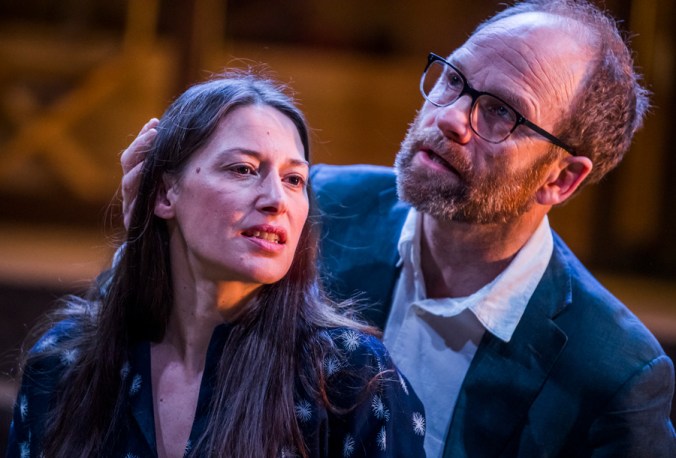
The Norwegian Ibsen Company has struck up a relationship with the Print Room, presenting their second show following last year’s Little Eyolf at the gorgeous Coronet Theatre in Notting Hill. The company sounds long-established but, in fact, was set up recently to fill a Royal Shakespeare Company-shaped gap in Norwegian culture. There is no arguing with more Ibsen on our stages: his plays combine dark folklore and poetry with a questioning of basic social assumptions that remains nagglingly current a century later. The Lady from the Sea, rarely performed in the UK,  is a fascinating and alluring play, but this production provides an uneven account.

We are used to European companies with distinctive styles, but The Lady From the Sea lacks a defining directorial grip. The main characteristic of Marit Moum Aune’s bi-lingual production, which features an Anglo-Norwegian version of the central family, is awkwardness. Wangel doesn’t know why his wife won’t sleep with him; Arnholm thinks his old pupil carries a torch; Bolette finds her old teacher’s attentions excruciating; Lyngstrand won’t admit he’s dying; and Hilde thinks her step-mother doesn’t love her. Meanwhile, Ellida is on pills and haunted by the call of the sea, and a darkly mythic secret. It’s a masterful picture of thwarted ambition tied up by unequal relationships, but the production – set on a beach overlooking the fjord where tourist ships come and go , leaving the inhabitants stranded – has an uneven cast, who lack the strong ensemble dynamic essential to the flow of the play.

The best performances come from Pia Tjelta as Ellida, Adrian Rawlins as Wangel, her struggling husband, and company founder Kåre Conradi (looking, coincidentally, very like his RSC counterpart, Greg Doran) as the increasingly manipulative figure of Arnholm.  Tjelta’s performance is alive and real rather than otherwordly, so her inability to resist the baleful influence of a mysterious seaman is a real shock. When she slips into subtitled Norwegian, which she does when talking of the sea, the production really catches light as an energy courses through her.  Rawlins plays Wangel, her long-suffering but controlling husband, as dishevelled, good hearted, and wrestling with himself, his demons and her impossible longing to return to the unattainable sea, other world of a life with The Stranger. Conradi is benign and white-suited, a middle aged man who gradually realises he has the power he needs over Bolette to get what he wants, and force her into marriage.

The Lady From the Sea confronts the need for liberation and mutual respect within marriage, the only way to achieve true freedom. Wangel makes a supreme effort to let Ellida go, and finds he has won her back by doing so. It is therefore ironic that his young daughter Bolette should meanwhile be compromising her own freedom, believing she can is escaping the constraints of her life while imprisoning herself in a union she does not want. The production suggests that, as she pulls away from Arnholm at the very end, she may realise her mistake, but it is very like Ibsen to avoid a clear-cut resolution. If men can accept the equal agency of women perhaps we can all liberate ourselves, but the desire for the impossible will always be there, the belief that a different and better version of our lives calling to us from somewhere out to sea.