Boxman

Boxmen-Exeter-Phoenix-e1529883024630

Boxman by Daniel Keene – Blue Elephant Theatre, London

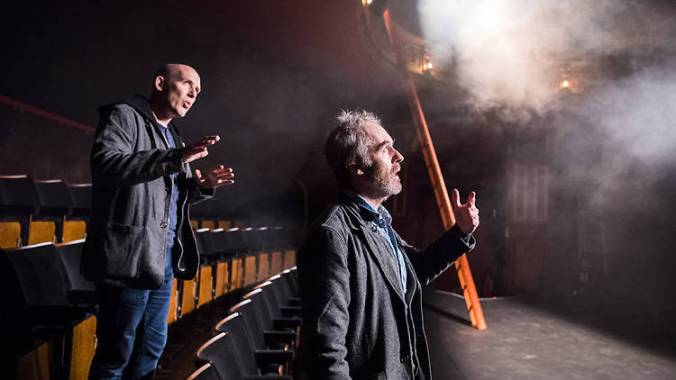
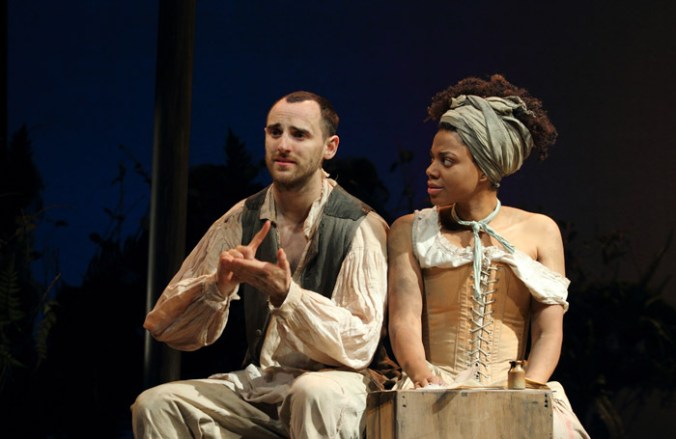
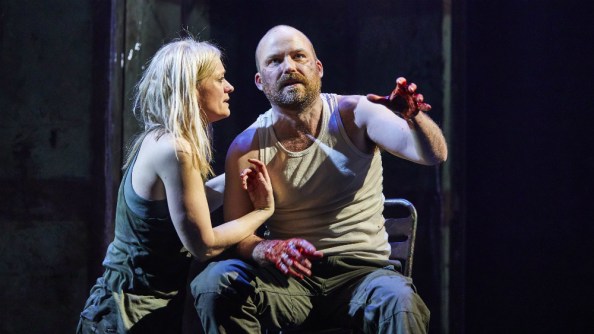
Daniel Keene’s new monologue, performed by Reice Weathers, belongs to a man who would be living in box, if it was big enough. Ringo, who is homeless and living on a pavement, is from an unnamed West African country that sounds very like Sierra Leone. He has a real name, but no-one in his adopted city can pronounce it. He has built a life which is driven by optimism, but stalked by his traumatic past as a child soldier and confined by his destitute circumstances. His world is a construction made of small cardboards which symbolises a space that is his own.

Both Keene’s writing and Weathers’ performance are excellent. As Ringo describes his life, details emerge of what has happened to him and how he came to be in London. The script alters to reflect details of the time (a re-enactment of England’s penalty shoot-out against Colombia) and place (he is living outside Oval tube) where it is performed. He describes his past as another time, and repeatedly talks about the many lives he has led. His descriptions of what happened to him are beautifully, sparsely written and difficult to forget, for example the image of his father being torn from his arms by soldiers rather than, as he observes is more usual, the other way around.

The dark story is lightly but searingly told, and provides deep insight into the complex experiences that lead to refugees living, stranded and homeless, in Britain. Boxman also owes its impact to Reice Weathers’ charismatic, physical performance. In a bewitching, note perfect West African accent, Weathers befriends and cajoles the audience, occupying the physical space that defines his boundaries with distinctive, inventive movement. Guided by Edwina Strobl’s focused direction, Weathers uses his body to express himself, including some expertly delivered Thriller dance moves.

Boxman is compelling, urgent and humane theatre about the trauma and terror hidden in plain sight on our streets. It is also an exceptionally high quality piece, from a confident creative team with the skills to produce work with real impact.
Cockamamy

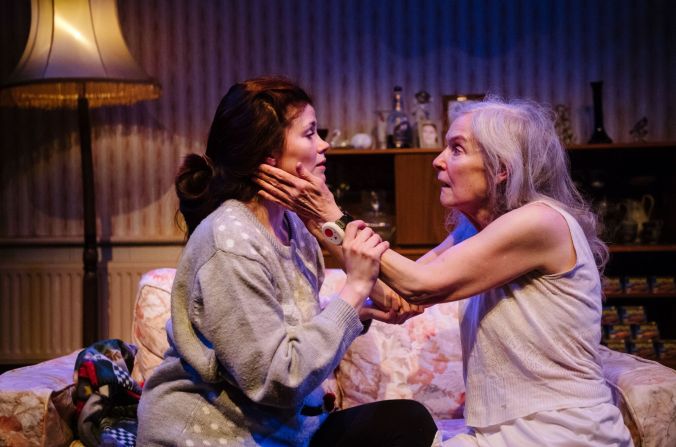
Cockamamy, The Hope Theatre (c) Alex Brenner, no use without credit (8) Louise Coulthard and Mary Rutherford_previewLouise Coulthard and Mary Rutherford (c) Alex Brenner

Cockamamy by Louise Coulthard – Hope Theatre, London

Louise Coulthard’s new play is a carefully crafted look at the impact of dementia, both on those afflicted and the people around them. Rosie, whose mother died when she was very young has been brought up by her grandmother, Alice. The two have moved down to London together, where they share a house. Alice is elderly but characterful and independent, but then she starts hiding tins of spam around the house, losing her pension and making inappropriate remarks to Rosie’s Irish boyfriend, Cavan, about the Potato Famine.

Coulthard, who also plays Rosie, has written a piece that treads a subtle line. The situation and characters could easily tip into stereotypes and truisms, but this never happens. Instead, all three are entirely convincing individuals, whose love for one another is tested to breaking point by the stress of Alice’s rapid mental deterioration. Cavan, played by Rowan Polonski, is allowed to be a straightforwardly nice guy,, a bold and effective decision, when many writers would have been tempted to use his reaction to the Alice’s condition to drive the plot forward. Mary Rutherford, as Alice, delivers an exceptional performance, losing her mental bearings in a way that feels all too real. Coulthard’s Rosie is someone trying to cope with the multiple problems of ordinary life, one of which happens to be a grandmother who attacks the cleaner with a walking stick and makes tea for her dead husband.

Cockamamy (US slang for nonsense) tackles several contemporary themes quietly and effectively, not least the financial pressures on young people that leave them with no choice but to live with older generations. The effects of dementia are explored in a way that leaves space for an open appreciation of the upsides, as well as the downsides. Alice becomes a child again, with the relief from responsibility that brings, but she also relives traumas of the past that she’s forgotten had happened, such as the death of her daughter. Meanwhile, her problems lands squarely with Rosie, who suddenly finds herself becoming a struggling carer. Coulthard’s writing is of a very high quality, and a play that could have been worthy or predictable in different hands is moving, complex and real. Cockamamy is a true delight, and Coulthard a serious talent.

This show was seen with a free ticket.

Sancho: An Act of Remembrance

126664

Paterson Joseph – image by Robert Day

Sancho: An Act of Remembrance by Paterson Joseph, Wilton’s Music Hall, London

Paterson Joseph’s play, performed by himself, is an account of the remarkable life of Charles Ignatius Sancho, butler to the Duke and Duchess of Montagu and the first black Briton known to have voted. Joseph, an actor with a fine stage CV, engages with the audience from the start as himself, author, performer, and black Briton. He explains that although his white contemporaries moved quickly into costume drama, he was never offered those parts. So he wrote one for himself, based on his discovery that the Britain of the past, where black faces are rarely shown, was in fact much blacker than he had ever realised.

A portrait of Sancho painted in 1768 by Thomas Gainsborough sits on stage throughout, a constant reminder of the social status he achieved. Joseph tells the extraordinary story of his life, from his birth on a slave ship to a mother who died in childbirth, and the suicide of his father, to his escape from the three sisters who denied him education and chance rescue by the Duke of Montagu. His adventures are fascinating, partly because they show how a black man could become respected and play a part in 18th century high society. Joseph is also careful to show how fortunate and exceptional his success was, compared to the fate of most black people carried away by the slave trade. When Sancho comes to vote – in public, pre-secret ballots – he is forced to prove he is entitled to be there. The acceptance he has enjoyed melts away when he stops acting the compliant servant and demands the same rights as his fellows.

Joseph has chosen a powerful and illuminating theme for his play, and the audience loved his performance. Sancho was an actor for a short spell, which gives Joseph full license to portray him as a flamboyant and self-dramatising character, and an entertaining guide to black experience. However, while there is plenty of scope for playing to the audience, there is less direct engagement with the political themes than might be expected. In fact, at the start Joseph assures us that this is not a political play. When, in select moments, Joseph drops the charm, he achieves a different level of impact. His personal experiences, glimpsed at the start, are intriguing and a modern counterpoint to Sancho’s story, but we hear little about them. At the end of the play he removes the mask, telling us as both himself and as Sancho that he cannot do this anymore, that he has to stop pretending. This is a moment of real power and, while Sancho is an engaging evening, it would benefit from more of them.


Machinal

DfErsSAXcAAlCc3

Emily Berrington and cast in Machinal © Johan Persson

Machinal by Sophie Treadwell – Almeida Theatre, London

“Hell to be a woman”. Sophie Treadwell’s stylised, expressionist drama Machinal is a cry of rage, induced by a male-driven society that is modernised, mechanised and all the more efficient at grinding women down. The central character is ‘Young Woman’ played by Emily Berrington, who does what she is supposed to do, all the while terrified. She obediently marries her boss when he asks, but all the while the weight of society presses on her from all sides. Eventually, she kills him.

Treadwell write Machinal in 1928 after attending every day of the Ruth Snyder trial in New York, executed along with her lover for murder of her husband. James M Cain was inspired to write Double Indemnity by the same trial. Treadwell’s response is intensely personal, reflecting the position of a woman in the city. Berrington plays the Young Woman brittle, assailed on all sides – by the din of clattering typewriters in the office where she works, by the uninvited attentions of her boss, the Husband (Jonathan Livingstone, impressively smug, by his body and by childbirth. She acquieses at every turn, and is horrified by the life that results. When she finds relief  through her lover, the Man (Dwane Walcott), her and happiness is only brief, before he cooly provides the evidence that dooms her.

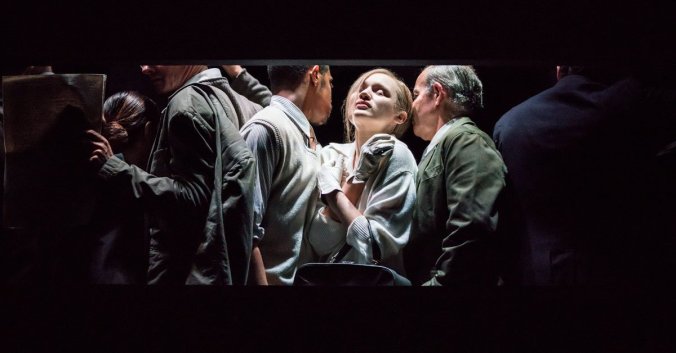
Natalie Abrahami’s production, designed by Miram Buether, is every effective in creating a claustrophia that builds to breaking point. From the very beginning, as the fire curtain letterboxes a writhing mass of bodies pressed around a gasping Berrington, the unstoppable processes of the mechanised world are viscerally created, carrying her on a course she never chooses. Between scenes, the audience is blinded by merciless, white neon tubes. Buether’s tilted mirror reflects the action back in helicopter view, while the expert sound design from Ben and Max Ringham is crucial. Abrahami makes the slightly risky decision to advance the time frame with each scene, beginning in the 1920s office of the play’s setting and ending with a contemporary huddle of tv reporters. This is subtly done, and a neat way to draw the play out of its context without undermining the  text.

Ultimately, it’s Sophie Treadwell’s writing that makes Machinal something special. Treadwell was a prolific writer, but almost all her other plays are far more conventional. Machinal is an experimental piece full of staccato delivery and syncopated speech, jump cuts and cross fades, and the experiment is a huge success. She uses cutting edge techniques of the time to create a work that leaps out from its era. The play is short, spare and incredibly intense, with an ending that, although it shouldn’t be revealed in a review, defies belief. The play was a great success when first performed in 1928, and was rediscovered by the National Theatre in the early 1990s. Since then, it seems to have been mislaid again, but it deserves a much higher profile. A entirely contemporary play, it presents themes that are as current on the stage now as they were in Treadwell’s time. The Almeida’s excellent production should do a great deal to give it the respect is deserves.

How It Is (Part 1)

imageConor Lovett and Stephen Dillane; Photo by Tristram Kenton

How It Is (Part 1) by Samuel Beckett – Print Room at the Coronet, London W11

The Print Room’s permanent home at the Coronet Theatre, Notting Hill, is the most atmospheric in London. In Gare St. Lazare’s astonishing staging of the first third of Samuel Beckett’s 1964 novel ‘How It Is’, the worn and flaking auditorium becomes a powerful presence. With the audience seated on the apron of the stage, looking back at the circle and the balcony seats (the stall level is now the basement bar) the theatre is turned in on itself and becomes a setting of decaying beauty.

‘How It Is (Part 1)’ is also a piece about decaying, but surviving. It was Beckett’s final novel, first published as ‘Comment C’est’ in 1961, the same year as ‘Happy Days’ and, like Winnie, features a protagonist stuck in the mud. It shares its unpunctuated streams of consciousness with the earlier novels of ‘Trilogy’. It also has three parts – ‘before Pim’, ‘with Pim’ and ‘after Pim’, and is narrated by a man crawling through mud. Putting it on stage is a huge undertaking, requiring prodigious feats of memory for the actors tasked with 105 minutes of entirely uncompromising prose. Gare St. Lazare, based in Cork, has developed a staging of the just the first part of the novel before the nameless man meets ‘Pim’. Their production is meticulous, demanding, and engrossing – a tour-de-force.

Three actors appear, each delivering Beckett’s looping, repetitive, stripped back language in waves of introspection. Conor Lovett’s Irish accent seems to match the complex rhythms of the piece. He makes Beckett sound the way we imagine he should, while Stephen Dillane’s delivery is counter-intuitively English, like a slightly annoyed schoolteacher pouring out his soul. The contrast bringing a fascinating richness of interpretation to the work. Who is this man who tells us everything, nothing in his life except a sack of tinned food and the contents of his head?

The third performer, Mel Mercier, has a smaller part as a third voice which renders the other two incomprehensible, and is also the sound designer. His work creates an unsettling setting, representing the nothingness that encloses every moment of this play with a constantly varying soundscape of white noise and interference and rumbles. Director and designer Judy Hegarty Lovett uses the full range of the circle and balcony seats, the actors appearing and disappearing concealed and revealed by smoke and lights. This  staging works conceptually, as Beckett’s narrator turns all his intention back on himself, and the audience gaze is also reversed. It also turns the spotlight, literally, on to the worn Victorian auditorium, a space heavily loaded with memory.

Gare St. Lazare has brought a treat to London, an exacting and difficult evening, but some of the highest quality theatre in Britain and Ireland at the moment. There are no compromises, and it is telling that more than fifty years on, Beckett’s work is tough enough for ten people, on the night I saw the show, to walk out. It is not an easy show to walk out of, unless you do not care about the amount of disruption you cause, but the actors did not blink. As a culture we are still trying to come to terms with Beckett’s writing, and ‘How It Is (Part One)’ is an important step in revealing the quality and depth of his work. As the nameless narrator says to excuse his obsessive accounts, “these details in preference to nothing”.

Spiked

Spiked, Pleasance - Courtesy of Felicite du Jeu (10) Charlotte Asprey, Daniella Dessa and Katie Clark_preview

Charlotte Asprey, Daniella Dessa and Katie Clark in Spiked. Image courtesy Félicité du Jeu.

Spiked by Félicité du Jeu – Pleasance Theatre, London

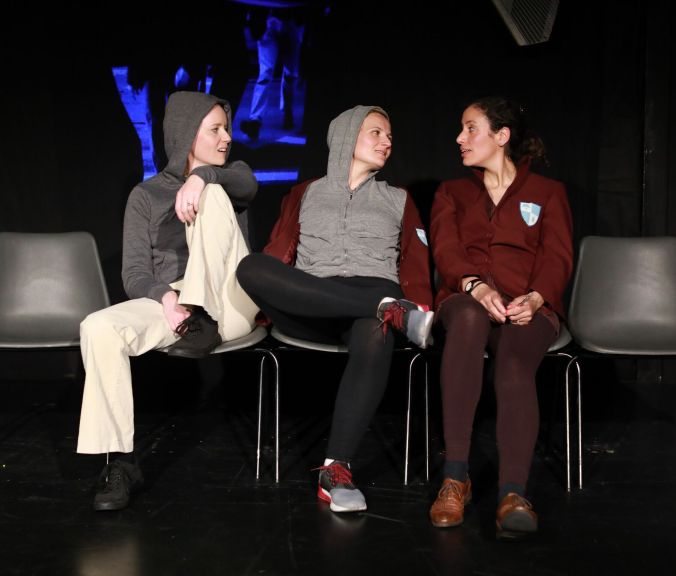
Three women sit in a hospital waiting room while their a secondary school class, brought down by something mysterious, are examined by doctors. Each has a teenager in the treatment room, and no-one will tell them what is going on. Their children may share a school, but they have contrasting backgrounds, attitudes and expectations of their offspring. Félicité du Jeu’s new play for Pepperbox Productions aims to tackle the social issues that divide and unite mothers head on. The three performers also double effectively as each other’s children in flashback scenes, creating characters with admiral ease with no more than a change of hoodie.

Spiked has good intentions and a tightly structured setting. However, du Jeu falls down through showcasing the stereotypes she intends to undermine. Joanna is a neurotic upper-middle class yummy mummy, Karen is a working class single mother, and Rozhin is a Kurdish immigrant. All three behave just as people of their type are supposed to. Joanna wraps her daughter in cotton wool, Karen refuses to tell her daughter who her vanished father is, and Rozhin is insistent on her son’s Kurdish identity. This aspect of the play tells us little about real people, and undermines the character developments that follow as the plot unfolds.

The setting – effectively a hostage situation, with the mothers trapped as something potentially terrible happens to their children – in ingenious and has great potential for escalating tension. However, this is not really the focus for the play. The central plot is used as a medium for spinning  narrative threads around each family rather than as the driving device for the action, and this seems a mistake. The play becomes a diffused meditation, and loses its power to demand attention. In this type of situation something always snaps, but Spiked leaves us instead with a shared speech about motherhood, and a soundtrack of recorded interview snippets about women’s fears and ambitions for their kids.

Spiked is at its most effective when staging the relationships between the three teens, and in scenes with their mothers. This is where the play suddenly jumps alive, and the writing sounds like lived experience. Despite the weight of parental expectation, the kids are just trying to get on with it, smoking a bit of dope and trying not to get caught. Their separation from the anxieties of their mothers is entirely natural and little heart-breaking. The play has something to say about the impossible pain of bringing up and letting go of a child. Its tendency to spell everything out wipes away ambiguity, and the play would definitely benefit from leaving more unsaid. This is an intriguing collaboration between women, with all-female cast and creatives, but lacks the subtlety or the focus to deliver the impact it clearly intends.

This show was seen with a free ticket.


Misty

Arinze-Kené-in-Misty-by-Arinze-Kené-at-the-Bush-Theatre-©-Helen-Murray-4-2000x1333.jpgArinze Kené © Helen Murray

Misty by Arinzé Kene – Bush Theatre, London

Plays about the process of writing plays are very difficult to pull off. They need sharp, self-aware writing, and charismatic performance. Fortunately, Arinzé Kene, who both writes and performs Misty, has these requirements covered. An outrageously talented performer, he is subtle and direct, funny and physical, and has serious singing and rapping abilities up his sleeve. He brings them all together in a complex, intellectually rich piece which takes itself seriously while retaining its sense of humour.

Misty is an important commission for the Bush Theatre, celebrating its first year in its refurbished space, and for artistic director Madani Younis. In development for three years, it is a flagship show for the theatre’s identity under Younis, staging work about the place and the people of Shepherd’s Bush and the wider city. Kene’s play is about the expectations and assumptions placed on him as a black man writing an urban play. He’s developing a story about a man who gets into a fight on a night bus, but a right-on friend and his wife keep leaving him voice message critiques, accusing him of writing “a nigga play” and giving white audiences the suffering black stereotypes they expect.

Although this is a one man show, the staging is an impressive piece of teamwork. Director Omar Elerian brings characters into the periphery of Kene’s world. His older sister, played by a young girl (Rene Powell), gives him a very funny and surreal lecture on cultural symbolism. His friends Raymond and Donna record their joint voicemail messages dismissively, from behind radio mikes. A ‘hot-shot producer’ and Kene’s agent appear as dictatorial voices off. Designer Rajha Shakiry threads an orange balloon theme through the show, which illustrates the pressures on Kene and leads to two remarkable scenes – a piece of slapstick physical comedy when Kene becomes lodged inside a giant balloon, and a balloon-stuffed room which, in a spectacular reveal, references Ralph Ellison’s The Invisible Man.

The production is very well suited to Kene’s multi-faceted performance. He both explores and laughs at the social expectations of his writing. When he performs extracts from the play he is constantly fretting over, he is captivating as his night bus character and tells a story that seems both real and important.  He does this through a series of rap performances accompanied by two musicians, Shiloh Coke and Adrian McLeod, on drums and keyboards. However, the status of this narrative is uncertain – is it a friend’s experiences, or is it stereotyped fiction? Kene unpicks big 21st London questions of racial and social polarisation and of gentrification, but does so in a way that is entirely his own.

Arinzé Kene is an exceptional performer, who clearly has the makings of a star. If he can make such an ambitious, complex and individual show work, it will be fascinating to see what he does next. Meanwhile, the Bush Theatre has delivered an original and effortlessly entertaining piece about the social issues of our time, which is pretty much a definition of its purpose.


Our Country’s Good

Our-Countrys-Good-Mar-2018-P-Nottingham-Playhouse-13Tom Dawze and Sapphire Joy. Photo: Catherine Ashmore

Our Country’s Good by Timberlake Wertenbaker – New Wolsey Theatre, Ipswich

Timberlake Wertenbaker’s breakthrough play is thirty years old, but its popularity remains high. The 1980s characteristics which give it away as a play from a different era are ones that current writers would do well to rediscover. The story of the first play – from a western point of view, of course – performed in Australia, in 1789 by convicts of the first transport ship, is politically courageous and clear-headed in a way that often evades playwrights in a more confused era. It is concise and incisive, complex but direct, and full of wider meaning which Wertenbaker has the good sense to avoid hammering home. Her writing is also wonderfully poetic but functional. She is a playwright who avoids indulgence, her drama apparently driven by a force of its own.

Fiona Buffini’s revival for Ramps on the Moon is an admirably managed and staged production, perfectly suited to the democratic New Wolsey Theatre space (one of six co-producing theatres). Boards cover the sands of Botany Bay, creating a stage for the newly arrived British officers and their cargo of prisoners. Power struggles play out over the identity of the new colony – a punishment camp or a new society – with brutal Major Ross (Colin Connor) contemptuous of naive Second Lieutenant Ralph Clark (Tim Pritchett)’s plan to stage Farquhar’s ‘The Recruiting Officer’, an argument refereed by the Governor-in-Chief (Kieron Jecchinis). The rehearsing convicts, including leading lady Mary Brenham (Sapphire Joy), threatening Liz Morden (Gbemisola Ikulemo) and pickpocket and Garrick-lover Robert Sideway (Alex Nowak) eventually find escape in playing roles that remove them temporarily from the prospect of flogging or the noose.

Ramps on the Moon stage work with casts who are 50% either deaf or disabled. Their determination to provide opportunities for actors who may otherwise struggle is impressive, but importantly the staging adds fascinating levels of meaning. The convicts are all deaf and/or disabled, while the officers, for the most part are not. This establishes a separation, reinforced by the use of British Sign Language throughout. Sometimes, cast members are on stage signing the action to one another and the audience, interpreting the officers’ actions amongst themselves. At other times, they are signing their own lines to one another or, in the case of two actors – Fifi Garfield as future-seeing Dabby Bryant and Emily Rose Salter as Duckling Smith, mistress to an officer – signing all the lines for actors who do not speak at all. This approach lends voices to those who would not have the in a conventional production while communicating the play to a wider range of audience members. It also introduces multiple layers of expression to the play, with physicality becoming as much part of the production as language.

As a result, the themes of imprisonment in ‘Our Country’s Good’ – by poverty, circumstance, class, culture and religion – are played by actors breaking through their own barriers to speak to the audience. As a progressive company, Ramps on the Moon are leading the way by showing what inclusive theatre looks like. It is encouraging that this fundamental innovation is coming from regional UK theatres: London has a lot to learn from them.

Macbeth

macbeth-national-theatre

Macbeth by William Shakespeare – National Theatre (Olivier), London

Despite featuring two of the National Theatre’s best loved leads of the last few years, Rufus Norris’ Macbeth has been on the end of universally poor reviews. Norris has also received some bad press, much of which is unjustified, for his programming in the Olivier Theatre, an infamously fickle space which has caught out every NT director during their tenure. Using the Olivier to stage new work has annoyed prominent critics, but is surely much-needed. However, it was perhaps unwise of Norris to take on critics by staging not only his second ever Shakespeare, but the one notorious for sinking reputations. But, like productions such as Common and Saint George and the Dragon, this Macbeth isn’t the disaster that has been claimed – nor is it a success.

Rae Smith’s vast set, dominated by a swivelling bridge, attempts to turn the cavernous spaces of Olivier stage into the witch-ridden Scottish moors. It is dramatic but confused, combining Throne of Blood medieval Japanese horror with cyber-Goth accessories and bin bag backdrops. It looks amazing in the opening scene, as Rory Kinnear pursues a rebel lord on stage and beheads him with a machete. However, Macbeth is not a play of epic battle scenes – the majority of the action is in intimate, claustrophobic settings. These have to be levered out of the huge stage spaces, and much of the play is spent in a concrete bunker or a temporary lean-to at the front of the stage, cutting out the majority of the space. While this makes sense as the architecture of a disrupted, warring nation, it undermines the poetry of the play. Balancing delicate language with grim reality is the challenge of Macbeth, and more difficult than it seems.

Rory Kinnear is caught in the same bind, a stocky, bluff military character with a tendency to choke back his lines. This is a Kinnear mannerism, usually under complete control, but his Macbeth seems less relaxed than his many previous successes at the NT. But as soon as the deed is done, a switch is flicked and he finds his groove as a possessed psychopath. It has rarely been clearer that Macbeth gives up all control over his future as soon as he stabs Duncan. Anne-Marie Duff’s Lady Macbeth is more smoothly conceived. She plays the party-loving hostess with conviction, and a chilling ability to manipulate. Her horror when she realises she no longer matters is a defining moment in the play.

There a number of intelligent, enjoyable performances in the supporting cast: Stephen Boxer’s foppish Duncan, Kevin Harvey’s angular Banquo and Patrick O’Kane’s warrior Macduff are all memorable. Trevor Fox’s strange, Geordie Porter reappears throughout as an attendant to Macbeth and as a sinister Third Murderer. His fellow murderers are effectively played as post-hippy drop-outs, and there is an illegal party theme to the staging, amusing and confusing in equal measure, which involves Duncan spending his final night dancing on a table lit by a generator.

The over-complication that undermines the staging affects the Witches too, who combine too many ideas to make much sense as a collective, although they look remarkable perched, swaying, on tall poles overlooking the final battle. Their cauldron scene, however, is inexcusably cut. The English scene, with Malcolm testing Macduff’s loyalty is not Shakespeare’s finest moment, but cutting most of it while leaving only the start and end makes little sense.

Once the play breaks free from the complications of its set its rolls much more smoothly. With the murder of the Macduffs, the action finally takes places on a reasonable portion of Rae Smith’s stage. Kinnear in particular, relaxes into his role and the final scenes are delivered with credibility. Norris’ production is messy and lacks the clarity of thought needed to stage such an unforgiving play. There is also much to like and enjoy about this production too, including inventive performances and strong ideas. However, Norris should probably play to his strengths as a director, which are many, and not feel he needs to transform into Nicholas Hytner as well.