Raven

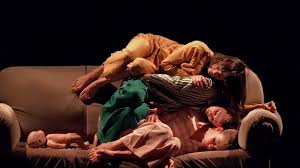
Raven by Chamaleon Productions

The three women who perform ‘Raven’ are Germans, acrobats and mothers. Having children means their lives no longer fit the template for performers. The precarious, risky and poorly paid existence of a female acrobat constantly conflicts with expectations of a mother, and in Germany they are ‘raven mothers’, the term for women who put themselves above their children.

The show is beautifully judged and full of clever moments. It provides a showcase for Romy, Lena and Anke’s remarkable rope work, dance and contortionist skills, but they are also funny and engaging performers. They make deceptively light work of describing their lives and families. It is a pleasure to watch them as they confess their fears and express themselves through cunningly choreographed movement, at one disappearing one after another down the back of a sofa. ‘Raven’ is a well crafted, experimental piece that gives a voice to women who feel sidelined.
Everything I See I Swallow

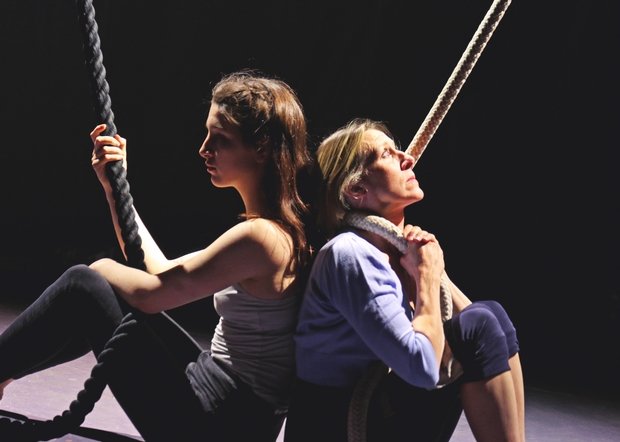
Everything I See I Swallow by Tamsin Shasha and Maisy Taylor – Summerhall, Edinburgh

Topless, strapped in Japanese bondage cords and hanging from a rope, Maisy Taylor makes quite an impression on the arriving audience. ‘Everything I See…’ is a acrobat show, performed and written by Shasha and Taylor. They play a mother and daughter, the latter dealing with disconnection from her body through experimental relationships and bondage. Her mother is angry and confused that a feminist education could lead to this.

The aerial work is exceptional, including daring moments where the pair cross and support one another on the same rope. The show explores how a generation gap can leave women in their 50s and 60s feeling they have never had the freedom to express themselves physically, while their daughters runs outrageous Instagram accounts. The ideas are interesting but not wholly successful. The two characters seem stereotyped, and it is hard to sympathise with Taylor’s character and her complaints about the burden of her own beauty.

Work-Life

Work-Life by Diane Stewart – Traverse Theatre, Edinburgh

The Traverse Theatre’s rehearsed breakfast readings are a treat, because it is not at all usual to see work in progress presented in front of an audience. It is not appropriate to review a performance after a single day’s rehearsal. However, Diane Stewart’s play tackles the impact of automation and the grip that multi-national corporations have over work, life and moral compasses – an essential area for discussion.

Are we not drawn onward to new erA

Are we not drawn onward to new erA by Ontroerend Goed – Zoo Southside, Edinburgh

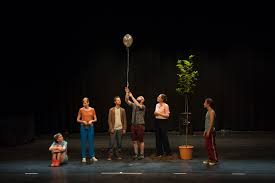
Belgian company Ontroerend Goed are seasoned experimenters, but even for them ‘Are we not drawn onward…’ is an extraordinary, ground-breaking show. The title is a palindrome, and the key to the structure of a performance that hinges in its centre. The first half hour is mysterious and oblique. The history of humanity passes before us, from the garden of Eden to a stage choked with plastic and fumes – our apparently unstoppable rush to environmental oblivion. The actors move strangely and speak an incomprehensible language. Then the curtain drops, a woman steps to the front of the stage, and suddenly we can understand her words. The play switches direction, and a film of the action we have just seen is projected on to a screen in reverse. Everything is now comprehensible and the reversed actions make sense.

Speaking and acting backwards is a stunning technical achievement, but Are we not drawn onward… is not a showcase for its performers. OG is an ensemble, and the low key performances are in service of the whole. Watching the impossible – reversing the mistakes we have made, magicking them away – is a moving, disturbing experience. Reversing everything creates a world of activism where people work together to make change. However, as the play returns to its start the cast absent themselves from the stage one-by-one, and the play suggests that the only sustainable future is one without people.

Coma

Coma by Darkfield

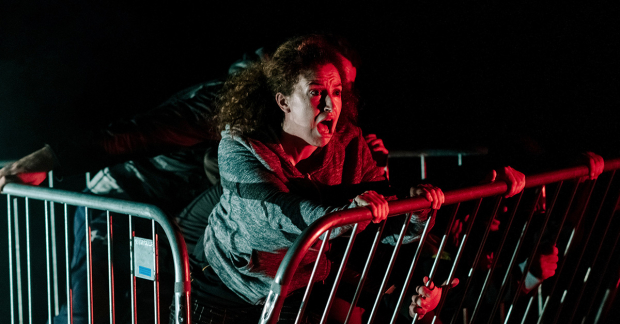
Lying on bunks in pitch darkness, inside a shipping container, participants are offered a pill to take. We are assured it has no active ingredients but will change everything. Darkfield specialised in playing with the minds of the audience, whose imaginations are rendered suggestible by the lack of stimulae. An authoritative voice in our headphones asks us to imagine him into the room. He spins a scenario, and the scents of coffee and perfume are blown in through grilles. It is over before you know it, and the bunks are too comfortable to be truly unnerving, but the feeling lingers that a coma may not be emptiness at all, but quite the opposite.

Mustard

Mustard by Eva O’Connor – Summerhall, Edinburgh

An Irish woman tells, in her own words, the story of her relationship with a cyclist with a large house in Crouch End. He is arrogant, and she comes second to the bikes. But she has her own issue, not least that she is obsessed with mustard. It clouds her mind and, in a memorable scene, covers her body from head to foot. Eva O’Connor’s monologue is energetic and direct, sexually revealing, but also traditional in form. The script is wordy and, at times, hard to believe. The boyfriend is a complete bastard with not redeeming features, which seems two-dimensional. And the central mustard theme is loose. It is not clear whether it is a metaphor for addiction and instability, or actual mustard. The latter just seem unlikely, particularly in the context of a show that focuses on the banality of life-changing events. A memorable performance, but a tonally uneven piece.

Crocodile Fever

Crocodile Fever by Meghan Tyler – Traverse Theatre, Edinburgh

Meghan Tyler’s wild ride of a play takes the patriarchy apart, literally, with a chainsaw. It also takes the same chainsaw, wielded by two woman pushed to the edge, and uses it to dismember the stereotypes of Irish drama. Set in South Armagh, it is a gleeful, Martin McDonagh-esque black comedy with women in the driving seat.

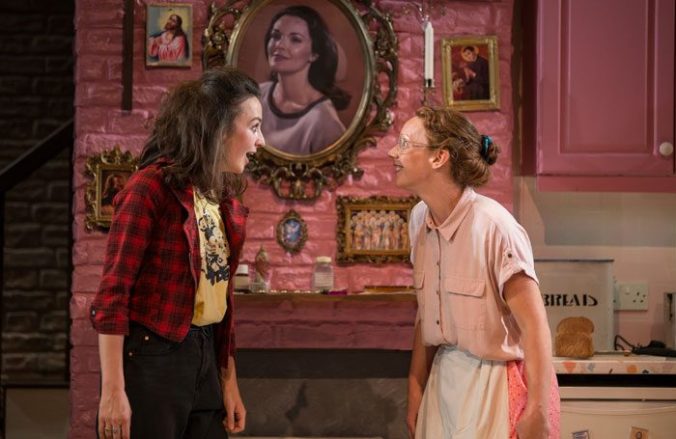
The main characters are sisters, the good one and the bad one. The former, in Mrs Doyle glasses, buttoned down and obsessed with cleaning, is trapped looking after ‘Da’, paralysed upstairs. The other is a rebel, just out of prison and in the IRA. The actors, who are clearly having a fantastic time, perform with immense verve. The plot encompasses a saintly, dead mother, the Paras, a priest, and the tyrannical, abusive father. The surreal, hilariously grim trajectory of events is a delight, as is the writing. Contrasting, skillful moments include a monologue about the true meaning of ‘Africa’ by Toto – Tarantino via Armagh – and the sisters’ realisation that neither can abide the smell of their father’s pipe. No more is said, but it tells us all we need to know.

Tyler takes on the tropes of the Irish stage, from the claustrophobic family to the black terrorist comedy, and puts the women in charge. Crocodile Fever is a confident, seriously entertaining evening, but also a play with meaning layered behind the surreal antics.

Knot

Knot by Nikki Rummer & JD Broussé – Assembly Roxy, Edinburgh

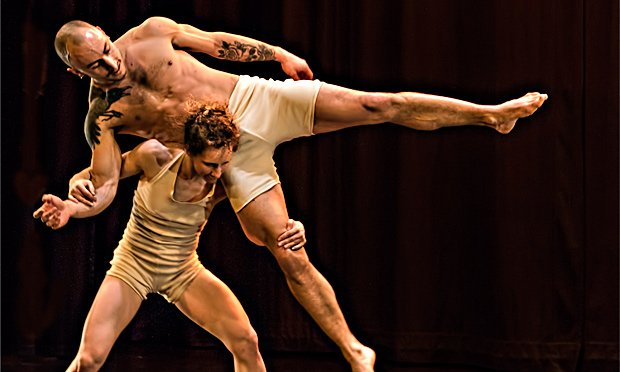
Nikki and JD are a couple, or so they tell us. Standing in front of microphones they explain their story, but how much of it is true? The lines between performance and reality are blurred, but they are dancers and acrobats who express themselves through movement. When they dance they tell the truth. Many of the physical feats in Knot are absolutely terrifying, not least those that involve Nikki standing on the crown of JD’s head before diving headfirst to the floor. He catches her, every time. Many of their moves need a slow motion replay to fully appreciate what they have just done, but their dance is subtle and moving as well as spectacular.

There is no way anyone could perform with such mind-blowing physical commitment without complete, mutual trust. The nature of that trust is unpicked as Nikki and JD reveal themselves, their personal lives and the strange dependence of performers. Knot is both an examination of the everyday cost of being on stage, and an astonishing demonstration of why it matters.

Working on My Night Moves

Working on My Night Moves by – Julia Croft & Nisha Madhan – Summerhall, Edinburgh

I am increasingly convinced that performance artist/theatre maker Julia Croft is a genius. Following unclassifiable shows that have somehow been impossible to forget – most recently Power Ballad – she returns to the Fringe with a show in which she spends a lot of time rearranging the furniture. In an auditorium that seems unprepared, she makes us watch her work. She moves ladders, sets up lighting and, gradually, suspends a stage full of utilitarian objects from the ceiling. In the midst of turning the world upside down, she creates moments of intense, weird magic from nothing, except a well-chosen prop or two. These include an unnerving dance, her head obscured by a cloud of black balloons, to ‘The Spy Who Loved Me’; a space walk, wrapped in foil, to the Killers, and some very odd moves dressed as Dorothy from the Wizard of Oz. Throughout, she is assisted by her sound woman, dressed identically, who helps with the heavy lifting.

The show is both oblique and direct. We cannot help being activities that, on paper, could scarcely be classified as theatre. They seem to reveal the prosaic reality of work and endeavour,and the overlaps between performance and life. There is also an underlying feminist meaning, the slog of women remaking the world laid out as a challenge. Working on My Night Moves is experimental, beautiful, strange, clever. It is the kind of theatre the Fringe, at its best, is all about.